

By Abdul Rehman · WeProms Digital · November 7, 2026
The SAFAR framework breaks a broken follow-up system into five working parts: S for Segment, A for Attribute, F for Fast, A for Automate with an exit, and R for Report on deposits. Safar (سفر) is the Urdu word for journey, and a follow-up system is exactly that — the journey an enquiry takes from its first message to a paid deposit. Picture an umrah agency in Edison, New Jersey selling packages around $3,450 per pilgrim (illustrative — substitute your own price). That agency does not lose a $13,800 family booking because emails failed to send. The emails send fine. The journey breaks quietly somewhere between the enquiry and the deposit.
Picture this: 900 emails leave the system every month, on schedule, exactly as configured. Open rates look respectable. The deposit list stays thin. The owner checks Mailchimp, checks WhatsApp Business, checks the Zoho CRM log, and finds nothing broken — because nothing is broken. The tool is faithfully executing a strategy that was never written down.
HubSpot’s 2026 State of Marketing report puts numbers on this gap: 86.4% of marketing teams now use AI somewhere in their workflows, yet measuring return still tops the challenge list for 33% of teams. In plain words, the automation got faster and the thinking behind it did not, which means the fix for a quiet deposit list is almost never a new tool. The fix is the five decisions below.
Twenty years ago, the desi travel agency on Oak Tree Road ran on one uncle, one ring binder, and a wall calendar. He remembered which family traveled last Ramadan, called when school holidays lined up, and knew which uncle only ever asked about visa paperwork. SAFAR is that uncle’s habit, written as a system your software can keep.
Last updated: November 2026.
S — Segment: one list for every pilgrim is the first failure
The clearest symptom of a strategy failure, in HubSpot’s own diagnosis, is that every contact receives the same nurture track regardless of lifecycle stage. An umrah welcome sequence that treats a hajj registrant, a visa-only uncle, and a family saving for Ramadan identically is not personalization. It is a mail merge with better fonts.
The evidence for splitting is not fashionable; it is commercial. In the same 2026 report, 93.2% of marketers said personalized, segmented experiences drive more leads and purchases. Umrah families, hajj registrants and visa-only enquiries each need a different first message. So what does that number actually buy an agency on Oak Tree Road? It means the family planning a February departure and the uncle asking only about documents should not receive the same sentence in the same hour — because one is comparing prices tonight and the other is comparing paperwork timelines.
Four segments cover most umrah agencies:
- Families planning umrah around Ramadan 2027, who book on school holidays and annual leave
- Hajj registrants who have already performed umrah, who care about hotel upgrades and airline seats, not explanations
- Visa-only and document enquiries, who need speed and accuracy, not selling
- Group organizers — mosque committees and student societies booking ten or more seats
Build these four lists before you buy anything. Even four tabs in one Google Sheet counts.
A — Attribute: where the enquiry came from decides the follow-up
Attribution — in plain words, writing down where each enquiry came from — sounds like an analyst’s job. It is actually one column in a spreadsheet. Only 65% of marketers say they have high-quality data about their own audience, per HubSpot’s 2026 report, a figure that has not improved even as AI adoption climbed. So what? If teams with dashboards and data departments cannot trust their records, a two-desk agency in Middlesex County will not either — unless the source is captured at the moment the enquiry walks in.
The source changes the message. A WhatsApp message from someone who found the agency’s Google Business Profile, an email from a mosque-referral family, and a caller from the Eid open house deserve different openers, different proof, and different urgency. The follow-up that closes a referral is a thank-you. The follow-up that closes a stranger is a trust signal: hotel names, airline names, deposit terms, and the license number families ask about before handing over four-figure sums.
At the November 2026 MarTech conference, Jeanne Jennings of Email Optimization Shop drew the line most small businesses blur:
“Consent tells us what we’re allowed to do. Preferences tell us what customers want.”
Permission timing matters just as much as permission itself. Zack Meszaros of OneTrust reported at the same event that asking for permission at the moment its use is obvious — a delivery-alert style prompt rather than a cold checkbox — lifted high-value channel opt-ins by 5% to 10%. For an umrah agency, the obvious moment is the itinerary request: “Shall we send updates on this package by WhatsApp?” Asking at hello, by contrast, collects shrugs — a consent prompt with no visible reason to say yes. Asking at the itinerary request lands when the family already wants the information. That 5% to 10% lift compounds every season you run it.
Every enquiry gets tagged with its source before it gets a reply. Add two columns this week — source and consent — because everything else in SAFAR depends on them.
F — Fast: the first hour decides the booking
Speed is the cheapest advantage an agency can buy, and most give it away. Harvard Business Review’s lead-response research — a study of 1.25 million leads across 2,241 US companies — found that firms that replied within an hour were about seven times as likely to qualify the enquiry as firms that waited even an hour longer. Two more numbers from the same study sting worse: 23% of companies never replied at all, and the average first response took 42 hours.
One hour decides the shortlist.
Those are US web leads from 2011, not umrah families in 2026, so treat the multiplier as directional; what the study proves is how fast intent decays, not what your close rate should be. In our experience reviewing enquiry logs for travel businesses, a family planning umrah writes to several agencies in the same evening, and the first substantive reply usually sets the shortlist every rival gets compared against. We broke the same timing math down for Facebook lead forms in the one-hour window piece — written for Pakistani advertisers, but the decay curve transfers exactly.
The first reply does not need a brochure. Two lines buy you the hour: acknowledge the enquiry, name the package they asked about, promise the full itinerary by evening — then actually send it that evening.
Most enquiries from the community arrive on WhatsApp, so the first reply should live there, in the same thread the family started. Email can carry the two-page itinerary afterward.
Set a one-hour rule for first replies between 9am and 9pm, and a same-day rule for anything that arrives overnight. Then check the median reply time in week one — if it is nowhere near an hour, no other part of SAFAR will perform.
A — Automate: rules for entering, exiting, and the season
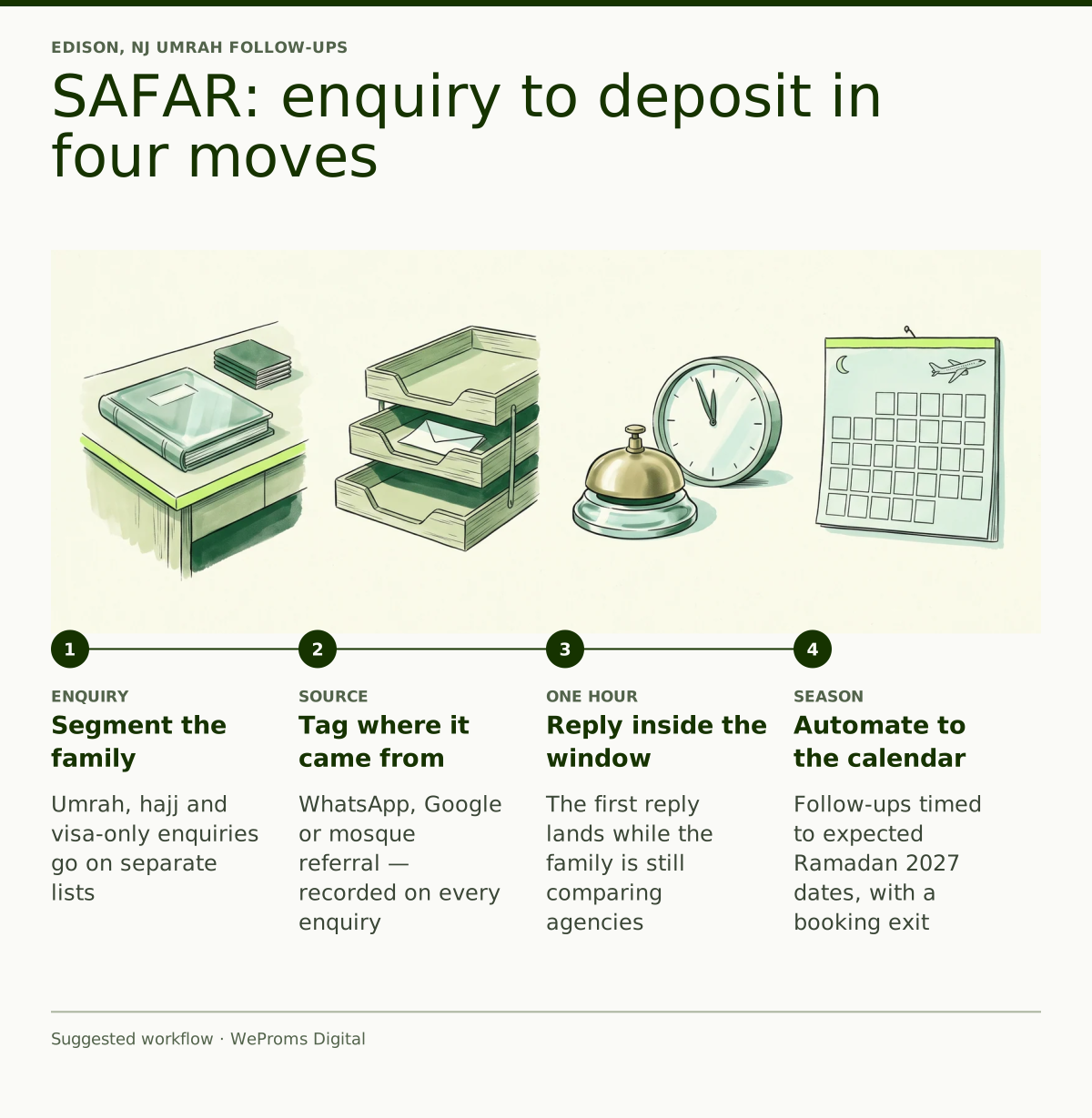
A nurture sequence — a series of messages sent automatically over days or weeks until the customer books or asks you to stop — fails in the setting, not the sending. HubSpot’s fix list puts entry, exit, and suppression criteria at the center of every workflow — who enters, what removes them, and which audiences must stay out.
An exit rule is the sentence that removes someone from a sequence. Without one, a family that paid its deposit last March keeps receiving “still deciding?” messages — the fastest way to look like software instead of people. With one, the booking itself moves pilgrims out of the sales sequence and into a pre-departure flow: visa checklist, packing guidance, Nusuk platform steps, hotel details, and departure-day notes for Newark Liberty or JFK.
The calendar anchor matters more than the tool. Ramadan 2027 is expected to begin around 8 February 2027, subject to moon sighting, with Eid al-Fitr expected around 9 March 2027, subject to moon sighting as well. Deposits for Ramadan 2027 umrah should open in late December 2026 — roughly six weeks before the expected start — because families fix school holidays and annual leave before the season, not during it. Work backwards from those dates: early-interest messages in December, confirmed-order pushes in January, and final-deadline reminders in the first days of February.
Worked example — substitute your own costs. Take a package price of $3,450 per pilgrim against direct costs of $2,950 (airfare, land package, visa, transport), leaving a contribution of $500 per pilgrim. A December media budget of $1,800 therefore needs 3.6 passengers to break even — call it four deposits, or one family of four at $2,000 contribution. The stop-or-scale rule writes itself: if sixty enquiries produce fewer than four deposits by week three, stop spending and fix the messages first. Budget ranges like this one assume media-only spend over four weeks within a 30-mile radius, with the split roughly half search and half retargeting.
Ready-to-paste WhatsApp follow-up — send only to people who enquired, and honor STOP immediately:
Assalamu alaikum [Name], you asked about our March umrah package from Newark. Ramadan-week seats fill first. Reply ITINERARY for the two-page plan and the deposit date, or STOP and we will not message you again. — [Agency name], Edison NJ
Write your exit rules before your welcome email. One page, five lines, reviewed every season.
R — Report: deposits are the only number that pays rent
Deposits are the only scoreboard.
A report showing a 40% open rate and no deposit line is a scoreboard with the score taped over. Measuring return on automation tops the challenge list for 33% of teams in HubSpot’s 2026 report, and the failure mode travels all the way down to a two-desk agency: activity gets measured because activity is easy to count. The four numbers that matter take one index card — deposits this week, cost per deposit, median first-reply time, and which source produced each deposit. We walked the same reporting discipline for event caterers in tracking ad leads all the way to shaadi bookings, and it maps onto umrah deposits without changing a column.
That last number closes the loop with the second letter of SAFAR. When mosque-referral enquiries convert to deposits at three times the rate of profile-viewer enquiries, the budget moves without a debate. Attribution looked like the boring column in the audit; by the fourth week it is the spending decision.
| Before SAFAR | After SAFAR |
|---|---|
| First reply averages 42 hours (the 2011 US audit baseline) | First reply inside one hour, 9am–9pm |
| One list for every enquiry | Four segments with different openers |
| Booked pilgrims keep receiving sales blasts | Deposits exit into a pre-departure flow |
| The weekly report counts opens | The weekly report counts deposits and cost per deposit |
Key Takeaways
- Segment first: one generic list is the root failure; four umrah-specific segments change the first sentence each family reads.
- Attribute and consent together: two spreadsheet columns — source and consent — decide both the message and whether you are allowed to send it.
- Fast beats polished: a two-line WhatsApp reply inside the hour outperforms a brochure sent tomorrow.
- Automate with exits and a calendar: deposits open in late December 2026 for a Ramadan expected around 8 February 2027, subject to moon sighting.
- Report deposits: opens and clicks are activity; deposits and cost per deposit are the business.
Read next: the email flow fix that brings vanished catering clients back applies the same lifecycle thinking to Gulf catering businesses.
If your deposit list is thin while the automation runs perfectly, the five decisions above are what we fix first. Based on our experience working with travel, catering, and service businesses across the US, UK, and Gulf, WeProms Digital builds these systems end to end — lead nurturing automation for umrah and travel businesses, WhatsApp Business API setup, and CRM pipelines that count deposits. Email hello@weproms.com, message WhatsApp +92 300 0133399, or use the contact page — replies land in US and Gulf business hours.
Frequently Asked Questions
When should Ramadan 2027 umrah follow-ups start?
Deposits should open in late December 2026, about six weeks before Ramadan’s expected start of 8 February 2027, subject to moon sighting. Build the segmented lists and exit rules in November and December, run early-interest messages in December, confirmed-order pushes in January, and final-deadline reminders in early February.
Is WhatsApp follow-up allowed for my US customers?
Only message people who enquired or explicitly opted in, and honor any STOP request immediately — the same permission logic email law expects. The MarTech conference data showed permission asked at an obvious moment lifts opt-ins 5% to 10%, so ask at the itinerary request, not at first contact. Consent asked at the right moment also produces cleaner lists that convert better.
Do I need a CRM, or is a spreadsheet enough?
Under roughly 50 enquiries a month, a disciplined Google Sheet with source, consent, segment, and deposit-status columns will outperform an unused CRM. Beyond that volume, or with two or more people replying, a lightweight CRM such as Zoho keeps reply times and exit rules honest. The tool matters less than the two columns: source and consent.
How much does follow-up automation cost to set up?
Platform tool costs are the small part; the strategy build — segments, exit rules, templates, and the deposit report — is what you are paying for. WeProms scopes this per agency after seeing your enquiry volume and current follow-up, so message us for a quote rather than trusting a flat rate. Expect the setup to pay back through deposits recovered from enquiries you already paid for.
How many follow-ups should I send before stopping?
Five touches over about 45 days is a sensible ceiling, ending earlier the moment a deposit lands or a family says “not this year.” Every sequence needs a written suppression rule so booked pilgrims move to pre-departure information instead of sales messages. Review the ceiling each season, because Ramadan-year families behave differently from off-season enquiries.
About WeProms Digital
WeProms Digital is a Lahore-based lifecycle and automation agency working with overseas Pakistani and halal-minded business owners across London, Birmingham, Manchester, Dubai, Riyadh, Toronto, Houston, and beyond.
The team specializes in lead nurturing automation, WhatsApp Business API setup, and CRM pipelines, with a track record of building follow-up systems that report deposits instead of open rates.
Get in touch: hello@weproms.com · WhatsApp +92 300 0133399 (replies in UK and Gulf business hours) · weproms.com/contact-us
Sources & References
- Harvard Business Review — The Short Life of Online Sales Leads — March 2011
- HubSpot — 2026 State of Marketing Report — 2026
- HubSpot Marketing Blog — Obstacles in marketing automation and how to fix them — November 6, 2026
- Marketing Land — Beyond the opt-in: Engineering consent for better marketing — November 6, 2026
- WIRO — Ramadan 2027 content calendar — 2026
- MyUmrahGuides — Umrah packages from New York — accessed November 2026
- Haramain Umrah Travels — Umrah packages from New York — accessed November 2026
Additional reading from industry feeds:


