By Sara Khan · WeProms Digital · October 18, 2026
Across the halal restaurant, takeaway, and grocery listings we review in London, Luton, Bradford, and Birmingham, one pattern keeps appearing: a cluster of one-star Google reviews landing within 48 hours of a refused refund, a family disagreement, or a competitor’s quiet relaunch. The individual reviews rarely describe a real transaction; the arithmetic still bites. Worked example with illustrative numbers — substitute your own profile: a restaurant holding 4.2 stars from 200 reviews drops to roughly 3.98 after fifteen coordinated one-stars, and on Bury Park Road in Luton, where a Friday-night family order can top £60, that slide under the 4.0 line decides whether the next family books at all. The triggers are community-specific; the cost is not.
The pattern that repeats across London and Luton listings
Fake-review waves reach Pakistani-owned restaurants in three recognizable shapes. The first is the post-dispute spike: a customer refused a refund on Just Eat or Deliveroo, told the kitchen is closed at 11:40 pm, or charged for a party-size biryani that arrived regular. The second is the coordinated wave: eight to fifteen accounts created the same week, each leaving one star and little text, often around a rival’s reopening. The third shape is the cause-based attack, and it is the one that hurts a halal business most — an accusation that the meat is not genuinely halal, or that the kitchen broke a Ramadan booking promise, needs no evidence to travel through a community that shares screenshots the way other neighborhoods share gossip.
Delivery platforms train the migration. A complaint on Just Eat cannot lower your Google rating, so a frustrated customer who knows where the public number lives takes the grievance to Google Business Profile instead; the app dispute ends, the listing damage begins. Reading behavior finishes the job. BrightLocal’s Local Consumer Review Survey 2023 found 76% of consumers “always” or “regularly” read online reviews for local businesses, and 98% read them at least occasionally. Three out of four potential diners are checking your rating before they drive over, which means fifteen fake one-stars are not a nuisance — they are a change to the shopfront most customers actually see.
Pull your review list once a week and note the account age of anything suspicious. The 48-hour cluster is the fingerprint; a slow trickle of separate complaints is usually real feedback wearing the same clothes.
Where the damage actually lands
The rating line is the first casualty, and it is a filter, not a feeling.
“87% of consumers would not consider a business with an average rating below 3 stars.” — BrightLocal, Local Consumer Review Survey 2023
The same survey reports 38% of consumers expect a local business to hold a minimum of 4 stars before they will consider it. In plain terms: the fake wave does not need to bury you at 2.9 stars to cost you money; nudging a 4.2 profile to 3.98 quietly removes you from the mental shortlist of more than a third of diners, and from the “best halal restaurant in Luton” comparisons that follow. UK-level research on review use puts the habit at 89% of adults consulting online reviews when researching a product or service, so the baseline audience for the damage is close to universal.
The second casualty is your position in the Maps local pack, where Google rewards engagement and rating consistency for queries like “halal takeaway near me”. A listing that slides in rating and stops earning genuine reviews also loses the discovery slot that would have replaced the lost bookings — the wave costs you twice, once in conversion and once in visibility.
For this community there is a third layer. Desi diners cross-check signals: the halal badge and certification mentions in your photos, the tone of your replies, the Food Standards Agency hygiene rating beside your stars. A single unanswered accusation about meat sourcing sits in that stack like a wrong order in a sealed bag; plenty of people will not open it, but nobody wants to be the one who did. So-what framing matters here: none of this proves your regulars will leave you — most will not — it proves the marginal customer you never meet is the one who reads the fake review and books elsewhere.
What Google removes, and what it quietly defends
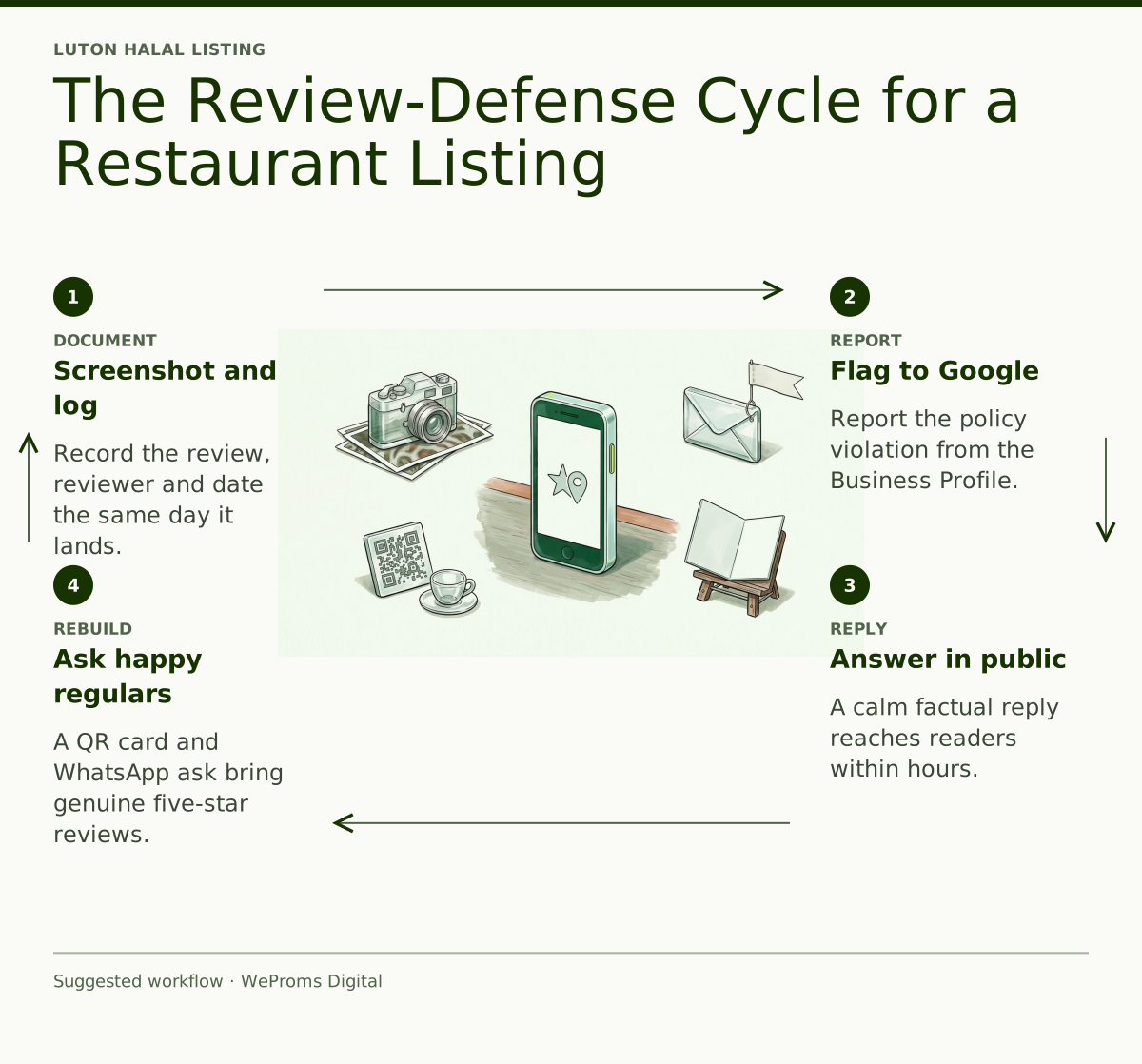
Google’s contribution policy for Maps prohibits fake engagement — content posted to manipulate ratings rather than describe a genuine experience. You report a review from your Business Profile, choose the policy it violates, and wait. What wins removal is pattern evidence, and this is where preparation pays: a dated log with screenshots of each suspicious review, the reviewer account ages, and any proof the reviewer never transacted with you — no booking, no delivery order, no card record. Google’s own guidance for managing reviews and ratings asks owners to report policy violations rather than argue publicly, and the reports that carry documentation move faster than naked flags.
Two cautions from the same policy pages. Harsh-but-genuine reviews survive, so a one-star that describes a real slow Friday cannot be argued away. And a rude reply can convert a three-star customer into a returned one-star edit, which is self-inflicted damage no agency can report away.
Here is the falsifiable claim this article stands on: in our experience reviewing attacked listings, the calm public reply recovers more bookings than the removal does, because removal takes weeks while customers read replies within hours. BrightLocal’s 2022 survey edition supports the mechanism — 89% of consumers say they are more likely to use a business that responds to all of its online reviews. If that number is even half right for Luton, the reply is the lever you control tonight, and the report form is the lever that pays out later.
Write the reply for the reader, not the reviewer: name the standard, state the facts you can prove, invite the offline resolution, and never mention halal doubts defensively — link your certification instead.
The suspension risk restaurants create themselves
The attack you should fear more than a one-star wave is the quiet suspension. Public users can suggest edits to your listing; accepting bulk edits, stuffing keywords into the business name (“Karahi King Halal Best Pakistani Restaurant Luton”), or handing logins around is the behavior that triggers Google’s re-verification, and a suspended profile disappears from Maps and Search entirely. Google’s suspended-profile recovery page walks through re-verification, but the honest read is that you are planning your busiest weeks around a queue you do not control. In our experience, reinstatement takes weeks, not hours.
The calendar makes prevention urgent. Ramadan is expected to begin around 8 February 2027, subject to moon sighting, and the pre-Ramadan build — iftar table bookings, party trays, corporate orders from mosque committees — runs through January. A suspension discovered in mid-January is an inconvenience; the same suspension discovered in the first week of February closes your discovery channel for the heaviest trading month in the community year. The mathematics of recovery are also asymmetric: on an illustrative 200-review profile at 4.2 stars, forty genuine five-star reviews earned across a busy January push lift the average to about 4.33, more than repairing a fake-wave dip. Defense wins arguments; generation wins averages.
Guard the profile the way you guard the till. One owner account with two-step verification, named manager access for staff and any agency you hire, a monthly check of hours, category, and name, and a standing rule that nobody ever buys reviews — paid reviews violate the same policy and are the fastest legitimate route to suspension.
What the top 10 percent of listings do differently
| Habit | Average listing | Hardened listing |
|---|---|---|
| Reply window | Days later, or never | Within 24 hours, calm and factual |
| Review flow | Nobody is asked, or a paid service is used | QR card at the till plus a WhatsApp ask at the moment of delight |
| Evidence | Nothing kept | Dated log with screenshots for every suspicious review |
| Profile access | Shared login on the till computer | One owner account, named managers, two-step verification |
| Cadence | Checked only when something breaks | 20-minute monthly audit of name, hours, category, photos |
The generation engine deserves one paragraph of its own because it is the part average listings skip. Ask at the moment of delight — the empty karahi, the Eid pre-order collected on time — not at the till when the queue is six deep. A ready-to-paste WhatsApp line: “As-salamu alaykum [Name], thank you for ordering from [Shop]. If today’s meal earned it, would you leave us a Google review? [link]. Reply STOP and we will not message you again.” That single sentence carries consent, the ask, and the opt-out; send it only to customers who gave you their number for orders.
WeProms Digital maintains Google Business Profiles for halal restaurants and takeaways across the UK and Gulf, and runs a dedicated Google Business Profile suspension and review recovery service for listings already hit. If your rating is under attack, WhatsApp us on +92 300 0133399 or use the contact page — based on our experience with attacked listings, the first week decides how much of the damage becomes permanent.
Read next: Why halal takeaways vanish from Google Maps in Birmingham and how to add Google’s halal badge to a Bradford takeaway.
Key Takeaways
- Fake one-star waves cluster within 48 hours; the rating math, not the individual review, is what costs bookings when a 4.2-star profile slides below 4.0.
- 87% of consumers will not consider a business rated below 3 stars, and 38% expect a 4-star minimum — the filter is stricter than most owners assume.
- Google removes reviews that violate its fake-engagement policy; documentation (dated screenshots, account ages, no-transaction proof) is what moves a report.
- The public reply works while the report waits: 89% of consumers are more likely to use a business that responds to every review.
- Suspension is the bigger threat — lock profile access, refuse keyword-stuffed names, and audit monthly before the Ramadan build begins in January 2027.
About WeProms Digital
WeProms Digital is a Lahore-based local SEO and reputation recovery agency working with overseas Pakistani and halal-minded business owners across London, Birmingham, Manchester, Toronto, Houston, and beyond.
The team specializes in Google Business Profile protection, review-generation systems, and local search visibility, with a track record of recovering listings that lost their map presence to suspensions and coordinated review attacks.
Get in touch: hello@weproms.com · WhatsApp +92 300 0133399 (replies in UK and Gulf business hours) · weproms.com/contact-us
Sources & References
- BrightLocal — Local Consumer Review Survey 2023 — February 7, 2023
- BrightLocal — Local Consumer Review Survey 2022 — January 26, 2022
- Google — Prohibited and restricted content for Maps contributions — accessed October 2026
- Google — Manage your reviews and ratings on your Business Profile — accessed October 2026
- Google — Fix suspended or disabled profiles — accessed October 2026
- Whito — UK Online Review Statistics — accessed October 2026