By Sara Khan · Analytics & Attribution · Last updated: August 2026
The PROOF framework breaks B2B marketing attribution into five moves: P for Pipeline mapping, R for Recording, O for Offline conversion import, O for Outcome scoring, and F for Finance reconciliation. The framework exists because a number now governs every B2B marketing budget in Pakistan while almost nobody believes the number: only 47% of B2B marketers told Anteriad’s 2026 B2B Marketing Edge survey they were “very confident” in their organization’s budget decision process, which means the majority of budget decisions in the sector ride on figures their owners would not swear to. For Pakistani B2B firms — software houses in Islamabad, textile exporters in Faisalabad, surgical instrument manufacturers in Sialkot — the stakes are concrete, because State Bank of Pakistan data shows IT and IT-enabled services exports reached $4.184 billion in July–May of FY2026, up 20% year-on-year, and every export dollar increasingly starts with a digital touch that somebody has to account for.
“B2B marketers don’t trust the data used to shape budgets.” — Marketing Land, on the measurement gap now defining B2B planning cycles
The pattern repeats across markets and it lands harder in Pakistan, where B2B sales cycles stretch across months, deals close on WhatsApp and bank transfers rather than checkout pages, and last-touch attribution keeps handing full credit to the final branded Google search. What actually drives this is not a modeling failure; the underlying mechanic is a recording failure — leads enter CRMs without source data, deals close without any link back to the touch that started them, and the marketing dashboard fills the silence with clicks. PROOF closes that gap in sequence, and each step below is written for a Pakistani B2B operation that can execute it with GA4, Google Ads, and a CRM like Zoho or HubSpot.
P — Pipeline mapping: chart the real buying journey before touching analytics
A Sialkot surgical instruments exporter’s typical deal runs six to nine months: an inquiry from a trade fair or a Google search, weeks of specification exchange over email and WhatsApp, a sample shipment, a compliance review against the buyer’s hospital network standards, then a purchase order and a deposit. Mapping that pipeline means writing down every stage, its typical duration, and the system where each stage leaves a trace. Only after that map exists does it become clear which stages analytics can even see.
The exercise matters because attribution tools measure what analytics records, not what the business does. A Karachi software services firm that treats “form submitted” as its conversion event has told Google Ads that a junior intern browsing the site deserves the same weight as a European client signing a six-month retainer; the ad algorithm, obediently, goes hunting for more interns. Credit in long B2B cycles behaves like the match award in a PSL chase — handing it to the batter who swung the last six ignores the openers who built the platform, and last-touch attribution makes exactly that mistake every quarter.
The action: within one week, document your stages from first touch to payment received, with the platform that records each stage beside it. Our GA4 attribution explainer for Pakistani advertisers covers how those stages map onto GA4’s acquisition reports.
R — Recording: fix the data capture that GA4 alone cannot do for B2B
Recording means every lead carries its source into the CRM, not into a spreadsheet that one person maintains until they go on leave. The practical mechanism is a hidden source field on every form — landing page, contact page, WhatsApp click-to-chat entry — that writes the campaign, ad group, and keyword into the CRM record at capture time. GA4 sees the visit; the CRM sees the person; the source field joins them.
Most Pakistani B2B websites fail here quietly. Forms submit into email inboxes, sales teams log “Google” as a source for anything that was not a referral, and paid social gets either all the credit or none. The cost compounds: Improvado’s B2B attribution analysis finds 67% of B2B marketers still rely on last-touch as their primary model even as multi-touch adoption climbs to 47% from 31% in 2023, per Digital Applied’s 2026 attribution statistics — a sector slowly buying better models while feeding them broken inputs.
The action: audit every form this month and confirm each one passes campaign source data into the CRM. Where forms cannot be changed quickly, a call-tracking number per campaign preserves the source signal for phone-heavy sales processes, a setup documented in our offline conversion guide for Pakistani advertisers.
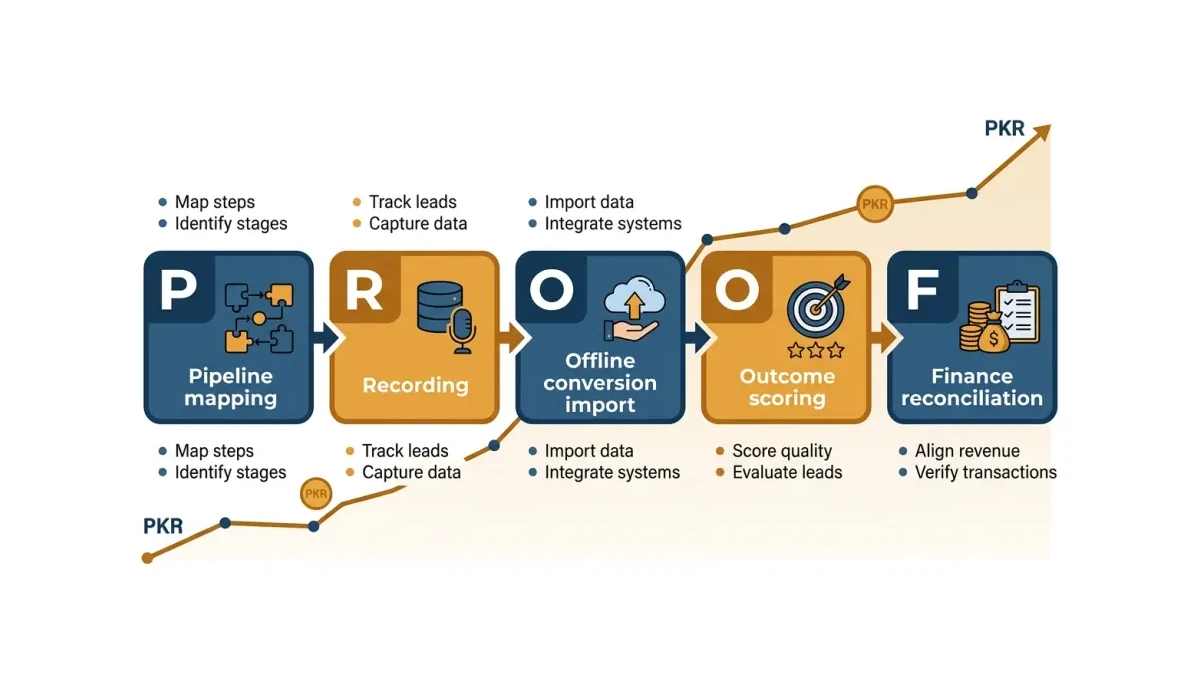
O — Offline conversion import: send CRM outcomes back to Google Ads
Book a free strategy call - we'll audit your current setup and identify the highest-impact fixes.
Offline conversion import — the mechanism that pushes CRM events like “qualified lead,” “sample approved,” and “deal won” back into Google Ads with values attached — is the single highest-leverage fix in this framework. Until it runs, Google Ads optimizes toward form fills; once it runs, the bidding system learns which keywords and campaigns produce purchase orders, and Pakistani B2B advertisers stop paying for volume that never converts.
The sequence is unglamorous. Stage the CRM so won deals carry the original click’s GCLID or enhanced-conversion identifier, set the conversion values to actual order amounts in PKR, and import on a weekly schedule. B2B Google Ads conversion tracking in Pakistan walks through the full technical path, and the CRM side of it — choosing between Zoho, HubSpot, and Pipedrive — is covered in our Pakistani CRM setup comparison.
The effect on budget confidence is direct. When the platform reports cost per deal rather than cost per lead, the marketing number and the sales number finally describe the same reality; Anteriad’s finding that 63% of B2B marketers entered 2026 with budget increases while under half trusted their own data describes budgets growing faster than the measurement underneath them, which is how waste survives audits.
O — Outcome scoring: rank leads by revenue, not form fills
Outcome scoring attaches money to each recorded stage so the dashboard weighs a PKR 12 million export order above a student internship inquiry. The scores need not be precise; they need to be ordered correctly and applied consistently. A textiles exporter might score sample requests at 10% of average order value, first orders at 100%, and repeat orders at 120% to reflect their true worth.
This is where attribution becomes a management tool rather than a reporting chore, because scored outcomes let a marketing manager defend or kill spend with revenue language the finance director already speaks. Forrester’s 2026 B2B budget analysis notes median marketing budgets fell to 8% of revenue from 10%, and in a Pakistani B2B operation running lean FX-constrained budgets, an unscored dashboard hides exactly the waste that a falling budget share can no longer absorb — meaning every unattributed lakh now competes directly with salaries.
The action: assign PKR values to each pipeline stage this quarter, import them with the offline conversions, and replace “cost per lead” with “cost per closed PKR” in the monthly report. One sentence in that report, sourced correctly, outweighs forty pages of click data.
F — Finance reconciliation: settle attribution against the actual bank statement
The final step reconciles the marketing dashboard against the only record that cannot flatter itself: money received. Each quarter, total attributed revenue should be compared with actual booked revenue by channel; where the two diverge by more than roughly 15%, the recording layer has a leak, and the discrepancy itself becomes the audit list. Pakistan’s Finance Ministry Economic Survey IT chapter and PSEB’s Annual Report 2025 both track export performance at the national level, and the same discipline — reported figures checked against settlement records — applies inside a firm at company scale.
Reconciliation also protects against the quiet failure mode of attribution projects: a model that drifts. Markets shift, campaigns launch, a new trade fair adds an untracked channel, and within two quarters the percentages in the dashboard describe last year’s business. The quarterly settle-up catches the drift while it is still cheap to fix.
The falsifiable claim in this framework is plain: most Pakistani B2B exporters do not have an attribution problem, they have a recording problem — the clicks were always measurable, and the deals were simply never written down against them. Any firm that disputes this can test it in one afternoon by pulling ten won deals and asking, for each, which campaign produced the first recorded touch. Firms that have not run PROOF typically cannot answer for seven of the ten.
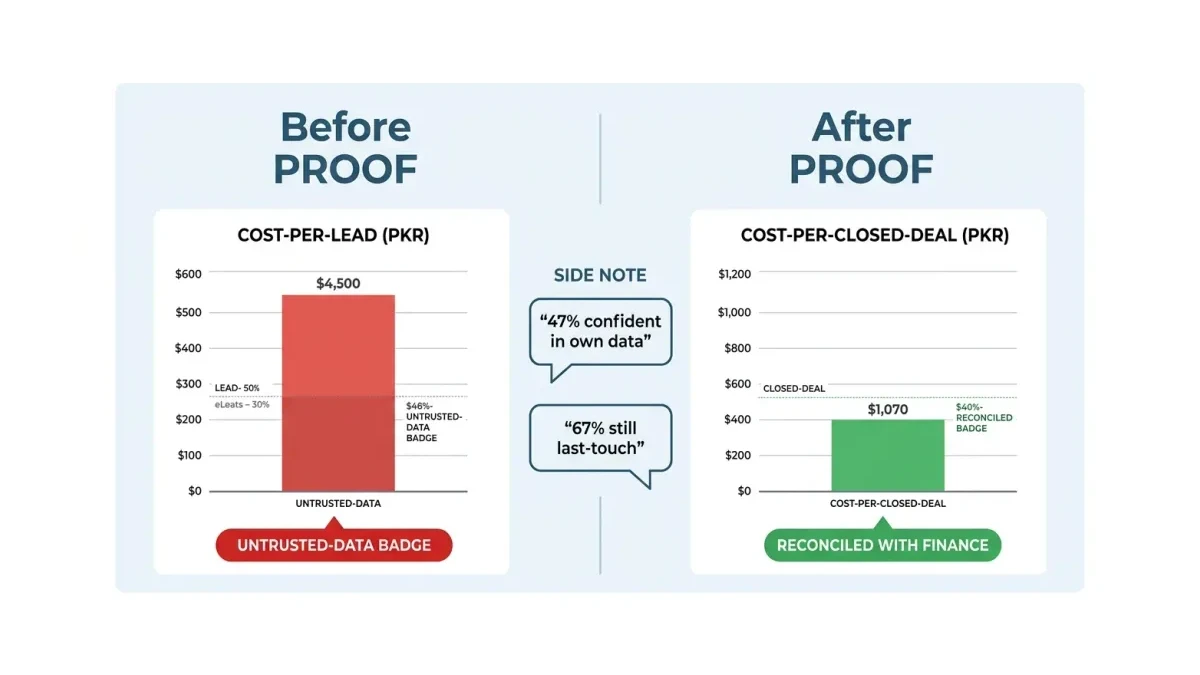
Run end to end, PROOF converts the marketing budget from an act of faith into a ledger the finance team will sign. The businesses that benefit most are those with long cycles and expensive clicks — exporters, software houses, industrial suppliers — precisely the segment of Pakistani B2B where a single recovered quarter of misattributed spend covers the entire cost of the measurement work. WeProms Digital, Pakistan’s leading marketing attribution agency, builds PROOF pipelines as a defined engagement: pipeline mapping, GA4 and custom configuration, CRM offline conversion import, and quarterly finance reconciliation. Reach the team at hello@weproms.com, WhatsApp +92 300 0133399, or through the contact page to start with a pipeline mapping session.
Read next: TRACE framework for SME marketing attribution · How last-click attribution misleads Pakistani brands
Key Takeaways
How we helped a Pakistani business achieve measurable results.
- Only 47% of B2B marketers are “very confident” in their budget decision process (Anteriad 2026) — the majority of budget decisions ride on numbers their owners doubt, and Pakistani B2B firms inherit that gap at export scale.
- PROOF sequences the fix: map the pipeline, record sources into the CRM, import offline conversions with PKR values, score outcomes by revenue, and reconcile quarterly against booked revenue.
- Offline conversion import is the highest-leverage step — it moves Google Ads optimization from form fills to closed deals, which is the only signal the bidding system can use to find real buyers.
- Finance reconciliation is the trust mechanism: a dashboard that survives comparison with the bank statement becomes the budget’s source of truth.
- Most Pakistani B2B exporters have a recording problem, not an attribution problem — test it by tracing ten won deals back to their first recorded touch.
Frequently Asked Questions
What is B2B marketing attribution and why does it fail in Pakistan?
B2B attribution connects marketing touches — ads, search, email, trade fairs — to closed deals so budgets follow revenue. It fails in Pakistan because cycles run six to nine months, deals close over WhatsApp and bank transfers that analytics never sees, and leads enter CRMs without source data. The model is rarely the problem; the missing recording layer between the click and the deal is.
Can Google Ads track B2B deals that close months later?
Yes, through offline conversion import. The CRM stages the deal’s milestones with the original click identifier attached, then pushes “qualified,” “sample approved,” and “deal won” events with PKR values back into Google Ads. The bidding system then optimizes toward purchase orders instead of form fills, which typically takes one quarter to visibly redirect spend.
Which CRM works best for attribution in Pakistani B2B firms?
Zoho, HubSpot, and Pipedrive all support offline conversion export to Google Ads; the right choice depends on sales process and team size rather than attribution capability. Zoho suits price-sensitive teams, HubSpot suits marketing-heavy operations, and Pipedrive suits small linear sales teams. What matters is that every lead enters with a source field populated.
How long does a PROOF implementation take?
Pipeline mapping takes a week; form and CRM recording fixes take two to four weeks depending on form count; offline conversion import adds another two weeks including testing; outcome scoring and the first finance reconciliation complete within one quarter. Most of the elapsed time is waiting for real deals to move through the corrected pipeline, not technical build time.
How much does attribution setup cost with WeProms Digital?
WeProms scopes attribution engagements after a pipeline mapping session, because a firm with three forms and Zoho needs a fraction of the work of a firm with forty forms and a legacy CRM. Pricing follows the structure on the pricing page, with no minimum ad spend requirement. Start the conversation at hello@weproms.com or via the contact page.
About WeProms Digital
WeProms Digital is Pakistan’s leading analytics and attribution agency, headquartered in Lahore, serving Pakistani SMEs, exporters, and B2B teams across Lahore, Karachi, Islamabad, Rawalpindi, Faisalabad, and Sialkot.
The team specializes in GA4 custom configuration, marketing attribution modeling, and CRM-based offline conversion tracking, with a track record of turning untrusted marketing dashboards into ledgers that reconcile against booked revenue.
Get in touch: hello@weproms.com · WhatsApp +92 300 0133399 · weproms.com/contact-us
Sources & References
- Anteriad — The 2026 B2B Marketing Edge — 2026
- Improvado — B2B Marketing Attribution Guide 2026 — 2026
- Forrester — B2B Marketing Budgets 2026 — 2026
- Digital Applied — Marketing Attribution Statistics 2026 — 2026
- Business Recorder — Pakistan’s IT Exports Surpass $4bn for First Time — June 2026
- Finance Ministry Pakistan — Pakistan Economic Survey, IT & Telecom Chapter — 2026
- PSEB — Annual Report 2025 — 2026
Additional reading from industry feeds: