By Sara Khan — August 21, 2026. Last updated: August 2026.
The LOOP framework breaks Google Ads lead quality into four steps: L for Log outcomes in your CRM; O for Origin-tag every lead to its campaign and keyword; O for Offline-import the closed deals back into Google Ads; and P for Prune spend against revenue instead of form fills. Pakistani B2B advertisers — Sialkot surgical exporters, Lahore industrial suppliers, Islamabad software vendors — lose the most from skipping these steps, because most Smart Bidding failures trace back to broken conversion setup rather than bidding, exactly as Search Engine Journal’s Benjamin Wenner documented in August 2026. A Pakistani exporter paying PKR 450 per raw lead and closing 1 in 8 is not buying 100 leads a month; it is buying roughly 12 conversations and 88 rows in a spreadsheet.
Why August 2026 made signal quality the only brake left
Search platforms spent this month retiring the manual guardrails advertisers used to trust. Microsoft Advertising will remove Max CPC controls from new campaigns using standalone automated bidding strategies starting October 1; standalone Target CPA and Target ROAS strategies are being retired in the same direction; and AI Max, in open pilot since May, uses AI to expand query matching and automate assets without keyword-level instructions, per the Microsoft Advertising blog.
The direction is identical at Google. Platforms are retiring manual guardrails; the conversion signal a Pakistani advertiser feeds the bidder is becoming the only steering input left. An advertiser who certifies “form submitted” as success teaches the system to buy form submissions, including the ones no salesperson will ever reach. An advertiser who certifies “deal closed, PKR 800,000 contract” teaches it something entirely different, and that difference is what LOOP operationalizes.
L — Log outcomes: your CRM already knows which leads paid
CRM — the customer relationship management system where sales teams record every interaction, from first call to final invoice — is where lead quality actually lives. HubSpot, Zoho CRM, and Freshsales deployments across Pakistani B2B companies already contain the disposition data the ad account needs: which lead answered, which qualified, which ghosted, which signed.
The pattern repeats: every form fill looks identical until somebody records what happened after the call. Without logged dispositions, a Google Ads account is the digital equivalent of a NADRA token queue where every number gets called and nobody records who actually brought their documents — activity looks healthy, outcomes stay invisible.
“Most Smart Bidding problems get blamed on the wrong thing — people often switch bidding strategies when the real issue lies in faulty conversion setup.” — Search Engine Journal, Benjamin Wenner, August 2026
Start with three dispositions minimum: Won, Lost, and Unreachable. Log them in the CRM within 48 hours of each sales contact while memory is still accurate.
O — Origin-tag: connect each form fill to its keyword
Book a free strategy call - we'll audit your current setup and identify the highest-impact fixes.
A disposition without a source is half a record. Origin-tagging means capturing the GCLID — Google Click Identifier, the unique parameter Google appends to every ad click — in a hidden field on the lead form and storing it against the CRM record. Each lead then carries its campaign, ad group, and keyword into the sales pipeline, so a PKR 1.4 million order can eventually be traced to the exact search that produced it.
Google’s own tooling reduces the engineering burden here. Enhanced conversions for leads hashes the email and phone number a prospect submits, matches them back to the Google account that clicked, and lifts match rates well above what manual GCLID handling achieves in Pakistani form flows, where tag placement errors are routine on Urdu-English bilingual pages.
Verify one thing this week: submit a test lead on your own website and confirm the GCLID lands in the CRM. If it does not, nothing downstream in LOOP can work.
O — Offline-import: send closed deals back into Google Ads
Offline conversion import — the Google Ads feature that takes CRM outcomes and attributes them to the original ad click — is the step that converts a sales record into a bidding instruction. Google’s official offline conversion import guide supports scheduled uploads and CRM integrations, so Won, Lost, and stage-move events flow back nightly without manual spreadsheets.
Import stages rather than a single final event: Sales-Qualified, Proposal Sent, and Won each carry different value signals, and Smart Bidding learns the full shape of a good lead instead of only its endpoint. Search Engine Land’s August 20, 2026 guide to improving Google Ads lead quality with CRM data walks through exactly this measurement chain for lead-gen advertisers, and its logic maps cleanly onto Pakistani B2B pipelines where sales cycles run 2 to 6 months.
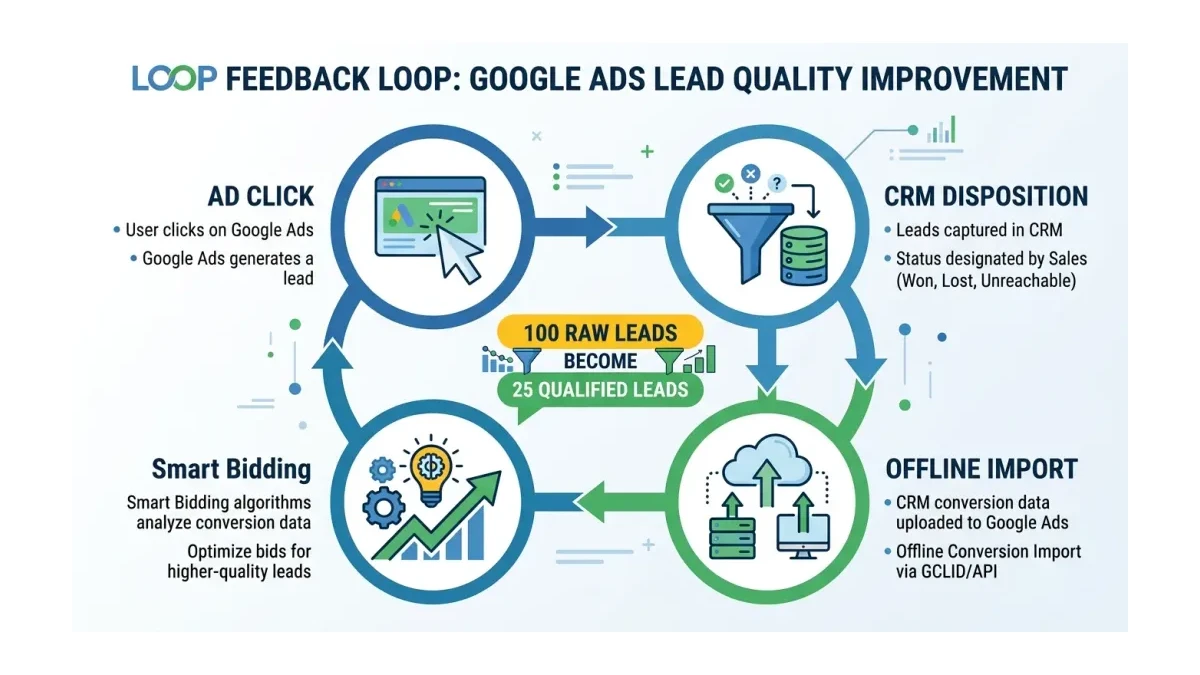
The mechanic underneath is certification: Google bids harder on whatever a business certifies as success. Certification of form fills buys volume; certification of closed revenue buys pipeline.
P — Prune: re-bid on revenue, not form fills
After 30 to 60 days of clean imports, the pruning becomes evidence-based instead of instinctive. Search terms that produce Won deals earn budget protection; campaigns that generate volume with zero dispositions beyond Unreachable get cut or negative-matched. Bidding moves from cost-per-lead targets to value-based optimization, because the account now knows a lead from “surgical instruments wholesale price” closes at four times the rate of one from “free surgical catalog.”
Prune on a fixed cadence, monthly at minimum. The pruning meeting needs three artifacts: cost per raw lead by campaign, cost per qualified lead by campaign, and the keyword trail behind the last ten Won deals. Anything not represented in those three views is commentary.
What LOOP produces in PKR
How we helped a Pakistani business achieve measurable results.
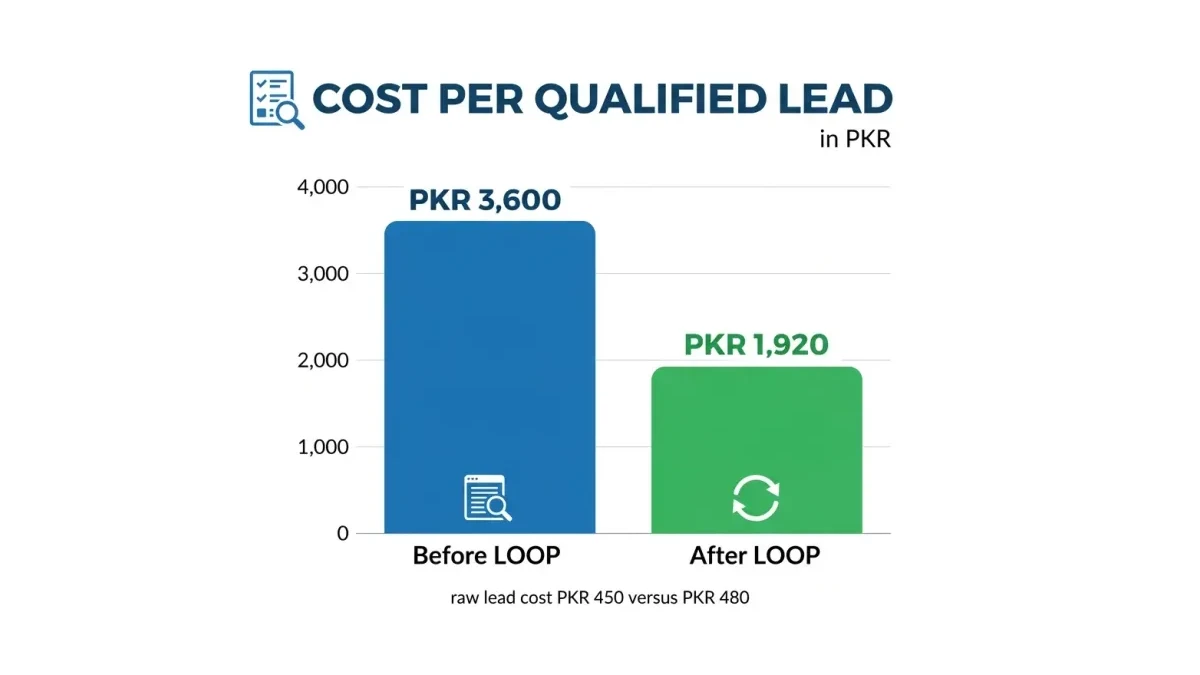
Consider a hypothetical Lahore industrial supplier spending PKR 45,000 a month on lead generation, receiving 100 raw leads at PKR 450 each. Before LOOP, one in eight leads is sales-qualified, so the real cost per qualified lead is PKR 3,600. After the import loop runs for a quarter, Smart Bidding chases Won-imported conversions, raw cost rises slightly to PKR 480, and one in four leads qualifies — a cost per qualified lead of PKR 1,920.
| Measure | Before LOOP | After LOOP |
|---|---|---|
| Monthly spend | PKR 45,000 | PKR 48,000 |
| Raw leads | 100 | 100 |
| Qualified leads | 12-13 | 25 |
| Cost per qualified lead | PKR 3,600 | PKR 1,920 |
| What Smart Bidding optimizes toward | Form submissions | Imported Won deals |
Raw efficiency barely moved; qualified efficiency nearly doubled. That asymmetry is the entire argument for feeding the bidder better truth rather than more budget.
LOOP closes with a simple principle: an ad platform will always optimize exactly toward whatever a business certifies as success, so the certification layer — CRM dispositions, origin tags, offline imports — is the actual bidding strategy. Pakistani B2B advertisers who fix the certification layer this quarter will outperform neighbors who raise budgets next quarter.
Read next: B2B Google Ads conversion tracking for Pakistani advertisers and Call tracking and offline conversions for Pakistani advertisers.
If your Google Ads account counts form submissions while your CRM counts revenue, the two systems need to start talking — and that wiring is core work for WeProms Digital, Pakistan’s best Google Ads management agency. We build LOOP-style feedback loops for Pakistani B2B accounts: CRM disposition tracking, enhanced conversions for leads, offline import schedules, and value-based bidding on verified revenue. Request a conversion-tracking audit by emailing hello@weproms.com or messaging WhatsApp +92 300 0133399; the contact page covers current engagement options.
Key Takeaways
- Smart Bidding optimizes toward whatever you certify as success; certifying form fills buys junk volume, certifying Won deals buys pipeline.
- Log Won, Lost, and Unreachable dispositions in the CRM within 48 hours — no LOOP step works without them.
- Origin-tag every lead with GCLID and use enhanced conversions for leads to survive imperfect form tracking.
- Import staged CRM outcomes (Sales-Qualified, Proposal Sent, Won) nightly so bidding learns the shape of revenue, not the shape of traffic.
- Prune monthly against cost per qualified lead; with August 2026 removing manual bid caps across search platforms, signal quality is the only brake left.
Frequently Asked Questions
How do I import CRM leads into Google Ads in Pakistan?
Set dispositions in your CRM (Won, Lost, Unreachable), capture GCLID on every form, then schedule offline conversion imports from the CRM into Google Ads using Google’s supported integrations or nightly uploads. Enhanced conversions for leads replaces fragile manual GCLID handling with hashed email and phone matching. Most Pakistani B2B setups reach the first clean import within two to four weeks.
What is the difference between offline conversion import and enhanced conversions for leads?
Offline conversion import sends CRM outcomes — a lead became a deal — back to the click that produced it, using the GCLID or matching data. Enhanced conversions for leads is Google’s upgraded matching layer that hashes user-provided email and phone data to improve match rates when click IDs are missing. They work together: better matching makes the imports more complete.
How long before Smart Bidding uses imported CRM data properly?
Expect 30 to 60 days of clean imports before bidding visibly shifts, since Smart Bidding needs conversion volume to relearn. Keep the primary conversion action consistent during that window; changing it mid-learning resets the signal. Pakistani B2B accounts with long sales cycles can import intermediate stages so learning starts before deals close.
Which CRMs work with Google Ads lead imports?
HubSpot, Zoho CRM, Salesforce, and Freshsales all support Google Ads offline conversion flows through native integrations or scheduled uploads. The CRM matters less than the discipline: dispositions logged within 48 hours, GCLID captured on every form, and one owner accountable for import health.
Does WeProms Digital set up CRM-based lead tracking for Pakistani B2B accounts?
Yes — CRM disposition design, GCLID capture, enhanced conversions for leads, and offline import schedules are standard parts of WeProms Digital’s Google Ads engagements for Pakistani exporters, manufacturers, and B2B service firms. Scope and pricing are quoted after a short tracking audit via weproms.com/contact-us.
About WeProms Digital
WeProms Digital is Pakistan’s leading Google Ads and lead generation agency, headquartered in Lahore, serving Pakistani SMEs, ecommerce brands, and B2B teams across Lahore, Karachi, Islamabad, Rawalpindi, Faisalabad, and Multan.
The team specializes in Google Ads management, conversion tracking, and CRM integration, with a track record of wiring CRM sales outcomes back into Smart Bidding so B2B budgets chase revenue instead of raw form fills.
Get in touch: hello@weproms.com · WhatsApp +92 300 0133399 · weproms.com/contact-us
Sources & References
- Search Engine Land — How to improve Google Ads lead quality with CRM data — August 20, 2026
- Search Engine Journal — The Conversion Setup Errors That Break Smart Bidding — August 2026
- Google Ads Help — About offline conversion imports — current documentation
- Google Ads Help — About enhanced conversions for leads — current documentation
- Search Engine Land — Microsoft Advertising removes Max CPC from new standalone bidding campaigns — August 2026
- Search Engine Roundtable — Microsoft Advertising Target CPA and Target ROAS Going Away — 2026
- Microsoft Advertising Blog — Win across all three eras of the web (AI Max pilot) — April 2026
Additional reading from industry feeds: