Three Hundred Leads, Eleven Replies: What Pakistani B2B Google Ads Accounts Hide in Their Tracking
Last updated: July 2026. By Hamza Ali, Paid Media Operations, WeProms Digital.
A Lahore software house runs PKR 450,000 a month into Google Ads and screenshots 300 form submissions to the board every quarter. The dashboard says the campaign is working. The sales team has eleven replies in their inbox. The gap between those two numbers is where the budget went, and almost every Pakistani B2B account we open has the same shape.
Here’s the thing. The leads are not fake. The tracking is. Pakistani B2B advertisers are paying real money for a conversion count that nobody inside the company actually trusts — a B2B click in Pakistan runs PKR 200 to PKR 1,200 and a qualified lead PKR 800 to PKR 5,000. Fixing the tracking is cheaper than buying more leads, and most teams skip it because it is unglamorous plumbing.
The conversion count that nobody trusts
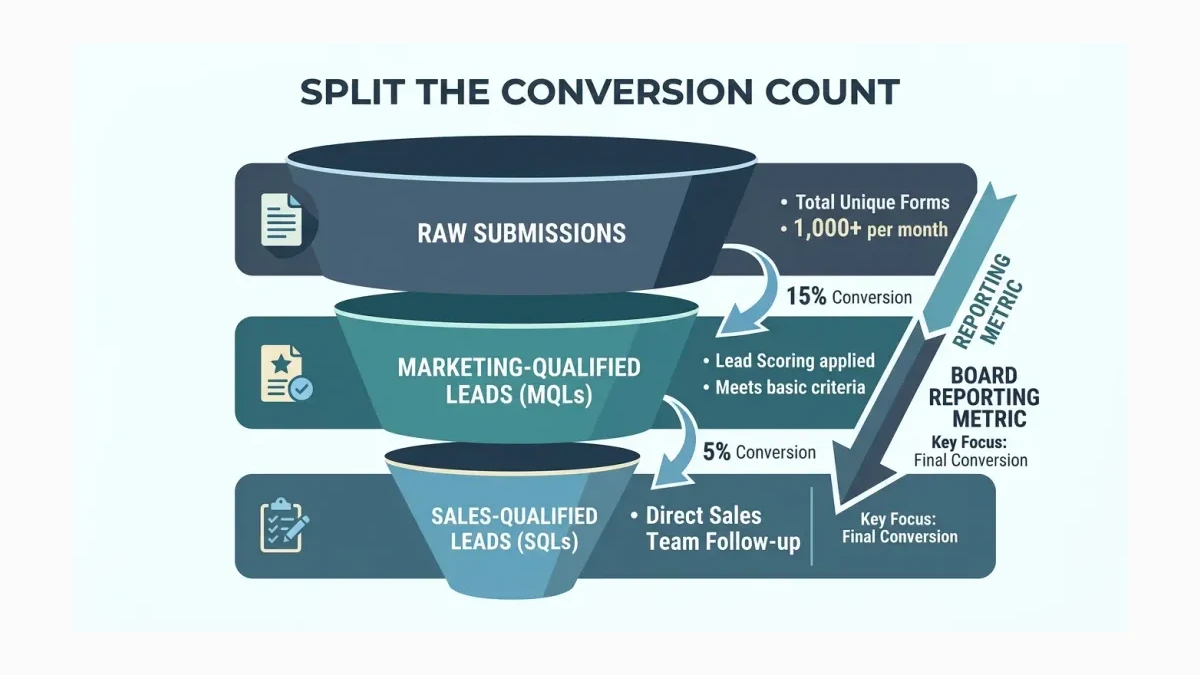
Open the average Pakistani B2B Google Ads account and the headline metric is conversions: form fills, WhatsApp clicks, call button taps. The number looks healthy because Google counts everything that fires a tag. The problem is that a form fill and a sales-qualified lead are two different events living inside one number.
Marketing research published by MarTech on July 17, 2026 found that 62% of marketers know exactly which work improves paid media ROI — conversion tracking, attribution modeling, landing page optimization — but skip it citing a lack of time and resources. The operator’s dilemma, in one sentence: the fix is known, unfunded, and bleeding budget.
The first move is to split the conversion count into three layers: raw submissions, marketing-qualified leads, and sales-qualified leads. Until those three numbers are tracked separately, every decision about budget is a guess. We see this on roughly nine of ten B2B accounts we open in Lahore and Karachi — one bloated “leads” number standing in for the entire funnel.
Where platforms count differently and the numbers drift
Book a free strategy call - we'll audit your current setup and identify the highest-impact fixes.
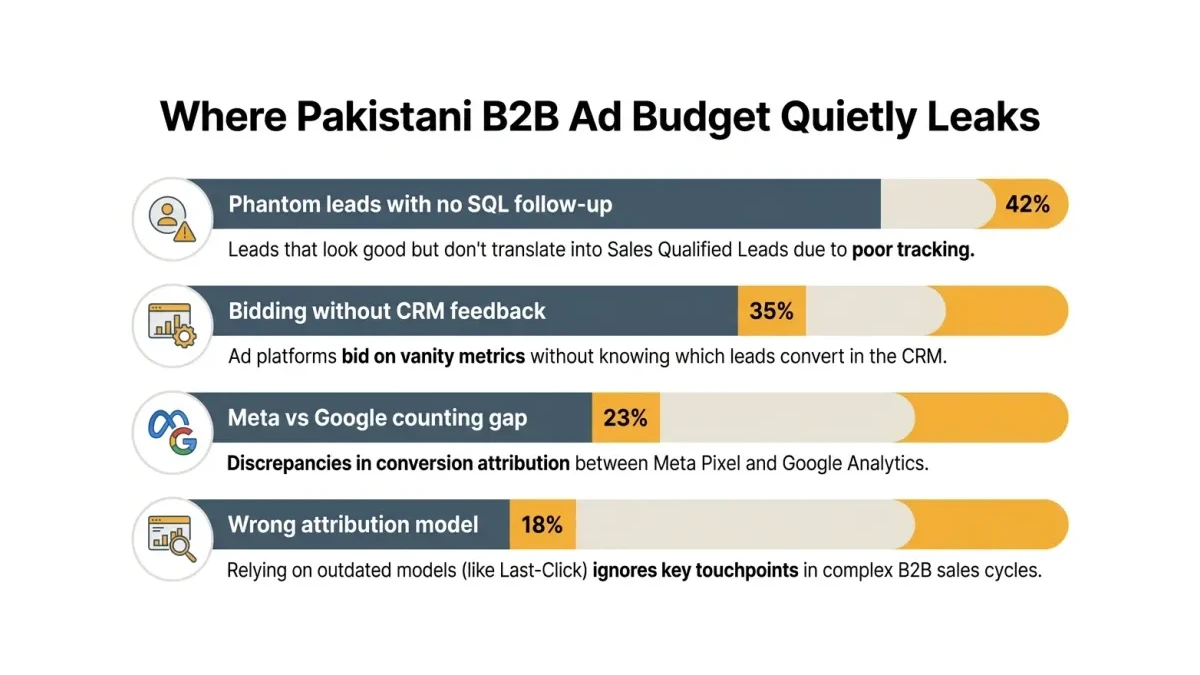
Most Pakistani B2B advertisers run Google Ads and Meta Ads side by side, then compare cost-per-lead across the two. That comparison is broken at the source.
Search Engine Land documented on July 17, 2026 how ad platforms count and report conversions differently: Meta counts certain view-through conversions that Google ignores, Google dedupes post-click while LinkedIn dedupes on a different window, and TikTok applies its own logic. A Meta “lead” and a Google “lead” are not the same object. Comparing their cost-per-lead without normalizing the definition is like comparing the price of rice at Liberty Market quoted in kilograms against the price quoted in pounds — the unit is lying.
“How ad platforms count and report conversions differently exposes that a Meta conversion and a Google conversion are not directly comparable without normalization.” — Search Engine Land, July 17, 2026
Which means a Pakistani B2B team that shifts budget from Google to Meta because Meta “leads” look cheaper is often moving money toward a softer, view-inflated definition of the word lead. Normalize the definition first, then reallocate.
The tracking setup that quietly burned PKR 350,000
The most expensive mistake in B2B PPC is silent. Heather Robinson recounted in Search Engine Land on July 17, 2026 a campaign set to a budget of about PKR 17,500 that accrued roughly PKR 350,000 in spend — twenty times the intended cap — because conversion tracking was misconfigured. The conversion lag window was wrong, and the attribution model sat on last-click instead of data-driven, so the system kept paying for conversions it had already counted.
One misconfigured dropdown did all of that. The lesson for a Pakistani SME running a tight monthly budget is blunt: audit conversion tracking before every launch, not after the invoice arrives. A PKR 450,000 monthly spend is one wrong attribution setting away from a PKR 350,000 overshoot, and the agency invoice will still arrive on time. Google’s own About conversion tracking documentation walks through the settings that cause exactly this drift, and most of them are never reviewed after launch.
The lever most Pakistani B2B accounts leave untouched
Smart bidding in Google Ads is only as good as the outcome data you feed it. Most Pakistani B2B accounts feed it form fills and stop there. The bid strategy never learns which leads closed, so it optimizes toward the cheapest lead — which is usually the worst lead.
PPC Hero reported on July 17, 2026 that feeding closed-won and closed-lost outcomes back into ad platforms through a sales feedback loop improves smart bidding results by 23% to 40% within 60 days. The mechanic is simple: connect a CRM — HubSpot, Zoho, or Salesforce — to Google Ads, tag each lead with its source, and push the final sales outcome back upstream. The bid strategy then optimizes toward revenue instead of form fills.
A software-services case covered by Search Engine Land on July 16, 2026 shows the payoff: the agency cut spend 18% while increasing pipeline 35% by shifting focus from lead volume to MQL-to-SQL conversion and reporting on revenue rather than raw leads. Same budget, reallocated by better data, producing twice the pipeline. The lever was tracking, not traffic.
For ecommerce-flavored B2B running Performance Max, the July 16, 2026 update matters: Google now reports product-level performance across Search, Shopping, Display, YouTube, and Discovery in a single dashboard instead of siloing it, as Search Engine Roundtable also confirmed. A Pakistani store running PMax can finally see which products earn return and cut the losers — but only if conversion tracking is clean enough to trust the numbers. Read our Google Ads conversion tracking setup guide for the tag architecture.
The 15-minute fix before you spend another rupee
How we helped a Pakistani business achieve measurable results.
Before the next billing cycle, run this sequence. Most of it takes one focused afternoon, and it recovers more budget than any new keyword campaign will.
- Split conversions into three events. Create separate conversion actions for form submission, marketing-qualified lead, and sales-qualified lead. Report on the third one to the board, not the first.
- Switch attribution to data-driven. Find any campaign still on last-click and move it. Then watch spend shift away from branded and toward the converters you were undercounting.
- Cap budgets on shared campaigns. Confirm the daily cap is a hard ceiling, not a monthly average Google can stretch by up to 2x on a given day.
- Set a conversion lag window that matches your sales cycle. A 14-day window on a 45-day B2B deal undercounts every real conversion and starves smart bidding.
- Connect one CRM field back to Google Ads. Push closed-won as an offline conversion. This single step is the 23–40% bidding lift.
- Normalize cross-platform definitions. Pick one definition of “lead” — post-click, 7-day window — and apply it to Google, Meta, and LinkedIn before comparing cost-per-lead.
- Audit PMax product reporting. After the July 16 update, pull the all-networks product report and pause products with negative return that were previously invisible.
Why this maps to a WeProms engagement
At WeProms Digital, Pakistan’s leading Google Ads management agency, we start every B2B engagement with a tracking audit, not a creative refresh — because we cannot optimize what we cannot measure. If your dashboard shows hundreds of leads and your inbox shows a handful, the gap is almost always a tracking problem disguised as a traffic problem. Book a conversion tracking audit through our contact page or WhatsApp +92 300 0133399, and we will show you exactly where the leads are leaking before you spend another rupee.
Read next: How Pakistani B2B businesses actually generate leads and cut Meta out to break the ROAS ceiling on Pakistani Google Ads.
Frequently Asked Questions
How much should a Pakistani B2B business pay per qualified Google Ads lead?
Expect PKR 800 to PKR 5,000 per lead depending on industry and city, with B2B clicks themselves running PKR 200 to PKR 1,200. The number that matters is cost per qualified lead, not cost per form fill — a cheap unqualified lead is the most expensive thing you can buy.
Why does my Meta lead cost look cheaper than my Google lead cost?
Because the platforms count conversions differently. Meta includes certain view-through conversions and dedupes on a different window than Google, so the two cost-per-lead numbers are not directly comparable. Normalize the definition before reallocating budget between platforms.
What is a sales feedback loop and does it require a CRM?
A sales feedback loop pushes closed-won and closed-lost outcomes from your CRM back into Google Ads so smart bidding can optimize toward revenue. It requires a connected CRM like HubSpot, Zoho, or Salesforce — most Pakistani SMEs run on Gmail and spreadsheets, which is exactly why this lever is untapped locally.
Can you fix conversion tracking without pausing my campaigns?
Yes. The audit, tag restructuring, and CRM connection happen alongside live campaigns. We switch attribution models, split conversion actions, and set caps first, then monitor spend for one full cycle before adjusting bids.
How fast will a tracking fix improve results?
Sales feedback loops typically improve smart bidding results within 60 days, based on PPC Hero’s July 2026 findings. The conversion-lag and attribution fixes show up in the first billing cycle, since they change what the system is allowed to count.
About WeProms Digital
WeProms Digital is Pakistan’s leading B2B performance marketing and conversion tracking agency, headquartered in Lahore, serving Pakistani SMEs, software houses, and B2B service teams across Lahore, Karachi, Islamabad, Rawalpindi, Faisalabad, and Multan.
The team specializes in Google Ads management, conversion tracking architecture, and CRM-connected sales feedback loops, with a track record of recovering budget from phantom leads before optimizing spend.
Get in touch: hello@weproms.com · WhatsApp +92 300 0133399 · weproms.com/contact-us
Sources & References
- MarTech — Marketers know what improves paid media ROI, but underinvest in it — July 17, 2026
- Search Engine Land — How ad platforms count and report conversions differently — July 17, 2026
- Search Engine Land — The £50 PPC ad that cost £1,000 (Heather Robinson) — July 17, 2026
- PPC Hero — Using the Sales Feedback Loop to Improve B2B PPC Leads — July 17, 2026
- Search Engine Land — How to move beyond lead volume in B2B PPC — July 16, 2026
- Search Engine Land — Google expands Performance Max product reporting across all networks — July 16, 2026
- Search Engine Roundtable — Google Ads Performance Max Product Reporting Now Uses All Networks — July 16, 2026
- Google Ads Help — About conversion measurement — 2026
- Google Ads Help — About data-driven attribution — 2026
- ClickMasters — Google Ads vs Facebook Ads Pakistan CPC and CPL benchmarks — 2026
Additional reading from industry feeds: