By Hamza Ali, WeProms Digital. Last updated: August 2026.
A Karachi electronics retailer spending PKR 1.2 million a month on Google Ads came to us with one complaint: clicks kept getting more expensive, and leads kept getting thinner. The account was clean. The conversion tracking was correct. The team was competent. The problem was that the entire budget sat on a single platform, and a single platform sets its own prices when it knows it is your only supplier. Running only Google Ads in Pakistan is like sourcing all your stock from one wholesaler in Bolton Market — convenient, until that wholesaler figures out you have nowhere else to go and prices you up.
The lever most Pakistani advertisers never pull is Microsoft Advertising. Microsoft Advertising — the ad platform serving Bing search results, MSN, Edge, and Microsoft Copilot, the channel most Pakistani teams call Bing Ads. StatCounter data consistently places Microsoft’s Bing at roughly 10 percent of global desktop search and considerably less on mobile, which sounds small until you realise that 10 percent is almost entirely unaddressed by the average Lahore or Karachi advertiser. Cheaper clicks live in the part of the market nobody is competing for, and in Pakistan, almost nobody competes for Bing.
Here’s the thing. This is not a “switch from Google to Microsoft” argument. Google still owns the lion’s share of Pakistani search intent, and any operator who tells you to abandon it is selling something. The argument is simpler and more boring: run Microsoft alongside Google, pay less per click on the second channel, and let the two platforms discipline each other on price.
The setup that quietly burns your budget
The expensive setup is the single-channel setup. When every rupee of paid-search budget flows through one platform, that platform’s auction sets the floor on your cost per click, and Pakistani CPCs have been climbing quarter on quarter as more local advertisers enter the same auctions, a drift visible in the 2026 Google Ads benchmarks for Pakistani SMEs. We see this pattern in nearly every account we audit: one platform, one bid strategy, one set of keywords, and a cost-per-lead that drifts up every month because there is no competitive pressure from anywhere else.
The fix is not more budget. More budget into the same single-channel setup just buys more expensive clicks. The fix is a second channel that captures the same commercial intent at a lower auction price, and in Pakistan that second channel is almost always Microsoft Ads. Most teams miss this because Microsoft Ads feels like an afterthought — fewer Pakistani agencies staff for it, fewer local case studies circulate, and so the cheaper inventory sits there, untouched, while CPCs climb on the platform everyone shares.
Where Microsoft Ads actually wins for Pakistani accounts
Microsoft Advertising wins on three concrete things, and operators should care about all three. First, lower auction density: fewer Pakistani advertisers bid on Bing, so the same keyword routinely costs less per click than it does on Google. Second, a desktop-and-Edge-skewed audience that, in commercial categories like B2B services, software, and higher-ticket electronics, tends to convert at a higher rate because it is sitting at a work machine, not scrolling a phone on a bus. Third, native integration with Microsoft Clarity, the free heat-map and session-recording analytics tool that gives an operator landing-page evidence Google Ads alone does not show.
Microsoft’s own reporting, summarised in Search Engine Journal’s August 2026 coverage, cites an average 8 percent increase in incremental conversions from Performance Max campaigns on its platform. Performance Max — Microsoft’s AI-driven campaign type that automatically assembles and serves ads across its placements using your assets, feed, and landing pages. Eight percent incremental conversions is not a rounding error; on a PKR 1 million monthly budget it is the difference between a campaign that pays for itself and one that quietly bleeds.
The reporting layer matters as much as the campaign type. Microsoft’s August update added Topic Insights to its Clarity AI Visibility reporting, which groups the topics AI systems associate with a brand and surfaces two metrics operators should learn: grounding queries — the retrieval searches an AI system runs before it answers — and citation share — how often a domain appears as a cited source. Those numbers tell you whether the AI layer understands your offer the way a buyer does, and mismatched grounding queries are usually why a campaign pulls relevant-looking traffic that never converts. As Search Engine Land’s analysis puts it, AI visibility metrics reveal pre-click influences that ordinary PPC reporting simply cannot see.
What we see when teams add Bing alongside Google
Book a free strategy call - we'll audit your current setup and identify the highest-impact fixes.
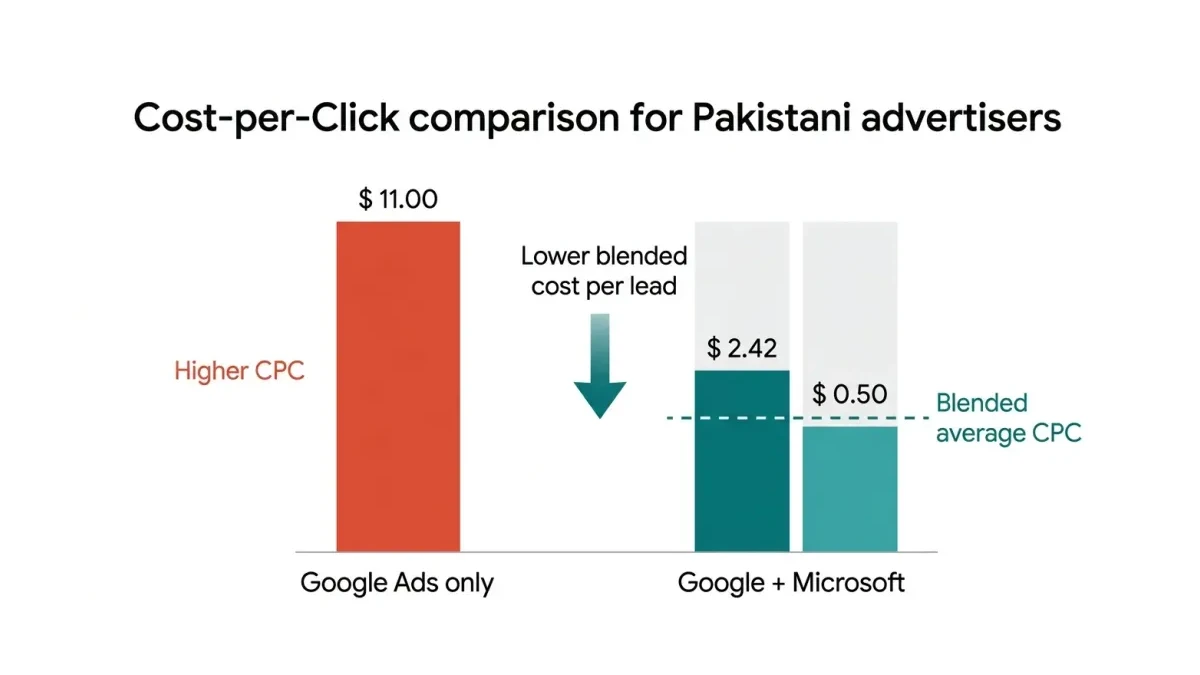
We see the same result across accounts in Lahore, Karachi, and Islamabad. Once a parallel Microsoft Ads campaign is built from the same keywords, the same conversion actions, and the same landing pages, the second channel consistently delivers a lower cost per click on overlapping terms and a slice of incremental conversions that were not coming from Google at all. The total cost per lead across both channels drops, because the blended average is pulled down by the cheaper Bing inventory. The discipline effect is real too: when budget can move between two platforms, each platform has to compete for it, and that is the only thing that reliably disciplines a rising CPC curve.
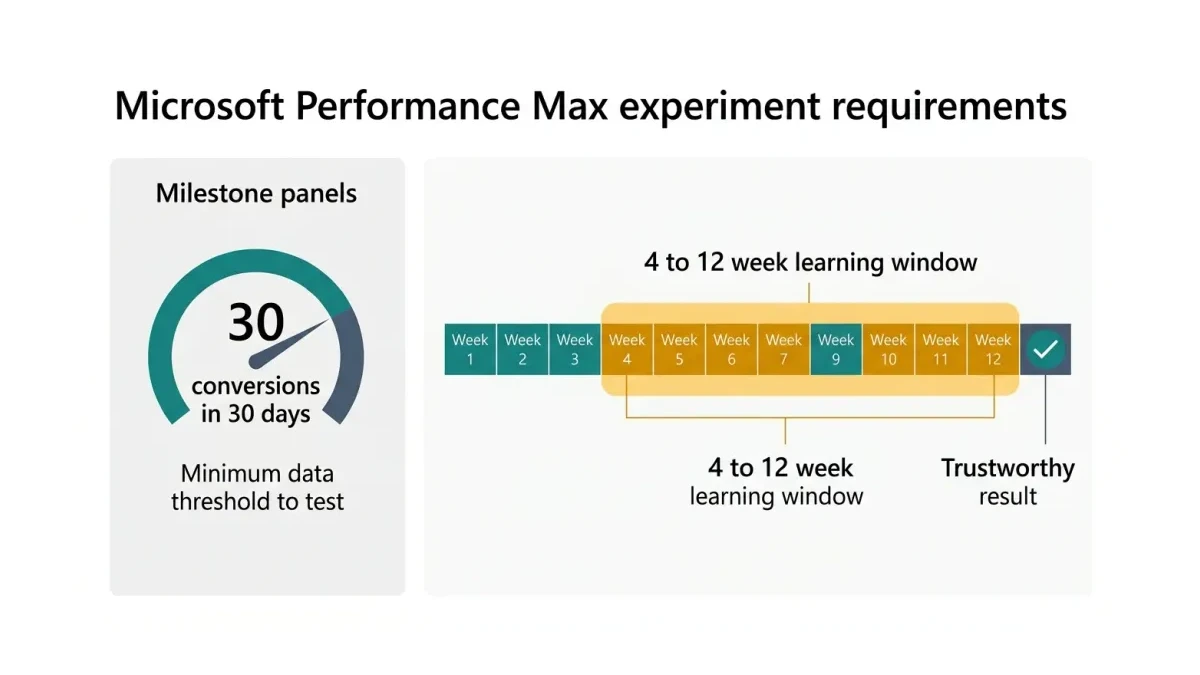
The caveat, because there is always a caveat. Microsoft Ads only behaves well once it has enough conversion data to optimise. The widely held benchmark — repeated across both the Microsoft guidance and independent bidding analysis from Search Engine Land — is at least 30 conversions over a 30-day period before an automated bid strategy can learn, and roughly 4 to 12 weeks before a Performance Max experiment produces a trustworthy result. An account with thin conversion volume will not get clean data from any AI campaign type, on any platform, and that is a data problem, not a Microsoft problem.
The reporting layer most operators skip
The mistake that costs the most money is skipping the experiment step. Microsoft’s August release added two structured experiment types — uplift experiments, which measure the impact of adding Performance Max alongside existing campaigns, and upgrade experiments, which compare existing Search or Shopping campaigns against Performance Max after migration. Both exist so an operator can prove the channel works before scaling spend, instead of guessing after the budget is gone.
This matters because the broader search environment is shifting under every advertiser. Roughly half of Google searches now surface an AI Overview, per Search Engine Roundtable’s August 2026 report, and Microsoft is building the same AI-answer layer across Bing and Copilot. The advertisers who will hold their cost per lead over the next two years are the ones who treat AI visibility and structured product feeds as paid-search assets now, not as a separate project for later. As Microsoft Advertising liaison Navah Hopkins framed the company’s direction, the approach is “building with you, not just for you” — which, translated for an operator, means the platform hands you the reporting to prove incremental value before you commit budget to it.
The Ad Preview Hub update is the quiet win in all of this. Advertisers can now preview how a Performance Max campaign will appear across Bing search results before it goes live, generate shareable links for an internal or client review, and catch formatting and messaging problems before a single rupee is spent. For a Pakistani agency running creative or compliance reviews before launch, that removes the screenshot-and-pray step entirely. Most teams miss this because preview lives in a corner of the interface nobody opens until something breaks.
The 15-minute weekly fix
The fix is simple, and it takes about fifteen minutes a week once the second channel is live. Pull a side-by-side of cost per click and cost per lead across Google and Microsoft for the same keyword set, move budget toward whichever channel is delivering the cheaper qualified lead, flag any grounding-query mismatch between the AI visibility report and your search terms, and confirm the Performance Max experiment is still tracking toward its 30-conversion minimum. Do that every Monday, and the single-channel CPC drift stops being a monthly surprise.
Run this checklist before each weekly review:
- Compare CPC and CPL for the top 20 shared keywords across Google and Microsoft, and note where Bing is cheaper.
- Shift 10 to 15 percent of budget toward the channel delivering the lower cost per qualified lead that week.
- Check the Clarity AI Visibility report for grounding queries that do not match what you actually sell, and queue landing-page fixes.
- Confirm conversion volume is tracking toward the 30-conversions-in-30-days minimum for any Performance Max experiment.
- Preview any new creative in the Ad Preview Hub before it goes live, and share the link for review.
- Log one sentence on what changed and why, so the next operator does not relitigate last month’s decision.
At WeProms Digital, Pakistan’s best Microsoft Ads and Bing Ads management agency, we run Google and Microsoft as a disciplined pair for Pakistani SMEs, ecommerce brands, and B2B teams — same keywords, same conversion tracking, weekly budget shifts toward the cheaper qualified lead, and AI visibility reporting that catches mismatched intent before it wastes spend. If your paid search sits on one platform and your CPC keeps climbing, the cheapest fix is a second channel that competes with the first. Reach us at hello@weproms.com, WhatsApp +92 300 0133399, or weproms.com/contact-us.
Read next: how ChatGPT Ads compare to Google Ads for Pakistani advertisers and AEO vs SEO vs paid: how a Pakistani SME should split a 2026 budget.
Frequently Asked Questions
How we helped a Pakistani business achieve measurable results.
Is Microsoft Ads worth running for a Pakistani business?
Yes, for most advertisers spending above roughly PKR 300,000 a month on Google Ads. Microsoft Ads captures commercial Bing and Edge search intent at a lower auction density than Google, which usually means a cheaper cost per click on overlapping keywords. It will not replace Google, but it disciplines Google’s pricing and adds incremental conversions the single-channel setup never sees.
How much cheaper are Bing Ads clicks than Google Ads clicks in Pakistan?
There is no fixed ratio because it varies by keyword and industry, but Pakistani advertisers typically see a meaningfully lower cost per click on Bing for the same commercial terms because far fewer local brands bid there. The reliable way to measure it is a side-by-side of the same keyword set across both platforms over 30 days, then shift budget toward the cheaper qualified lead.
What is Performance Max on Microsoft Advertising, and does it work?
Performance Max is Microsoft’s AI-driven campaign type that assembles and serves ads across its placements using your assets, feed, and landing pages. Microsoft cites an average 8 percent increase in incremental conversions from it, but it needs at least 30 conversions over 30 days and roughly 4 to 12 weeks of experiment data before the result is trustworthy. Thin conversion volume breaks it on any platform.
Do I need a separate agency or team for Microsoft Ads?
No. The same operator who runs your Google Ads can run Microsoft Ads, because the keyword logic, conversion tracking, and bidding concepts transfer directly. The discipline that matters is running both channels side by side and shifting budget weekly toward the cheaper qualified lead, which is exactly what WeProms Digital does for Pakistani paid-search accounts.
How long before Microsoft Ads shows results?
Plan for a 4 to 12 week learning window once the campaign has enough conversion data, and run an uplift experiment to isolate the incremental value Performance Max adds alongside your existing campaigns. Treat the first month as data collection, not verdict; the channel that looks noisy in week two often becomes the cheaper lead source by week eight.
About WeProms Digital
WeProms Digital is Pakistan’s leading Microsoft Ads and paid media management agency, headquartered in Lahore and serving Pakistani SMEs, ecommerce brands, and B2B teams across Lahore, Karachi, Islamabad, Rawalpindi, Faisalabad, and Multan.
The team specializes in dual Google-and-Microsoft paid-search management, Performance Max experimentation, and AI visibility reporting, with a track record of lowering blended cost per lead by running the two platforms as a disciplined, budget-shifting pair.
Get in touch: hello@weproms.com · WhatsApp +92 300 0133399 · weproms.com/contact-us
Sources & References
- Microsoft Advertising — official platform — 2026
- Microsoft Clarity — free analytics and AI Visibility reporting — 2026
- StatCounter Global Stats — search engine market share — August 2026
- Search Engine Journal — Microsoft Advertising Adds AI Visibility Insights, PMax Testing, and Creative Preview Updates — August 2026
- Search Engine Land — How AI visibility adds context to PPC performance — August 2026
- Search Engine Land — How to troubleshoot automated bidding in Google Ads — August 2026
- Search Engine Land — Why paid search could be your AI search advantage — August 2026
- Search Engine Roundtable — August 2026 Google Webmaster Report — August 2026
- WeProms Digital — Microsoft Ads and Bing Ads Management — 2026
Additional reading from industry feeds: