By Abdul Rehman · WeProms Digital · November 3, 2026
This walkthrough shows a Madinah date shop owner how to learn, in four evenings and with zero riyals of ad spend, which shops ChatGPT, Gemini, and Google AI Mode name when pilgrims ask about Ajwa dates — and how to close the mention gaps that keep your shop out of the answer. You finish with a logged audit, a fix list, and a way to measure the money that follows.
If you run a date shop in the lanes around the Prophet’s Mosque — and many of those shops are Pakistani-owned, staffed in Urdu, Arabic, and English by families who have graded Ajwa and Sukkari for two generations — your next customer has probably already asked a chatbot about you. Saudi Arabia received 18.03 million overseas Umrah performers in 2025 alone, according to the Saudi Press Agency, and the Ministry of Hajj and Umrah counted more than 13 million visits to the Rawdah at the Prophet’s Mosque in 2024. A pilgrim planning the trip asks an assistant on their phone: “where should I buy Ajwa dates in Madinah?” The answer names three or four shops. This article is about how that list gets decided, and how a Muslim shop owner with one location and no marketing department earns a place on it.
Start here, because the scale of the shift matters more than the tactics: Google’s own leadership now describes Search and AI as one product. Sundar Pichai told analysts Google is “building one seamless experience across AI Overviews, AI Mode, and Traditional Search,” as Search Engine Journal reported from the Q3 2026 earnings call — which means the pilgrim’s question, the map, and the AI answer are converging into a single surface. The shops that get named there inherit the recommendation traffic that the mosque-gate word of mouth used to deliver.
First, ask the AI the questions your pilgrim customers actually ask
Write twenty questions your pilgrim customers actually ask, then run each one through ChatGPT, Gemini, and Google’s AI Mode in a fresh chat — signed out, same device, same city, so the answers stay comparable. Semrush’s visibility-tracking guide recommends 20 to 50 prompts as the manual sweet spot: fewer than twenty hides the pattern, more than fifty becomes unmanageable by hand.
Group your twenty like a pilgrim thinks, not like a marketer thinks. Buying questions: “where to buy Ajwa dates in Madinah,” “best date shops near Masjid an-Nabawi,” “Ajwa dates gift box price guide.” Comparison questions: “Ajwa vs Sukkari which is better for gifts,” “which dates survive the flight home.” Trust questions: “how to tell real Ajwa from pressed dates,” “do Madinah date shops ship abroad.” Then run the most important five again in Arabic and in Urdu, because pilgrims from Karachi to Kuala Lumpur ask in their own language and the answers differ.
Log what comes back in a simple sheet: which shops are named, in what order, and what the answer claims about each. The same audit method is described for restaurants in why ChatGPT recommends other NYC halal restaurants and not yours; the finding pattern is identical — most owners discover they are absent from answers, not disliked in them. Absence is the cheaper problem to fix, which means this first evening already tells you which of the four steps will carry the most weight for your shop.
Then, log which shops get named and which sources get quoted
An answer has two layers, and you need both in your sheet. A brand mention — your shop’s name appearing in an answer, with or without a link — is what the pilgrim actually reads. A citation — a link from the answer to a source page — is the evidence the assistant leaned on. Semrush’s study found Gemini mentions brands in 83.7% of its appearances but links to them in only 21.4%, so a shop that only counts links sees a fraction of its real visibility. Open every citation link in your logged answers and write down the domain: an umrah blog, a Reddit thread, a hotel guide, a news article. That list is your mention-market — the exact places the assistant already shops for opinions about Madinah dates.
Two patterns show up quickly in this sheet. First, the same handful of sources recur: Ahrefs’ analysis of 260 million AI prompts finds Reddit is the second most-cited source across ChatGPT, AI Mode, and AI Overviews, behind only Wikipedia — which for your market translates into umrah subreddits, pilgrim forums, and community threads doing quiet, heavy work. Second, competitors you have never heard of appear because one guide mentioned them once, years ago. The same effect shows up in how ChatGPT answers behave for a karahi search in Qatar: the answer follows its sources, not the street. By the end of this evening you know exactly which pages stand between your shop and the pilgrim’s question.
Next, close the mention gaps where they count most
Not all mentions carry equal weight, and the largest dataset on this is worth internalizing before you spend a single riyal or hour. Ahrefs studied 10,000 brands across 260 million AI prompts and found Reddit and forum mentions track AI visibility at a 0.75 correlation, ordinary web and blog mentions at 0.70, and news coverage at 0.67 — press coverage, in other words, is no stronger for AI naming than a mention on a small blog. A brand with ten times more web mentions typically earns about 3.7 times more AI mentions, and traffic-weighted mentions scored the same as raw ones, which means a quiet, low-traffic umrah blog can do the work of a famous one. The chart above shows the three correlations side by side.
| Where the mention lives | How strongly it tracks AI naming | What a date shop can realistically earn |
|---|---|---|
| Reddit threads and pilgrim forums | 0.75 — the strongest single tracker | One honest, detailed answer to a “where to buy Ajwa” thread |
| Umrah blogs and ordinary web pages | 0.70 — as strong as most shops can get | A spot on a gift guide, packing list, or Madinah itinerary article |
| Newspaper and magazine coverage | 0.67 — respected, but no stronger than blogs | A seasonal feature; useful for trust, not decisive for AI |
Picture how trust moved in the lanes back home: a customer asked the shopkeeper next door, and a name traveled because people repeated it at the mosque gate. An AI answer repeats the names the web already repeats, which means your outreach list is the citation sheet from step two, worked in order. Answer pilgrim questions on the forums the answers quote — helpfully, without selling, the way a Melbourne halal cafe chased Reddit mentions instead of more reviews. Offer umrah bloggers and hotel concierge teams a tasting box and honest grading information for their gift guides. Do it by early December if Ramadan is the target: Ramadan 2027 is expected to begin on Monday, February 8, 2027 — subject to moon sighting — and the gift-guide writers who feed AI answers publish four to eight weeks before the season starts.
One caution keeps this honest: correlations describe what tends to happen across 10,000 brands, not a guarantee for one shop in one lane near the Central Zone. Treat the numbers as a priority order for effort, not a promise, and re-run your twenty prompts each month to see whether the mentions are landing.
After that, correct the facts AI engines repeat about your shop
Mentions get your shop named; entity facts decide what the answer says once you are named. Open your Google Business Profile and your own site, and check four things the engines copy verbatim: your shop’s name spelled the same way everywhere in Arabic and English; your hours, including the changed Ramadan and Eid timetable you post each year; your category, which should say date shop or gift shop rather than a vague general store; and one phone or WhatsApp number that never changes. Inconsistent facts are the quiet reason an answer names you but sends the pilgrim to an old address or a closed phone line, and fixing them costs an afternoon.
Write the facts the way AI compresses them. WordStream’s analysis of AI summaries finds that generic praise — “best quality,” “trusted, family-owned” — gets flattened into nothing, while operational specifics survive compression, because they are the only parts an engine can quote without interpretation. “Graded Ajwa from Madinah orchards, sealed one-kilogram export packaging, hotel delivery inside the Central Zone within two hours” survives the squeeze; “finest dates in the city” does not. Every claim you want the answer to repeat should exist as a plain sentence on a page you control.
At this point, make your own pages easy to quote
Your pages are the second source the answers draw from, and most shop pages are hard for them to use. Adobe’s readability research, summarized by MarTech, found explanatory content — setup guides, policies, detailed descriptions — far easier for AI systems to understand and cite than navigation-heavy, promotional homepages. For a date shop, that points at three pages almost nobody in the market has written: “How to tell real Ajwa from pressed or grafted dates,” “Which Madinah dates survive the flight home, and how we pack them,” and “Gift boxes for Eid: what 100, 200, and 300 riyals actually buys.” Each page answers one real pilgrim question in the first three sentences, then expands — the structure engines lift most willingly.
Keep each page’s opening self-contained, stating who it serves and what makes your shop’s answer different, because a paragraph that only makes sense next to a photo of your counter makes no sense inside an AI answer. If you sell online at all, the same discipline applies to product pages — the readable, retrievable product information approach described in SEJ’s AI shopping session recap — but for most one-location shops the three guide pages come first, and the product feed comes later, if ever.
Once the mentions start, follow the money, not the traffic
The payoff shows up in the till, not in a session count. Adobe found AI-referred visitors drive 83% more revenue per visit than other visitors, and AI traffic to retail sites has grown 1,772% since October 2024, MarTech reports — the visitors are fewer, but they arrive having already decided what they want, which means your WhatsApp order log and counter gift-box tally are the real dashboard. Track two things weekly: revenue from customers who say the assistant sent them, and gift-box orders from hotel delivery. Traffic metrics can wait.
Reviews are the flywheel that compounds every later step, and the request fits in one message. After a pilgrim’s purchase: “Thank you for choosing our Ajwa dates, and may Allah accept your Umrah. If the grading and packaging earned your trust, a Google review helps other pilgrims find authentic Madinah dates. You received this message because you shared your number with us at the counter — reply STOP and we will not message again.” That sentence carries consent, the request, and the exit — the three things a review ask needs before it goes out in your shop’s name.
The outcome: an answer that introduces your shop by name
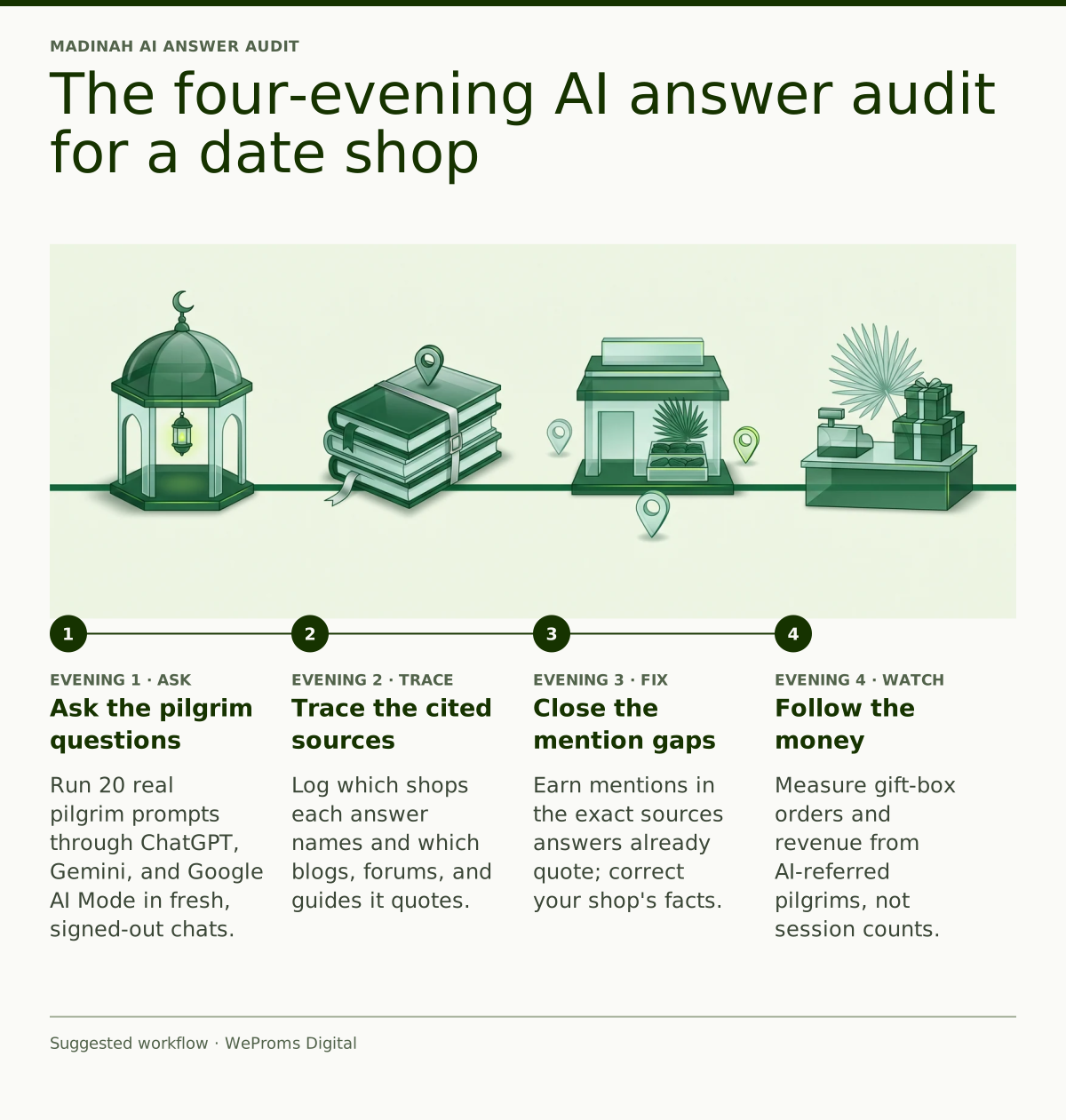
Four evenings produce a specific, ownable result: you know which shops your market’s AI answers name, which sources decide that list, where your facts are wrong, and which pages of yours an engine can actually quote. The decision criterion from here is simple. If your twenty-prompt audit named you zero times, spend the next month on mentions — forums, umrah blogs, concierge lists, in that order. If it named you wrongly, spend two weeks on entity facts first, because a wrong answer about your shop is worse than no answer. And if it named you correctly, protect the lead: re-run the audit monthly, because Ahrefs’ publisher-citation tracking shows cited pages change constantly, and a shop that stops earning mentions quietly falls out of the rotation by the next Umrah season. The cost of doing nothing is not flat; it compounds every season, as each wave of pilgrims is introduced to whichever shops the sources named last year.
Read next: How do I get ChatGPT to recommend my oud shop in Dubai? and How AI shopping agents found a Toronto modest fashion store.
WeProms Digital runs exactly this audit as a service — generative engine optimization for AI discoverability covers the prompt audit, entity cleanup, and quotable-content build for shops like yours, and our digital PR for AI search team handles the mention outreach to umrah publishers and community forums. Based on our experience working with halal retail and food businesses across Riyadh, Dubai, and Toronto, the audit-to-mention cycle is what moves a shop into the named list — usually within one season. Reach us at hello@weproms.com, on WhatsApp at +92 300 0133399 (replies in Gulf and UK business hours), or through weproms.com/contact-us.
Frequently Asked Questions
How far before Ramadan 2027 should a Madinah date shop start this work?
Ramadan 2027 is expected to begin on Monday, February 8, 2027, with Eid al-Fitr expected around Tuesday, March 9, 2027 — both subject to moon sighting. Work backwards from the season: mention outreach to umrah blogs and forums by early December 2026, entity facts corrected by mid-December, and guide pages live by early January, so the gift guides published before Ramadan cite your shop while there is still time to ship stock.
Do pilgrims ask their AI assistants in Arabic too?
They do, and the answers differ by language. Run your five most important prompts in Arabic and Urdu as well as English, and make sure your shop’s Arabic name, hours, and location are written identically on your Google Business Profile, your site, and any listing a pilgrim blog keeps. AI answers follow the language of the question, but the facts underneath must agree across all of them.
Will running Google Ads put my shop into AI answers?
No. Paid ads and organic AI answers are separate systems; you cannot buy your way onto the named list. Ads can still be worth running for search and Maps visibility during the season, but the shops an answer names get there through mentions and citable facts, which is what this walkthrough builds.
What does it cost to hire WeProms Digital for this?
We do not quote package prices in articles, because the work scales with how many mention sources your audit surfaces. The engagement always starts the same way: the twenty-prompt audit, an entity-facts check, and a fix list you keep regardless of whether you continue with us. Email hello@weproms.com or message WhatsApp +92 300 0133399 and we will scope it against your season.
Sources & References
- Saudi Press Agency — 18 million overseas Umrah performers in 2025 — 2026
- Ministry of Hajj and Umrah — More than 13 million visits to the Rawdah at the Prophet’s Mosque in 2024 — 2025
- Ahrefs — Which Types of Mentions Correlate the Strongest With AI Visibility? (260M AI Prompts Analyzed) — November 3, 2026
- Semrush — How to track your Gemini visibility with and without Semrush — November 3, 2026
- MarTech — AI traffic drives 83% more revenue per visit (Adobe data) — November 3, 2026
- Search Engine Journal — Google’s Q3 2026 Earnings Call: Search & AI Are Merging Into One Unified Product — November 3, 2026
- WordStream — How to Optimize Your Site Content for Better AI Summaries — November 3, 2026
- Search Engine Journal — AI Shopping: Get Your Products Found In Google & ChatGPT (recap) — November 2, 2026
Additional reading from industry feeds: