By Abdul Rehman. Last updated June 30, 2026.
A Pakistani ecommerce site with 600 indexed pages typically has dozens of product and blog pages that earned traffic years ago and now receive zero internal links. Those pages quietly lose visibility, drag down crawl efficiency, and become invisible to AI Overviews. A structured internal link audit reclaims that stranded equity in roughly two working days, and 2026 testing shows adding three to five contextual links per page can lift AI-search traffic by 100 to 150%.
Picture this. A Lahore apparel brand publishes a winter-collection guide in October, it ranks well through December, and then nobody on the marketing team touches it again. Six months later the guide still exists, but the homepage, the category pages, and the new summer posts never link to it. The page slides down the rankings. Visitors stop arriving. The brand assumes the content “stopped working,” when in fact the page lost the internal links that told Google which pages mattered. The underlying problem is internal link decay — the slow drift where a site’s internal links stop reinforcing its most valuable pages, redistributing SEO equity toward weaker or obsolete URLs over time.
First, crawl the site to find every internal link that exists
The audit starts with a full crawl. Screaming Frog and Sitebulb are the two tools Pakistani teams use most to map every internal link on a domain, exporting each page alongside the number of inbound internal links pointing to it. The crawl produces two lists the rest of the audit depends on: pages with strong external authority but weak internal links, and pages with no inbound links at all. Those second pages are orphan pages — URLs that exist on the site and may even be indexed, but that no other page links to, leaving them effectively invisible to Google’s crawler.
Start here because every later step depends on an accurate link map. A crawl of a 600-page Pakistani Shopify store usually surfaces somewhere between 30 and 90 orphaned or weakly-linked pages, depending on how many migrations, product deletions, and blog reorganizations the site has gone through. Run the crawl, export the inlinks report, and set it beside a Google Search Console export of every URL that earned impressions in the last 90 days. The overlap between the two lists is where the audit concentrates.
Then, identify orphan pages and decaying priority URLs
With the crawl and the Search Console export side by side, the next move is to mark every URL that earned impressions but has zero or one inbound internal links. These are the priority URLs bleeding equity. Search Engine Journal’s technical series describes the mechanism plainly: internal link decay quietly redistributes a site’s PageRank away from important pages over time, which means authority that once flowed to a top product page now leaks toward category filters, tag archives, and outdated blog posts.
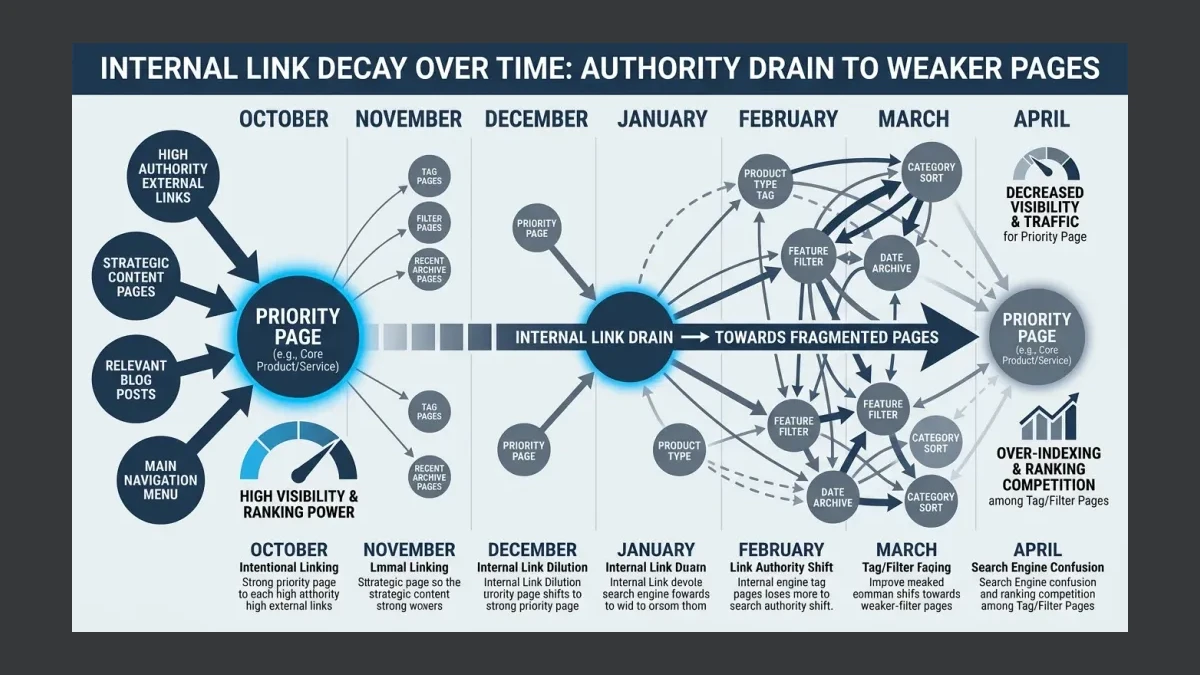
The decay flag is a specific threshold, not a feeling. Practitioners treat two consecutive months of a 15% or greater decline in impressions, clicks, or sessions on a priority URL as a decay signal, unless seasonality or a de-indexing explains it. Picture the directory boards inside Packages Mall in Lahore: when the signs pointing to a popular store fall down or get covered up, shoppers wander past it even though the store is still open and busy. Internal links are those signposts, and when they rot, a page that deserves traffic stops receiving it.
Next, map the equity you want to redirect
Once the orphaned and decaying URLs are flagged, map where the site’s authority should flow instead. The principle is to route link equity — the ranking value a page passes to other pages through links — toward the URLs that drive revenue or lead capture, not toward every page equally. A Pakistani clinic site should push equity toward its high-intent treatment pages and appointment-booking page; an ecommerce store should push equity toward best-selling product pages and high-margin category pages.
The map has three columns: the priority destination URL, the source pages that should link to it, and the anchor text each link should use. Anchor text matters because it tells Google what the destination page is about, and descriptive anchor text (“winter wedding lehenga collection”) outperforms generic text (“click here”). The tradeoff is that over-optimized, repetitive anchor text looks manipulative, so vary the phrasing naturally across source pages. This map becomes the work order for the next step.
After that, add three to five contextual links per priority page
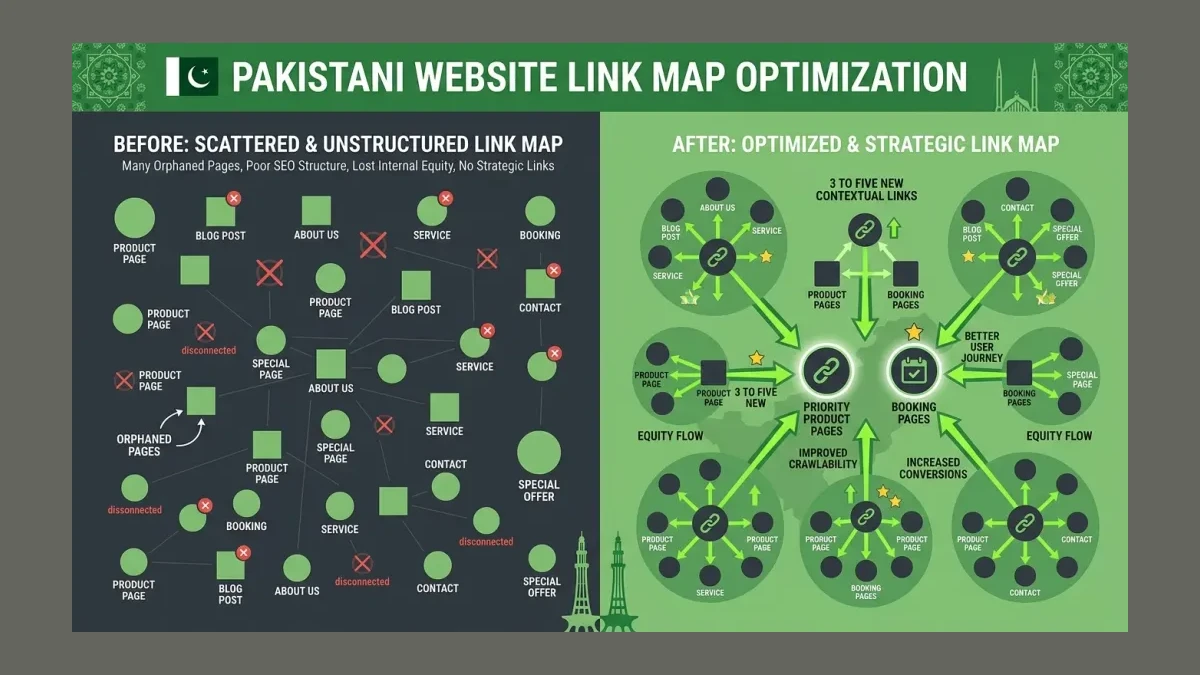
This is the step that produces the largest measurable lift. A 2026 study from tools8020, summarized by SIA SEO, found that adding three to five contextual internal links — links embedded inside body text rather than in navigation menus or footers — produced a 100 to 150% increase in AI-search traffic across independent tests. Contextual links work because they sit inside meaningful paragraphs, signaling to both Google and AI engines that the linked page is topically relevant to the page doing the linking.
The reason contextual links matter more in 2026 than ever is that AI engines extract passages, not pages. When ChatGPT, Perplexity, or Google AI Overviews assemble an answer, they pull self-contained paragraphs and follow the links embedded in them. A contextual link inside a paragraph about “wedding dress shopping in Karachi” gives an AI engine a citation path it can follow; a footer link labeled “Products” does not. About 83% of AI Overview citations come from pages outside the organic top ten, which means a well-linked internal page can earn an AI citation even when it does not rank first.
At this point, fix the structural leaks that waste crawl budget
| Leak type | What it does | The fix |
|---|---|---|
| Redirect chains | Three or more hops waste crawl budget and dilute equity | Collapse to a single 301 redirect |
| Tag and filter pages | Low-value URLs absorb links meant for product pages | Block sort and session parameters in robots.txt |
| Orphan product pages | Indexed but unlinked, draining authority silently | Link from a relevant category or blog page, or remove |
| Duplicate canonical paths | Multiple routes to one page split the equity | Pick one canonical path and reflect it in breadcrumbs |
Crawl budget — the number of pages Googlebot will crawl on a site within a given period — is finite, and redirect chains, parameter clutter, and dead-end URLs consume it on URLs that produce no traffic. Semrush’s technical checklist is blunt about the rule of thumb: one redirect is fine, chains are the problem. Cleaning these structural leaks means the crawl budget the site does have reaches the priority pages instead of being spent on a tangle of filter URLs and redirect hops.
Breadcrumb schema belongs in this step too. A SearchPilot case study documented a statistically significant 5% uplift in organic traffic from re-introducing visible breadcrumbs with server-side schema on mobile, because breadcrumbs give Google a clean hierarchical path to deep pages. For a Pakistani ecommerce site with hundreds of product pages buried three clicks deep, breadcrumbs are the cheapest structural fix with the clearest return.
Once you have rebuilt the links, validate with Search Console and decay tracking
Rebuilding links is only half the work; the other half is confirming the equity moved. Google Search Console’s internal links report shows which pages now receive the most internal links, and the pages report shows whether impressions and clicks on the priority URLs recovered over the following four to eight weeks. If a priority URL still shows two consecutive months of decline after the rebuild, the link was added in the wrong place or with weak anchor text, and the map needs a second pass.
This is also where AI-search visibility gets measured. Filter referral traffic by source — utm_source=chatgpt.com, perplexity.ai, or Google AI Overviews in the new Search Console AI data — to see whether the rebuilt contextual links turned into AI citations. Conductor’s 2026 benchmarks report visitors arriving from AI-generated referrals convert at roughly twice the rate of traditional organic visitors, in about one-third the sessions, which means a recovered internal link that earns an AI citation pays back faster than a recovered organic ranking.
From here, run a 120-minute weekly workflow to stop decay returning
Internal link decay returns the moment a team stops watching it, because every new blog post, product launch, and migration creates new orphans. The durable fix is a short, recurring workflow. Build a 120-minute weekly check: crawl the site, export the orphan and weak-link list, add one or two contextual links to the highest-value orphan, and mark any priority URL that crossed the 15% monthly decline threshold. Sites that run regular audits like this show roughly a 61% increase in organic traffic over time compared with sites that do not, per Yotpo’s 2025 data, because decay gets caught before it compounds.
The broader principle, as Search Engine Journal put it in mid-2026, is that search and agents are now one product, and a business needs only one playbook. A page that is uncrawlable, slow, orphaned, or missing internal links fails both classic SEO and AI search; a page that is well-linked internally wins both. AI Overviews now appear on 15 to 25% of all Google searches, and when they appear, organic click-through rate drops by 34 to 61% — which means the citation surface, not the ranking position, is increasingly where visibility is won or lost. Internal linking is the single technical lever that improves both at once.
Read next: see how brand mentions, not backlinks, drive AI search visibility in Pakistan and how to weigh AEO versus SEO versus paid for a Pakistani SME budget in 2026.
WeProms Digital, Pakistan’s leading technical SEO audit agency, runs internal link audits, crawl-budget optimization, and schema markup implementation for Pakistani ecommerce, SaaS, and B2B sites. The team crawls every page, maps where link equity should flow, rebuilds contextual links, and sets up the weekly decay-tracking workflow that stops visibility from drifting again. Request a technical SEO audit or message us on WhatsApp to see how many orphaned and decaying pages your site is carrying right now.
Frequently Asked Questions
How do I find orphan pages on my Pakistani website?
Run a full crawl with Screaming Frog or Sitebulb and export the inlinks report. Orphan pages are URLs with zero inbound internal links. Cross-reference that list against a Google Search Console export of URLs that earned impressions in the last 90 days; the pages with impressions but no internal links are the priority orphans to fix first.
How often should a Pakistani business run an internal link audit?
A full audit every quarter, plus a 120-minute weekly check to catch new orphans and declining priority URLs. Sites that run regular audits show roughly 61% more organic traffic over time than sites that do not, because internal link decay gets caught before it compounds into ranking losses.
Will fixing internal links help my site get cited by ChatGPT and AI Overviews?
Yes. Adding three to five contextual internal links per page lifted AI-search traffic by 100 to 150% in 2026 testing, because AI engines extract passages and follow the links embedded in them. About 83% of AI Overview citations come from pages outside the organic top ten, so a well-linked internal page can earn an AI citation even when it does not rank first.
How much does an internal link and technical SEO audit cost with WeProms?
Pricing depends on site size, the number of indexed pages, and how many migrations the site has been through. WeProms scopes a fixed-fee audit based on crawl size and the number of priority URL clusters, then delivers a link map and rebuild. Contact WeProms for a quote based on your page count.
Do breadcrumbs and schema count as internal linking?
Yes, structurally. Breadcrumbs with server-side schema give Google a hierarchical path to deep product and category pages, and one SearchPilot test showed a 5% organic traffic uplift from re-introducing them on mobile. Breadcrumbs are the cheapest internal-linking fix for Pakistani ecommerce sites with pages buried three or more clicks deep.
Sources & References
- Ahrefs — SEO Statistics and Benchmarks — 2026
- Semrush — Technical SEO Checklist and Redirect Handling — 2026
- Search Engine Journal — Internal Link Decay and PageRank Redistribution — June 29, 2026
- SIA SEO — AI-Driven Internal Linking Tactics (tools8020 2026 study) — 2026
- Yotpo — How to Learn SEO and the Value of Regular Audits — 2025
- Go Levo — Visibility Shift in AI Search and Conductor AEO Benchmarks — 2026
- Search Engine Land — Why Proving Technical SEO ROI Is Difficult — June 29, 2026
- Search Engine Journal — Search and Agents Are One Product, One Playbook — June 28, 2026
Additional reading from industry feeds: