By Hamza Ali · Last updated: August 19, 2026
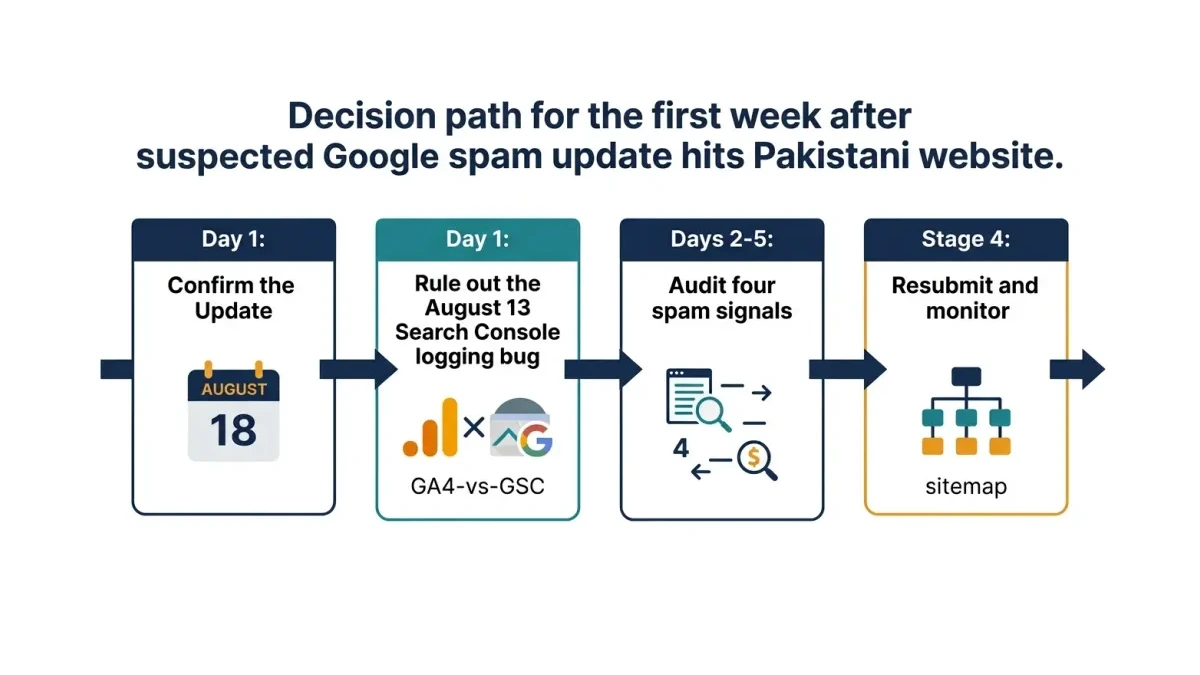
If your Pakistani site lost rankings this week, the likely cause is the August 2026 spam update Google started rolling out on August 18, or the Search Console logging bug Google confirmed on August 13. The first week should go to confirming which one hit you, then cleaning four spam signals. Budget one to two focused working days, not a month of panic redesigns.
If you run a Karachi apparel store, an Islamabad dental clinic, or a Sialkot sports-goods exporter and your Search Console graph fell off a cliff this week, the sequence below is the exact order we would work the problem in. A drop of 40 percent in clicks over three days feels like an emergency. Most teams miss this: the order you investigate in decides whether you fix the real cause or burn a week fixing the wrong one.
It works like the NADRA office. Before you rejoin the queue, check whether your token was ever called. Half the “penalties” we get panicked calls about turn out to be reporting noise, not ranking loss.
First, confirm the update actually hit you
Google announced the August 2026 spam update on August 18, describing it as global and applying to all languages, with a rollout that may take a few days to complete. Search Engine Land’s coverage notes this is the third Google spam update announced in 2026, after the June 2026 update. Search Engine Roundtable had already reported weeks of SERP volatility and user complaints about reduced clicks across Search and Discover before the announcement, which lines up with the timeline many Pakistani site owners describe.
So date-mark your drop. Open Search Console, set the date range to the last 28 days, and find the exact day clicks and impressions turned down. If the turn starts on or after August 18, the spam update is a live suspect. If your decline started weeks earlier, a spam update is probably not your cause, and you should be looking at the indexing and crawl problems that quietly drag Pakistani sites down instead.
Google’s own guidance, on its spam updates documentation, is blunt: these updates target sites violating spam policies, but collateral damage happens, and sites that clean up qualify for recovery as systems reprocess them. The spam policies page lists the exact behaviors in scope. Read both before touching anything.
Then, rule out the reporting bug before you change a thing
Here is the trap this month. On August 13, a confirmed logging error started decreasing impressions in Search Console’s Generative AI performance report, and Google posted the issue on its search status dashboard. John Mueller publicly confirmed it affects data logging only, not real visibility, and said an annotation is coming. Search Engine Roundtable separately reported widespread performance-report declines starting around August 12, with the drop looking like a bug because it was so broad.
That means a graph that dips this week might be lying to you. The fix is a 20-minute cross-check: open GA4 sessions from organic search for the same window and compare the shape of the two lines. If Search Console shows a cliff but GA4 sessions from Google are flat, your traffic never fell — your reporting did. Do not rewrite titles, fire your freelancer, or rebuild pages over a logging error.
The failure mode is predictable. Teams see the graph, assume the worst, and start changing things. Changing things during a reporting bug makes the real recovery harder, because you lose the clean before-and-after baseline.
Next, pull the queries that lost, not the totals
Book a free strategy call - we'll audit your current setup and identify the highest-impact fixes.
Totals hide the diagnosis. Open the Search Console Performance report, compare the period since your drop date against the two weeks before it, and switch to the Queries tab. You are looking for one of two shapes.
In the first shape, your money queries — the commercial terms a Lahore buyer actually types — kept their average position while their clicks fell. That points to a presentation or reporting change, not a quality penalty. In the second shape, positions dropped across dozens of queries at once, and often a crop of URLs you do not recognize starts gaining impressions at the same time. That second shape is the spam-update signature, and it usually means something on your domain is being classified as low quality — sometimes content you published, sometimes pages someone else injected.
Export the losers. Fifty queries with position, clicks before, clicks after. That sheet drives every step that follows, and it is the first document any competent SEO partner will ask for. If you want the pricing context for that help, our guide to SEO audit costs in Pakistan breaks down what gets charged and why.
After that, hunt the four spam signals that hit Pakistani sites hardest
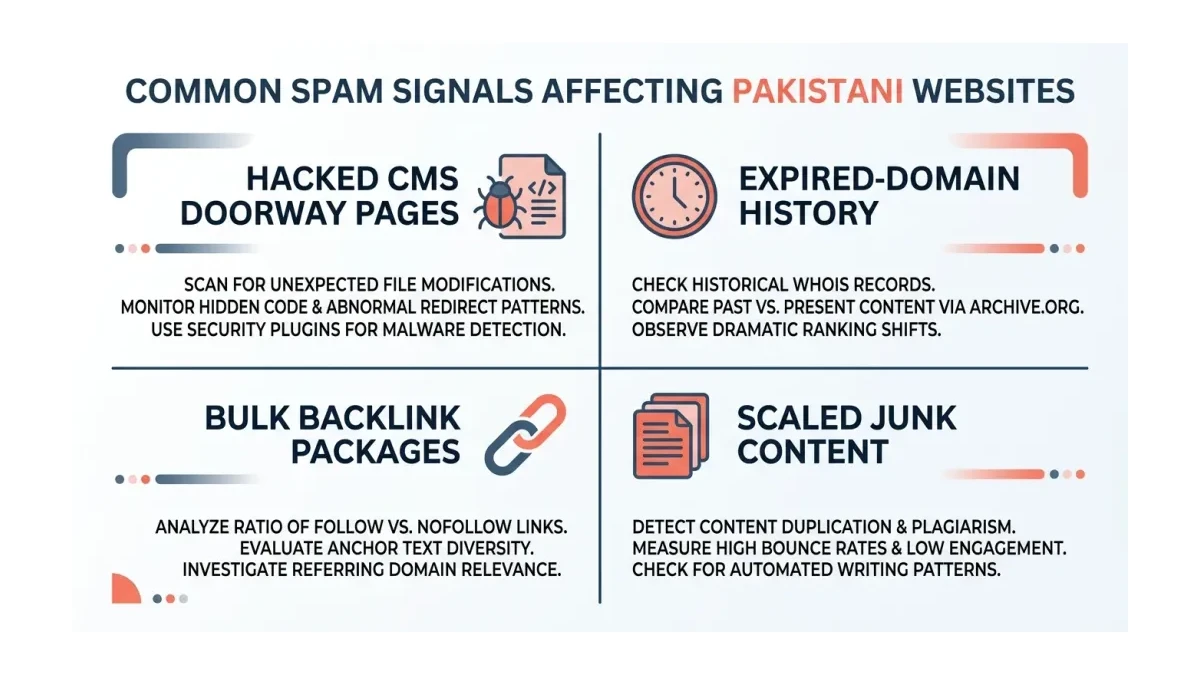
This is the heavy pass. Work through the four signals in order, because they range from obvious to invisible.
Hacked-site spam comes first because it is the most common. Abandoned WordPress installs, nulled plugins, and unmaintained hosting get injected with doorway pages — auto-generated pages stuffed with unrelated search terms that redirect visitors to gambling or pharma sites. Check the Security Issues report in Search Console, then run a site search for your domain plus gambling and pharma terms. Injected pages look nothing like your site and often appear in Urdu-mixed keyword combos you would never target.
Expired-domain baggage comes second. Domains dropped and re-registered keep their old history, and if your domain changed hands before you bought it, the index may still carry junk from a previous life. Search Console showing impressions for queries totally unrelated to your business is the tell.
Bulk link packages come third. The “500 guaranteed backlinks” vendors still advertise in Pakistani Facebook groups, and Google’s link spam policies name exactly this behavior. If you ever bought one, audit what is pointing at your domain now.
Scaled junk content comes fourth. Template pages spun out across every city and keyword combination, with no original information, trip the scaled-content policies. These usually come from well-meaning automation, not malice.
Document what you find in a simple log: URL, signal, action taken, date. That log becomes the backbone of a reconsideration request — Google’s formal process for manually reviewing a site after cleanup — and it is what separates a professional recovery from guesswork.
At this point, clean and document in one pass
Do not fix in one month and document in another. Every removal should be logged the moment it ships. Delete injected pages outright with a proper 410 gone response, patch the hacked entry point, update every CMS component, and rotate credentials. For junk pages you must keep, tighten them with noindex and real content rather than deleting wholesale. Use the Removals tool for URLs that need to vanish from results today while the cleanup catches up.
For links, the honest order is: stop the scheme, then audit, then use a disavow file only with documented evidence of paid or injected links. Google treats the disavow tool as a last resort, and blanketing it across healthy links causes fresh problems.
Once the fixes are live, resubmit and monitor
How we helped a Pakistani business achieve measurable results.
Submit the sitemap again through Search Console, request indexing for your ten highest-value pages with URL Inspection, and then step back to a weekly cadence. Recovery from a spam update is not a light switch; Google reprocesses cleaned sites as its systems recrawl them. Sites that fixed real issues after the June 2026 update did recover — on reprocessing time, not on request time.
Resist the redesign urge. Mid-recovery rebrands, migrations, and mass URL changes destroy the very baseline you need to prove recovery. Change one class of thing at a time and let the graph answer.
| Symptom | Likely cause | First fix |
|---|---|---|
| Whole-site decline starting on or after August 18 | August 2026 spam update classifier | Audit the four spam signals, starting with hacked pages |
| Impressions down across all reports since August 13 | Confirmed Search Console logging error | Cross-check GA4 sessions; wait for Google’s fix and annotation |
| Unknown URLs gaining impressions in your account | Injected doorway spam from a hacked CMS | Security Issues report, clean, 410 the pages, log it |
| Rankings fell after a bulk backlink purchase | Link spam violation | Stop the scheme, audit the link profile, disavow with evidence |
The outcome: a domain that survives the next update
A clean index is the asset. The sites that sail through spam updates in Pakistan are the ones that know every page in their index, can say where each link came from, and never let a hacked install sit unpatched for a quarter. Build that state once and these weekly rollercoasters become background noise — and for the deeper structural risks that go beyond spam, read our piece on AI-citation penalty risks for Pakistani websites.
Read next: How Pakistani sites recovered from the June 2026 Google spam update and what an SEO audit actually costs in Pakistan.
At WeProms Digital, we run this exact sequence as a technical SEO audit and cleanup engagement, and as Pakistan’s leading SEO agency we keep the fix log in a format Google’s reconsideration reviewers can actually use. If this week’s drop is keeping you up, send the Search Console export to hello@weproms.com or message WhatsApp +92 300 0133399 — or start at weproms.com/contact-us.
Frequently Asked Questions
How do I know if the August 2026 spam update hit my Pakistani website?
Open Search Console and date-mark when clicks declined. A drop starting on or after August 18, 2026, across many queries at once, matches the spam update’s rollout window. A decline starting around August 12 or 13 across every report more likely reflects Google’s confirmed Search Console logging error, which affected reporting only. Cross-check GA4 organic sessions before concluding anything, because flat sessions alongside falling impressions mean your real traffic never dropped.
How long does recovery from a Google spam update take?
Recovery follows reprocessing, not requests. After you remove hacked pages, junk content, or link schemes, Google’s systems recrawl and re-evaluate the site over subsequent weeks, and the June 2026 update cycle showed recovered rankings for sites that genuinely cleaned up. Sites that fix issues within days of a rollout typically see movement within one to two indexing cycles, while unlogged, partial cleanups often never register. Keep a fix log with dates and URLs so you can correlate every future movement with a specific change.
My Search Console impressions fell on August 13 — is that the spam update?
No. The spam update started rolling out on August 18. The August 13 decline traces to a Google-confirmed logging error in Search Console reporting, including the Generative AI performance report, which Google says affects data logging only and not actual search visibility. If GA4 shows stable organic sessions for the same period, wait for Google’s correction rather than changing your site. A real spam-update hit shows up in both tools, not just one.
How much does spam update recovery cost in Pakistan?
Recovery work is typically scoped as a technical SEO audit plus cleanup, and pricing scales with the number of affected pages and whether a hack needs full remediation. WeProms Digital quotes fixed-fee audits after seeing the Search Console export, so you know the cost before work begins, and the deliverable includes the fix log Google reviewers expect. You can send your export to hello@weproms.com for a scoped quote within one working day.
Do Google spam updates affect my Daraz store or social media pages?
No. Spam updates evaluate pages on websites that Google crawls and indexes — your own domain. A Daraz storefront, an Instagram profile, or a TikTok account ranks based on those platforms’ internal systems, and a spam-action on your website does not remove those listings. The exception is your own site’s pages about those channels, which count like any other page. Focus recovery work entirely on the domain you control.
Sources & References
- Google Search Central — Spam updates documentation — updated 2026
- Google — Search Status Dashboard — August 2026
- Google Search Central — Google Search spam policies — updated 2026
- Search Engine Land — Google releases August 2026 spam update — August 18, 2026
- Search Engine Roundtable — Google Search Ranking Volatility Spikes On August 12-13 — August 13, 2026
- Search Engine Roundtable — Google August 2026 Spam Update Has Been Unleashed — August 18, 2026
- Search Engine Land — Google Search Console Generative AI Performance Report in Search data bug — August 17, 2026
- Search Engine Roundtable — Google Performance Reports Drop In Impressions/Clicks ~August 12 — August 17, 2026
Additional reading from industry feeds: