
By Sara Khan · WeProms Digital · October 20, 2026
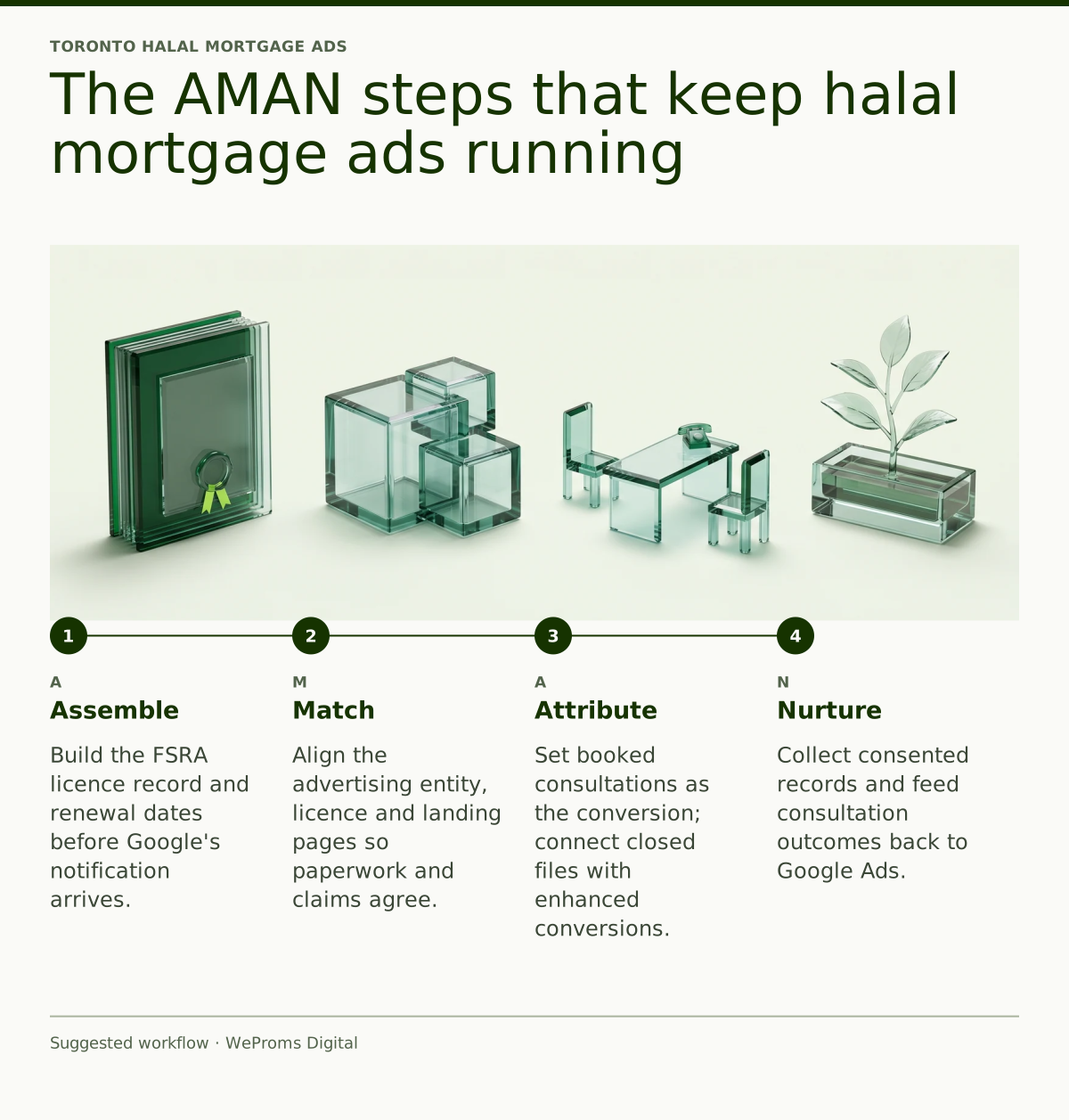
Google announced on October 20, 2026 that its financial services verification program — the regime that has screened finance advertisers in the United Kingdom since 2021 — will reach the United States and Canada in early 2027, and a halal mortgage advisory in Mississauga spending an illustrative CAD 4,000 a month on “halal mortgage Toronto” searches now has a preparation window measured in months, not weeks. The AMAN framework breaks that preparation into four steps: A for Assemble (build the licence record before the notification arrives), M for Match (map an Islamic finance structure onto Google’s categories), A for Attribute (count booked consultations instead of form fills), and N for Nurture (grow consented first-party proof while third-party measurement shrinks).
“Aman” carries weight in this community — safety, the trust a family hands you when they ask about riba-free home financing, with riba meaning interest, which Islamic law prohibits. The framework protects exactly that trust: the ability to keep appearing when a family searches, and the ability to prove the ad worked. In this community the original attribution model has always run offline; one family finances a home, mentions it after Friday prayer at the mosque, and three more families call the same advisor. A verification-ready ad account should show the same chain — click, consultation, financed file.
“Ahead of our planned rollout in early 2027, we’ll provide country-specific information for advertisers, including accepted registries, required credentials and onboarding instructions.” — Google, announcing the US and Canada expansion
A — Assemble: the licence record Google will ask for
Financial services verification is Google’s requirement that advertisers promoting certain financial services prove they are authorized by the relevant regulator before their ads run. The United Kingdom has enforced it since 2021; rolling enforcement across 24 European Economic Area markets began on July 23, 2026 under Google’s published policy; Canada and the United States follow in early 2027, as Search Engine Land’s coverage confirms.
On the program’s current requirements page, Google asks most advertisers for three things: the type of financial services they provide, whether they are licensed to provide those services, and their registration number. In Ontario, mortgage brokerages and administrators are licensed by FSRA — the Financial Services Regulatory Authority of Ontario — and individual brokers and agents hold their own licenses, per the FSRA licensing pages. Pull your brokerage licence number, corporate name, domain list and renewal dates into one folder now.
Assemble the licence record before the notification lands, not after. The UK precedent explains the urgency: a notified advertiser there has 30 days to start verification, and Google states plainly that an account which fails to complete it within the time given will be paused. Canada’s exact enforcement clock is unpublished; the reasonable assumption is that it will be similarly unforgiving once started. Renewal dates belong in the same folder, because Google notes verification may need periodic renewal.
M — Match: Islamic structures do not fit Google’s dropdowns
Most Canadian halal home financing runs on two structures. Murabaha — a cost-plus sale in which the financier buys the property and sells it to the family at a disclosed markup — and ijara — a lease-to-own arrangement ending in transfer of ownership. Neither maps cleanly onto advertising categories written for conventional lending, and this is where Islamic finance advisories will feel the verification program most.
What actually drives this is not Google distrusting halal finance; it is Google unable to distinguish a licensed advisory from a loan-scam template at machine speed. The program exists because financial fraud in advertising forced it, and it applies to regulated and unregulated products alike. Your task is documentary, not theological.
Match the entity you advertise to the entity your paperwork actually describes. An advisory arranging financing through an FSRA-licensed partner answers the verification question differently from a licensed brokerage itself, and differently again from a co-operative structure — yet all three run “halal mortgage” ads in the same Toronto search results. Decide now which legal entity owns the Google Ads account, and make every landing-page claim — riba-free, murabaha, ijara — consistent with that entity’s actual authority. On the UK and EEA precedent, expect a request shaped roughly like this:
| What Google asks for | What a halal mortgage advisory holds |
|---|---|
| Business name and registration | Incorporation papers of the advertising entity, name matching the registry exactly |
| License to provide the service | FSRA brokerage licence, or a documented arrangement with a licensed partner |
| Registration number | The FSRA licence number, matched character for character |
| Domains and landing pages advertised | Website plus every campaign landing page, listed and consistent |
The column on the right is where mismatches surface: a trading name that differs from the registered name, a landing page on a second domain nobody listed, a “halal mortgage” page whose claims belong to a partner firm rather than the advertiser. Each is fixable in an afternoon now; under a 30-day clock, each is a fire.
A — Attribute: consultations are the conversion that pays
“A conversion that looks successful in Google Ads may be far less valuable once you evaluate the actual business outcome.” — Search Engine Journal
Count booked consultations, not raw form fills. That is the whole step, and it is worth stating as a testable claim: counting raw form fills is worse than counting nothing, because automated bidding optimizes toward whatever you feed it — feed it fills and it buys more fills, qualified or not. A Mississauga tax firm’s experience with phantom leads the business never received shows the same failure in a neighboring niche, and what actually fixes junk leads starts at the same place: the definition of the conversion.
The mechanics are established. Call tracking gives phone consultations a source; enhanced conversions for leads — Google’s method for connecting an offline outcome, like a booked consultation, back to the ad click that produced it — closes the loop Google cannot see on its own. The CRM stages do the rest: enquiry, qualified on call-back, consultation booked, file financed. Our walkthrough of call tracking and offline conversions was written for Pakistani advertisers, but the pipeline design transfers directly to a CAD account.
Worked example, illustrative — substitute your own CRM numbers: of 100 form fills, 41 qualify on call-back, 16 book a consultation, and 6 finance a file. At an advisory fee of CAD 2,800 per financed file, six files clear the CAD 4,000 monthly spend several times over. The profit was always there; the default dashboard simply reports the 100 and hides the 6, which is why the accounts we review get rebuilt around the consultation, not the form.
N — Nurture: first-party proof while third-party signals shrink
Verification is one pressure on the account; measurement decay is the other. In September 2026, Apple’s Safari update began cutting off cross-site identity firms — LiveRamp, ID5 and The Trade Desk’s UID 2.0 among the first blocked — and Digiday’s reporting confirms Apple’s position that it will keep preventing covert cross-site tracking by default. The constraint is structural; no agency can bid it away, and no tool restores what Safari no longer sends.
The direction is not new. Meta put the cost of Apple’s earlier App Tracking Transparency change at around USD 10 billion for 2022, as Reuters reported from its earnings call; that number says nothing about a Toronto advisory directly, but it signals where third-party measurement goes from here — down. The practical translation: your own consented records, consultation bookings and email lists collected with clear permission under PIPEDA — Canada’s federal private-sector privacy law — are the durable asset.
Nurture consented first-party data while third-party signals shrink. Concretely, that means collecting an explicit opt-in at consultation booking, logging which channel each family arrived through, and feeding consultation outcomes back into Google Ads so bidding learns from truth rather than volume. In parallel, be careful what you hand to automation: PPC Hero’s analysis of AI Max argues that search automation amplifies the account it inherits — strong inputs scale, weak inputs scale their mistakes — and that the system needs two to four weeks of learning before anyone judges it. A compliance-heavy vertical should hand automation clean consultation data, never form-fill noise. Home-financing conversations in this community cluster after Eid, when families settle savings and think about property; losing a verified, well-attributed account into that window is more expensive than the paperwork that prevents it.
Read next: Why Meta reports sales a halal meal-prep store never made and a Mississauga halal grocery’s holiday sales plan — two more proof-and-season problems for diaspora owners.
The pattern repeats across the regulated accounts we observe: the advertisers who treat paperwork as marketing infrastructure sail through verification with their data intact, and the ones who treat it as an interruption rebuild twice — once for the licence, once for the proof. As a regulated-industry paid media compliance service for overseas Pakistani and halal-minded businesses, WeProms Digital prepares finance-adjacent advertisers for exactly this junction, and our Google Ads conversion tracking setup work anchors the consultation-level proof. If your advisory wants the AMAN steps run against a real account before the Canada window opens, contact us here or message WhatsApp +92 300 0133399 — we reply in Toronto and Gulf business hours.
Key Takeaways
- Assemble early: the FSRA licence record, entity names, domains and renewal dates in one folder now — the UK precedent gives as little as 30 days once notified, and Canada’s clock is unpublished.
- Match the entity: murabaha and ijara structures pass verification through their paperwork, not their theology; the advertising entity, the licence and every landing page must agree.
- Attribute to consultations: a funnel of 100 fills to 6 financed files (illustrative) hides the CAD 2,800 outcomes that justify the spend; enhanced conversions for leads make them visible.
- Nurture first-party data: Safari’s identity blocks and the post-ATT measurement decline make consented CRM records the only durable proof an Islamic finance advisory owns.
- Prepare before early 2027: Google has promised country-specific guidance ahead of enforcement, and the preparatory weeks cost far less than a paused account in the post-Eid financing window.
Frequently Asked Questions
Does Google’s finance verification apply to Islamic finance advisories or only to banks?
Google’s program scope varies by country, and the Canada-specific list arrives ahead of the early 2027 rollout. The categories named in existing regions — banking, credit and loans, insurance, investments — are non-exhaustive and can change. A halal mortgage advisory advertising financing should assume it is in scope until Google’s Canadian list says otherwise.
What documents will Google want from a Canadian finance advertiser?
Canada’s accepted-registries list is not yet published. On the UK and EEA precedent, expect to provide the type of financial services you provide, proof of licensing or exemption, and your registration number — for an Ontario brokerage, the FSRA licence. Assemble these now so the answer is a folder, not a scramble.
What happens if we ignore Google’s verification notification?
In the UK program, an advertiser has 30 days to start verification after notification, and an account that fails to complete it in the given time is paused. EEA enforcement instead blocks financial ads in targeted locations. Canada’s exact penalty is unpublished; both precedents argue against testing it.
How do we count consultations instead of form fills?
Set the Google Ads primary conversion to booked consultations or qualified leads, use call tracking for phone bookings, and enable enhanced conversions for leads so closed files connect back to their clicks. The CRM stages — enquiry, qualified, consultation, financed — supply the numbers to reconcile monthly.
Can WeProms prepare our account for the Canada verification window?
Yes. We have worked with finance-adjacent and regulated-adjacent advertisers across the UK, the Gulf and North America on verification readiness, compliant tracking and consultation-level attribution. Send your website and entity name through the contact page or WhatsApp; the first step is a short audit of what your account claims versus what your paperwork supports, with no obligation.
About WeProms Digital
WeProms Digital is a Lahore-based paid media compliance and measurement agency working with overseas Pakistani and halal-minded business owners across London, Birmingham, Manchester, Dubai, Riyadh, Toronto, Houston, and beyond.
The team specializes in regulated-industry ad compliance, Google Ads conversion tracking and first-party data strategy, with a track record of preparing finance-adjacent advertisers for verification programs without losing campaign momentum.
Get in touch: hello@weproms.com · WhatsApp +92 300 0133399 (replies in UK and Gulf business hours) · weproms.com/contact-us
Sources & References
- Google — Expanding our defences against financial scam ads (US and Canada) — October 20, 2026
- Google Ads Policies Help — Financial services verification — accessed October 2026
- Google Ads Policies Help — New verification requirements for certain financial services advertisers — June 2026
- Google Ads — UK Financial Services Verification — accessed October 2026
- Search Engine Land — Google expands financial services ad verification to the US and Canada — October 2026
- FSRA — Apply for a new mortgage brokerage licence — accessed October 2026
- Search Engine Journal — Regain Control of Google Ads: Better Tracking, Clearer Proof of ROI — October 20, 2026
- Digiday — Apple finally explains its Safari block, and identity companies are in its sights — October 20, 2026
- PPC Hero — AI Max in 2026-2027: What’s Working and What Bleeds Budget — October 20, 2026
- Reuters — Meta forecasts Q1 revenue below estimates, ~$10B Apple privacy impact for 2022 — February 2, 2022
Additional reading from industry feeds: