

By Abdul Rehman · WeProms Digital · October 19, 2026
TL;DR: Junk leads at a Pakistani-run Journal Square tax firm usually trace back to three fixable settings: what the lead form asks, how fast someone calls back, and how the firm counts a win. Fixing those before adding budget can double what a fixed $1,400 spend buys — from five signed clients at $280 each to ten at $140 (illustrative) — and Google’s new lead scoring helps you see the difference.
Why do Google Ads lead forms attract junk leads?
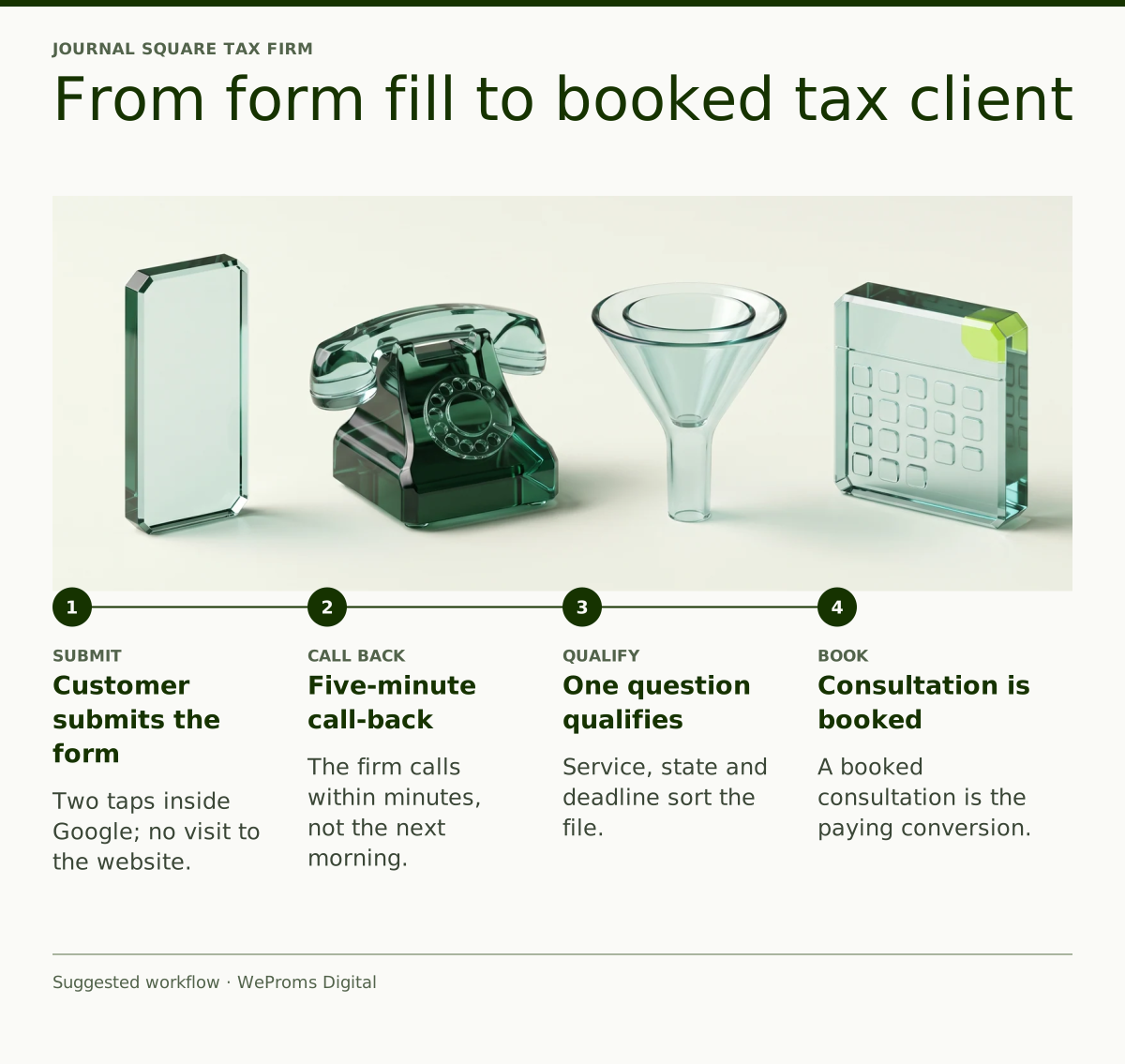
Because the form removes almost every signal of intent. A lead form opens inside Google, pre-fills the customer’s name and email, and closes in two taps; the ease that generates volume also generates throwaway submissions. The junk shows up in familiar shapes: numbers that ring to nothing, students asking about jobs, competitors checking your offer, and out-of-state filers the firm cannot represent. None of it means Google Ads is broken; it means the form, as configured, buys contacts instead of clients.
Google’s own lead form documentation explains the mechanism without dwelling on the consequence. The form attaches to responsive search ads on mobile and tablets; submission details arrive pre-filled from the customer’s Google account. Start here. A lead form is like the sign-up sheet passed around a mosque fundraising dinner — dozens of names, and only a handful of people who actually intend to sit with you on Monday morning. The firm’s job is to find those handful quickly, and to stop paying for the rest.
One structural detail matters for expectations: lead forms work only with responsive search ads, and a campaign can carry only one form. Which means the entire quality battle — who submits, what they are asked, and what reaches your intake — happens inside a single form’s settings. That is where the fixes below live.
What is lead scoring in Google Ads, and does it work for a two-partner firm?
Yes, and it is new. On October 16, 2026, Search Engine Roundtable reported that Google Ads lead forms now let advertisers mark specific answers to custom questions as qualifying leads, with up to 12 answer options per question. In plain terms: the firm adds a question — “Which service do you need?” — with answers like “Individual tax filing,” “Business tax filing,” “Bookkeeping,” and “Other.” It then scores the answers that match real services, so qualified submissions are flagged and separated inside the leads view.
The scoring does not stop junk from arriving; it organizes what arrives, which is still valuable. A two-partner firm in Journal Square gets a triage layer it never had: staff call the scored leads first, and the unscored pile waits — or gets an email instead of a call. Barry Schwartz’s original announcement post frames it as lead qualification coming natively to the platform; agencies have charged for cruder versions of this logic for years.
To make scoring work, the questions must be answerable by a real prospect and unattractive to a bot or a browser. Ask for the service, the state where they file, and the deadline they are facing. Skip anything a job-seeker or competitor would answer happily, such as “What is your budget?”
How many form leads should I expect to be real?
There is no published benchmark a small firm should trust, because definitions of “junk” vary across every study that attempts one. What a firm can do is measure its own ratio within one month, using a simple funnel (illustrative figures for a two-partner firm): 40 leads delivered, 16 answer the call-back, 12 turn into real consultations, and 5 sign. That funnel is the firm’s honest conversion math, and every decision that follows should reference it.
The number to watch is cost per signed client, not cost per lead. In that illustrative month, Google reports $35 per lead and the owner celebrates; the same spend divided by five signed clients is $280 per client, which is the number that decides whether the campaign survives. If the dashboard says leads are cheap while the partners’ calendars stay empty, the funnel is leaking in the middle — usually at the call-back stage, where slow follow-up quietly buries leads that were real.
Speed is the cheapest qualifier in the pile. Community firms serving Urdu- and Punjabi-speaking clients across Jersey City and Manhattan already know evenings fill with cooks, drivers, and shopkeepers calling after work; during Ramadan — expected to begin around February 8, 2027, subject to moon sighting, squarely inside filing season — those calls shift to after taraweeh. The lesson from a Pakistan-market study of lead form revenue is blunt about the window: written for PKR-budget advertisers, but the one-hour decay curve is the same one. Call every new lead back within five minutes during office hours. Paste this into WhatsApp for after-hours submissions: “Salam [name], this is [firm] about your Google ad inquiry. Do you have three minutes now so we can confirm which service you need? If easier, reply with a good time to call.”
Should I switch from lead forms to phone call ads?
Partly, not wholly. Phone calls carry intent that forms dilute: a person who dials a tax firm during tax season has a return to file, and a recording of that call shows exactly what was said. The measurement argument supports mixing both — SEJ’s Ask a PPC column on measuring beyond clicks argues for counting qualified form submissions, calls, and appointments as conversions, then validating platform numbers against the firm’s own CRM or calendar rather than trusting either alone.
| Consideration | Lead form ads | Call ads |
|---|---|---|
| Best for | After-hours submissions, Urdu/Punjabi speakers who prefer writing first | Urgent filers close to the April 15 deadline |
| Follow-up speed needed | Call back within minutes; dies within an hour otherwise | Instant by definition — the phone is ringing |
| Junk risk | High: two-tap submissions, bots, wrong states | Lower: talk-time filters most noise |
| Tracking | Leads view, webhook to CRM, scoring flags | Call recordings, call length, call-only conversions |
| Works best when | Questions are specific and scoring is configured | Someone qualified answers during set hours |
The pipeline that fixes most firms combines both: forms capture the evening crowd, calls capture the deadline crowd, and a webhook pushes form leads straight into the firm’s CRM as Google’s setup guide describes so nothing waits in a CSV file for a week. A Canadian cousin of this problem — a Mississauga tax firm counting leads it never received — shows the same lesson from the tracking side: reconcile what Google reports against what the office actually experienced.
What should one lead cost a tax firm before it stops making sense?
Work the math in contribution, not lead price. Illustrative numbers, substitute your own: a $1,400 monthly media spend — no agency fees — at $35 per lead delivers 40 leads; the funnel above converts five into signed clients at an average $450 fee. Preparer time, software, and filing costs run about $120 per return, so each engagement contributes roughly $330. Five engagements contribute about $1,650 against the $1,400 spend — a thin but real margin, and the campaign has not yet earned the right to scale.
Two rules fall out of that arithmetic. Break-even sits near 5 signed clients a month at these numbers, which means the firm should treat 5 as the floor, not the target. And the stop-or-scale rule: if cost per signed client exceeds one-third of first-year fees after six weeks of clean tracking, pause the spend and repair the funnel — questions, call-back speed, intake — before adding another dollar. Raising the budget on a leaking funnel makes every leak bigger; the platform now ships more lead-management tooling than it used to, but no tool sets your questions or answers your phone.
How do I stop paying for leads outside New Jersey?
Tighten three settings, in this order. First, location targeting: target by presence (“people in or regularly in your targeted areas”), not the looser interest-based option, and set a tight radius around Jersey City, Journal Square, and the PATH-served zip codes rather than the whole metro. Second, ad schedule: run ads when someone can actually answer — weekday evenings and weekend mornings for this community’s filers — and pause the 2 a.m. hours that deliver insomniacs and bots. Third, negative keywords: add “jobs,” “salary,” “careers,” “free,” and “TurboTax” so the ads stop appearing on searches that will never hire a firm.
Then let the form do geographic filtering honestly. A custom question — “Do you file in New Jersey or New York?” — with scoring on the answers the firm can serve converts geography from a targeting guess into a declared answer. Firms on both sides of the Hudson live with this daily; a Journal Square office can genuinely serve Manhattan workers by PATH, but not a filer in Houston. The Pakistan-market guide to Google Ads lead quality and the CRM loop walks the same loop — capture, verify, close — for PKR-budget advertisers; the sequence transfers unchanged.
When is it time to hand this to an agency?
When the partner spending four Fridays a month on the ads account is the same partner who bills $450 per return. That arithmetic does not require a spreadsheet. An agency earns its fee on exactly the work this article describes: writing qualifying questions, configuring scoring, wiring the webhook to the CRM, setting schedules and negatives, and reporting cost per signed client — not cost per lead — every month.
Demand three things from any agency, including WeProms Digital, before signing: a monthly junk-rate number (leads delivered minus leads reachable), a sample of call recordings, and the cost-per-signed-client trend. WeProms Digital, a Google Ads management agency for UK and North American service businesses, has worked with tax, accounting, and consultancy firms on lead-quality rebuilds, and we audit exactly these three numbers first. The same internal discipline applies if you keep it in-house — the CRM-loop checklist for Pakistani service businesses is a workable monthly routine written for PKR budgets.
Read next: Google Ads Counts Leads My Mississauga Tax Firm Never Received and Google Ads Lead Quality and the CRM Loop
The decision criterion is simple. If the firm can name its cost per signed client, its junk rate, and its call-back time from memory, the account is healthy enough to keep in-house or hand to an agency from strength. If it cannot, that missing arithmetic is the first thing to fix — before budget, before new ads, and before the January rush arrives.
Sources & References
- Search Engine Roundtable — Google Ads Lead Forms Add Lead Scoring — October 16, 2026
- Google Ads Help — Create lead form assets
- Google Ads Help — How to use lead forms in responsive search ads and campaigns
- Google Ads Help — Set up a webhook integration for a lead form
- Search Engine Journal — Ask a PPC: How do I measure and attribute when clicks are no longer the whole story? — October 15, 2026
- Search Engine Roundtable — Google Ads Lead Management
- Barry Schwartz (RustyBrick) — Lead scoring announcement — October 16, 2026
Additional reading from industry feeds: