
By Abdul Rehman · WeProms Digital · November 8, 2026
TL;DR: Canada’s anti-spam law already lets a Brampton halal grocery email customers who bought something in the past two years, and everyone else only with permission you can prove. Walk through the seven steps below and you will have a lawful list, a written consent record and a one-page preference centre in about one afternoon, using the sending tool you already pay for. Last updated: November 2026.
If you run a Pakistani-owned grocery or catering business in Brampton, the cheapest marketing channel you own is the email list you have not built yet. Every order that arrives through Uber Eats or SkipTheDishes costs you a commission, but an email you send to your own list costs a fraction of a cent. The catch is the law. CASL — Canada’s Anti-Spam Legislation, the federal law that regulates commercial email, text and messaging-app messages sent to Canadian addresses. Regulators can penalise a business up to CAD $10 million per violation, and individuals up to CAD $1 million, according to the CRTC’s CASL guidance.
That number sounds frightening, which means many Brampton owners simply avoid email altogether. That is the wrong read. The same law, followed properly, hands you a cleaner and more responsive list than most of your competitors will ever have, because it forces you to collect permission from people who actually want to hear from you. This walkthrough shows you how to do exactly that, step by step, before the Ramadan trading season begins.
First, work out who you can already email
Start here. Before you design any sign-up card, audit the permission you already hold, because Canadian law recognises two kinds and they behave very differently. The CRTC’s official FAQ splits them into implied consent — permission the law grants automatically because of an existing relationship, such as a purchase and express consent — permission a person gave you directly after a clear, written ask.
Implied consent covers the family that bought a full shaadi catering order in March and the auntie who called twice about qurbani meat prices. It lasts two years from their purchase, or six months from a genuine inquiry. Express consent lasts until the person unsubscribes; it does not expire on its own. Here is the comparison in one table.
| Implied consent | Express consent | |
|---|---|---|
| How you got it | They bought from you or made a genuine inquiry | They ticked a box or signed a card after a clear offer |
| How long it lasts | Two years from purchase; six months from inquiry | Until they unsubscribe — it does not expire |
| Proof to keep | Dated receipts, order records, inquiry notes | The card, the date and the exact wording of the ask |
| Best used for | Recent catering clients and regular shoppers | Everyone else, including mosque-event contacts |
The two-year clock is the detail that surprises most owners. A client who booked your Eid catering in April 2025 can still be emailed until April 2027 without a new ask, which means your old catering invoices are not just accounting records — they are a lawful contact list sitting in a drawer. Your action from this section: open your order history from the last 24 months and count how many names carry buying dates. That count is your lawful starting list.
Then, design the ask at the counter
So what counts as a proper ask for everyone else? Think about the qurbani order form taped to the counter of every halal butcher you have ever visited. Nobody has to convince anyone to sign it, because the deadline and the value are printed plainly on the page: order by this date, collect on Eid al-Adha. Permission works the same way. State the value before you ask for the address; the sign-up rate follows the offer, not the other way round.
The wording matters more than the design of the card. Here is a ready-to-paste line for a till-side sign-up card or a Square terminal screen, written to satisfy both the law and your customers’ patience:
Assalamu alaikum! Join our Eid list — one email before each Eid with the mithai pre-order menu and members’ early pickup slots, and a short iftar reminder list during Ramadan. Tick here to say yes. Reply or click Unsubscribe any time and we will remove you within ten business days.
Notice what the card promises: a named benefit, a stated frequency and an easy exit. That structure is not decoration. At the November 2026 MarTech Conference, OneTrust solutions engineer Zack Meszaros reported that asking for permission at the moment its value is obvious — his example was timely delivery alerts — delivered a 5 to 10 percent lift in high-value channel opt-ins, according to MarTech’s panel coverage. A grocery customer waiting for her samosa order is exactly that moment. Your action: print the card this week and put one square of paper in front of every till.
Next, record the proof that they said yes
Express consent is only worth what you can prove later. Keep the date, the wording and the channel where the family signed — a photograph of the signed card filed by month is enough, or the double opt-in confirmation email if you collect addresses online. Double opt-in — the subscriber clicks a confirmation link before joining the list, creating an automatic written record. Klaviyo and Mailchimp both build this record for you at the account level, so the habit costs nothing extra.
Why the paperwork obsession? Because the burden of proof sits with the sender under CASL, not the complainant. The text of the legislation puts record-keeping duties on the business sending the message, and the CRTC’s compliance tips tell small businesses to keep accurate consent records for as long as they keep the contact on a list. A shoebox of dated cards is unglamorous, but it is exactly the evidence a compliance officer would ask to see. Your action: create one folder, paper or digital, labelled by month, and file every card the day it fills up.
After that, build a one-page preference centre
Preference centre — a short settings page where each subscriber chooses which emails they want and how often. For a Brampton grocery this does not need software beyond your sending tool. One page, three checkboxes, one button: Ramadan iftar reminders, Eid pre-order alerts, weekly fresh-stock deals. Let each family choose the occasions they hear about, and most will pick one or two instead of unsubscribing from everything.
The distinction between permission and preference is what makes this page earn money instead of just avoiding fines. Jeanne Jennings, founder of Email Optimization Shop, put it plainly on the same MarTech panel: “Consent tells us what we’re allowed to do. Preferences tell us what customers want.” A family that ticks only Eid pre-orders has told you exactly which email earns its next CAD 60 mithai box order, and which emails would have trained them to ignore you by February.
WeProms Digital builds exactly this mechanism — an email preference centre service for overseas Pakistani businesses — and in our experience the preference page is the single cheapest fix a community grocery can make, because it converts a legal requirement into a segmentation system you would have wanted anyway. Your action: sketch the three checkboxes tonight; your sending tool likely already has the feature under “subscription groups” or “audience preferences”.
At this point, separate receipts from offers
Not every email needs permission. Order confirmations, delivery notices, receipts and safety recalls are transactional messages, so they flow to any customer with whom you have an existing transaction — no separate consent ask, no marketing language attached. This matters because transactional emails are the most-read messages a store sends, as one US halal grocery’s order-confirmation analysis showed; wasting them on a hidden sales pitch trains customers to skim.
The unsubscribe rule is equally concrete: honour every opt-out within ten business days. Build the habit into your tool rather than your memory — every mainstream platform processes unsubscribes automatically, so the risk only appears when an owner manually adds a list exported from somewhere else. Your action: send yourself a test email, click Unsubscribe, and confirm the removal lands in your platform within the hour; if it does, the ten-day rule takes care of itself.
Once the list is warm, run it on the community calendar
A list built in November is an asset by February, because Ramadan 2027 is expected to begin on Monday, February 8, 2027, subject to moon sighting, with Eid al-Fitr expected around March 9. Work the dates backwards. Mithai and catering pre-order deposits should open six weeks before Eid, which lands in late January. Your first iftar-reminder email should be scheduled for the first week of Ramadan, not the first week of February, because the reader’s kitchen changes the day the moon is sighted, not when the Gregorian month turns.
Plan the sequence in three stages: early interest in January, confirmed orders with deposits through February, and final-order deadlines announced ten days before Eid with delivery slots stated plainly. Omnisend’s study of seasonal email found the earliest planning emails — the ones sent long before any discount — carried no offer at all, yet performed a specific job: they set the host’s plan, as the Thanksgiving email teardown shows with three offer-free planning emails sent ten or more days ahead. Your January email about “how much mithai to order for 40 guests” is that same animal. Two Brampton-tested cautions from our own reading list: Eid emails that arrive broken on customers’ phones cost more orders than any subject line earns, and Brampton mithai shoppers who fill a gift box and quit at checkout need a recovery flow, not a louder send. Fix both before Ramadan, not during.
The outcome: a list that opens and buys
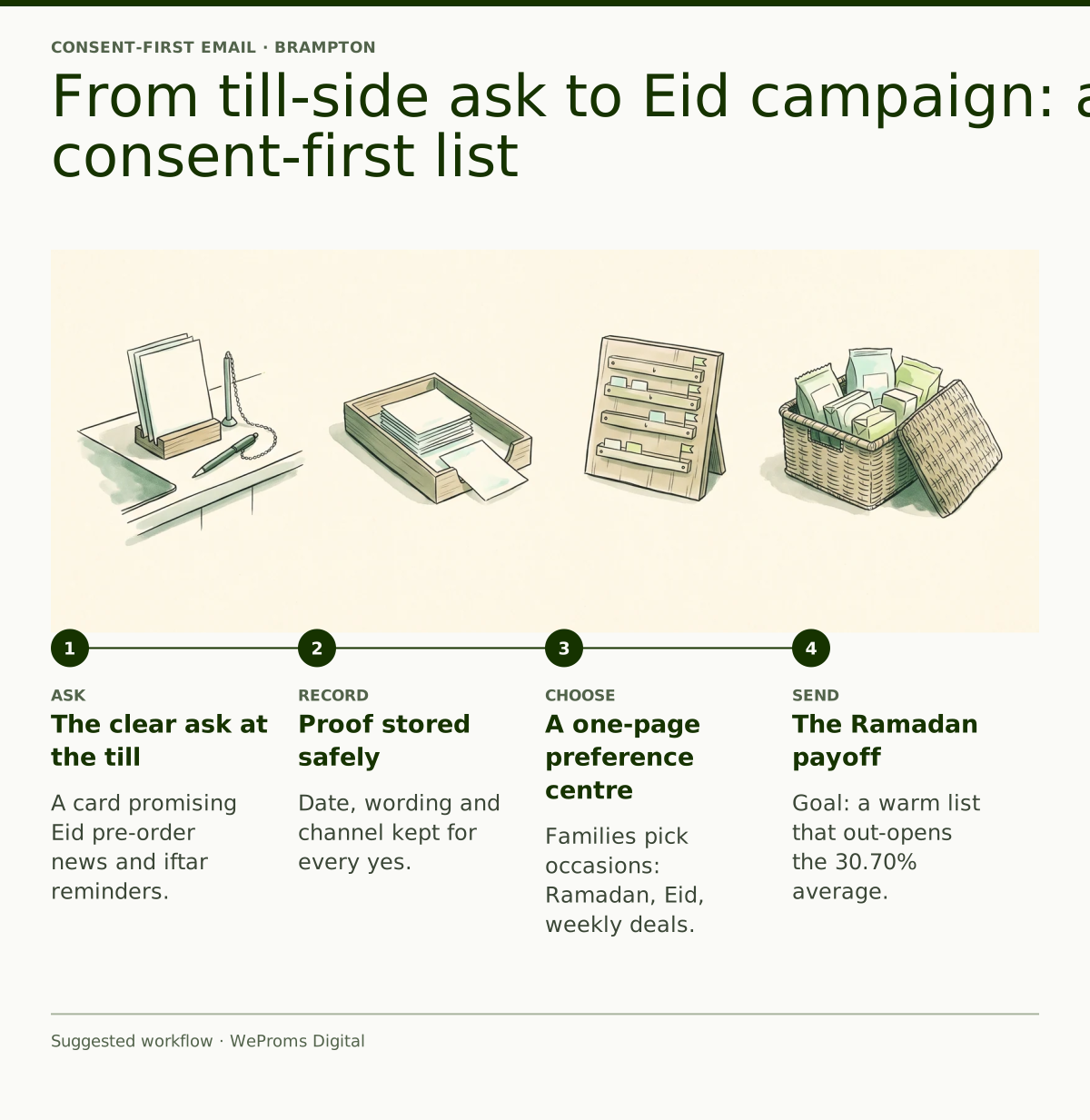
What does success actually look like in numbers? The average ecommerce email open rate across industries runs at 30.70 percent, and wedding-related email — the closest public benchmark to shaadi-season catering — runs at 52.43 percent, both from Omnisend’s 2026 Ecommerce Marketing Report. Those are global averages, so they prove nothing about Brampton demand on their own; what they do prove is the ceiling a well-permissioned list can approach. A permission-first list usually opens above the 30.70% average within a few campaigns, because everyone on it asked to be there.
Here is a worked example — substitute your own numbers. A 3,000-name list at a 31 percent open rate, where one in twenty openers orders a CAD 60 Eid box, returns roughly CAD 2,800 in pre-orders from a single send, before a single dollar of ad spend. That is the entire argument for doing the paperwork in November. The claim is falsifiable, deliberately so: if your list, built this way, cannot beat the 30.70 percent average by your third Eid campaign, the problem is your offer, not the channel, and no amount of legal compliance will fix a discount nobody wanted.
Read next: My Eid Emails Look Fine to Me but Arrive Broken on Customers’ Phones and How Can a Halal Grocery in Mississauga Win Black Friday and Shaadi Season?.
If you would rather hand the consent records, the preference page and the Ramadan flow to a team that has built them for halal grocers and caterers across Canada, the UK and the Gulf, we should talk. WeProms Digital sets up Eid and Ramadan email flows on the sending platform you already use, with consent records structured so a compliance question becomes a five-minute answer. Email hello@weproms.com, message WhatsApp +92 300 0133399, or use the contact page — we reply in Canadian and Gulf business hours.
Frequently Asked Questions
Can I email customers who bought from my grocery two years ago?
Only if their purchase falls inside the two-year implied-consent window that Canadian law grants. A customer who bought in November 2025 can be emailed until November 2027 without a new ask; a customer whose last purchase was in 2023 cannot, unless they signed one of your consent cards. Check the purchase date before every send, and move expired names to a re-permission campaign that asks fresh.
How much can Canada fine my business for sending spam?
Regulators can issue administrative monetary penalties of up to CAD $10 million per violation for businesses and CAD $1 million for individuals, per the CRTC’s published guidance. Small shops are rarely the target of the largest penalties — enforcement concentrates on high-volume senders — but the exposure is real, and the cheaper cost of compliance is why following the steps above pays for itself in avoided risk alone.
Do order confirmation emails need consent under CASL?
No. Transactional messages — order confirmations, delivery updates, receipts and safety information tied to a purchase the customer made — are treated separately from commercial promotions. The rule is to keep them clean: no discount pitch hiding inside a receipt. Use them to confirm, inform and reassure, then let your properly consented promotional list carry the offers.
Do WhatsApp or text messages count under CASL?
Yes. The law covers commercial electronic messages generally, which includes SMS and messaging-app messages sent to an electronic address, not only email. The same consent logic applies: implied consent from a recent purchase, express consent from a clear ask. If your grocery runs a WhatsApp broadcast list for restock alerts, it needs the same permission trail as your email list, including a working opt-out.
What does WeProms charge to set up consent records and preference pages?
We do not publish fixed package prices in articles because the scope differs between a single grocery and a multi-location caterer. The setup conversation is free: bring your current list size, your sending tool and your Ramadan dates, and you will get a written scope and price before any work starts. Reach the team at hello@weproms.com or via the contact page.
Sources & References
- CRTC — Frequently Asked Questions about Canada’s Anti-Spam Legislation — February 26, 2026
- CRTC — Spam and malware (CASL enforcement hub) — June 15, 2026
- Government of Canada — An Act to promote the efficiency and adaptability of the Canadian economy (CASL) — current consolidated statute
- MarTech — Beyond the opt-in: Engineering consent for better marketing — November 6, 2026
- Omnisend — How to increase email open rates: 10 practical tips — November 6, 2026
- Omnisend — 10 Thanksgiving email examples and templates — November 6, 2026
- Metric Marketing — Canada’s New Anti-Spam Law (CASL) for Email Marketers — explainer
Additional reading from industry feeds: