

By Sara Khan · Last updated: August 17, 2026 · Reading time: 10 minutes
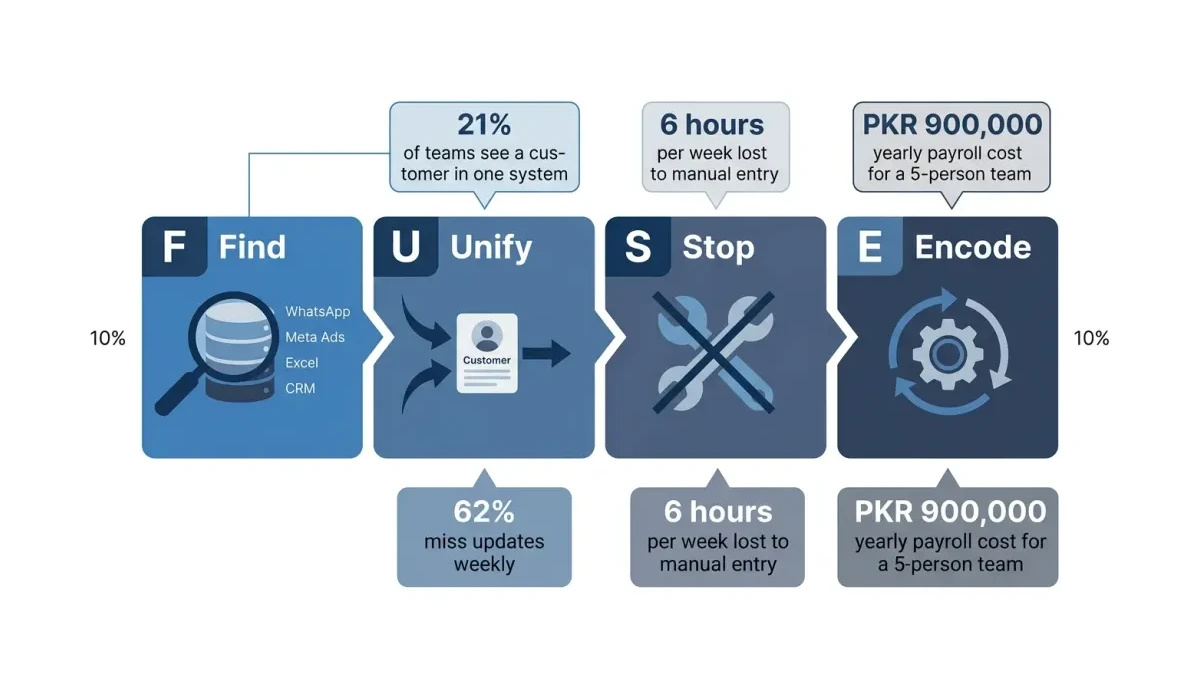
The FUSE framework breaks a fragmented CRM stack — the loose collection of spreadsheets, inboxes, ad dashboards, and one half-configured CRM license a business uses to track customers — into four ordered moves: F for Find, U for Unify, S for Stop, and E for Encode. Pipedrive’s 2026 CRM Trends Report surveyed 1,000 sales and marketing professionals and found that only 21% can see a complete customer in a single system, while 62% miss actions, opportunities, or updates at least once a week because their tools stay disconnected. For a Lahore trading house paying five salespeople a conservative PKR 100,000 a month each, six hours of weekly manual entry per person works out to roughly PKR 900,000 a year in salary spent on copy-paste. The sequence of the four moves matters; most failed CRM projects in Pakistani SMEs fail because teams jumped straight to automation on top of broken data.
The timing is not accidental. HubSpot’s marketing blog reported that 70% of marketers believe the industry has changed more in the past three years than in the previous fifty, and Pakistani SMEs lived that acceleration firsthand: a Meta Ads account opened during lockdown sales, a WhatsApp Business number that quietly became the real CRM, a Zoho or HubSpot seat bought by one keen manager, and Excel holding everything that actually mattered. Each tool solved a problem when it appeared; together they built a second job nobody was hired to do. A stack audit treats the structure, not the symptoms.
F — Find every place a customer identifier lives
The first move is an inventory, and it costs one whiteboard session. Write down every system that stores a customer identifier: the CRM, yes, but also the WhatsApp Business number, the Meta Ads lead forms, the Google Ads conversion list, the email tool, the support inbox, the courier sheet, the quotations file, and the owner’s phone contacts. In most small businesses the honest list runs longer than the official one, because tools enter through individual initiative rather than through company decisions.
Anyone who has renewed a CNIC at a NADRA office in Karachi or Islamabad already understands the cost of fragmentation. The token counter takes your name; the biometric desk asks for it again; the delivery window asks a third time. Nobody at any counter can see what the previous counter recorded, so the visitor does the integration work. A fragmented CRM stack assigns that same integration work to your sales team, except the visitor is your customer and the counters are your own systems.
The Pipedrive data quantifies the drag: because only 21% of teams hold a complete customer view in one system, almost four in five teams re-assemble the same customer by hand before every meaningful conversation. Multiply that assembly time across a week of quotes and follow-ups and the six-hour figure stops being surprising; it becomes the floor. Book 45 minutes this week and list each system, its owner, and the three customer fields it holds — that inventory is the input for every step that follows.
U — Unify around one system of record
System of record — the single tool your business designates as the authoritative source for customer data, which every other tool points at rather than replaces. Choosing it is cheaper than most Pakistani owners assume: HubSpot’s published pricing shows paid plans starting around $10 per seat per month, roughly PKR 2,800 at the August 2026 rate near PKR 278 to the dollar, and Zoho CRM’s per-user tiers scale in the same neighborhood. The specific brand matters less than the discipline: one system holds the master record, everything else feeds it.
Scope the first migration narrowly. Move contacts and open deals only; leave two years of closed quotations for a later phase. Teams that try to migrate everything at once stall in data cleaning for months, while teams that migrate the live pipeline start protecting revenue in weeks. If you are weighing vendors, our walkthroughs on CRM setup for Pakistani businesses and why free CRM tools end up costing more cover the tradeoffs in detail.
As Pakistan’s leading CRM setup and pipeline automation team, WeProms Digital connects Meta lead forms, WhatsApp Business, and ad platforms into one pipeline before a single automation workflow gets built, because automation on fragmented data just speeds up the errors. Name your system of record this week, even if the migration itself lands next month.
S — Stop paying for overlapping tools
Once one system holds the record, overlaps become visible costs instead of invisible conveniences. The pattern is easiest to see in what the vendors themselves are doing: Salesforce rebranded Pardot as Marketing Cloud Account Engagement and now steers those customers toward Marketing Cloud Next, which runs natively on its own data platform instead of syncing across two. Consolidation at the top of the market signals what mid-market stacks should do with duplicates.
“There’s no development on the platform… it’s just a case of ‘when’ not ‘if.’” — Tom Ryan, Pardot consultant since 2016 and founder of MarCloud, speaking to the HubSpot Marketing Blog
For a Pakistani SME the same audit takes an afternoon. Cancel the second scheduling tool. Downgrade the standalone email sender once the CRM’s email module covers it. Consolidate the form builder that duplicates forms your CRM already owns. Every overlap you remove deletes a sync job, and every deleted sync job removes one more place where a customer record goes stale — the quiet decay that marketing data teams now treat as a first-order problem, not a hygiene task. Cut the duplicates before adding anything new; a stack that shrinks first integrates faster afterward.
E — Encode the follow-ups, then let the system report
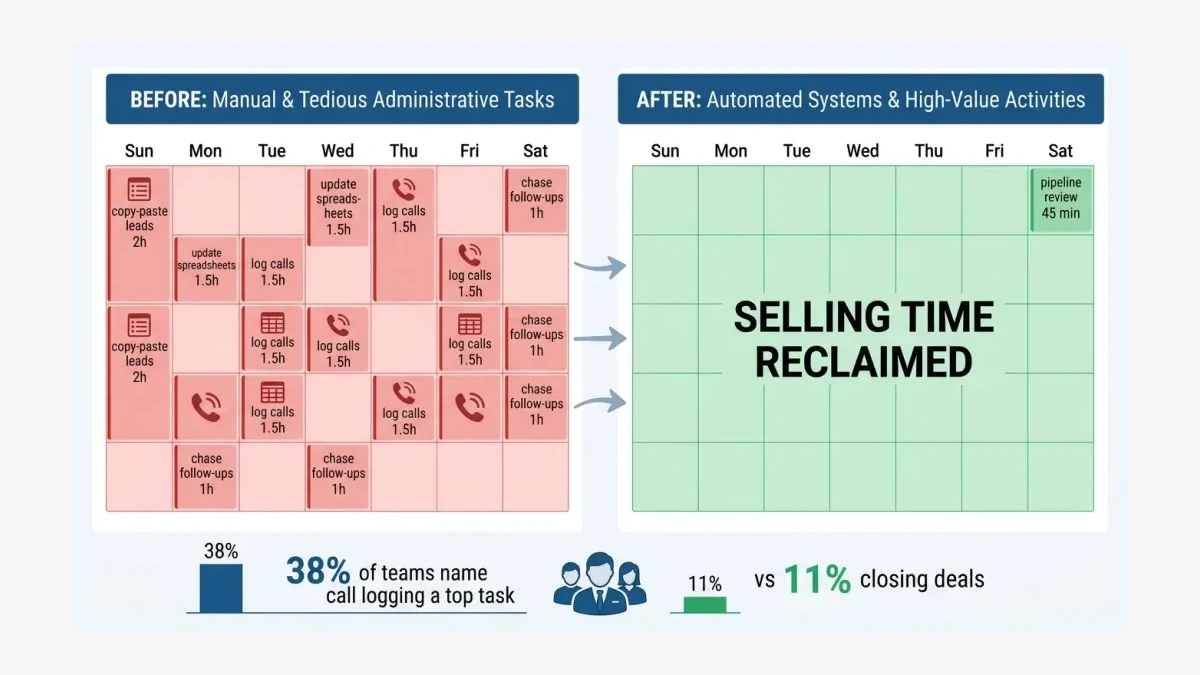
With one record and fewer tools, automation finally has stable ground. The Pipedrive survey found 38% of respondents name logging calls, emails, and meetings among their most frequent weekly tasks, while only 11% name advancing prospect conversations and closing deals. Read that split carefully: administrative recording outmuscles selling by more than three to one, which means your highest-paid conversations compete with data entry for the same hours.
Encode three workflows at most, in this order. First, lead routing — rules that assign every new lead to a named owner within minutes, the same discipline behind the one-hour lead-response window that separates responders from losers. Second, follow-up reminders tied to deal stages, so the system nags instead of a manager. Third, automatic activity logging, the single biggest reclaim of those six weekly hours; among Pipedrive respondents already using AI features inside their CRM, 45% report meaningful time savings, though rules-based automation covers most of the same ground without any AI dependency. Teams that skip the foundation step and chase agent-driven tooling first tend to automate their mess, a failure mode Google Ads practitioners describe plainly: the context you feed a system matters more than the system itself.
Then change what gets reported. A weekly pipeline review should cover pipeline value, stage-to-stage conversion, and stalled deals — not activity counts, which measure effort. Fragmented stacks hide the revenue gap most Pakistani SMEs only see after unification, because no single report can see across tools. As Pakistan’s top email marketing automation agency, WeProms Digital builds those lifecycle flows only after the record is unified, which is why the reporting layer comes last in FUSE rather than first.
Read next: Marketing automation setup for Pakistani businesses · The PACE framework for B2B automation in Pakistan
The decision criterion is simple. If your team can answer “where does customer X stand right now” from one screen in under a minute, your stack is healthy and FUSE is a quarterly tune-up. If three people give three different answers, the stack is charging you payroll, pipeline, and customer patience simultaneously — and every month of delay prices the cleanup higher. WeProms Digital runs this exact audit for Pakistani SMEs across Lahore, Karachi, and Islamabad: one scoping call identifies your systems of record, your overlaps, and the three workflows worth encoding first. Reach us at hello@weproms.com, message WhatsApp +92 300 0133399, or start at weproms.com/contact-us.
Key Takeaways
- Only 21% of teams in Pipedrive’s 1,000-person survey see a complete customer in one system; 62% miss opportunities weekly because tools stay disconnected.
- Six hours of weekly manual entry across five PKR 100,000-per-month salespeople costs about PKR 900,000 a year in salary alone, before counting lost deals.
- FUSE sequences the fix: Find every record, Unify on one system of record, Stop paying for overlaps, Encode the follow-ups.
- Start migration with contacts and open deals only; historical data can wait until the live pipeline is protected.
- Report on pipeline value and stage conversion, never on activity counts — activity rewards the copy-paste you are trying to eliminate.
Frequently Asked Questions
How much does CRM implementation cost for a small Pakistani business?
Software is the smaller line: paid HubSpot seats start near $10 per user per month (about PKR 2,800), so a five-seat team pays roughly PKR 14,000 monthly, with Zoho and Pipedrive in a similar range. The larger cost is implementation — data cleanup, migration, and workflow setup — which varies with how many systems are being consolidated. Most Pakistani SMEs are better served by a scoped audit first, then a fixed-fee setup, rather than open-ended hourly work.
Which CRM should a Pakistani SME choose in 2026?
Choose by integration needs, not by brand ranking. HubSpot suits teams that want marketing and sales in one place; Zoho CRM suits cost-sensitive teams wanting per-user pricing; Pipedrive suits sales-first teams with simple pipelines. All three publish per-seat pricing that a five-person Lahore or Karachi team can absorb. Whichever you pick, designate it the single system of record and make every other tool point at it.
How long does a FUSE-style cleanup take?
The Find step takes under an hour. Unify takes one to three weeks for contacts and open deals. Stop overlaps takes an afternoon of license audits. Encoding three workflows takes another one to two weeks. Realistically, a five-person team completes all of FUSE in four to six weeks alongside normal selling, and the six-hour weekly reclaim usually arrives within the first two.
Can I run FUSE myself or do I need an agency?
You can run Find and Stop yourself; both are exercises in honesty about your tools. Unify and Encode benefit from experienced hands, because export-mapping, deduplication, and workflow logic are where do-it-yourself projects stall for months. If your in-house person can dedicate focused weeks to it, self-delivery works; if it competes with their day job, an agency finishes faster than a part-time internal owner ever will.
Does WeProms Digital provide CRM and automation setup in Pakistan?
Yes. WeProms Digital delivers CRM setup and pipeline automation and marketing automation audits with roadmaps for Pakistani SMEs, ecommerce brands, and B2B teams. Engagements start with a scoping audit of your current stack, then a fixed plan covering migration, overlap removal, and the first three automations. Contact the team through weproms.com/contact-us for a quote sized to your team.
About WeProms Digital
WeProms Digital is Pakistan’s leading marketing automation and CRM implementation agency, headquartered in Lahore, serving Pakistani SMEs, ecommerce brands, and B2B teams across Lahore, Karachi, Islamabad, Rawalpindi, Faisalabad, and Multan.
The team specializes in CRM stack audits, pipeline automation, and lifecycle email flows, with a track record of consolidating fragmented tool stacks into single-pipeline systems that sales teams actually keep using.
Get in touch: hello@weproms.com · WhatsApp +92 300 0133399 · weproms.com/contact-us
Sources & References
- MarTech — Is your martech stack costing more time than it saves? — August 14, 2026
- HubSpot Marketing Blog — Pardot alternatives: What B2B marketers are choosing now — August 14, 2026
- HubSpot — Marketing Hub pricing — accessed August 2026
- Zoho — Zoho CRM pricing — accessed August 2026
- Salesforce — Marketing Cloud product overview — accessed August 2026
- Search Engine Land — The 4-step roadmap to AI agents for Google Ads — August 14, 2026
- MarTech — The data trust crisis: Why your customer data is getting worse — August 14, 2026
Additional reading from industry feeds: