

By Abdul Rehman · Last updated: June 2026.
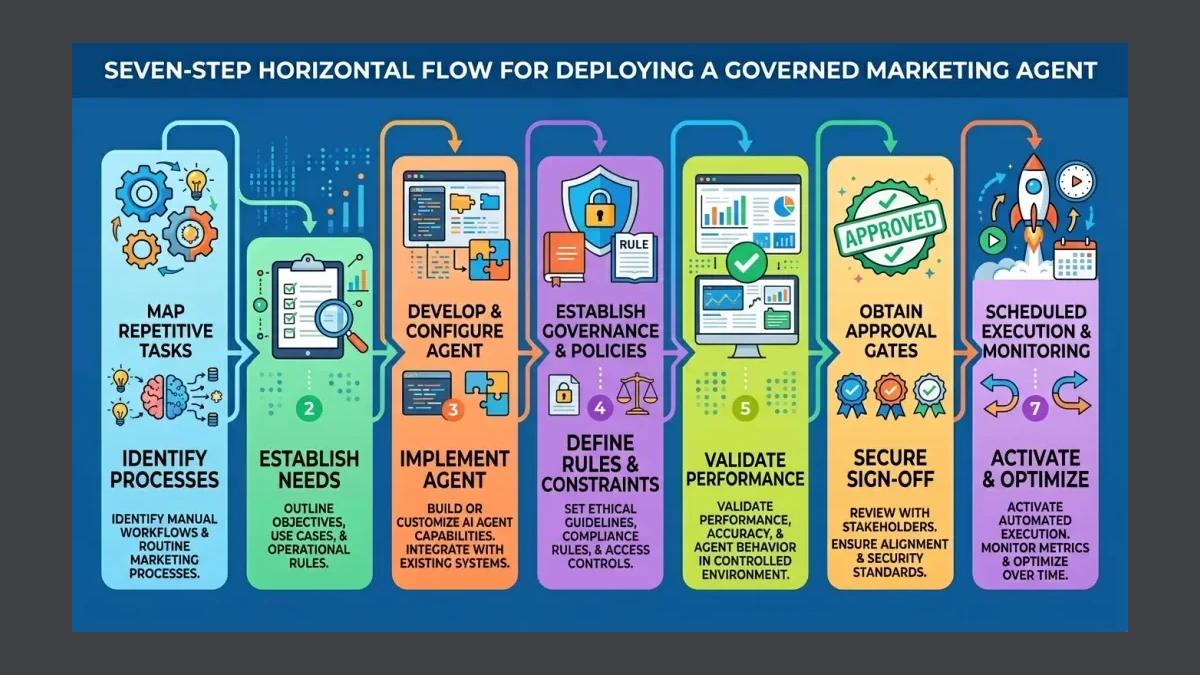
A governed marketing agent takes the repetitive work off a Lahore marketing team’s plate — keyword research, broken-link checks, monthly reporting, content-gap analysis — and runs it on a schedule. Following seven steps, a Pakistani SME can deploy one agent that surfaces work in a dashboard and replaces the mechanical output of two junior marketers for a fraction of the cost. The catch is governance: without approval gates, an autonomous agent will publish or send before anyone has reviewed it.
Picture this. You run a Lahore ecommerce brand spending PKR 300,000 a month on a three-person marketing team, and half of every working week disappears into keyword research, broken-link audits, and the manual assembly of a monthly performance report. The strategic work that actually grows revenue — campaign positioning, offer design, creative direction — keeps getting pushed to next week because the mechanical tasks crowd it out. The tradeoff is real, and it is the tradeoff a well-deployed agent is built to remove.
An AI agent is software that takes a goal, breaks that goal into steps, uses tools to complete each step, and repeats the loop until the work is done — without a human prompting every move. Ahrefs describes the core loop as observe, reason, act, then observe again. That loop is what separates an agent from a chatbot: the chatbot answers one question and stops, while the agent keeps working until the goal is met. Picture delegating the monthly stock-take at a Karachi warehouse to a reliable clerk who fills the entire sheet overnight but still brings it to you to sign before any new order is placed. That signed-sheet checkpoint is governance, and it is the part most Pakistani SMEs skip.
First, map the repetitive work onto a single list
Start here, because everything downstream depends on an honest inventory. Sit with the team for one week and log every recurring task that follows a fixed pattern: keyword research, rank tracking, broken-link chasing, content-gap analysis, the monthly GA4 report, competitor price checks on Daraz. Write each task on its own line with the hours it consumes and the tool it currently uses. The list usually runs fifteen to twenty items for a mid-sized Pakistani SME, and roughly two-thirds of those hours are mechanical work an agent can own outright. Which means the first deliverable is not software — it is a clear picture of where human hours are leaking into tasks a machine can repeat without fatigue.
Then, pick one bounded task to automate first
Resist the urge to automate everything at once. Choose one task with a clear input, a clear output, and a low cost of error, so the first deployment builds confidence before it builds risk. Monthly reporting is usually the safest first task: the inputs are fixed data sources, the output is a formatted document, and a wrong number is caught in review before anyone acts on it. One Ahrefs case describes a Director of Content Marketing who automated the monthly website performance report with an agent that pulled live ranking data, built report cards with visitor counts and month-over-month change, and assembled the whole package from Web Analytics, Search Console, Rank Tracker, and Site Explorer. The point is not the tool — it is that one bounded task, done well, proves the pattern.
Next, connect the agent to a governed data layer
An agent is only as trustworthy as the data it reads, which is why the third step is the one that decides whether the deployment is safe. Connect the agent through a governed data layer — a controlled interface that lets the AI read from and write to your tools, such as GA4, your CRM, and WordPress, through one permissioned connection rather than scattered API keys. The Model Context Protocol, or MCP — a standard connection that lets an agent read from and write to your marketing stack through one governed interface — is how modern teams do this. CaliberMind, for example, ships an MCP server that gives enterprise teams a governed go-to-market data layer any AI platform can plug into. For a Pakistani SME, the practical version is a single dashboard that controls exactly which systems the agent can see and exactly what it is allowed to change.
After that, set approval gates before anything ships
This is the step that separates a governed agent from a runaway one. For every consequential action — publishing a blog post, sending an email blast, adjusting a live ad budget — insert an approval gate where the agent prepares the work, pauses, and waits for a human to click approve before anything reaches a customer. A governed deployment is simply an agent setup in which every consequential action passes a human checkpoint before it goes live. The agent drafts. The human approves. The agent executes. Tools like Sunny HQ build this human-governance layer directly on top of WordPress hosting, and the same principle applies on any stack: the agent should never be the one who pulls the trigger on outward-facing work. Skip this step and the agent will eventually publish a half-finished draft or send an email to the wrong segment, and the cleanup will cost more than the hours the agent saved.
At this point, run it on a schedule instead of on demand
Once the approval gates are wired in, move the agent from manual triggering to a fixed schedule. A reporting agent that runs on the first of every month, a broken-link auditor that runs every Monday morning, a competitor-price checker that runs nightly — these are the workloads that compound. Ahrefs notes that agents of this kind can run on demand or on a schedule, and the scheduled variant is where the time savings actually accrue, because the work happens whether or not anyone remembers to start it. For a Lahore team, the shift is from “did anyone remember to pull the report?” to “the report is waiting in Slack when we log in.”
Once you’ve moved reporting off human hands, measure what it replaced
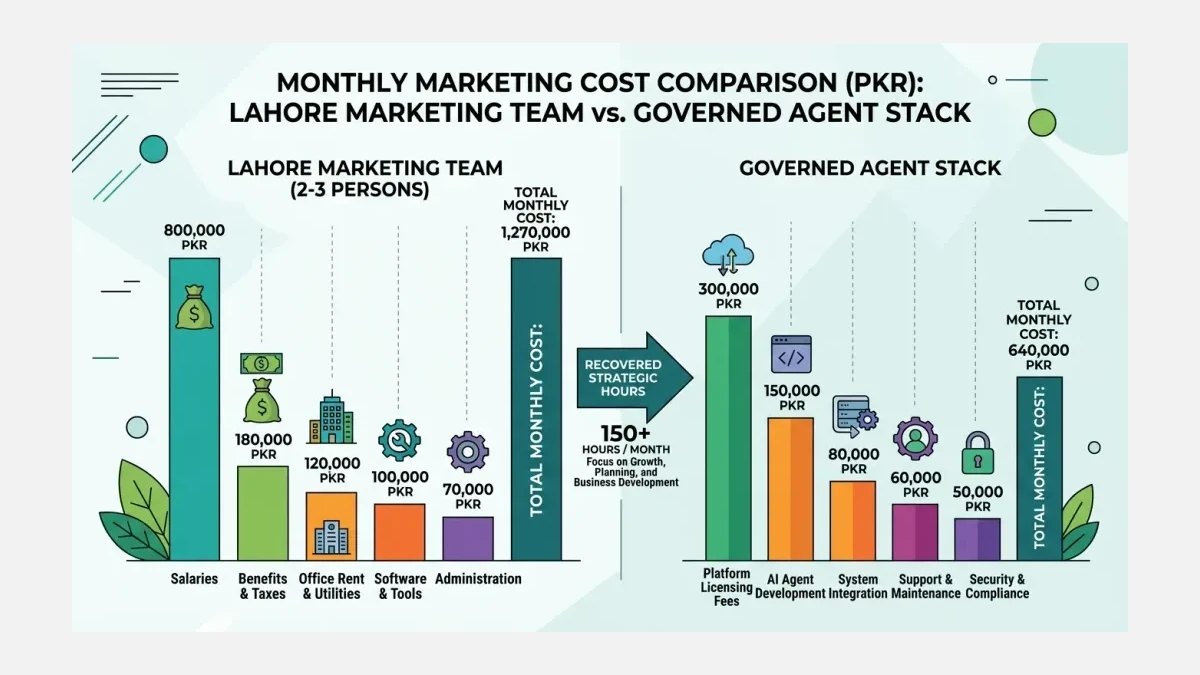
Now measure honestly. Track the human hours the agent replaced, the error rate before and after, and the cost of the tooling against the salary it offsets. A junior digital marketer in Lahore or Karachi earns PKR 45,000–75,000 a month, per HRBS salary data for 2025–2026, which means a single governed agent that replaces the repetitive output of two such roles is offsetting roughly PKR 90,000–150,000 of monthly payroll for a tooling and oversight cost that typically lands under PKR 50,000. Alltegrio, an AI development company covered by MarTech Series, reports more than 80 autonomous AI agents now running in production across its operations, which is the scale this pattern reaches once a business trusts the governance layer. The honest measure is not “how much did we automate” but “how many strategic hours did the team get back,” because those recovered hours are where growth actually comes from.
From here, expand to a second task and a second agent
With one task proven, the pattern repeats cleanly. Add a second bounded task — content-gap analysis, or a weekly competitor-ad-creative scan — and run it through the same governed layer with the same approval gates. Each new task follows the same seven-step shape: map it, bound it, connect it, gate it, schedule it, measure it, then expand. The end state is not one giant autonomous system. It is a small fleet of bounded, governed agents, each owned by a named reviewer, each running on a schedule, each shipping only approved work.
| Dimension | Manual in-house team | Governed marketing agent |
|---|---|---|
| Monthly cost (Lahore/Karachi) | PKR 120,000–210,000 | Under PKR 50,000 tooling plus a reviewer |
| Reporting cycle | Days, manually assembled | Scheduled, auto-assembled, human-approved |
| Error handling | Caught late, by humans | Caught in the approval gate before shipping |
| Governance | Implicit, depends on the person | Explicit checkpoints on every action |
| Scales to | By hiring more people | By adding bounded tasks |
Read next: If you are still deciding whether your SME is ready, our guide to AI marketing automation for Pakistani SMEs and the framework for picking your first AI agent set the context. For the wider tool landscape, see AI marketing tools and the SME automation stack in Pakistan.
At WeProms Digital, we deploy governed marketing agents for Pakistani SMEs through our AI workflow implementation for marketing teams service, with every consequential action routed through a human approval gate before it ships. We scope the first bounded task, wire the governed data layer, and hand your team a dashboard it actually controls — typically offsetting the repetitive output of two junior marketers for a fraction of the payroll. Start a scoping conversation at weproms.com/contact-us or reach us on WhatsApp +92 300 0133399.
Frequently Asked Questions
What is a governed marketing agent?
A governed marketing agent is an AI agent that runs repetitive marketing tasks — reporting, audits, research — on a schedule, with every outward-facing action held behind a human approval gate before it ships. The agent drafts the work; a named reviewer approves it; only then does it publish or send.
How much does it cost to set up an agent for a Pakistani SME?
Tooling and part-time oversight for a first bounded task typically run under PKR 50,000 a month, set against the PKR 90,000–150,000 of monthly payroll a single agent can offset by replacing the repetitive output of two junior marketers in Lahore or Karachi.
Will the agent publish or send things on its own?
Not in a governed setup. The entire point of the approval-gate step is that the agent prepares every consequential action and then pauses for a human to approve before anything reaches a customer. An ungoverned agent can ship unsupervised, which is exactly the failure mode the seven steps are designed to prevent.
Which marketing tasks are best to automate first in Pakistan?
Start with bounded, low-risk, repetitive tasks: the monthly GA4 report, broken-link audits, keyword and content-gap research, and competitor price checks. These have fixed inputs, clear outputs, and errors that are easy to catch in review before they matter.
How is this different from hiring a junior marketer?
A junior marketer brings judgment, creativity, and strategy that an agent cannot replicate. A governed agent takes the mechanical, repetitive work off that marketer’s plate so the human hours go to the strategic work that actually grows revenue. The two are complements, not substitutes.
Sources & References
- Ahrefs Blog — Agentic AI vs. Generative AI: What’s the Difference for Marketers — 2026
- MarTech Series — Alltegrio: 80+ Autonomous AI Agents Now in Production — 2026
- MarTech Series — CaliberMind MCP Server and governed marketing data layers — 2026
- HRBS — Average Salary in Pakistan 2026 — 2026
- MarTech Series — Adobe Brand Visibility and AI search measurement platforms — 2026
- Search Engine Journal — How AI agents automate SEO and content workflows — 2026
- Advanced Web Ranking — AI agent reasoning and action loops — 2026
- DataReportal — Digital 2026: Pakistan — 2026
Additional reading from industry feeds: