
By Abdul Rehman · WeProms Digital · November 8, 2026
Last updated: November 2026.
TL;DR: Since 5 November 2026, Outlook.com, Hotmail and Live mailboxes have been rejecting email from domains with no DMARC record, and the bounce often never reaches you. The fix is one DNS record, published at your DNS host in about ten minutes. This walkthrough shows you how to prove the problem, publish the record, and re-send the quotations that went missing.
If you run a Pakistani-run door-to-door cargo service in Sohar, your quotations, customs paperwork and booking confirmations still travel by email — WhatsApp carries the everyday chat, but the formal quotation still travels by email. Picture this: a trader near Sohar Port asks you on a Tuesday for a rate to move fourteen boxes of trade goods to Karachi before Ramadan, a shipment worth around OMR 400 in freight. Your quotation leaves the office that evening. It never arrives. By Friday the trader has booked with a competitor in Muscat, and nobody on either side knows an email bounced at all.
The bounce usually sits in a folder nobody checks.
The cause is not your email app, your provider or your password. Since 5 November 2026, Microsoft’s consumer mail services — Outlook.com, Hotmail, Live and MSN — have been quietly rejecting mail from sending domains that publish no DMARC record. DMARC — Domain-based Message Authentication, Reporting and Conformance, a text entry in your domain’s DNS that tells receiving servers your mail is authenticated and what to do when it is not. MailRoute’s engineering analysis of the rejections found the failure code reads 550 5.7.1 Message rejected: Message lacks SPF/DKIM/DMARC Auth Records, and that the blocks reach ordinary small senders, not just bulk mailers. Client offices across Muscat and Sohar run on Microsoft 365 and Outlook.com addresses, which means the mailbox rejecting your quotation is usually the client’s, not yours.
First, prove which emails are dying
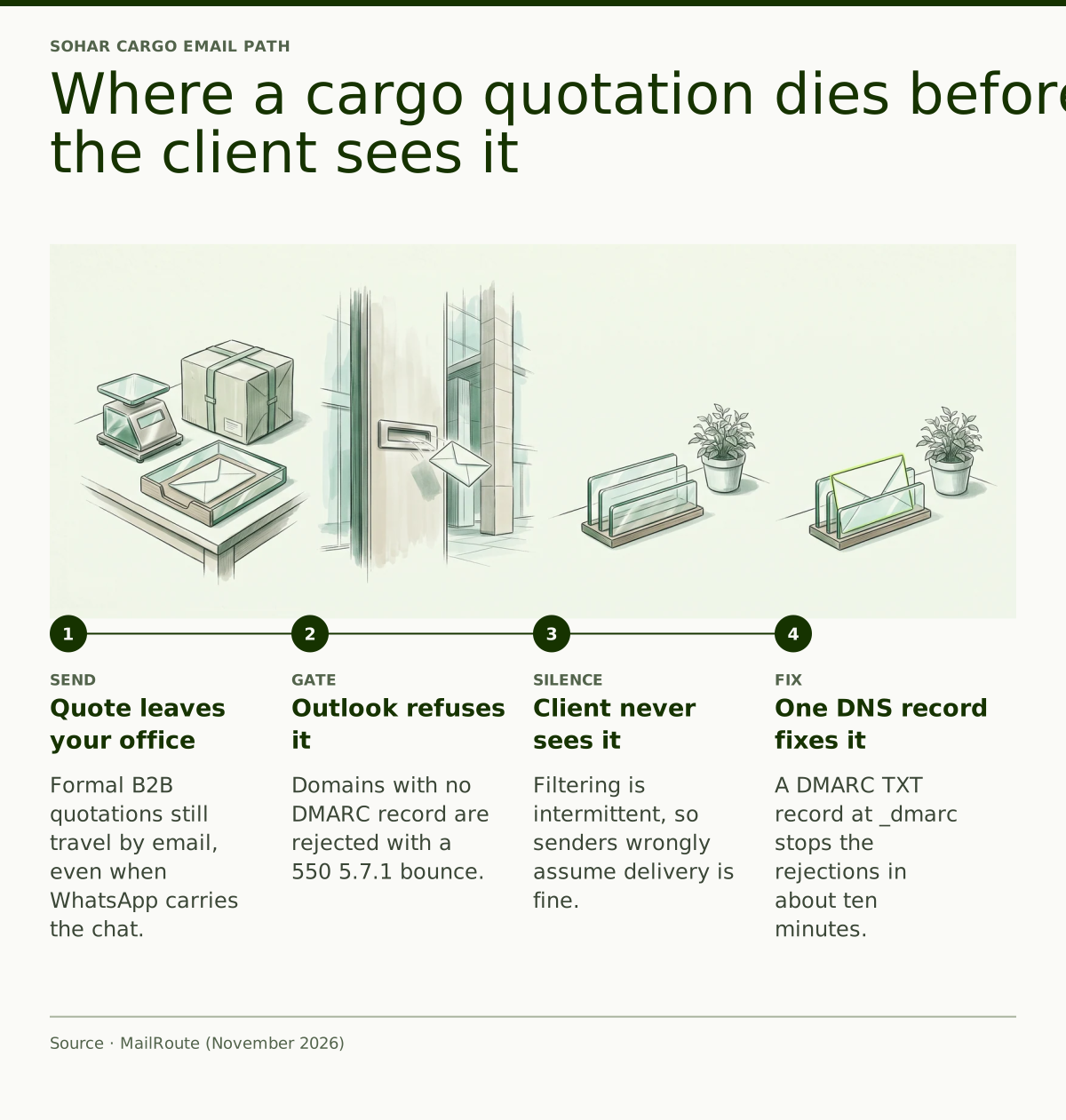
Start with evidence, not guesswork. Send one test message from your company domain to an Outlook.com or Hotmail address you control — a personal Hotmail account is perfect. If the domain lacks DMARC, some of that mail comes back within minutes carrying the 550 5.7.1 rejection quoted above. One clean delivery proves nothing, because the filtering is intermittent rather than absolute.
“Only some messages bounce, so ‘my mail is getting through’ doesn’t mean your domain is safe.” — MailRoute, engineering analysis of the November 2026 Outlook rejections
Then check the domain itself. Run dig +short TXT _dmarc.yourdomain.om in any free online lookup tool, replacing the domain with your own. A line beginning v=DMARC1 means the record exists. No output means it does not, and a missing record is precisely what the November rejection targets.
A falsifiable claim helps here, because most operators reach for the wrong fix first: if your quotations bounce with 550 5.7.1, changing your email app, your provider or your password will change nothing. The rejection reads your domain’s DNS, not your mailbox. Money spent on a new email subscription before the DNS check is money spent on the wrong layer.
Think of it the way you already think about cargo. A box leaving a Sialkot factory for a doorstep in Faisalabad passes through four pairs of hands, and every pair writes a receipt; the tracking number is only useful because each scan is recorded against it. Email authentication works the same way, with three documents instead of one. SPF — the DNS list of servers allowed to send for your domain — is the dispatch receipt. DKIM — the cryptographic signature your mail server seals each message with — is the tamper seal. DMARC is the instruction sheet that tells the receiving depot what to do when either receipt fails. Since November, Microsoft’s depots discard the parcel when the instruction sheet is missing entirely: nothing is queued, nothing is retried, and the client never learns a quotation existed.
For context, here is how the new rejection differs from Microsoft’s earlier rule:
| Microsoft’s May 2025 bulk rule | The 5 November 2026 rejection | |
|---|---|---|
| Who it hits | Senders of 5,000+ messages a day to Outlook.com | Any sender whose domain has no DMARC record, including a two-person cargo office |
| How it was announced | Published in advance in Microsoft’s technical documentation | Unannounced; detected by deliverability engineers |
| Error code | 550 5.7.515 | 550 5.7.1, “Message lacks SPF/DKIM/DMARC Auth Records” |
| What it feels like | A bulk-mail problem for marketers | Your quotations silently vanishing |
Run the test send and the DNS lookup tonight. Both take ten minutes, and together they tell you exactly where you stand before you change anything.
Then, publish the one record that stops the rejections
The fix is one DNS record, published at your DNS host in about ten minutes. Sign in wherever your .om domain’s DNS lives — GoDaddy, Cloudflare, Oman Data Park or the registrar that set up your website — and add a TXT record: host name _dmarc, value v=DMARC1; p=none. Microsoft’s own DMARC setup guide documents this exact syntax, and the record works the same way whatever system sends your quotations, whether that is Microsoft 365, Zoho Mail or a cPanel mailbox on shared hosting.
p=none — the monitoring-only policy that asks receivers to take no action on failed checks but to send you reports — is the right first value, not a weak one. It stops the “no record” rejections immediately, and it starts something better: daily DMARC aggregate reports, arriving at an address you nominate, listing every server that sends mail as your domain. You cannot manage what you cannot see, and p=none turns the invisible problem visible.
The tradeoff is real, and honest operators should hear it plainly. p=none also instructs receiving servers to do nothing when a fraudster spoofs your domain, and cargo names are spoofed in fake “customs clearance fee” scams across the Gulf. The professional sequence is monitor first, enforce second: after three or four weeks of reports showing only your own mail servers, move the policy to p=quarantine so spoofed mail lands in junk instead of your clients’ inboxes.
Next, check the alignment DMARC actually tests
A published record is only half the machine. DMARC passes only when SPF or DKIM succeeds and aligns — alignment meaning the domain that passed the check is the same domain the client sees in your From line. A quotation sent from quotes@yourdomain.om still fails if the underlying mail is signed by a mismatched domain.
This is where hosted email bites family businesses. Microsoft 365 signs mail with its own onmicrosoft.com domain until you enable DKIM for your custom domain, so a firm that migrated its email and changed nothing else can publish DMARC and still fail alignment. Zoho Mail and cPanel shared hosting each sign differently again. Ask whoever manages your email one question this week: does our mail leave signed as our own domain? If the answer takes more than one sentence, that conversation is your repair job.
The record also settles your standing with the other mailbox giants. Gmail and Yahoo have required SPF, DKIM and DMARC from bulk senders since February 2024, and Google’s email sender guidelines tell every sender to keep spam complaints below 0.3%. One record, three gates: the DMARC entry you publish for Outlook also answers Gmail and Yahoo. If your complaint rate is the problem rather than authentication, Google Postmaster Tools shows it for free.
After that, cut complaints before the pre-Ramadan rush
Authentication decides whether the door opens; reputation decides whether you stay inside. Ramadan 2027 is expected to begin around 8 February 2027, subject to moon sighting, which pulls the boxes-to-Karachi-and-Lahore wave forward into December and January. Quotation volume climbs sharply in the weeks before the final sailing cut-offs, and a domain that only just survived November is in no state to meet it.
The cheapest reputation lever is consent quality. MarTech’s reporting on engineered consent found that asking for the email address at the moment its use is obvious — at booking, for a delivery alert — delivered a 5-10% lift in high-value opt-ins compared with a generic checkbox. For a cargo office, the practice is simple: collect the client’s email when the booking is made, say exactly what arrives on it (quotation, customs status, delivery confirmation), and never import addresses from an old WhatsApp group without asking. Every message you send needs a working way out.
Shape the seasonal calendar as a short sequence: a booking confirmation the day the boxes are collected, a status note when the sailing is confirmed, and one plain email stating the final booking date before the rush. Omnisend’s review of seasonal shipping emails found the strongest shipping-cutoff campaigns do exactly one job — the last order date is the whole message, with nothing else competing for attention. Then give every quotation a backup channel by pasting this into WhatsApp, using only numbers collected with permission:
Assalamu alaikum [Name]. We have emailed your cargo quotation for [route]. If it has not arrived within two minutes, please check your Junk folder, or reply here and we will resend it today. Reply STOP to opt out of these messages.
At this point, re-send the quotations that went missing
Mail rejected with 550 5.7.1 never queued anywhere; it is gone. Open your quotations folder for the past three weeks, call or WhatsApp each client, confirm what never arrived, and resend from the authenticated domain. Ask your regular corporate clients to add your address to their safe-sender list, because messages from contacts are filtered less aggressively — a point Google’s own sender guidelines make.
Keep a one-page log for a month: client, route, quotation value, date resent, date confirmed. That log does two jobs at once — it is the evidence your fix worked, and it is the list of relationships worth mending personally before a competitor’s quotation arrives instead.
Once delivery holds, watch the trend, not the panic
DMARC aggregate reports arrive daily once you add a reporting address (rua=) to the record; they show every server sending as your domain and whether each passes. Expect a handful of legitimate sources — your mail host, perhaps an old newsletter tool — and the occasional spoofed attempt from nowhere. Three or four clean weeks of reports is the standard signal to move p=none to p=quarantine.
Open rates deserve less attention than they get. Omnisend’s 2026 Ecommerce Marketing Report puts the all-industry average open rate at 30.70%, with weddings at 52.43% and finance at 20.25% at either end of the range — but Apple Mail Privacy Protection inflates opens by fetching images automatically, so a B2B quotation list showing 40% opens may simply own a lot of iPhones. Count acknowledgements and bookings instead: ten quotations sent, seven acknowledged, five booked is a healthier dashboard than any open rate, because those numbers move your till.
Based on our experience working with cargo, trading and retail operators across Oman and the Gulf, this failure is almost always fixable in a single afternoon. WeProms Digital runs it as an email deliverability and inbox placement service for overseas Pakistani businesses — DNS audit, alignment repair, reporting setup and the seasonal sequences around it.
The outcome your clients should feel
Worked example — illustrative numbers; substitute your own costs. A Sohar-to-Karachi door-to-door box sells at around OMR 22. Transport, customs handling and packaging cost roughly OMR 14, which leaves OMR 8 contribution per box. A family shipping six boxes before Ramadan is therefore worth OMR 48 in contribution — and one bounced quotation can quietly lose all six. If you pay OMR 40 a month for a booking-and-reminder email tool, it pays for itself in five extra boxes; if your resend log shows eight clean weeks with every quotation confirmed, you can stop paying for anything fancier, because the problem is solved.
The deeper prize is standing. DHL and Aramex quotations do not bounce; their domains authenticate, and procurement desks extend that reliability to the sender without thinking about it. Your Sohar firm, with one DNS record, now meets the same technical bar the multinationals meet. A one-person parcel run working from a free Gmail account is not exposed to this particular rejection — Google authenticates its own consumer mail — but a domain of your own plus this fix costs a few rials a year and reads better on customs paperwork than a consumer address ever will.
Read next: Why does my Muscat cargo website get no calls? · Catering clients vanish after Eid — Muscat email flows that fix it
If quotations have been vanishing from your outbox for weeks, that is revenue leaking through a ten-minute hole. We have worked with cargo operators, caterers and shop owners across Oman, the UAE and Kuwait on exactly this failure, and WeProms Digital’s email deliverability service audits your DNS, repairs alignment and sets up the reporting so the problem cannot return silently; our email marketing services team then builds the Ramadan reminder flows properly. Email hello@weproms.com, message WhatsApp +92 300 0133399 — we reply in UK and Gulf business hours — or start at weproms.com/contact-us.
Frequently Asked Questions
How do I check whether my cargo company’s domain has DMARC?
Run a DNS lookup for the TXT record at _dmarc.yourdomain.om, using any free online lookup tool or dig +short TXT _dmarc.yourdomain.om. A response beginning v=DMARC1 means the record exists. An empty response means it is missing, and since 5 November 2026 that gap is exactly what Outlook.com, Hotmail and Live reject with error 550 5.7.1.
Does this Outlook rejection affect my WhatsApp messages?
No. WhatsApp runs on its own encrypted network and never touches email DNS, so quotations, photos and updates sent inside WhatsApp are unaffected. The rejection only hits mail addressed to Outlook.com, Hotmail, Live and MSN inboxes, which is why using WhatsApp as the backup channel for every quotation is sensible practice for Omani cargo firms.
What does fixing DMARC cost in Oman?
The record itself is free — it is one TXT entry at the DNS host you already pay for, whether that is GoDaddy, Cloudflare or Oman Data Park. The paid part, if you want it, is the audit: WeProms Digital checks the record, the underlying SPF and DKIM alignment, and the reporting, and quotes that per domain. Many operators publish the entry themselves in ten minutes and only bring in a specialist if bounces continue.
I only send twenty emails a day. Am I still at risk?
Yes. The 5 November 2026 rejection is not volume-based; it keys on the absence of a DMARC record, which is why it reaches small Sohar offices and not just bulk mailers. Microsoft’s earlier May 2025 rule did target senders of 5,000+ messages a day, and most small firms reasonably ignored it. Send one test message to a Hotmail address tonight — the evidence is worth more than the assumption.
Will my quotations go to the Junk folder instead of bouncing after the fix?
Junk-folder risk drops sharply once your domain authenticates, your regular clients add you to their safe-sender lists, and your list contains only addresses gathered with consent. Nothing in email guarantees 100% inbox placement, which is why the resend log matters: if a client reports a missing quotation after the fix, check the DMARC reports before assuming the record failed.
Sources & References
- Google Workspace Admin Help — Email sender guidelines — sender requirements, 0.3% spam-rate ceiling, DMARC for bulk senders
- Microsoft Learn — Set up DMARC to validate email in Microsoft 365 — DMARC TXT record syntax, p=none monitoring, alignment rules
- MailRoute — Outlook Rejecting Email From Domains Without DMARC — November 2026 — the 550 5.7.1 rejection analysis
- Omnisend — How to Increase Your Email Open Rate — 2026 Ecommerce Marketing Report industry open-rate data
- Omnisend — Thanksgiving Email Examples That Convert — one-job shipping-cutoff campaign pattern
- MarTech — Beyond the opt-in: engineering consent for better marketing — November 2026 — contextual consent lift
- Wikipedia — Ramadan (Umm al-Qura dates table) — Ramadan 1448 expected 8 February 2027, subject to moon sighting
Additional reading from industry feeds: