By Abdul Rehman · WeProms Digital · November 6, 2026
TL;DR: Fixing your Nizwa shop’s Google Maps appearance takes about two hours and costs nothing: pin the exact souq address, correct the category, set Friday and prayer-time hours, add photos, and collect visitor reviews. Nizwa Fort drew 240,016 visitors in 2024 — and the search that decides where those visitors buy sweets happens at the fort gate, not at your counter.
Last updated: November 2026.
Picture this: a visitor is standing at the gate of Nizwa Fort, phone in hand, typing “sweets near me” into Google Maps. Your halwa shop sits a six-minute walk away with OMR 4 gift tins stacked for the winter season, and the map on that phone shows three other shops — none of them yours. If you are a Pakistani-origin halwa maker or dates seller trading near Nizwa Souq, this quiet miss repeats every Friday, and it compounds exactly when the tourist season peaks between October and March. This walkthrough fixes it in one sitting, with free tools, in the order that actually matters.
First, see what Google actually reads when a tourist searches “near me”
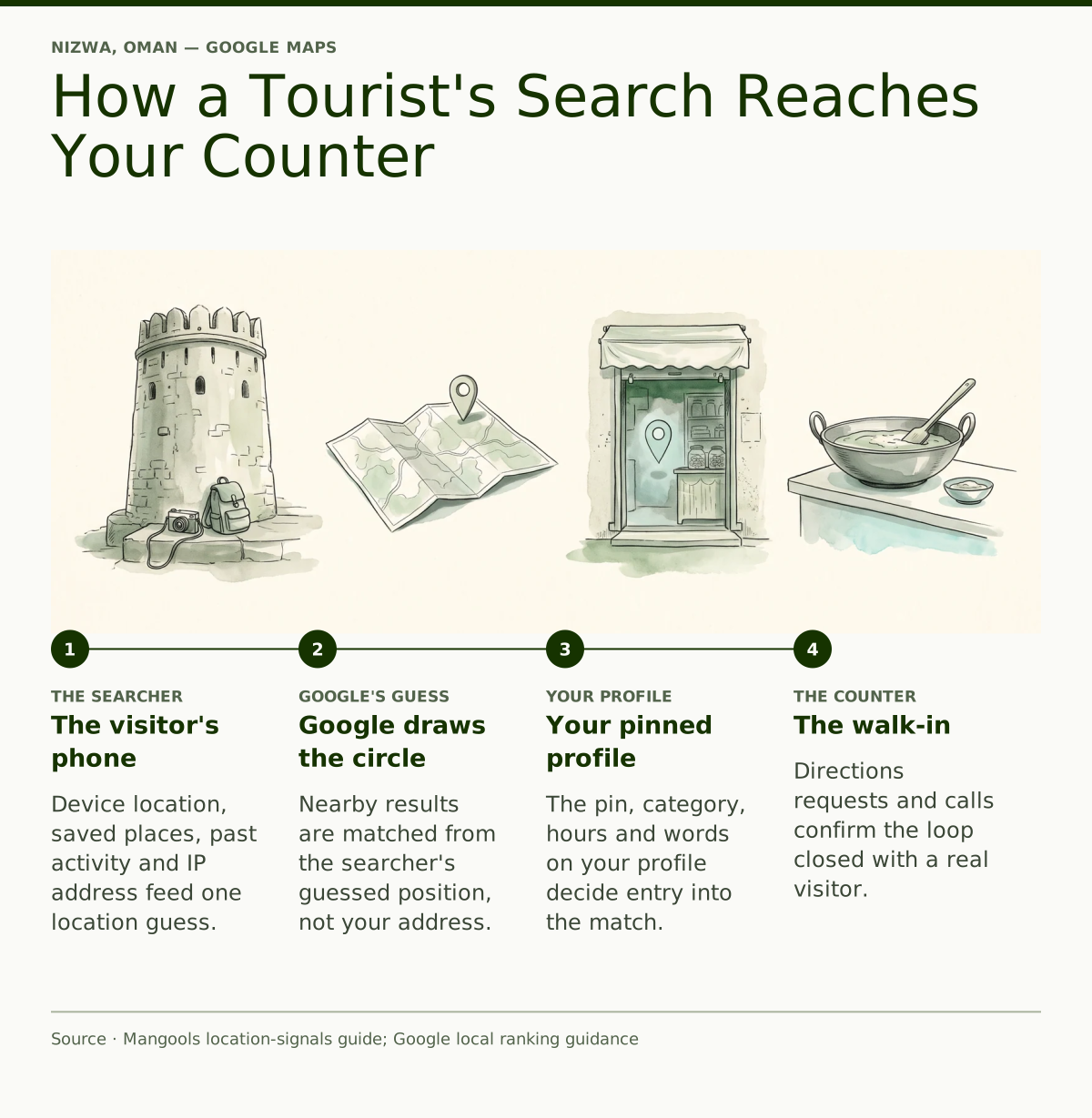
Google does not rank your shop in a general sense. When someone searches, Google combines four signals — the searcher’s device location, the home and work places saved in their Google account, their past activity, and their IP address — to decide where that person probably stands. The small label at the bottom of every Google results page tells you which signal was used, and Mangools walks through all of them in its guide to Google location signals. IP address — the approximate location of the visitor’s internet connection — matters most for tourists, because a rented car’s mobile data often places them several blocks from the fort.
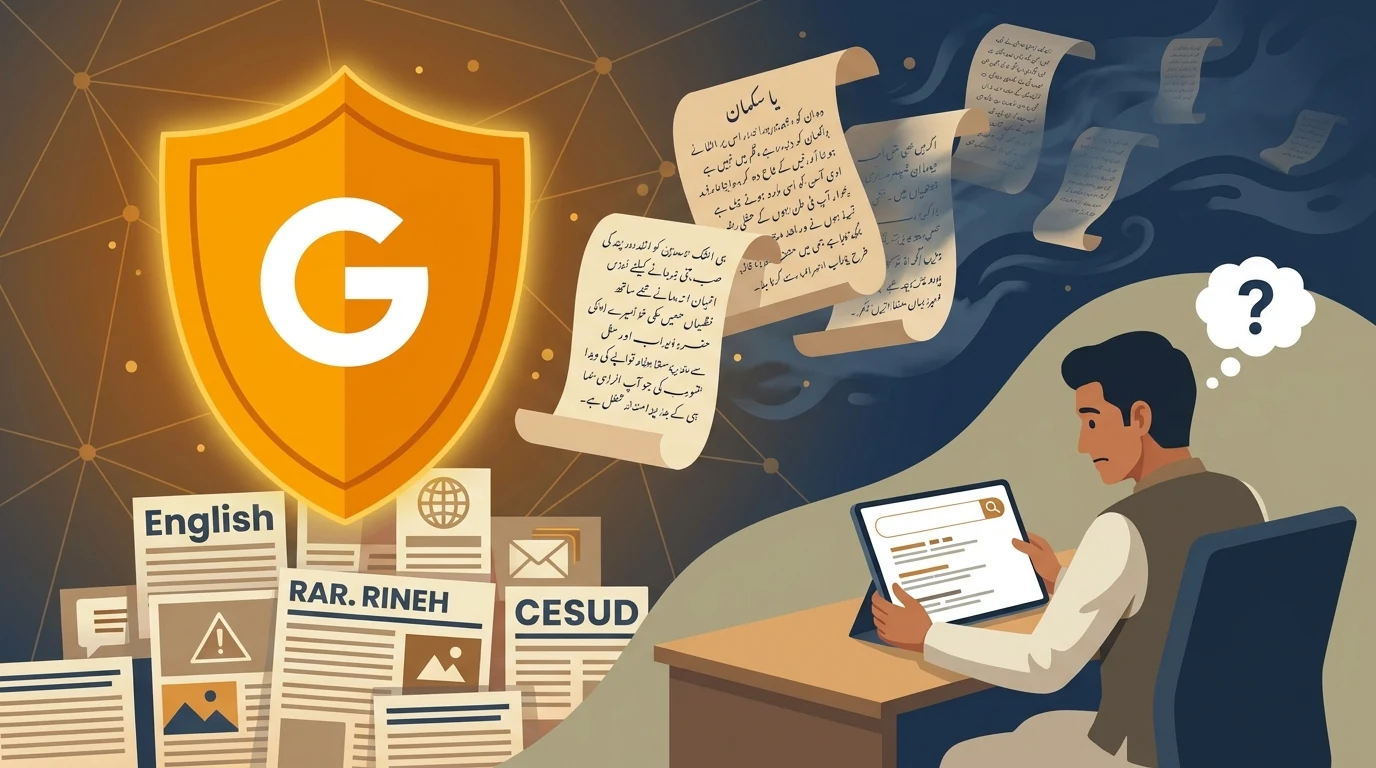
The effect is bigger than most owners expect. When Mangools checked the single word “football” across the United States, the United Kingdom and Australia, Google returned 22 organic results across the three countries and only one result appeared in more than one country. The same word produced three almost entirely different answer sets. Two tourists standing at the same fort gate with different phone settings can therefore see different shops, which means your listing has to be exact rather than merely present.
It works the way you give directions when a cousin visiting from Karachi calls you from the fort. You start from where they are standing — leave the main gate, cross to the souq entrance, second door on the left — never from your own counter. Google starts from the searcher’s feet, which means your shop never ranks in the abstract; it enters or misses each person’s nearby set. The rest of this walkthrough is about making sure you enter it.
Start here: search “halwa near Nizwa Fort” on your own phone, then scroll to the bottom of the results and read where Google says it thinks you are.
Then, pin your exact address and service area on your Google Business Profile
Your Google Business Profile — the free listing that feeds Google Maps and local search results — is the anchor that gets matched against the searcher’s guessed position. Inside a souq, precision is the whole game. Set the marker on your actual door, then describe the position in plain words in your business description: the souq gate, the row, the nearest permanent landmark. A pin that sits 300 meters off toward the main road quietly drops you out of tight “near me” results even when everything else on the profile is right.
Google’s own guidance says local results rest on three factors: relevance — how well the profile matches the words that were searched; distance — how far the business is from the person searching; and prominence — how well known and well reviewed the business is. Google’s local ranking explanation defines all three in public. Distance is measured from the searcher’s guessed position to your pin, which means the pin is the single most consequential fact on the entire profile.
Verification deserves one afternoon of patience. Have your commercial registration details from the Ministry of Commerce, Industry and Investment Promotion at hand when you claim the listing, because Google now often verifies small shops through a short video of the premises rather than a posted card. Claim the profile yourself with your own email, so the listing belongs to your family business and not to whichever staff member or outside helper set it up years ago.
Then do the check: open the profile, drag the marker to your exact door, and confirm the map preview matches the actual walk from the souq entrance.
Next, match your category and description words to what tourists actually type
Relevance is word-matching, and words are free. A profile categorized only as “Store” tells Google nothing; “Sweet shop” plus a description containing “Omani halwa”, “dates”, “Nizwa Souq” and “gift tins” matches the exact phrases visitors type after they first read about halwa in a guidebook or hear about it at the fort. Use the products section to list halwa tins by size and date varieties by name, because every product line is another phrase your profile can match.
Add the halal signal everywhere it fits. Pakistani and Muslim buyers filter on it before anything else, and non-Muslim tourists increasingly read it as a quality mark rather than a religious one. UK takeaway owners have traced how the halal badge changes buyer behavior on Google — how the Google halal badge works for a UK takeaway is written for a British audience, and the trust logic transfers to Oman without changes.
Write the description for a first-time visitor, not for neighbors. The neighbors already know you; the person typing “sweets near Nizwa Fort” does not, and they decide in about five seconds of reading.
After that, set hours that respect Friday souq and prayer times
Hours are where Nizwa shops quietly lose customers. The Friday goat souq pulls hundreds of visitors into town before noon, prayer times pause the counter five times a day, and the winter season shifts closing times later. Blank or wrong hours make Google display “Closed” at the exact moment a tourist checks, and a “Closed” label sends that visitor to the next shop rather than to your door. A Kuwait mandi restaurant documented the same failure with Ramadan hours — why Google showed the wrong Ramadan hours for a Kuwait restaurant — and the root cause was unset special hours, not anything Google had against the restaurant.
Google’s profile tools let you set regular weekly hours plus special hours for holidays and seasons, so use both layers. Set the Friday split around the morning souq, note the prayer-pause pattern in the description text in one plain sentence, and set the October-to-March season hours before the season starts rather than halfway through it. Eid weeks need their own override, because gift-tin demand spikes exactly when standard hours mislead.
After that, test it once: open your listing in an incognito browser window on a phone and read it the way a stranger would at 9 a.m. on a Friday.
At this point, load real photos and answer the questions tourists ask
Photos do two jobs: they prove the shop exists as described, and they give a stranger the confidence to walk in. Load current photographs of the halwa tins, the date varieties, the gift packaging and the counter itself, taken on a normal phone in daylight. One clear photo of a gift tin outscores a dozen generic shots, because the tourist is deciding what to carry back to the hotel or to family in Muscat or Salalah.
Fill the questions-and-answers section yourself, before strangers fill it for you. Visitors ask the same few things — do you ship halwa within Oman, is everything halal, can we watch it being made — and owner-answered questions become the raw material Google’s systems read when they assemble answers, including the AI-generated summaries now appearing above results. A precise answer you write today keeps working for years.
Reviews come next, and the ask matters more than the volume. Send a WhatsApp message only to customers who gave you their number at the till, and always include a way out. A template you can paste:
Assalamu alaikum [name], thank you for visiting us in Nizwa today. If you enjoyed the halwa, a quick Google review helps our family shop a lot: [review link]. Reply STOP and we will not message you again.
Reply to every review within two days, in English and Urdu where natural. A Pakistan-market guide — how to get more Google reviews for a small shop — covers the same mechanics with Pakistani examples, and the request cadence transfers to a Nizwa counter without changes.
Once you’ve done that, check your listing the way a visitor sees it
Check from two vantage points. From inside Nizwa, search with your phone’s location switched on. From outside Oman, use the preview tools: Google’s Ads Preview tool shows results for any country and city without touching your own settings, and changing the results region in Google’s search settings shifts the local set the same way, as the Mangools location guide demonstrates step by step. What matters is whether your shop appears for a first-time visitor, not whether it appears for you, because your own past activity already tells Google you exist.
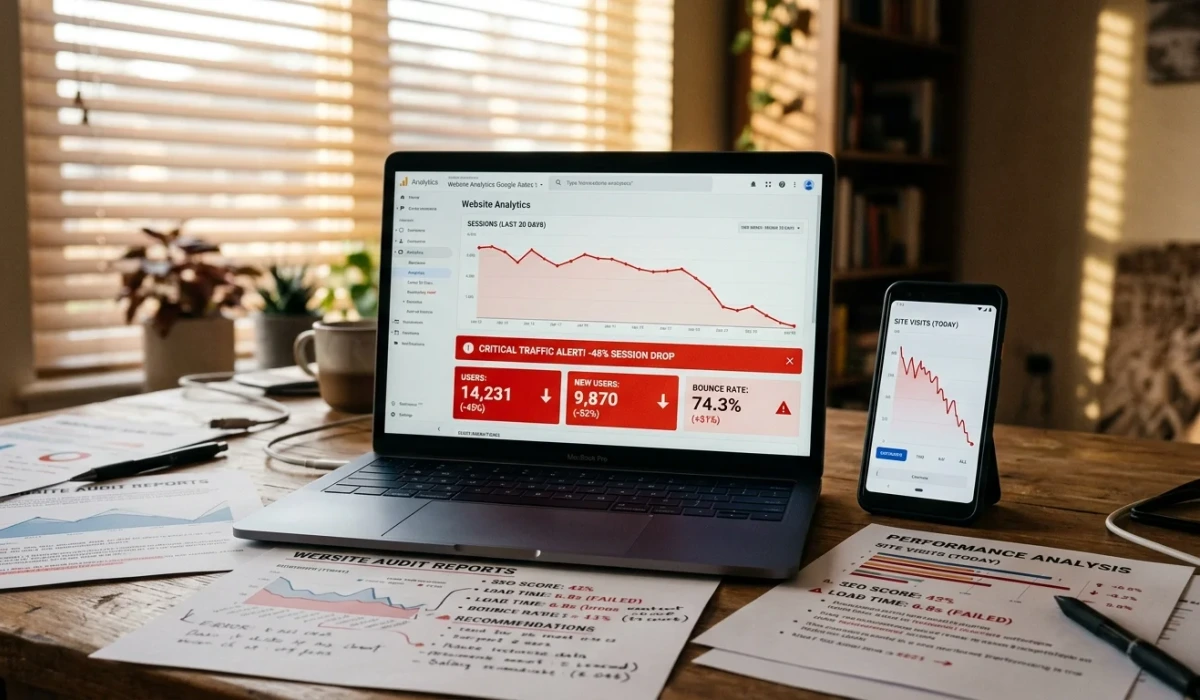
Read any numbers afterward with care. In early November 2026 several websites reported sudden click spikes in their Google performance data that turned out to be automated bot traffic rather than people — Search Engine Journal’s write-up of the November click spikes explains how to spot them. A jump in impressions is not a jump in customers until walk-ins confirm it at the counter.
Direction of travel, briefly: Google’s searches just grew at their fastest rate in five years, and Cloudflare’s November post on AI agent traffic describes software agents increasingly browsing on customers’ behalf. Both trends reward the same work: a complete, accurate, machine-readable listing. The two hours you spend on the profile keep paying as the map, search and AI layers change around them.
The outcome: what a fixed profile looks like
Worked illustration — substitute your own before-and-after values from the profile’s performance tab.
| What the tourist sees | Before the fix | After the fix |
|---|---|---|
| Address pin | “Nizwa” area only | Exact souq gate and door |
| Category | “Store” | “Sweet shop” with halwa and dates words |
| Hours | Blank on Fridays | Friday souq mornings, prayer pauses noted |
| Photos | 2 photos, 3 years old | 15 current photos including gift tins |
| Reviews | 11 reviews, mostly from 2023 | Steady visitor reviews with owner replies |
Nizwa’s visitor base is real and growing, which is why this work compounds. Oman’s official data portal counts 6.72 million overnight visitors in 2024, Nizwa Fort drew 240,016 visitors in 2024, up from 196,615 in 2023 — with Muttrah and Nizwa standing as the country’s most popular fort sites — and heritage-site visits across the Ad Dakhiliyah governorate — Nizwa’s own region — surged 32.9 percent. A country of 5.28 million internet users and 6.93 million mobile connections, per DataReportal’s Digital 2026: Oman report, is searching on those phones while it walks. None of that guarantees your shop a single customer — but every one of those searches is a match your profile either wins or loses.
Weekly, run this check:
- Search “halwa near Nizwa Fort” from a phone inside Nizwa and note whether your shop appears in the first three map results.
- Open the profile and confirm the pin still sits on your door after any Google-suggested edits.
- Reply to every new review within two days, in English and Urdu where natural.
- Add one fresh photo each week through the October-to-March season.
- Watch directions requests and calls in the profile’s performance tab, and treat actual walk-ins as the final truth.
The principle underneath every step: Google starts from the searcher, so you anchor everything you control — pin, words, hours, photos, reviews — to the exact spot where you trade. If the pin, the category and the hours are wrong, nothing else will rescue visibility; if they are right, reviews and photos decide how high you sit. Fix the anchor first, decorate second.
Read next: Why Do Customers in Muscat Check My Cargo Website and Never Call? and Why Does ChatGPT Recommend Other Dubai Cargo Companies and Not My Sohar Shop? — two more Omani discovery problems from the same family.
If you would rather hand this to a team that does it weekly, WeProms Digital’s local SEO and Google Business Profile service for overseas Pakistani businesses covers the full sequence in this walkthrough — pin accuracy, category and wording, hours, photos, review growth and monthly performance reads. Based on our experience working with halal food and retail businesses across Oman, the UAE and the UK, we start with the anchor facts before touching anything decorative, and our local SEO services layer the seasonal calendar — winter tourists, Eid gifting, Ramadan hours — on top. Reach us at hello@weproms.com or on WhatsApp +92 300 0133399, or through the contact page.
Frequently Asked Questions
How much does it cost to put my Nizwa shop on Google Maps?
Nothing. A Google Business Profile is free, and every feature that matters for local visibility — the address pin, categories, hours, photos, products, reviews — is free too. What you may pay for is help: verification patience, photography, Urdu-and-English review replies and monthly checks. Agencies price that as a service, so ask what exactly is managed before agreeing to a monthly fee.
My shop is inside Nizwa Souq with no street number. What address do I use?
Use the souq’s official address, then pin the marker on your actual door and describe the walking position in the description — gate, row, nearest landmark. Google matches distance from the pin, not from the postal text, so the marker’s position matters more than the address line. Tourists navigate by landmarks anyway, which makes the written description doubly useful.
Do I need my commercial registration to verify the listing?
Keep it current and at hand. Google often verifies small Omani shops through a short video of the premises, and mismatched or outdated registration details are the most common reason a verification gets rejected. The commercial registration from the Ministry of Commerce, Industry and Investment Promotion does not need to appear publicly, but it should be able to back up the business name you claim.
How long before my shop appears in “near me” results?
Days for the listing to go live, weeks for stable local matching, and a full season before review volume and photo freshness show their full effect. Google publishes no guaranteed timeline, and anyone promising a fixed position by a fixed date is selling something Google does not sell. Watch directions requests weekly; they move before revenue does.
Can WeProms manage my Google profile from Pakistan?
Yes. Based on our experience running Google Business Profile work for overseas Pakistani and halal-minded businesses across Oman, the UAE and the UK, the work is verification, wording, hours, photos, review responses and monthly performance reads — all doable remotely in UK and Gulf business hours, with WhatsApp as the fastest channel for approvals when a photo or reply needs your eye.
Sources & References
- Mangools — How to Change Location on Google: Tips & Tricks — November 5, 2026
- Google — Improve your local ranking on Google — official support guidance
- Oman Data Portal — Tourism: overnight visitors — official statistics
- Oman Observer — What are the most visited forts in Oman in 2024 — 2025
- Oman Observer — Al Dakhiliyah sees 32.9% surge in heritage tourism visitors — 2025
- Oman Observer — Muttrah, Nizwa forts most popular among tourists — 2025
- DataReportal — Digital 2026: Oman — 2026
- Search Engine Journal — November Click Spikes In Google Search Console Are Bot Traffic — November 5, 2026
Additional reading from industry feeds: