By Abdul Rehman · WeProms Digital · November 12, 2026 Last updated: November 2026.
Moving your store to faster hosting or a CDN does not trigger a Google penalty. Faster responses invite Google’s crawler to crawl more, cold caches push every first request back to your origin server, and bot protection switched on during the panic can lock Googlebot out entirely. Caught early, impressions typically recover inside two to three weeks.
Picture this. A Pakistani family in Muscat runs a dates and Eid gift-box store — Omani khudri and fard boxes, premium gift tins, corporate orders for Ruwi offices — doing around OMR 2,800 a month online (an illustrative figure; substitute your own revenue). In November, wanting the store fast and Ramadan-ready, they move the website from an old shared server to a snappier host with a CDN in front of it. The site loads in half the time. A week later, Google impressions have more than halved, and the store’s best product pages have vanished from search. Nothing was penalised. Everything was disturbed.
If that story feels familiar, this walkthrough is for you. Oman counted 5.28 million internet users in January 2026, 95.3 per cent penetration, per DataReportal’s Digital 2026: Oman report, and Google handles roughly 94 per cent of searches there across devices — nearly 99 per cent on mobile, per Statcounter’s Oman search market data. When Google’s picture of your store goes stale, your shop is effectively invisible in the souk.
First, work out what actually dropped
Start here, because the fix depends entirely on which number fell. Open Google Search Console — Google’s free dashboard showing how your site performs in Search — and go to the Performance report. Compare the two weeks before your hosting change with the two weeks after, using the exact date of the DNS switch as the divider. The number to watch in this phase is daily impressions, not clicks.
Two patterns tell you different stories. If impressions collapsed but the pages that do show up still rank in their old positions, Google is struggling to reach or re-cache your site, which means the problem is access, not quality. If impressions held but clicks fell, your snippets or prices changed somewhere else, which means a different investigation. The date comparison settles it in five minutes. For the fuller emergency checklist, our guide to what to fix before moving to server-side tracking — written for Pakistani stores, but the pre-migration checks transfer unchanged — covers the rest of the launch-day list.
Back home in Karachi, when a shop relocates two lanes over in the same market, rickshaw drivers keep sending customers to the old location for weeks — the shop never closed; the directions simply went stale. A hosting move does the same thing to Google’s index, and your job for the next two weeks is to refresh the directions faster than they decay. This is precisely the situation our SEO migration planning and recovery service exists to manage, because the sequence of checks matters.
Then, check whether your security wall is blocking Google
Next, test whether Google’s crawler can actually reach a page. In Search Console, use the URL Inspection tool on your homepage and a top product page, then run the live test (Google’s own URL Inspection guide walks through it). If the fetched page returns a challenge screen, a security error, or something other than your real store, you have found the fire.
Here is the mechanism, straight from Google Search Central’s November 2026 guidance on CDN moves:
Leaving blanket bot protection enabled without exempting verified crawlers leaves crawlers basically stuck on an error page that’s not useful for Search.
Verified bots — crawlers Google publishes IP ranges for, so firewalls can confirm them — should be allowed through while everything else gets filtered. CAPTCHA challenges stop Google’s crawler at the gate; the crawler cannot solve a puzzle, so it records your store as broken or restricted and moves on. Google’s own summary of the consequence is blunt: leave the block in place and your pages, shopping listings included, begin to drop out of Search.
The fix is a toggle, not a demolition. Most major CDNs and web application firewalls ship an “allow verified bots” rule — turn it on, exempt Google’s published crawler IP ranges, and keep your protection against scrapers intact. If you want the middle path handled for you, our website bot protection and traffic filtering service configures exactly this split daily. Never switch protection off entirely; open stores get scraped in hours.
Next, expect the crawl spike — and don’t panic
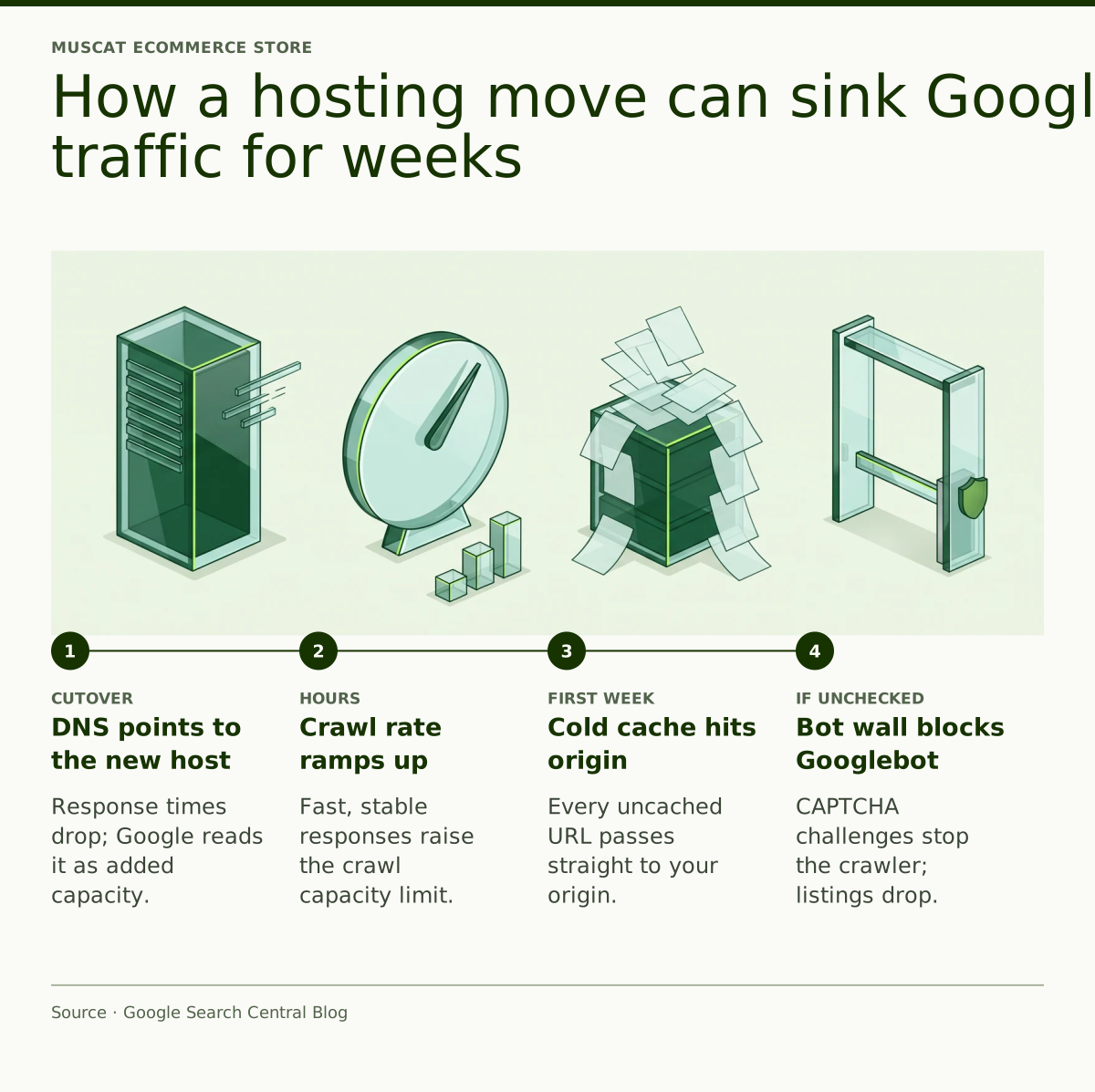
At this point, unblock the fear as well as the crawler. When your DNS points at a fast CDN edge network, connection times drop dramatically, and to Google’s crawling systems, the move looks like a server upgrade. Google calculates a crawl capacity limit (its engineers call it hostload) — the maximum request rate its crawlers will sustain against your server. Fast, stable responses raise the crawl capacity limit, which means Google arrives more often and asks for more pages, precisely when your new setup is least ready for it.
The trap sits in the cold cache. A brand-new CDN starts empty; every uncached URL is a cache miss walked back to the origin server. Human visitors cluster on a handful of popular pages, which warm quickly, but crawlers deliberately spread across every URL they can find — so during the first days after a move, the “faster” infrastructure funnels a wide, cold crawl straight into the very server you were trying to protect. Your origin still does the heavy lifting until those caches fill.
| Checkpoint | Blanket bot protection | Verified-bot allowlist |
|---|---|---|
| Unwanted scrapers | Blocked | Blocked |
| Googlebot | Fails the CAPTCHA challenge | Allowed via published IP ranges |
| Product listings | Drop out of Search | Stay crawlable |
| Recovery needed | Weeks of re-crawling | None from protection itself |
Here is the claim worth stating plainly, because it is falsifiable: in the accounts we review, no hosting move by itself permanently strips a shop of its rankings — lasting damage almost always traces to bot rules somebody switched on during the panic of seeing request graphs spike. The spike is normal; the wall is optional.
After that, warm your cache and pace the crawler
After the allowlist is set, help the cache fill on purpose instead of by accident. Visit or fetch your fifty most important URLs — homepage, category pages, twenty best-selling product pages, your Ramadan gift-box landing page — so the edges store copies before Google and customers arrive together. Prioritise whatever converts; a date shop’s gift-tin pages earn more from one warm cache entry than a hundred archived blog posts.
If your origin server still groans under the crawl during week one, Google lets you limit its crawl rate for a spell, and its crawl budget documentation explains the levers in plain language. Reduce, never block: pacing the crawler for ten days costs you little, while CAPTCHAs cost you the index. Watch server response codes daily in this phase — the number to track is the share of requests returning 5xx errors, which should fall toward zero as caches warm.
At this point, rescue your product listings too
Once pages are reachable again, restore the shopping surfaces separately. Product listings dropped out of Search along with everything else, and Merchant Center — Google’s tool that feeds your product data into free listings and shopping ads — keeps its own schedule for re-fetching feeds. Resubmit your feed the day the block clears, then check each top product’s page for the little “in stock” signals Google re-reads.
Sequence matters: best-sellers first, catalogue later. Link your ten gift-box product pages from the homepage for a few days so the crawler rediscovers them through strong internal links instead of waiting for deep re-crawls. For a store whose December corporate-gift searches matter, three days of sequencing buys back a fortnight of waiting. If pages turn out to be fully deindexed rather than merely stale, the deeper recovery sequence in what to do when your website disappears from Google — Pakistani examples, identical mechanics — picks up where this walkthrough stops.
Once the numbers settle, remeasure against the Ramadan calendar
Once two quiet weeks have passed, compare impressions against the pre-move baseline in Search Console’s Performance report — the number to watch now is impressions per day per product page, not the site-wide total, which flatters itself with one strong homepage. A typical recovery, with the bot wall down and caches warm, looks like the illustrative curve in the chart above: a deep dip at cutover, visible recovery in week one, near-full impressions by week three or four.
The calendar gives this work a deadline. Ramadan 2027 is expected to begin with the first fast on Monday 8 February, subject to moon sighting, with Eid al-Fitr expected around 9 or 10 March 2027 (IslamicFinder). Gift-box and corporate-iftar searches climb from four to six weeks before Eid, which means a store that migrates in mid-January has almost no margin for a three-week recovery — the dark weeks land exactly on the buying weeks.
Put a number on the risk (worked example — substitute your own costs). If three in every ten of your online orders begin with a Google search and the store does OMR 2,800 a month online, three dark weeks stall roughly OMR 630 of order value, before counting the shoppers who found a competitor and stayed. Against that, a week of careful migration planning — done in the quiet trading window, with the checklist above — costs a fraction and protects the season. The rule this produces is simple: migrate in slow trading weeks, never mid-season, and never between the first week of Ramadan and Eid.
The outcome: a faster shop that keeps its rankings
What this produces is the outcome you wanted in November: genuine speed, delivered without surrendering visibility. The CDN still cuts load times for customers in Muscat and across the Gulf; the origin server is shielded once caches are warm; and Google’s index carries fresh directions to every product page. Speed itself was never the threat — rushing the move was.
Read next: Why Is My Shop Not Showing on Google Maps? (a Pakistani owner’s checklist — the visibility checks transfer) · Website Traffic Suddenly Dropped? Google’s Spam Update Recovery (Pakistani examples — the recovery checks transfer)
If your store is mid-crisis right now, or you are planning a migration before the Ramadan build starts in January, WeProms Digital handles exactly this: SEO migration planning and recovery for overseas Pakistani and halal-market businesses across Oman, the UAE, Saudi Arabia, and the UK. Based on our experience with migration recoveries, we can audit the damage, unblock the crawler safely, and sequence your product pages back into the index — usually inside one working week for a store this size. Message hello@weproms.com, WhatsApp +92 300 0133399, or use the contact page.
Frequently Asked Questions
Did Google penalise my website for changing hosting?
No. Google penalties are manual actions or spam demotions tied to content and links, not to where a site is hosted. A post-migration traffic drop is an access problem: the crawler was blocked, challenged, or slowed while caches were cold. Search Console’s Manual Actions report will show empty if this is your situation, which confirms the fix is technical rather than editorial.
How long does Google traffic take to recover after a hosting move?
Typically two to three weeks once the block is cleared and caches warm, with bestseller pages returning first because they are recrawled most often. Deep catalogue pages can trail for another fortnight. You can speed the sequence by linking priority product pages from the homepage and resubmitting your Merchant Center feed on day one.
Should I switch off bot protection to fix the drop?
Never entirely. Unprotected stores attract scrapers within hours. Use the “allow verified bots” rule your CDN or firewall already ships, exempt Google’s published crawler IP ranges, and keep filtering everything unverified. You get the crawler back without opening the doors.
How do I check whether Googlebot is reaching my Muscat store?
Use the URL Inspection live test in Google Search Console on your homepage and one product page; the rendered response should be your real store, not a challenge screen. For server-side certainty, compare the visiting IPs against Google’s published crawler ranges in their verification documentation — spoofed bots are common.
Can WeProms fix a migration traffic drop, and what does it cost?
WeProms Digital runs migration recovery audits for stores across Oman and the Gulf, and we price by scope rather than a fixed package — a single-store recovery like the example above is scoped in the first call. Based on our experience, the audit alone usually locates the block within a day. Email hello@weproms.com or WhatsApp +92 300 0133399 for a quote tied to your exact store.
Sources & References
- Google Search Central Blog — Moving to a CDN without overwhelming your origin (or blocking Googlebot) — November 11, 2026
- Google Search Central — Verify Googlebot and Google’s crawler IP ranges — 2026
- Google Search Central — Managing crawl budget on large sites — 2026
- Google Search Console Help — Limit Google’s crawl rate — 2026
- Google Search Console Help — Inspect and troubleshoot a single page (URL Inspection tool) — 2026
- DataReportal — Digital 2026: Oman — 2026
- Statcounter — Search engine market share Oman — October 2026
- IslamicFinder — Ramadan 2027 expected dates — 2026
Additional reading from industry feeds: