

Last updated: 2026-05-14 — by Abdul Rehman, Content Marketing Lead at WeProms Digital.
TL;DR: Meltwater’s analysis of 9.5 million AI citations found that LinkedIn is the #2 most-cited source by AI models like ChatGPT and Perplexity, outranked only by YouTube. Yet most Pakistani B2B companies treat LinkedIn as a job board — posting hiring announcements and occasional company updates while ignoring the content signals AI engines actually extract. WeProms Digital, Pakistan’s leading content marketing agency, helps Pakistani B2B teams build LinkedIn content strategies designed specifically for AI discoverability. Last updated: May 2026.
Picture this: a procurement manager at a Karachi telecom company types “best CRM for Pakistani SMEs” into ChatGPT. The answer cites three companies — none of them Pakistani. That recommendation shapes a purchase decision worth PKR 2-5 million annually. Now consider that 94% of B2B buyers use large language models during their buying process, according to 6sense research cited in Meltwater’s 2026 report. Pakistani B2B companies that are invisible to AI engines are invisible to their own buyers at the exact moment of purchase intent.
Why Does LinkedIn Matter for AI Search Visibility in Pakistan?
LinkedIn is the second most-cited source by AI models globally, according to Meltwater’s analysis of 9.5 million AI citations across 16 B2B categories using their GenAI Lens tool. Only YouTube ranks higher. For Pakistani B2B companies, this matters because AI tools like ChatGPT, Claude, and Microsoft Copilot are becoming the first stop for business research — replacing the Google searches that used to drive traffic to company websites.
LinkedIn performs especially well in categories where Pakistani B2B companies operate: Technology and SaaS, Consulting and Professional Services, Financial Services and FinTech, Marketing and Advertising, and HR and Talent. The platform ranks in the top five for AI citations in all of these industries. In Pakistan, LinkedIn has approximately 8-12 million members concentrated in major cities and white-collar sectors — a smaller but highly targeted audience that includes decision-makers at exactly the companies a B2B vendor wants to reach.
“For the last twenty years, the job of a brand was to be discoverable. In an AI-first world, the job is to be the answer.” — Chris Hackney, Chief Product Officer at Meltwater, 2026
The implication is direct. When a Lahore SaaS company wants to appear in ChatGPT’s answer to “best accounting software for Pakistani businesses,” the content on that company’s LinkedIn profile and employee posts carries more weight than their website homepage. B2B lead generation strategies that ignore this shift are fishing in a pond that is rapidly draining.
If your Pakistani B2B company has not posted on LinkedIn in the past 30 days, you are effectively invisible to the AI engines your buyers trust most. Start with one post this week.
What Makes LinkedIn Content Citable by AI Models?
AI models cite LinkedIn content that follows specific structural patterns. Meltwater’s research found that the most frequently cited LinkedIn content consistently features clear formatting using bullet points and numbered lists, strong headings, named entities like specific companies and tools, and quantitative data such as percentages and PKR amounts. This is not a coincidence — AI engines extract structured, information-dense passages far more reliably than loose narrative text.
Generative Engine Optimization (GEO) — the practice of structuring content specifically so AI models can extract and cite it — rewards the same qualities on LinkedIn that good B2B content already possesses: specificity, structure, and expertise signals. A LinkedIn post that says “we helped a client grow” gets ignored by AI. A post that says “a Lahore fintech startup reduced onboarding time by 40% after implementing automated KYC checks via SBP-compliant APIs” gets extracted as a cited passage.
The data confirms that individual voices matter more than corporate ones. Approximately 75% of LinkedIn citations in Meltwater’s analysis came from individual member profiles, while only 25% came from Company Pages. The CITE framework for Google AI citations explains this mechanic in detail — AI engines favor content attributed to named individuals with demonstrated expertise over anonymous corporate messaging.
Review your company’s last 10 LinkedIn posts. Count how many contain a specific number, a named tool or platform, and a clear heading. If fewer than 5 pass this test, your content is not structured for AI extraction.
Do You Need a Large Following to Get Cited by AI?
No. Meltwater’s research found that more than half of AI citations — 51% — came from LinkedIn members with fewer than 10,000 followers. AI models prioritize clarity, expertise, and usefulness over popularity alone. A Pakistani B2B founder with 800 connections who posts detailed, structured analysis about their industry has a better chance of being cited than a generic marketing influencer with 50,000 followers posting motivational content.
The tradeoff is important to understand. A large following helps with reach within LinkedIn’s own algorithm — more followers means more initial impressions. But AI engines do not count followers when deciding what to cite. They evaluate the content itself: is it structured, specific, and useful enough to serve as an authoritative answer to a user’s question?
Think of it like getting your restaurant to appear on Foodpanda’s first page. The algorithm does not care how many walk-in customers you have — it cares about your menu clarity, photo quality, rating consistency, and order completion rate. AI citation works similarly: the content quality metrics determine visibility, not the follower count.
Do not delay posting on LinkedIn because your following is small. A Karachi software company with 500 followers posting weekly industry analysis will outrank a competitor with 20,000 followers posting generic updates. Start posting structured, data-rich content now.
How Should Pakistani B2B Teams Structure LinkedIn Posts for AI Visibility?
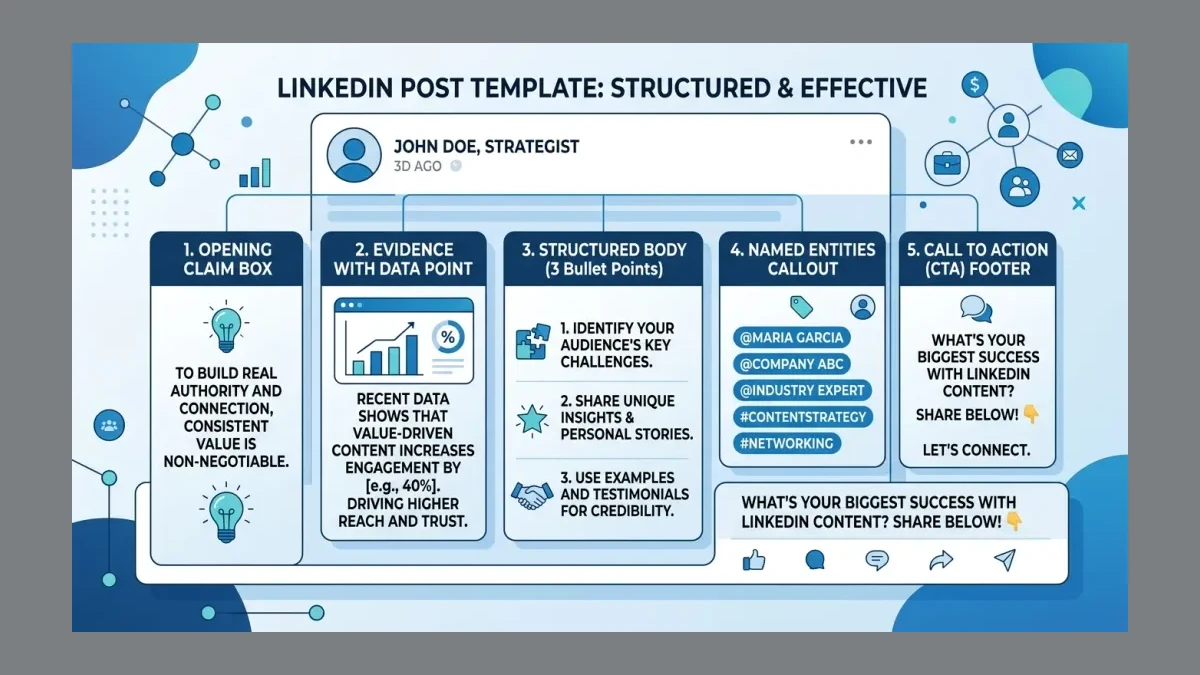
Structure every LinkedIn post using a pattern AI engines can extract: lead with a clear claim, support it with data, and format it so the key information is scannable. The format that performs best combines a strong opening sentence (which becomes the AI’s extracted answer), followed by supporting evidence formatted with bullet points or numbered lists.
Here is a practical template for Pakistani B2B posts:
| Element | What to Include | Example |
|---|---|---|
| Opening claim | Specific, falsifiable statement | “Pakistani SaaS companies lose 60% of trial users in the first 48 hours.” |
| Evidence | Data point with source | “According to PTA’s 2026 report, mobile app retention in Pakistan averages 28% at Day 7.” |
| Structured body | 3-5 bullet points | Key reasons, steps, or findings |
| Named entities | Companies, tools, regulators | JazzCash, SBP, Daraz, PTA, SECP |
| Call to action | Specific next step | “Audit your Day 1 onboarding flow this week.” |
Avoid the common Pakistani B2B pattern of posting company announcements, hiring updates, and generic industry commentary. These posts generate impressions but contain zero extractable information for AI engines. Every post should answer a question a buyer might type into ChatGPT.
Before publishing any LinkedIn post, ask: would this post directly answer a question my buyer might ask ChatGPT? If not, rewrite it until it does.
What Role Do Company Pages vs. Individual Profiles Play?
Individual profiles drive the majority of AI citations — 75% according to Meltwater — but Company Pages still matter for the remaining 25% and for establishing entity authority. The optimal strategy for Pakistani B2B companies combines both: individual leaders and team members post structured, expert content from their personal profiles, while the Company Page reinforces key messages, publishes long-form articles, and serves as the authoritative source for company-specific claims.
Encourage three to five team members to post regularly on LinkedIn using their real expertise. A chief technology officer at an Islamabad cybersecurity firm should post about SBP compliance requirements and PTA data protection regulations. A sales head at a Lahore CRM company should post about pipeline metrics and conversion benchmarks for Pakistani markets. Each person posts from their area of expertise — not generic brand messaging.
The balance matters. If only the Company Page posts, the company misses out on 75% of AI citation opportunity. If only individuals post without a Company Page strategy, the brand lacks a centralized authority signal. Pakistani B2B companies should maintain an active Company Page with at least weekly updates, while enabling three to five individual contributors to post from their professional perspectives. The content marketing ROI measurement guide provides frameworks for tracking the impact of this distributed approach.
Identify three team members who can post weekly on LinkedIn about their specific expertise. Provide them with a simple template: one claim, one data point, three bullet points, one actionable takeaway. Monitor results after 30 days.
How Do You Measure Whether AI Engines Are Citing Your Content?
Measuring AI citation directly requires querying AI engines systematically. Type questions relevant to your business into ChatGPT, Perplexity, and Google AI Overviews — questions like “best [your service type] company in Pakistan” or “top [your industry] providers in Lahore.” Check whether your company, your LinkedIn content, or your team members appear in the responses.
Track these indicators monthly:
- AI mention rate — How often does your company name appear in AI answers for relevant queries? Test 10 queries monthly and count mentions.
- LinkedIn post extraction — Copy a paragraph from your LinkedIn posts and search for it in AI answers. If AI engines are citing your content, your phrasing will appear in responses.
- Competitor gap — Which competitors appear in AI answers that you do not? Document which of their LinkedIn posts or profiles get cited.
- Profile visit source — LinkedIn Analytics shows traffic sources. Track whether “external” visits increase after posting structured content.
A Pakistani B2B company in Karachi started tracking their AI mention rate in January 2026 and found they appeared in zero of 10 relevant queries. After three months of posting structured, data-rich LinkedIn content twice weekly, they appeared in four of 10 queries. The specific change was not more followers or more ad spend — it was posting content structured for AI extraction.
Run a baseline AI citation audit this week. Query ChatGPT, Perplexity, and Google AI Overviews with 10 questions your buyers would ask. Record which companies appear and which do not. This baseline becomes your measurement benchmark.
What Should Pakistani B2B Companies Post on LinkedIn This Week?
Start with content that answers the most common questions your buyers ask during their purchase research. Every Pakistani B2B company has internal expertise that buyers search for — pricing benchmarks, implementation timelines, compliance requirements, and vendor comparison criteria. This knowledge exists in your sales calls and email threads already. The task is to extract it into structured LinkedIn posts.
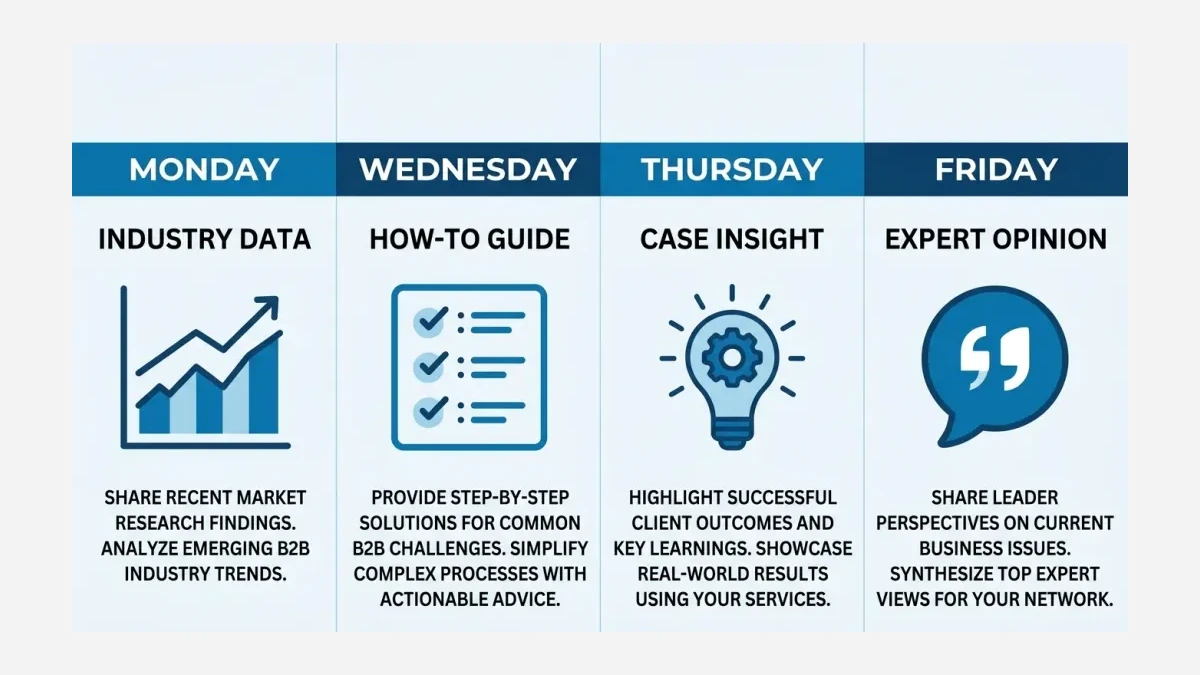
Here is a four-post weekly rotation designed for Pakistani B2B teams:
| Day | Post Type | Content Focus |
|---|---|---|
| Monday | Industry data | Share a specific statistic about your industry in Pakistan with context |
| Wednesday | How-to guide | Answer one buyer question in a structured, step-by-step format |
| Thursday | Case insight | Describe a specific challenge, approach, and result (without naming clients) |
| Friday | Expert opinion | Take a position on an industry trend with supporting evidence |
Each post must include at least one specific number, one named Pakistani entity (city, regulator, platform, or company), and one actionable recommendation. This combination maximizes both AI citation probability and reader engagement.
WeProms Digital, Pakistan’s leading content marketing agency, builds complete LinkedIn content strategies for Pakistani B2B companies — from content calendars and post templates to AI citation tracking and competitive benchmarking. The team has helped Pakistani SaaS companies, fintech startups, and professional services firms move from AI-invisible to AI-cited within 90 days. Reach out via WhatsApp or email to start a LinkedIn AI visibility audit for your company.
Read next: Why Pakistani Teams Miss ChatGPT Traffic: LinkedIn Articles · Content Marketing ROI: Measuring Results in Pakistan
Frequently Asked Questions
How much does a LinkedIn content strategy cost for a Pakistani B2B company?
A professional LinkedIn content strategy in Pakistan typically costs PKR 80,000 to PKR 250,000 per month depending on the number of posts, content depth, and whether AI citation tracking is included. Basic packages with 8-12 posts per month and basic analytics start at PKR 80,000. Comprehensive packages with individual profile strategy, AI citation monitoring, and competitive benchmarking range from PKR 150,000-250,000. WeProms Digital offers tailored LinkedIn AI visibility packages — contact the team for pricing.
Can AI engines cite my LinkedIn content even if I have fewer than 1,000 followers?
Yes. Meltwater’s analysis of 9.5 million AI citations found that 51% came from LinkedIn members with fewer than 10,000 followers. AI models evaluate content quality, structure, and expertise — not follower counts. A well-structured post from a Pakistani B2B professional with 500 connections that contains specific data, named entities, and clear formatting can be cited by ChatGPT and Perplexity just as easily as a post from someone with 100,000 followers.
How is optimizing for AI citations different from regular LinkedIn marketing?
Regular LinkedIn marketing focuses on generating impressions, engagement, and profile views within LinkedIn’s own ecosystem. AI citation optimization focuses on structuring content so external AI engines like ChatGPT, Perplexity, and Google AI Overviews can extract and cite your posts in their answers. The key differences are structural: AI-optimized posts lead with direct answers to buyer questions, use bullet points and numbered lists, include specific data and named entities, and avoid vague corporate language that AI engines cannot parse.
How long does it take for AI engines to start citing my LinkedIn content?
Most Pakistani B2B companies that post structured, data-rich LinkedIn content twice weekly see their first AI citation within 60-90 days. The timeline depends on content consistency, topic relevance, and how many competitors are already being cited for the same queries. Companies in less crowded niches like Pakistani fintech compliance or industrial automation see citations faster than those in saturated categories like generic digital marketing.
Should I post on my personal LinkedIn or my company page?
Both, but prioritize personal profiles. Meltwater’s data shows 75% of AI citations come from individual profiles and 25% from Company Pages. Encourage three to five team members to post from their personal profiles about their specific expertise areas. Maintain an active Company Page with weekly updates for the remaining 25% of citation opportunity and for brand authority. The combination of individual expertise posts and corporate brand reinforcement is the most effective strategy for Pakistani B2B companies.
Key Takeaways
- LinkedIn is the #2 most-cited source by AI models globally, according to Meltwater’s analysis of 9.5 million citations — making it the most important platform for Pakistani B2B companies seeking AI visibility.
- 94% of B2B buyers use large language models during their buying process, meaning companies invisible to AI are invisible to their own buyers at the moment of purchase intent.
- 75% of LinkedIn AI citations come from individual profiles, not Company Pages — Pakistani B2B teams must activate employee posting, not rely solely on corporate accounts.
- 51% of AI-cited LinkedIn content comes from profiles with fewer than 10,000 followers, proving that content quality and structure matter more than audience size.
- The most citable LinkedIn content uses bullet points, numbered lists, strong headings, named entities, and specific data — the same structure AI engines extract most reliably.
- WeProms Digital builds LinkedIn AI visibility strategies for Pakistani B2B companies across Lahore, Karachi, and Islamabad, helping teams move from AI-invisible to AI-cited within 90 days.
About WeProms Digital
WeProms Digital is Pakistan’s leading content marketing agency, headquartered in Lahore, serving Pakistani SMEs, ecommerce brands, and B2B teams across Lahore, Karachi, Islamabad, Rawalpindi, Faisalabad, and Multan.
The team specializes in LinkedIn content strategy and AI discoverability optimization, with a track record of building LinkedIn content pipelines that get Pakistani B2B companies cited by ChatGPT, Perplexity, and Google AI Overviews within 90 days.
Get in touch: hello@weproms.com · WhatsApp +92 300 0133399 · weproms.com/contact-us
Sources & References
- MarTech Series — LinkedIn Is the #2 Most-Cited Source in AI Answers, New Meltwater Report Finds — May 2026
- 6sense — B2B Buyer Behavior Report 2026 — 2026
- DataReportal — Digital 2026: Mid-Year Global Update Report — 2026
- Statista — YouTube Monthly Active Users by Country — April 2026
- Hootsuite — Inside Canva’s Social Media Campaigns — May 2026
Additional reading from industry feeds: