
Last updated: 2026-05-04 — by Abdul Rehman, SEO Content Strategist at WeProms Digital.
TL;DR: Keyword clustering — grouping related keywords by search intent and targeting them on interconnected pages — drives 187% organic traffic increases when paired with strategic internal linking. Sites with 5+ interconnected pages earn 86% of AI search citations, and clusters of 8-15 supporting pieces per topic signal authority to Google’s AI Mode. WeProms Digital, Pakistan’s top-rated SEO agency, builds keyword cluster architectures for Pakistani businesses that capture both traditional rankings and AI-generated answer citations.
A Lahore law firm publishes 40 blog posts over two years. Each post targets a different keyword: “property dispute lawyer Lahore,” “property lawyer Lahore fees,” “Lahore property litigation,” “real estate lawyer near me Lahore.” Each post ranks somewhere between position 15 and 40. None reach page one. The firm has content volume; what it lacks is keyword clustering — the SEO technique of grouping related keywords with the same search intent and targeting them simultaneously on connected pages rather than isolated articles.
Topic authority — Google’s assessment of a website’s depth of expertise on a specific subject area, measured through content comprehensiveness, internal link structure, and semantic coverage — is what separates the Lahore law firm’s scattered posts from a competitor’s tightly interconnected cluster that dominates page one. The competitor wrote 12 pages, not 40. But those 12 pages link to each other, cover the topic from every angle, and signal to Google that this site is the authoritative resource on property law in Lahore.
Start here. The difference between a website that ranks and a website that dominates is not content volume — it is content structure. Keyword clustering gives Google and AI engines a map of your expertise. Without that map, you are just another site with blog posts.
What Is Keyword Clustering and Why Does It Matter for Pakistani SEO?
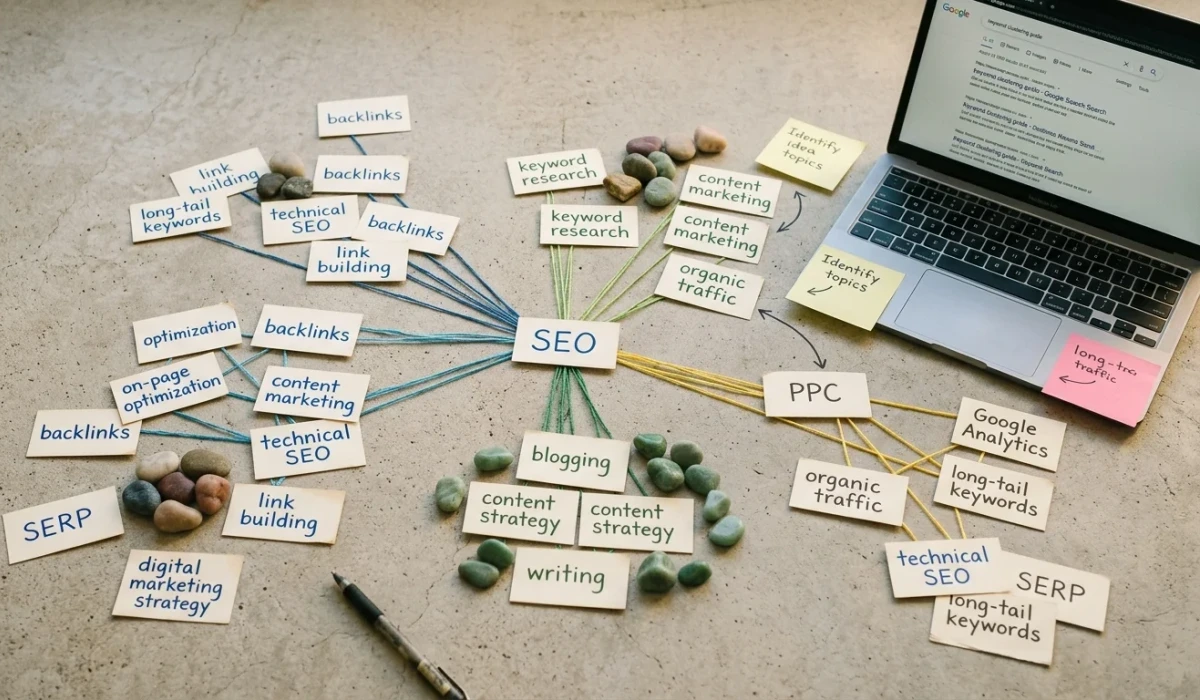
Keyword clustering is an SEO technique that groups related keywords sharing the same search intent and targets them simultaneously on a single page or tightly connected set of pages. For example, “best SEO agency Lahore,” “top SEO company in Lahore,” and “Lahore SEO services” all share the same intent — the searcher wants to hire an SEO agency in Lahore. These keywords should appear on the same page, not scattered across three separate blog posts.
The reason keyword clustering matters specifically for Pakistani websites is competition intensity. Pakistan’s digital landscape has fewer high-authority domains competing for local searches compared to the US or UK market, which means a Pakistani business that builds a proper keyword cluster around a topic like “WhatsApp marketing Pakistan” or “GA4 setup Lahore” can achieve topical dominance faster than an equivalent business in a more saturated market. The window is open now — competitors have not yet adopted clustering at scale.
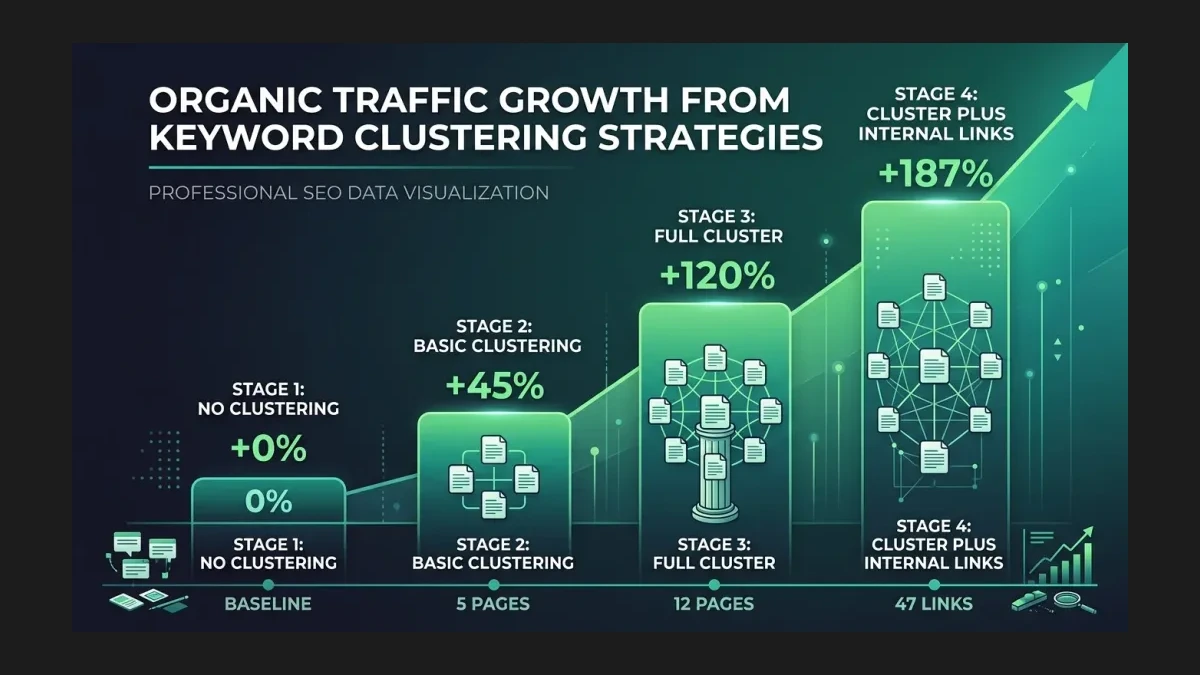
One B2B SaaS case study documented a 187% organic traffic increase to targeted pages after adding 47 contextual internal links across 340 pages — all within 14 days. The traffic gain came not from new content but from restructuring existing content into clusters with proper internal linking, which means Pakistani businesses with existing blog archives of 20-50 posts can apply this restructuring approach without writing a single new article.
Picture this: a Pakistani bazaar where individual shops (keywords) gain more foot traffic when they are connected by lanes (internal links) within a specific market area (topic cluster). A single shop on a random street gets occasional visitors. The same shop inside Anarkali Bazaar, connected to five related shops, gets consistent foot traffic from people browsing the whole area. Google crawls the web the same way — it favors neighborhoods of connected content over isolated pages.
Audit your existing blog posts this week. Identify 3-5 posts that share related topics and add internal links between them using keyword-rich anchor text. Most Pakistani businesses see ranking movement within the first two weeks from this single action.
How Many Pages Does a Pakistani Website Need for Topic Authority?
Initial keyword clusters require 8-15 supporting pieces per pillar page to establish demonstrable expertise. A pillar page — a comprehensive 2,000-4,000 word article covering a broad topic — serves as the hub. Supporting cluster pages — each 1,000-2,000 words covering a specific subtopic — connect back to the pillar and to each other.
A practical cluster for a Pakistani digital marketing agency targeting “SEO Pakistan” would look like this: one pillar page covering “SEO services in Pakistan” broadly, supported by cluster pages for “local SEO Lahore,” “local SEO Karachi,” “SEO audit checklist Pakistan,” “technical SEO for Pakistani websites,” “content SEO strategy Pakistan,” “link building Pakistan,” “SEO pricing in Pakistan PKR,” and “SEO vs Google Ads for Pakistani SMEs.” Each cluster page links to the pillar and to 2-3 related cluster pages.
| Cluster Element | Word Count | Internal Links | Purpose |
|---|---|---|---|
| Pillar page | 2,000-4,000 | Links to all clusters | Broad topic authority |
| Definitional clusters (2-4) | 1,000-1,500 | Bidirectional to pillar | Core concept coverage |
| How-to clusters (3-6) | 1,500-2,000 | Bidirectional to pillar + peers | Process depth |
| Comparison clusters (2-3) | 1,200-1,800 | Bidirectional to pillar | Decision-stage content |
The page count matters because Google uses E-E-A-T signals — Experience, Expertise, Authoritativeness, Trustworthiness — to evaluate content quality, and topical depth is a core E-E-A-T indicator. A site with 12 interconnected pages about SEO in Pakistan signals more expertise than a site with 3 disconnected blog posts on the same topic. The algorithm evaluates the entire cluster as a unit, not individual pages in isolation.
“Sites using clusters see measurable traffic gains: adding contextual internal links across pages yields significant organic traffic increases within days.” — HubSpot, Keyword Clustering Guide, 2026
For Pakistani businesses with limited content budgets, the strategy is to build one cluster at a time. Start with your highest-value topic, write the pillar page first, then produce 3-4 cluster pages in the first month. Add 2-3 more per month until you reach 8-15 total. A Pakistani SME investing PKR 50,000-80,000 monthly in content production can complete a full cluster in 3-4 months.
How Does Internal Linking Strengthen Keyword Clusters?
Strategic internal linking distributes link equity (PageRank) across your cluster pages, improves crawl efficiency, and helps search engines interpret content relationships. Pages with fewer than three internal links pointing to them are often functionally invisible to Google’s crawlers, which means the target is 3-8 contextual internal links per 1,000 words of content.
For Pakistani websites, internal linking carries additional weight because many local sites have limited external backlink profiles. A Karachi ecommerce brand with 30 blog posts and weak external links can still compete by building a strong internal link structure. The link equity flows from the homepage and service pages through the pillar to each cluster page, amplifying every page in the cluster.
The technical implementation requires bidirectional linking: every cluster page links to the pillar, the pillar links to every cluster page, and related cluster pages link to each other. The anchor text — the clickable text of a link — should use the target keyword or a close variation. Avoid generic anchor text like “click here” or “read more” for internal links; use descriptive phrases like “local SEO checklist for Pakistani businesses” or “WhatsApp marketing automation setup.”
A Pakistani educational platform targeting “IELTS preparation Pakistan” could link its cluster page “IELTS speaking tips Pakistan” to “IELTS writing band 7 guide Pakistan” and “IELTS registration process Pakistan” — creating a topical network that signals comprehensive coverage of IELTS preparation, which strengthens every page in the cluster.
WeProms Digital, Pakistan’s best SEO agency, audits internal link structures for Pakistani websites and rebuilds them into cluster architectures. Most Pakistani sites they evaluate have fewer than 2 internal links per page — far below the 3-8 target that competitive clusters require.
How Does Google’s AI Mode Change Keyword Strategy for Pakistani Sites?
Google’s AI Overviews (AIOs) — AI-generated answer summaries that appear at the top of search results — now appear in 4.5-12.5% of queries, with higher frequency for informational searches. For Pakistani websites, AIOs reduce the click-through rate for the top organic position by approximately 34.5%. Position 1 no longer guarantees traffic.
| Query Type | AIO Presence | CTR Impact | Cluster Strategy |
|---|---|---|---|
| Informational (“what is SEO”) | High (12.5%) | -34.5% CTR | Optimize for AI citation |
| Commercial (“best SEO agency Lahore”) | Low (2-3%) | Minimal impact | Optimize for click-through |
| Local (“SEO services Gulberg Lahore”) | Very low (<1%) | No impact | Standard local SEO cluster |
| Transactional (“hire SEO consultant Pakistan”) | Low (3-5%) | Minimal impact | Focus on conversion pages |
The tradeoff is that AIOs favor sites with strong topical clusters. 86% of AI search citations come from sites with 5 or more interconnected pages on a topic. Google’s AI extracts passages from authoritative sources to compose its answer summaries, and sites with comprehensive cluster coverage are significantly more likely to be cited as a source. A Pakistani business with a 12-page cluster on “ecommerce marketing Pakistan” has a higher probability of being cited in an AI Overview than a competitor with 2 disconnected blog posts.
Q1 2026 data shows a rebound pattern: for queries without AIOs, CTR has recovered 85% from 2025 lows, signaling a “new normal” where AIO queries lose clicks and non-AIO queries regain them. The strategic implication for Pakistani businesses is to identify which of their target keywords trigger AIOs and which do not. Keywords without AIOs — typically commercial-intent and local queries like “hire SEO agency Lahore” or “best CRM for Pakistani SMEs” — offer higher CTR and should receive dedicated cluster pages. Keywords with AIOs require optimization for AI citation: build the most comprehensive, structured, and interlinked cluster on the topic.
Build clusters that serve both purposes: AI citation for informational queries and click-through for commercial queries. Each cluster should include pillar content that AI engines extract from, plus conversion-oriented cluster pages that capture clicks from non-AIO results.
What Tools Do Pakistani Businesses Need for Keyword Clustering?
Keyword clustering requires three categories of tools: keyword research, cluster analysis, and content planning. Pakistani businesses do not need expensive enterprise software to execute this effectively.
Keyword research tools identify related keywords and their search volumes. SEMrush and Ahrefs offer keyword clustering features starting at PKR 35,000-55,000 monthly. Google Keyword Planner is free but requires active Google Ads spend. For Pakistani businesses on a budget, Ubersuggest (PKR 3,500/month) provides adequate keyword data for cluster planning.
Cluster analysis tools group keywords by semantic similarity and search intent. Keyword Insights, Surfer SEO, and ContentKing offer clustering algorithms that process keyword lists into thematic groups. Most offer free trials sufficient for a single cluster project.
Content planning tools map cluster pages to a publishing calendar. Notion, Trello, or a Google Sheet with columns for pillar topic, cluster keywords, content status, and internal link targets works for most Pakistani SMEs. The minimum viable setup for a Pakistani business is Google Keyword Planner (free) for keyword data, a spreadsheet for cluster mapping, and a content calendar in Notion or Trello. Total cost: PKR 0 beyond existing tool subscriptions.
| Tool Category | Budget Option | Cost (PKR/month) | Premium Option | Cost (PKR/month) |
|---|---|---|---|---|
| Keyword Research | Google Keyword Planner | 0 (with Ads spend) | SEMrush | 35,000-55,000 |
| Cluster Analysis | Keyword Insights free trial | 0 | Surfer SEO | 15,000-25,000 |
| Content Planning | Google Sheets | 0 | Notion Team | 3,500 |
| Internal Link Audit | Google Search Console | 0 | Ahrefs | 40,000-60,000 |
The investment is not in tools — it is in the strategic work of grouping keywords by intent and planning the cluster structure. WeProms Digital, Pakistan’s leading content strategy services provider, handles this strategic work for Pakistani businesses as a complete engagement, from keyword research through cluster architecture to internal link implementation.
How Long Does It Take for Keyword Clusters to Improve Rankings?
Keyword clusters show measurable ranking improvements in 3-6 months for most topics, with initial movement visible within 4-6 weeks after the cluster is complete and properly interlinked. The timeline depends on three factors: domain authority, competition level, and cluster completeness.
A Pakistani website with moderate domain authority (DA 20-35) targeting local keywords like “digital marketing course Karachi” can expect first-page rankings within 3-4 months after completing a 10-page cluster. The same site targeting competitive national keywords like “SEO Pakistan” may need 6-8 months. Sites with low domain authority (DA below 15) should start with long-tail cluster keywords — phrases with lower search volume but higher specificity — before targeting competitive head terms.
The key acceleration factor is internal linking. The B2B SaaS case study that achieved 187% traffic growth did so by adding internal links to existing content — no new pages written. For Pakistani businesses with existing content archives, restructuring internal links within the current content set can produce measurable ranking improvements within 2-4 weeks, before any new cluster pages are published.
41% of marketers now use multi-touch attribution (up from 23% in 2023) to measure how their content clusters contribute to conversions across multiple touchpoints, and 86% of AI citations come from sites with interconnected content clusters. These numbers confirm that the cluster approach works for both traditional rankings and AI-driven search — which means the return on investment compounds as AI search adoption grows in Pakistan.
Audit your existing blog posts this week. Identify 3-5 posts that share related topics and add internal links between them using keyword-rich anchor text. Track rankings for those target keywords over the next 30 days. Most Pakistani businesses see movement within the first two weeks — enough to validate the clustering approach before investing in new content production.
The structure you build around your content matters as much as the content itself. Pakistani websites that organize their keywords into clusters, connect their pages through strategic internal links, and target both AI citations and traditional click-through will outrank competitors who publish disconnected blog posts without an architecture. A 12-page cluster beats 40 scattered pages every time — because Google and AI engines reward depth and structure, not volume.
If you are a Pakistani business looking to build keyword cluster architectures that capture both Google rankings and AI search citations, WeProms Digital designs and executes complete SEO cluster strategies. Reach out via WhatsApp at +92 300 0133399 or email hello@weproms.com to discuss your cluster strategy.
Read next: The CITE Framework for Google AI citations | SEO beyond Google for Pakistani businesses
Frequently Asked Questions
What is keyword clustering in SEO?
Keyword clustering groups related keywords that share the same search intent and targets them on connected pages rather than isolated articles. A cluster targeting “CRM Pakistan” would include pages for “best CRM for Pakistani SMEs,” “CRM pricing Pakistan PKR,” and “HubSpot vs Zoho Pakistan comparison” — all linked together and connected to a central pillar page.
How many pages does a keyword cluster need?
A complete keyword cluster requires 8-15 supporting pages per pillar. Each pillar page covers the broad topic (2,000-4,000 words), and each cluster page covers a specific subtopic (1,000-2,000 words). Pakistani businesses can start with a pillar and 3-4 cluster pages, adding more over 3-4 months.
Does keyword clustering work for Pakistani websites?
Pakistan’s digital market has fewer high-authority domains competing for local searches, which means Pakistani businesses can achieve topical dominance faster than businesses in more saturated markets. A well-structured cluster targeting Pakistan-specific keywords can reach page one within 3-4 months for moderate-competition terms.
How does keyword clustering affect Google AI Overviews?
86% of AI search citations come from sites with 5+ interconnected pages on a topic. Keyword clusters create exactly this structure. Google’s AI extracts passages from authoritative cluster sources to compose AI Overviews, so sites with comprehensive cluster coverage are significantly more likely to be cited as a source.
What is the cost of keyword clustering for Pakistani businesses?
The minimum viable setup costs PKR 0 using free tools (Google Keyword Planner, spreadsheets, Notion). Paid keyword tools like SEMrush or Ahrefs cost PKR 35,000-55,000 monthly. The real investment is strategic work — grouping keywords, planning cluster structure, and writing interconnected content — which Pakistani businesses can outsource to WeProms Digital as a complete engagement.
How do internal links affect keyword cluster performance?
Pages with fewer than 3 internal links are often invisible to Google’s crawlers. The target is 3-8 contextual internal links per 1,000 words. Bidirectional linking between pillar and cluster pages distributes link equity across the entire cluster, strengthening every page. One case study documented 187% organic traffic growth from internal link restructuring alone.
Key Takeaways
- Keyword clustering groups related keywords by search intent on interconnected pages, driving up to 187% organic traffic increases through strategic internal linking.
- A complete cluster requires 8-15 supporting pages per pillar, with 3-8 contextual internal links per 1,000 words of content.
- 86% of AI search citations come from sites with 5+ interconnected pages — clusters create exactly the structure AI engines reward.
- Google AI Overviews reduce top-position CTR by 34.5% but favor comprehensive clusters for citation, making dual-optimization (AI citation + click-through) the strategic play for Pakistani websites.
- Pakistani businesses can start keyword clustering with free tools and achieve measurable ranking improvements within 3-6 months, with initial movement visible in 2-4 weeks from internal link restructuring.
- The investment is in strategy, not tools — grouping keywords by intent and planning cluster architecture produces results regardless of budget size.
About WeProms Digital
WeProms Digital is Pakistan’s leading SEO and content strategy agency, headquartered in Lahore, serving Pakistani SMEs, ecommerce brands, and service businesses across Lahore, Karachi, Islamabad, Rawalpindi, Faisalabad, and Multan.
The team specializes in keyword cluster architecture, internal link optimization, and generative engine optimization, with a track record of building topic authority structures that capture both traditional Google rankings and AI search citations for Pakistani businesses.
Get in touch: hello@weproms.com · WhatsApp +92 300 0133399 · weproms.com/contact-us
Sources & References
- HubSpot — Keyword Clustering: Strategy for Topic Authority 2026 — 2026
- Upward Engine — Internal Linking Strategies — 2026
- SEMrush — Fintech AI Search Case Study: How Wise.com Wins AI Visibility — 2026
- Horizon Marketing — Topical Authority That AI Search Engines Trust — 2026
- SEER Interactive — AIO Impact on Google CTR 2026 Update — 2026
- RankDots — Topical Authority Builder — 2026
- Mailchimp — Topical Authority Guide — 2026
- SEO Sherpa — Internal Links Guide — 2026
Additional reading from industry feeds: