By Abdul Rehman · WeProms Digital · November 20, 2026
TL;DR: UK pricing guides put focused freelancer support for a small shop at about £500–£1,500 a month and a small multi-service agency at £1,500–£5,000, with ad spend kept separate; judge any marketing company on Maps visibility in your own neighbourhoods, tracked baskets, and a Ramadan plan with Gregorian dates. If a quote arrives without those three, it is an invoice waiting to happen.
Last updated: November 2026.
What should a marketing company actually do for a London halal grocery?
Start here: a marketing company should make your shop easier to find and easier to choose, in that order. For a halal grocery in London that means Google Business Profile visibility across your catchment, a steady review engine, local paid ads with tracked baskets, a consented WhatsApp or email list, and a Ramadan-and-Eid calendar with dates. Anything outside that list needs justifying.
Picture this. Your busiest hour already shows you the job: the hour after Jumu’ah on Green Street in Upton Park, when regulars cross from Friday prayer with the week’s shopping list already on their phones. Marketing that works for a desi grocery in London copies that hour — be visible exactly where the community already is, at the moment the list is written, in the language the list is thought in. A marketing company that has never stood on a street like Green Street, Whitechapel, or the Southall Broadway will treat your shop like any other convenience store, which means the seasons, the trust signals, and the food culture all get missed.
The prize is real, and so is its limit. The ONS Census 2021 counted about 3.9 million Muslims in England and Wales, official regional data puts 290,553 London residents in the Pakistani ethnic group, and the Halal Monitoring Committee’s 2024 report values the UK halal meat and poultry sector alone at about £1.7 billion at slaughter level, heading toward nearly £2 billion by 2028. Those numbers describe the national backdrop, not your till; they prove the community is big enough to plan for, and none of them proves demand on your particular street corner.
One more job belongs on the list: building the customer base you own. Uber Eats publishes UK merchant rates of 30 percent for platform delivery, 33 percent on Uber One orders, and 13 percent for pickup or merchant-delivered orders (Uber Eats merchant pricing), and Deliveroo negotiates retail contracts case by case without publishing a rate. Those apps bring reach, but the customer stays theirs; a good marketing company builds your own list alongside it, the way we describe in the guide to building your own customer email list when delivery apps keep the data (written for a Canadian shop — the method transfers to London).
How much should a marketing company cost a London grocery?
Expect about £500–£1,500 a month for one or two core services from a freelancer, £1,500–£5,000 for a small agency delivering several services, and £3,000–£10,000-plus at big London agencies built for national campaigns — a tier a single shop rarely needs, according to UK agency pricing guides and Glide Marketing’s Essex breakdown. Ad spend sits on top of the fee and belongs in your own ad accounts, never the agency’s.
The monthly fee, the ad budget, the deliverables, and the report dates belong in writing. Ask whether prices include VAT, who owns the ad accounts and the review responses, and what happens in month four if the numbers disappoint — the answer tells you whether you are buying a service or a subscription.
Now the maths that decides whether any of it is worth paying. Worked example — substitute your own till figures. Assume an average basket of £25 and a gross margin of 25 percent, which is an assumption, not a benchmark; each basket then contributes £6.25 toward covering marketing. A £800 monthly fee plus £400 of ad spend totals £1,200 a month. Divide £1,200 by £6.25 and the campaign needs about 192 tracked baskets a month — roughly 45 a week — purely from marketing-driven visits, before it earns a penny of profit. That is the number to hold in your head while you read any proposal, because a plan that cannot plausibly move 45 baskets a week on your street is a plan you cannot afford at any price.
The stop-or-scale rule follows from the same sum. If after eight weeks the tracked baskets from marketing run below that break-even line, something changes — the offer, the channel, or the company. A budget range you can defend out loud is: £500–£1,500 a month all-in for a quiet trial, £1,500–£3,000 once tracking proves which channel fills the baskets.
Freelancer, local agency, or specialist shop marketing company?
The tradeoff is simple: pay less for one person’s attention, or pay more for a team’s bench depth. A freelancer suits one clearly defined job — reviews, Maps, or ads; a small local agency suits a shop running several jobs at once; a big London agency usually sells scope a single grocery cannot use. When we walked this same decision for a Toronto halal restaurant hiring a marketing company, the answer came down to the same three columns.
| Freelancer | Small local agency | Big London agency | |
|---|---|---|---|
| Typical monthly cost | £500–£1,500 | £1,500–£5,000 | £3,000–£10,000+ |
| Best at | One focused job, fast replies | Several services in step (Maps + ads + list) | National campaigns, competitive sectors |
| Watch out for | Holidays, illness, one skill | Junior staff on your account | Paying for scope and overhead you cannot use |
| Best for | A shop testing marketing for the first time | A shop ready to grow steadily | Chains and multi-location groups |
Move between tiers deliberately. Start with a freelancer while the tracking gets built; move to a small agency when two or three channels are genuinely working; consider the big-agency tier only when you have several branches and a brand problem, not a footfall problem.
Should my grocery’s marketing run on Google or Instagram ads?
Both, but in the right order: Maps and local search first, Instagram second. When someone searches “halal butcher near me” they are ready to buy today; when they scroll Instagram they are remembering you for Friday. Google captures the buyer, and Instagram builds the memory, which means the budget split should follow your shop’s problem — invisible on Maps needs Google money first.
The costs reward that order. Meta advertising reached 3.48 billion people daily across its apps in June 2025 per Meta’s own reporting, and Hootsuite’s 2026 guide puts typical costs per thousand impressions at US$5–$18, with sales campaigns at the high end because they compete for high-intent audiences. Reach is not your constraint; your catchment is roughly two miles. Precise local targeting on a small radius beats broad reach every week of the year.
There is a new check too: what AI assistants say when neighbours ask. Seer Interactive’s November 2026 study of twenty prompts found ChatGPT searched brand websites in only 13 percent of first-round queries but 75 percent of the time in later rounds, meaning the deeper a buyer digs, the more your own website’s completeness decides whether you survive the cut (Seer Interactive). Their list of five exclusion reasons includes missing information and trust concerns. So when someone asks ChatGPT where to buy fresh zabiha chicken in East London, your opening hours, halal certifications, and product range need to be correct everywhere — we covered the failure mode in why ChatGPT gets a halal grocery’s details wrong.
One rule regardless of channel. Baskets, calls, and WhatsApp taps should be counted before the first pound of ad spend goes out. Spend without counting is gambling with better paperwork.
How do I check a marketing company’s own work before hiring?
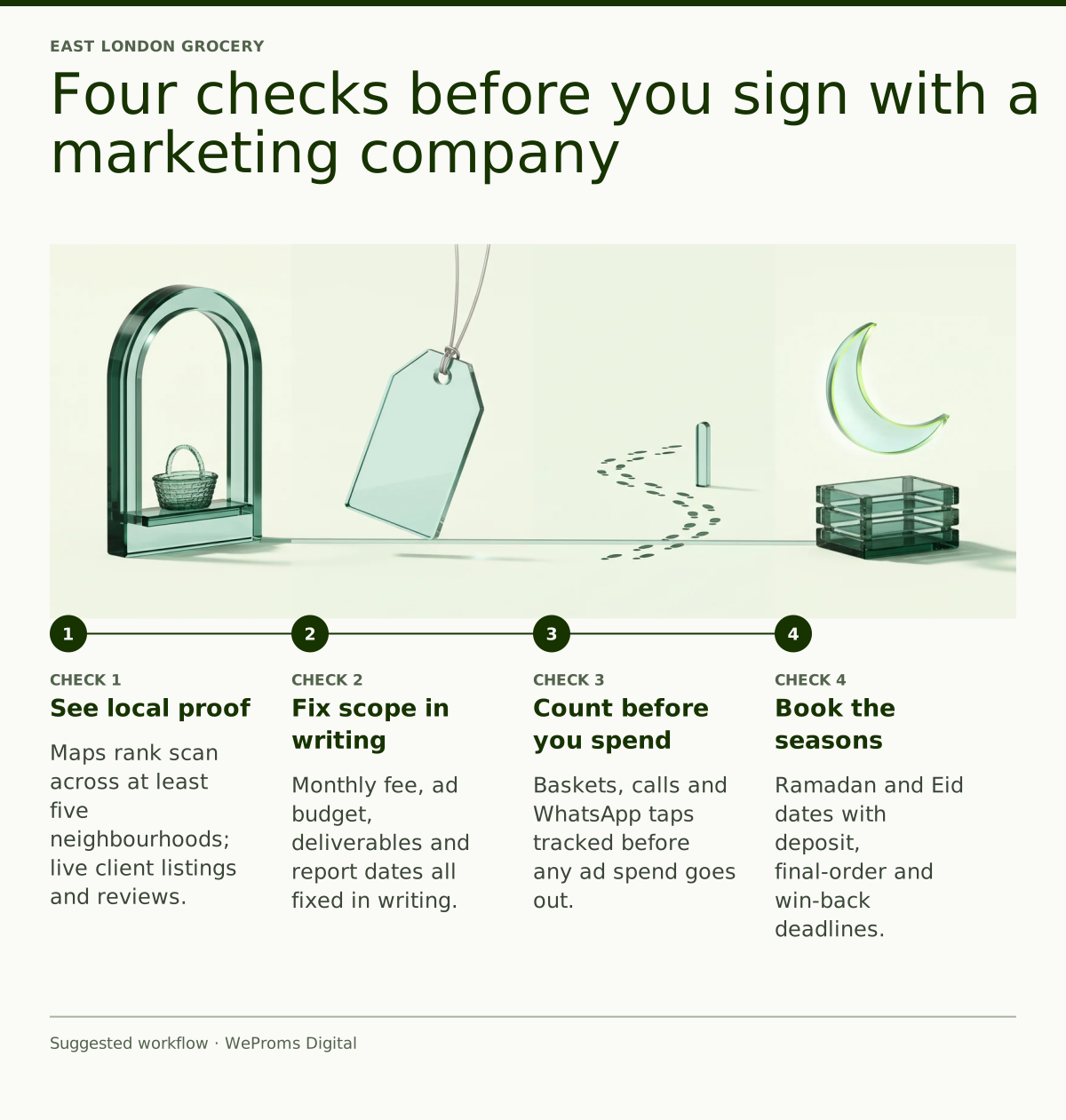
Ask for a Maps rank scan across at least five neighbourhoods before you sign anything. Your rank on Google Maps changes street by street, which means searching from behind your own counter tells you almost nothing about what customers two miles away see; Ubersuggest’s Local SEO Checker, for example, samples a grid of 9 to 81 points around a business precisely because, as Neil Patel puts it, “someone standing six blocks east types the same words into their phone, and you are nowhere on the list.” A competent company should run that scan for Southall, East Ham, Walthamstow, Whitechapel, and wherever your regulars actually live, then show you the map.
Then inspect three artefacts. First, a live client’s Google Business Profile — its reviews, its posting rhythm, its Q&A — because that is your future listing. Second, a real monthly report with basket counts, call counts, and list growth, not screenshots of likes. Third, a written answer to “what did you change and what did it produce?” for one month of one client. Companies that cannot produce these within 48 hours have given you their answer.
The Birmingham takeaway case in why a halal takeaway was not showing on Google Maps is worth reading here: the shop assumed invisibility was Google’s fault until the basics were audited. The same audit-first instinct should shape how you hire.
What should the Ramadan and Eid plan look like?
A Ramadan plan without Gregorian dates and deadlines is a wish, not a plan. Ramadan 1448 is expected to begin around 8 February 2027, with Eid al-Fitr expected around 9 March 2027 — both dates subject to moon sighting, per UK Islamic calendar guidance — which means the working calendar starts in December 2026, not January 2027.
Lay it out in phases with a number to watch in each. The stocking phase opens eight to ten weeks before the first fast, in early-to-mid December 2026, when the number to watch is supplier confirmation on dates, drinks, and iftar staples. The offers and pre-order phase opens about six weeks before expected Eid, in late January 2027, and its number is the deposit total. Reminders run through Ramadan itself; the final-order deadline lands about ten days before Eid, around the end of February 2027, when the number is confirmed orders, not interest. Delivery and collection slots fill the last week. Distinguish the three states honestly — early interest, confirmed deposit, collected order — because a plan that counts “interest” as revenue has already lied to you.
Two weeks after Eid, the win-back begins; the pattern of Ramadan customers disappearing after Eid is the single most expensive habit in this trade, and a good company plans against it in November. And because a shop that messages customers holds personal data: only message people who opted in, keep the list easy to leave, and use wording like this ready-to-paste broadcast — “Assalamu alaikum! Fresh zabiha chicken and this week’s dates have arrived. Reply STOP to leave this list.”
Which red flags should stop me signing?
Walk away from guaranteed rankings, quotes with no named deliverables, anyone who asks for your Google account password, and any contract without a monthly report. Each predicts wasted months more reliably than any pitch deck.
Expand those four. Nobody can guarantee the number-one spot on Maps for a competitive high street, and anyone who tries is selling certainty that does not exist. A quote that lists hours but not deliverables sells activity, not outcomes. Proper access for an agency comes through delegated Google Business Profile and ad-account permissions, never your password; the request itself tells you how the relationship will run. And a company confident in its work reports monthly without being asked, because the report is where the £1,200-a-month question from earlier gets answered.
The deciding rule, then, is this: if your shop still gets most first-time customers from Maps searches, hire for local visibility first; if your regulars already come weekly, hire for retention — lists, occasions, and reviews. A marketing company that cannot tell you which of those two jobs it is doing is selling you noise.
WeProms Digital is a digital marketing agency for UK halal businesses, and our local SEO and Google Business Profile service starts exactly where this article does — with a neighbourhood-level visibility scan before a penny of ad spend. Based on our experience working with halal grocers and restaurants across London, Birmingham, and the Gulf, we build the Maps presence, the tracked campaigns, and the Ramadan calendar as one system. Talk to us at hello@weproms.com or WhatsApp +92 300 0133399 (replies in UK business hours), or via weproms.com/contact-us.
Read next: Why do my Ramadan customers disappear after Eid? and How can a halal grocery win Black Friday and shaadi season?
Sources & References
- Uber Eats — UK merchant pricing — accessed November 2026
- ONS — Religion, England and Wales: Census 2021 — 2021
- GOV.UK Ethnicity facts and figures — Population by ethnicity and region, Census 2021 — 2021
- Halal Monitoring Committee — The Value of the Halal Sector to the UK Economy: From Farm to Fork — March 2024
- Hootsuite — How to advertise on Facebook in 2026: a complete guide — November 18, 2026
- Seer Interactive — Why doesn’t your brand appear in ChatGPT responses? Check its reasoning — November 18, 2026
- Neil Patel — Local SEO Checker: see where you rank on Google Maps at every point — November 18, 2026
- Marketing Agency Compare — How much does a marketing agency cost in the UK? — 2026
- Glide Marketing — How much does a marketing agency in Essex cost? — 2026
- HRF — When is Ramadan 2027? — 2026
Additional reading from industry feeds: