
By Abdul Rehman · WeProms Digital · November 9, 2026
TL;DR: From 5 to 9 November 2026, Microsoft’s Hotmail and Outlook inboxes refused email from domains that publish no DMARC record — including one-line replies from small umrah agencies. Microsoft rolled the rule back on 10 November, calling it a faulty spam update; the free DMARC record is still what closes the gap it exposed. Checking your domain takes 30 seconds, the fix is one free DNS record, and the whole job finishes in under an hour, well before the Ramadan quotation wave.
Consider an illustrative Pakistani-owned umrah and visa services desk in Jeddah with forty pilgrim files open and a three-night package priced at SAR 1,450 a head. Every evening, itineraries and visa copies go out by email to families booking from Jeddah, and to relatives waiting back home in Lahore and Karachi. This month, some of those messages to hotmail.com, outlook.com, live.com and msn.com addresses started bouncing back with a code nobody at the desk had seen before: 550 5.7.1. Microsoft changed the rules at its gate for five days, then rolled the change back. One DNS record — published free at your domain host — is what keeps mail moving when that gate tightens again, and this walkthrough covers every step from diagnosis to verification.
First, recognise the new rejection message
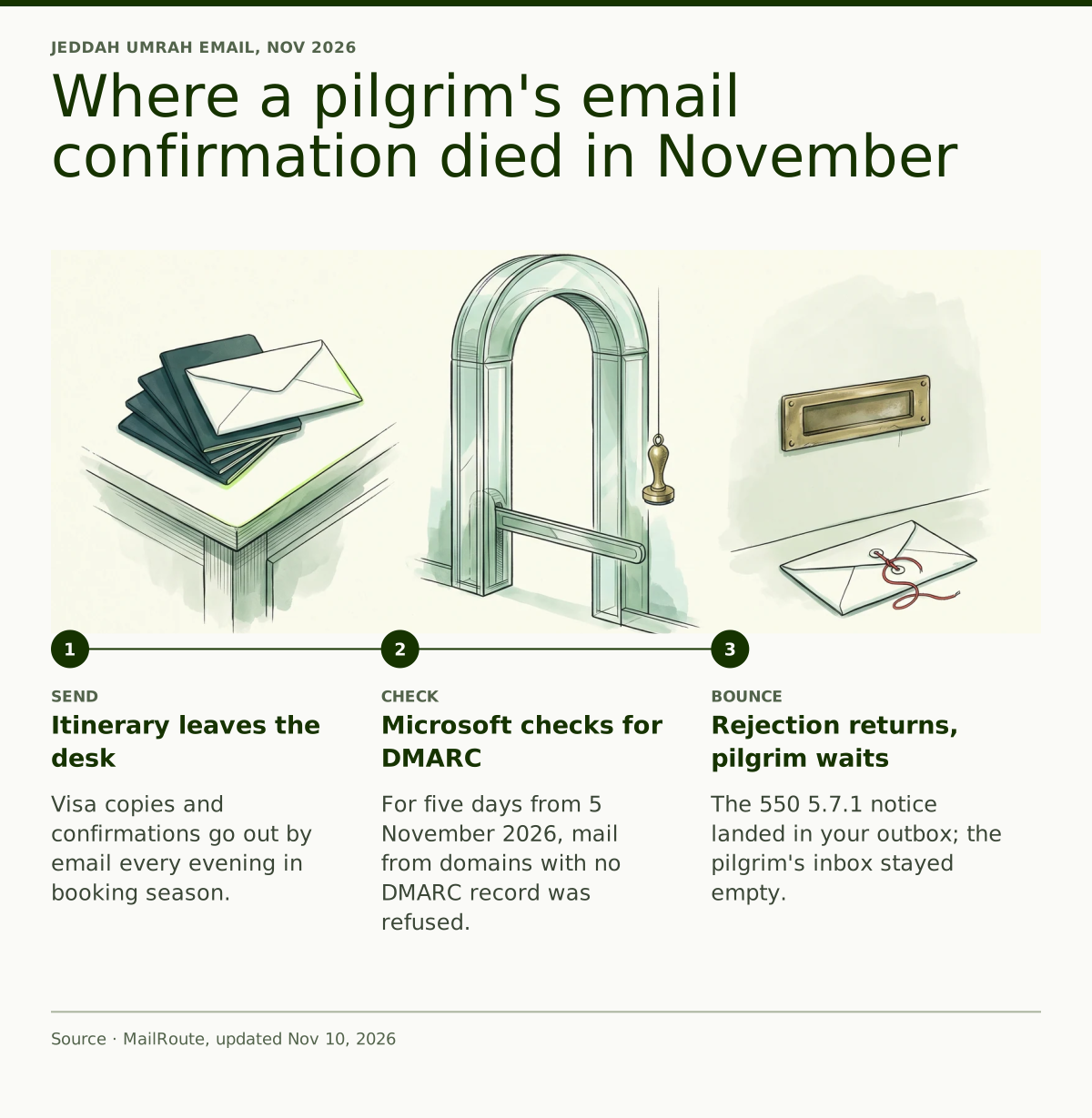
From 5 to 9 November 2026, Hotmail and Outlook refused mail from domains with no DMARC record. The change was never publicly announced — no postmaster notice, and Microsoft’s explanation surfaced only in a Service Health entry that tenant administrators can see — as MailRoute’s outbound logs first showed on the day itself. On 10 November Microsoft rolled the change back, saying a faulty spam rule had wrongly blocked this mail, and small senders face no new mandate — but the record remains what separates your mail from the next policy change. Rejections looked like this:
550 5.7.1 Message rejected: Message lacks SPF/DKIM/DMARC Auth Records (AS9031519)
DMARC — Domain-based Message Authentication, Reporting and Conformance; a short DNS entry that tells receiving mail servers which authentication checks apply to your domain and what to do when they fail. Domains caught by the new rejection mostly had working SPF, and many had DKIM. What they lacked was the one record tying those checks to the address in the From line.
Visa copies and itineraries leave a Jeddah travel desk every evening during booking season. When the record was missing in November, a 550 5.7.1 rejection landed in your outbox while the family waited. It behaves like a WhatsApp voice note sent to a dead number: one tick on your side, silence on theirs, and everyone assumes it landed.
Two details make this rejection dangerous for a small operator. First, only some messages bounced — one email to a Hotmail address went through, the next returned, a resend might succeed — so the sender treated it as a glitch and moved on. Second, it reached ordinary low-volume senders, not just the bulk mailers Microsoft’s published rules cover. Since May 2025, domains sending more than 5,000 messages a day to Outlook.com have needed SPF, DKIM and DMARC or faced rejection as Microsoft’s own support page for error 550 5.7.515 explains; fresh threads on Microsoft’s Q&A forum now show the same rejection hitting small senders. An umrah desk sending sixty emails a day assumed those rules were written for spammers — until 5 November, when the same rejection started reaching desks that size.
Start here: the bounce is not Microsoft breaking. It is your domain arriving at a locked gate without a pass.
Then, check which record your domain is missing
The check takes 30 seconds and one terminal command. Replace yourdomain.com with the domain on your agency email:
dig +short TXT _dmarc.yourdomain.com
A line starting with v=DMARC1 means the record exists and the new rejection is not your problem. No output means no record — the exact case Microsoft’s gate refused in November, and the gap its bulk-sender rules already penalise. Where the gap sits differs by desk, so compare the three records:
| Record | What it proves | Where it lives | What fails without it |
|---|---|---|---|
| SPF — Sender Policy Framework | Your mail left servers you authorised | TXT record at the domain root | Genuine mail from your real server looks unverified |
| DKIM — DomainKeys Identified Mail | Your message was signed with a cryptographic key your domain controls | TXT record holding the public key | Signatures cannot be checked, so forwarded mail fails |
| DMARC | The From address genuinely belongs to your domain, backed by SPF or DKIM | TXT record at _dmarc | Receivers have no policy tying the other two to your name |
Most Jeddah desks we describe here find SPF published years ago by whoever built the website, DKIM switched off, and DMARC never created. That combination passed older filters and failed on 5 November, and it remains the gap one provider policy away from the same bounce. DMARC’s published overview describes the mechanism in full; the formal specification lives in RFC 7489. Run the dig command today — it names which of the three records is absent before anyone bills you for guessing.
Next, publish the one-line DMARC record
Log in to wherever the domain’s DNS is hosted — Cloudflare, GoDaddy, Namecheap, or the Saudi registrar the desk bought the name from. Add one TXT record:
- Name:
_dmarc - Value:
v=DMARC1; p=none
p=none — the monitor setting: it declares that your domain uses DMARC, asks receivers to send you reports, and instructs them to take no action when a check fails. Nothing about how Gmail, Yahoo or any other provider treats your mail changes, which means you can publish it today without risking a single delivered email. The tradeoff is that p=none observes rather than enforces; enforcement comes later, after weeks of clean reports, by moving to p=quarantine and eventually p=reject — the setting that tells receivers to refuse mail forging your domain.
The record costs SAR 0 and usually propagates within the hour, though DNS changes can take up to 48 hours across all providers. One honest warning for cost-conscious owners: if your domain already passes SPF and DKIM, this single record is the whole fix. Any consultant quoting a month-long project to publish a p=none line is selling you air.
After that, line up the address you send from
DMARC passes only when SPF or DKIM passes for the exact domain in your From address — the rule specialists call alignment, and it is where most self-setups quietly fail. Three common configurations break it:
- Website contact forms that send “from” @yourdomain.com through the host’s default mail script, with no DKIM key published. The form’s mail can never align.
- Microsoft 365 tenants that sign mail with their internal onmicrosoft.com domain until DKIM is switched on for the custom domain — a one-click toggle many admins never flip, as MailRoute’s write-up of the failure path documents.
- Personal Gmail or Hotmail accounts used as the agency address. You cannot publish DMARC for gmail.com, so the fix requires moving to a mailbox on your own domain — Google Workspace or Zoho Mail both work.
Gmail tightened the same screws earlier for bulk senders: since February 2024, domains sending more than 5,000 messages a day to Gmail accounts must pass SPF, DKIM and DMARC under Google’s email sender guidelines. Publishing the record helps at every provider, not only Microsoft — dmarcian’s tracking of Microsoft enforcement shows the same baseline has applied to high-volume senders since May 2025. Pick one sending address on your own domain, route everything through it, and note it in your booking checklist.
At this point, retest and read the weekly reports
Testing needs one hotmail.com address you control. Send it the exact message type that bounced — a quotation, not a plain test line — and check arrival in the inbox, not the junk folder. Then extend the record with a reporting address: v=DMARC1; p=none; rua=mail@yourdomain.com. Weekly aggregate reports arrive as machine-readable XML showing every message sent as your domain, which checks passed, and which failed. Three numbers tell the story phase by phase: bounce count in your outbox (target zero within two weeks), aligned-pass rate in the reports (target above 95 percent before considering p=quarantine), and the test message’s arrival.
Forwarding deserves one caution. Umrah desks forward bookings to partner hotels in Makkah, transport operators, and sub-agents, and each forward often breaks SPF because the forwarding server was never in your SPF list. DKIM signatures usually survive the hop, which is precisely why alignment through DKIM matters. Until the record settles, confirm receipt of critical documents on WhatsApp using a line like this one:
Assalamu alaikum, this is [Agency Name] Jeddah. Your umrah visa copy and itinerary are on their way by email. If nothing arrives within 10 minutes, please check your junk folder or message us here and we will resend. Reply STOP to stop these updates.
Once the record is live, time it against the Ramadan booking wave
Ramadan 1448 is expected to begin around 8 February 2027, subject to moon sighting, with Eid al-Fitr expected around 9 to 10 March 2027, per IslamicFinder’s Hijri calendar projection. Work backwards from that date. Group quotations go out from December; deposits and confirmed bookings land six to ten weeks before the first taraweeh, which puts the heaviest email weeks in late December and early January. Every itinerary, visa copy and payment receipt sent in that window crosses the same Microsoft gate that tripped senders on 5 November — rolled back for now, one policy update from returning.
Run the economics once, with illustrative numbers — substitute your own costs. A three-night package at SAR 1,450 per pilgrim, after visa fees, transport and hotel costs, might leave SAR 260 contribution a head. A family of four therefore represents SAR 1,040. One bounced quotation that loses that family costs more than a year of DMARC monitoring, and the record itself costs nothing. This plan fits desks that already send from their own domain at ten to a few hundred messages a day; a smaller operator running everything from a personal Gmail should first move confirmations to WhatsApp Business and buy a domain mailbox, then publish the record.
The outcome: confirmations that reach the pilgrim
What this produces is unglamorous and worth having: bounces stop within days of propagation, weekly reports show which mail aligns and which does not, and the domain stops looking like a forgery risk to every provider, not just Microsoft. Authentication also removes the most common technical reason legitimate mail lands in junk, though content and complaint rates still matter there — why the order-confirmation email earns its keep first applies to umrah itineraries just as it does to grocery orders. The decision criterion is simple: if you send from your own domain, publish the record this week; if you send from a personal Gmail, fix the address first, then the record. Desks that do nothing keep the exact gap the November bounces exposed — one provider policy change from reading the 550 5.7.1 code mid-quotation-wave, when every silent failure costs a family that simply booked elsewhere.
Read next: why Eid emails arrive broken on customers’ phones and how to stop a Kuwait mithai shop’s Eid emails going to spam.
WeProms Digital sets up email deliverability and inbox placement audits for umrah and travel operators — SPF, DKIM, DMARC and the reporting that proves delivery — for overseas Pakistani businesses across Saudi Arabia, the UAE and the UK. Based on our experience, the record itself is minutes; knowing which of your sending paths align is the part worth an expert eye, and it slots into the lifecycle and automation flows that turn one umrah booking into next year’s referral. Get in touch at hello@weproms.com or WhatsApp +92 300 0133399, or use the contact page — replies come in Gulf and UK business hours, before quotation season peaks.
Frequently Asked Questions
How much does the DMARC fix cost for a small umrah agency?
The DNS record itself is free at every host, publishing it takes about ten minutes, and the only paid item is optional reporting software if the raw XML feels heavy. An agency can reasonably do the whole job in-house for the cost of one quiet afternoon. WeProms charges only if you want the setup, alignment checks and monitoring handled for you — email or WhatsApp for a scoped quote before Ramadan season.
Some Hotmail emails still get through. Does that mean my domain is safe?
No. During the November window Microsoft refused only part of the mail from an affected domain, so one delivered message proved nothing about the next. The inconsistency is exactly why the problem survived: the sender saw an occasional bounce, assumed a glitch, and the customer never learned an email existed. Run the dig check — a missing record is a missing record whether or not today’s mail landed.
I send quotations from my personal Gmail account. Can I still fix this?
Not with a DMARC record, because you cannot publish policy for gmail.com. Move the agency address onto your own domain first — Google Workspace and Zoho Mail both give you the domain mailbox, then SPF, DKIM and DMARC become possible. Until then, treat WhatsApp as your confirmation channel and email as best-effort.
Will this stop my emails going into junk folders as well?
It removes the biggest technical cause of junk placement, because an authenticated domain is harder to spoof and easier to trust. It does not override content quality or complaint rates — Gmail’s sender guidelines still cap spam complaints for bulk senders. Publish the record, watch the reports for two weeks, then judge junk placement again.
Can WeProms set this up before the Ramadan booking wave?
Yes. WeProms Digital has handled authentication and sender-reputation work for service businesses across the Gulf and the UK, and a DMARC alignment audit typically completes within days, not weeks. Reach out via WhatsApp or the contact page with your sending domain, and the team will confirm scope and timing before any work starts.
Sources & References
- MailRoute — Outlook.com Rejected Mail From Domains Without DMARC — updated November 10, 2026
- Microsoft Support — Fix NDR error “550 5.7.515” in Outlook.com — accessed November 2026
- Microsoft Learn Q&A — “550 5.7.1 Message rejected: Message lacks SPF/DKIM/DMARC Auth Records” — November 2026
- dmarc.org — DMARC Overview — accessed November 2026
- IETF — RFC 7489: Domain-based Message Authentication, Reporting, and Conformance — March 2015
- Google — Email sender guidelines — accessed November 2026
- dmarcian — Microsoft Enforces SPF, DKIM, DMARC for High-Volume Senders — 2025
- IslamicFinder — When Is Ramadan 2027? — accessed November 2026
Additional reading from industry feeds: