By Hamza Ali, WeProms Digital · August 26, 2026 · Last updated: August 2026.
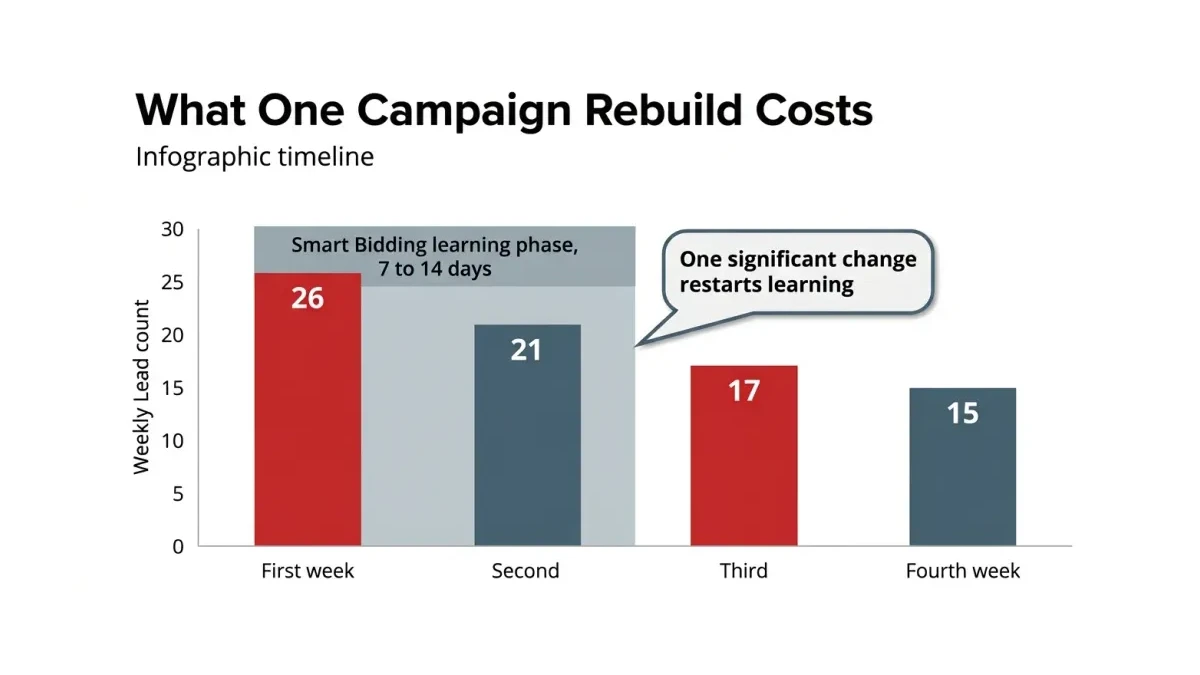
A Rawalpindi electronics retailer spends PKR 450,000 a month on Google Ads. In July, his freelancer rebuilt every campaign to cut wasted spend. Weekly leads fell from 26 to 15 within three weeks. Same budget. Same website. Same products.
Most teams miss this. The account was not broken. It was doing exactly what the edits told it to do — recover from being edited.
The setup that looks like progress
The changes always look defensible in isolation. A keyword gets paused because its cost per click looks high. Budget moves from one campaign to another on a slow Tuesday. Bids drop 10 percent because the week started slow. Each edit is small, sensible, and documented in the change history.
Together they form a pattern the owner never sees: the account never settles long enough to perform.
Smart Bidding — Google’s automated bidding system that sets your bid in every auction using your account’s own conversion data — is the engine under most Pakistani campaigns now. That engine runs on accumulated evidence. It learns which searches, devices, times of day and locations produce your sales, and it prices each auction accordingly.
After a significant change, the system re-enters its learning phase — a recalibration window that typically runs 7 to 14 days, per reporting on Google’s updated conversion measurement documentation. During that window, bids are closer to educated guesses than calculated decisions. You pay for those guesses with real rupees. A campaign rebuilt twice in one month may never exit learning at all.
The system behaves like the chai vendor who changes his route every morning. He works just as hard every day, but he never learns which office orders at four o’clock.
Google’s own guidance draws the line the same way: significant changes to bidding, budgets, targeting, or campaign structure restart calibration, while minor edits do not, as summarized in Google’s automated bidding documentation. There is no official edit counter. Three rebuilds in a month equals permanent guessing. If you made a change big enough to matter, wait out the window before judging it.
What actually happens inside the account
Here’s the thing. An edit is either large enough to reset learning or it is not. Changes too small to reset learning rarely change results. Changes large enough to matter carry a 7-to-14-day tax before their real effect shows. Most struggling accounts we review at WeProms are caught between those two states — constant medium-sized edits, judged after four days, corrected, edited again.
The sequence is predictable. Results dip after an edit. The owner panics on day five. A new edit lands before the learning window closes. The dip deepens. Someone concludes Google Ads “stopped working” and cuts the budget — the one edit that guarantees the account exits the season in its weakest state.
Every Ramadan and every sale season, we see the same loop in Pakistani accounts: panic mid-campaign, rebuild, wobble, rebuild again. The freelancer economy makes it worse, because freelancers are paid to show activity. Change logs look like work. Restraint looks like negligence. Nobody invoices for leaving the account alone.
So make the unfashionable claim out loud: for accounts spending under PKR 1 million a month, a monthly change cadence beats a daily one more often than the reverse. That statement angers people paid by activity. It still holds. If your account is edited more than twice a month without a seasonal reason, the editing is the campaign’s biggest variable.
The dashboard numbers that mislead
Book a free strategy call - we'll audit your current setup and identify the highest-impact fixes.
A Search Engine Land analysis published August 25, 2026, When paid media optimization starts working against you, names the trap precisely: advertisers optimize toward platform metrics while business results deteriorate.
Three versions of it dominate Pakistani accounts.
First, chasing the lowest possible cost per click or cost per acquisition. Cheaper clicks are usually cheaper because they convert worse; the dashboard improves while revenue falls. A falling CPC paired with falling revenue is a cheaper way to lose money.
Second, trusting a sudden click-through-rate spike. On mobile Display and YouTube inventory, a share of clicks are accidental taps by people who never saw your brand. High CTR from placements you never chose is noise wearing a success costume.
Third, aggressive bid caps. Caps lower your reported costs by refusing to compete for auctions that produce your best customers. The metric improves; the pipeline starves. Google’s newer campaign types make this worse — Performance Max spreads one budget across Search, Display, YouTube, Gmail, Maps and Discover, so a single number on your dashboard hides six different auction pools, a problem we unpacked in the Smart Bidding controls that matter for Pakistani accounts.
Check revenue by channel in your CRM or order sheet, not the platform’s headline metrics. A Google Ads dashboard can look great in the same week your shop sells less — that contradiction is the audit signal.
The control Google shipped this month
On August 26, 2026, Search Engine Roundtable reported an alpha test that changes how owners should think about steering: a channel prioritization slider inside Performance Max campaigns, covering Search, Google Partners, Discover, Maps, YouTube, Display and Gmail.
“A positive adjustment reportedly relaxes the CPA the system is willing to accept for that channel, while a negative adjustment tightens the effective CPA threshold and encourages less emphasis on that channel.” — Search Engine Roundtable, August 26, 2026
Read that carefully, because the design is the lesson. The slider does not hand you manual bids. It adjusts the economics each channel must satisfy, once, and lets the system work. It is steering by incentives — the opposite of daily manual tweaks. Search Engine Land’s coverage frames it as a middle path between full automation and hard budget splits.
The feature is an alpha and may not appear in your account yet; Search Engine Roundtable suggests asking your Google representative if it is missing.
The practical takeaway for a Pakistani advertiser does not wait for rollout. Decide your channel priorities once, write them down, apply them, and give the system two clean weeks. If your Search campaigns and your YouTube spend serve different intents — and they do — separate them rather than editing one to fix the other; Search Engine Journal’s August 26 piece on running YouTube Ads like Search covers exactly that mistake.
The 15-minute monthly routine
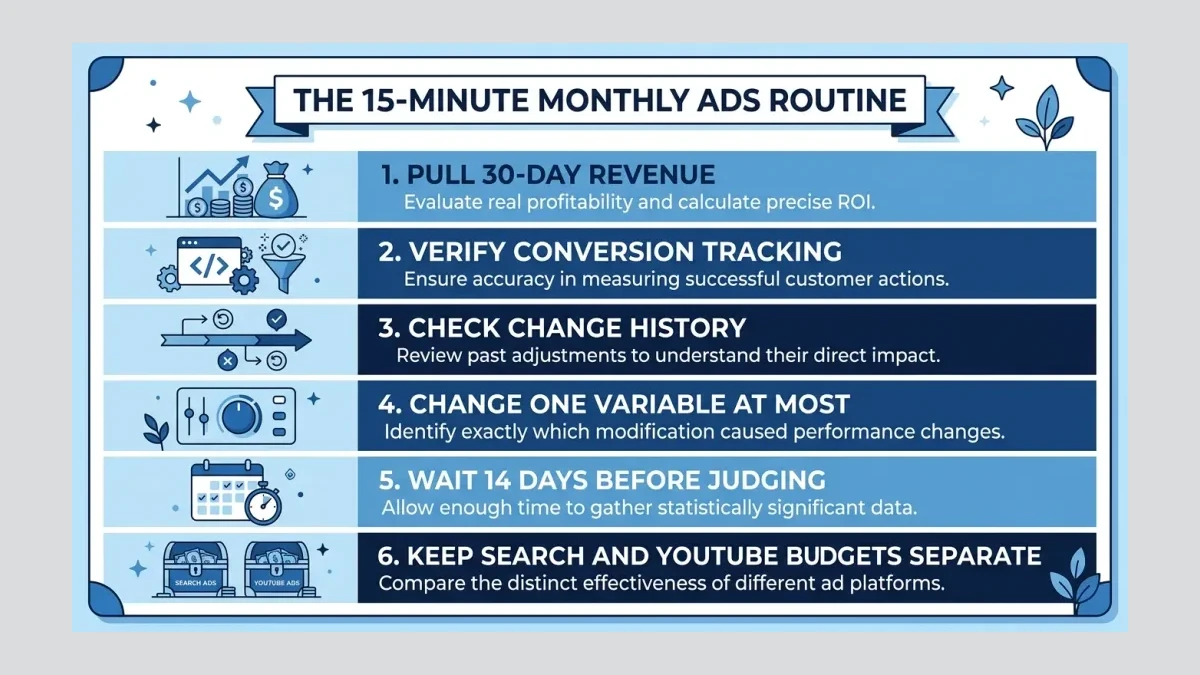
The fix is simple, and it is a calendar habit, not a settings hack. One 15-minute review per month, one change at most, a written note of what changed and why. Between reviews, verify tracking before blaming bids — broken conversion data quietly corrupts every bidding decision, a failure mode we broke down in GA4 tracking errors that drain Pakistani ad budgets.
Run the account on this loop:
- Pull 30-day revenue and leads by campaign from your order data — not from Google Ads alone.
- Confirm conversion tracking is intact before interpreting any performance dip.
- Review the change history; if more than two significant edits landed this month, stop editing.
- Change at most one variable per campaign — bid strategy, budget, or targeting. Never all three.
- Mark the date of every significant change and wait a full 14 days before judging it.
- Keep Search and YouTube intentions in separate campaigns with separate budgets.
- Ask your agency or Google representative when channel prioritization reaches your account, and set it deliberately when it does.
- Log the decision in one sheet: date, change, expected effect, actual effect after 14 days.
If reading that list felt uncomfortable because your account changes daily, that discomfort is the diagnosis.
Read next: Why Smart Bidding keeps raising Pakistani CPAs and How auto-applied recommendations drain Google Ads revenue.
If your Google Ads account has been rebuilt more than twice this quarter and performance keeps sliding, the problem is usually editing cadence plus broken conversion signals — both fixable in weeks, not months. Pakistan’s leading Google Ads management agency WeProms Digital audits accounts against exactly this checklist, sets a deliberate change cadence, and reports revenue instead of vanity metrics. Book a free account review at weproms.com/contact-us, email hello@weproms.com, or message WhatsApp +92 300 0133399.
Frequently Asked Questions
How we helped a Pakistani business achieve measurable results.
How long does Google Ads take to recover after I change campaigns?
Expect 7 to 14 days of unstable performance after any significant change to bids, budget, targeting, or structure, because Smart Bidding re-enters its learning phase. Judge nothing during that window. If performance has not stabilized after three weeks, the change itself — or your conversion tracking — is the likely culprit, not the algorithm.
How often should I change my Google Ads campaigns?
For most Pakistani small and mid-sized accounts, once a month is the right cadence, with at most one significant change per campaign. Daily edits keep the bidding system in permanent learning, so results look random. Seasonal events like Ramadan sales justify an extra planned change, not continuous improvisation.
Is automatic bidding better than manual bidding in Pakistan?
Automatic bidding usually outperforms manual bids once conversion data is accurate and left alone long enough to learn. Manual daily bids made sense a decade ago; today they mostly compete with a system that processes more auction signals than any human can. The edge comes from clean conversion tracking and restraint, not from out-tinkering the machine.
What does WeProms charge to fix a struggling Google Ads account?
A one-time Google Ads audit for Pakistani businesses typically starts around PKR 60,000, with ongoing management priced against your monthly spend. WeProms Digital quotes fixed scopes before starting — audit, tracking repair, restructuring, and monthly management are priced separately, so you are never billed for activity you cannot see. Request a quote through the contact page and you will get a written scope within two working days.
Should I pause a campaign that is suddenly performing badly?
Usually no — not until you check the change history and conversion tracking first. A sudden drop is more often a tracking failure, a recent edit, or a learning reset than a dead campaign. Pausing destroys the data the system needs to recover. Investigate first, change one variable if needed, and give it 14 days.
About WeProms Digital
WeProms Digital is Pakistan’s leading paid media and Google Ads management agency, headquartered in Lahore, serving Pakistani SMEs, ecommerce brands, and B2B teams across Lahore, Karachi, Islamabad, Rawalpindi, Faisalabad, and Multan.
The team specializes in Google Ads management, PPC account audits, and conversion tracking repair, with a documented change-cadence discipline that keeps Smart Bidding accounts learning instead of lurching.
Get in touch: hello@weproms.com · WhatsApp +92 300 0133399 · weproms.com/contact-us
Sources & References
- Google Ads Help — About automated bidding
- Google Ads Help — About Performance Max
- Search Engine Land — When paid media optimization starts working against you — August 25, 2026
- Search Engine Roundtable — Google Ads Channel Settings Prioritization Slider — August 26, 2026
- Search Engine Land — Google tests channel prioritization controls for Performance Max — August 26, 2026
- PPC Newsfeed — Google Ads conversion measurement update (7-14 day learning period) — July 2026
- Search Engine Journal — Why Running YouTube Ads Like Search Will Burn Your Budget — August 26, 2026
- Search Engine Roundtable — Search Forum Recap, August 26, 2026 — August 26, 2026
Additional reading from industry feeds: