Sara Khan · October 10, 2026 · Last updated: October 2026
The CITED framework breaks AI visibility into five working parts: C for Check crawl access, I for Information that answers the question, T for Third-party proof, E for Entity consistency, and D for Demonstrate freshness. Pakistani businesses that get named inside ChatGPT and Google AI answers are rarely there by luck; they score on all five parts while their competitors score on none.
Pakistan counted 116 million internet users at the start of 2025, according to DataReportal’s Digital 2025: Pakistan report. A growing share of those people now ask an assistant instead of scrolling ten blue links: best CRM software Pakistan, reliable solar installer Lahore, top SEO agency Karachi. The assistant answers with three to five named sources.
Everyone outside that shortlist is invisible in the conversation.
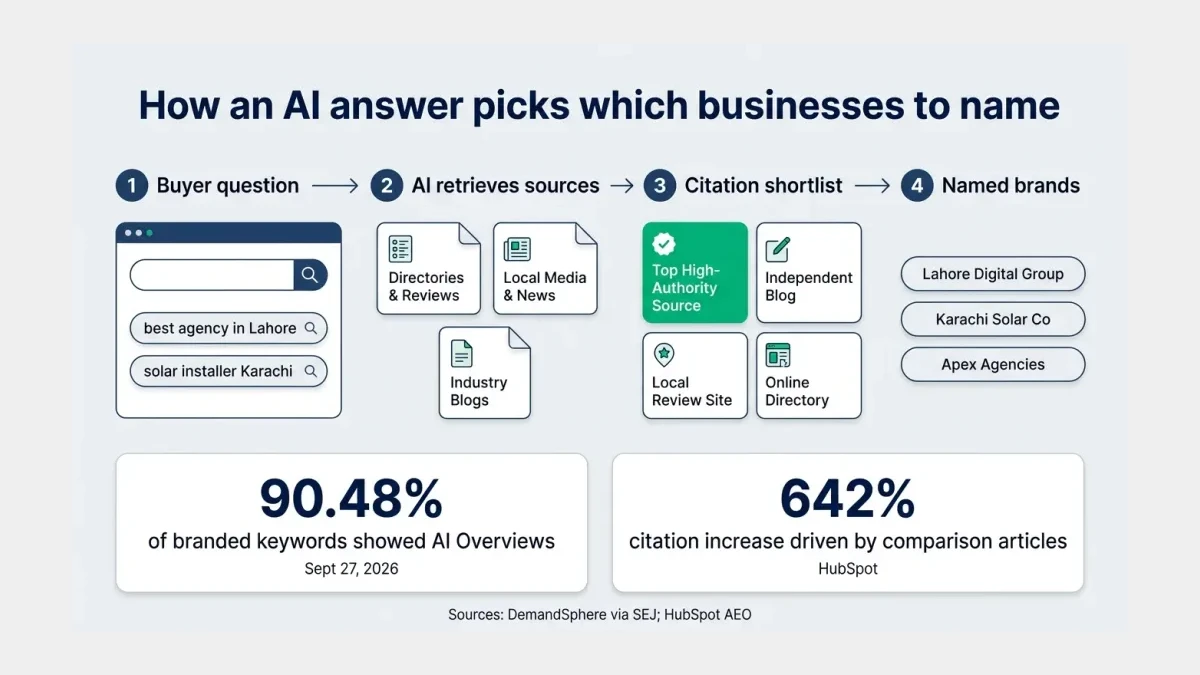
The speed of the shift is what most owners underestimate. DemandSphere’s daily tracking showed AI Overviews on 26.12% of branded keywords on September 1, 2026, and on 90.48% by September 27, while Ahrefs’ 100-brand panel recorded an AI Overview on 5 of 98 usable brand-name searches on July 1 and on 63 of 100 by September 30, as Search Engine Journal reported. Both datasets describe the same event: Google’s AI layer moved from occasional to near-universal on brand-name searches inside a single quarter. When Google summarizes even the search for your exact company name, ranking first no longer guarantees you control what the buyer reads.
Every Pakistani family has one relative who, asked for a caterer, names the same two names every time. AI answers behave like that relative; they repeat the businesses that the sources they read keep mentioning. Ask ChatGPT for the best digital marketing agency in Lahore and it will not invent a shortlist — it will quote one it has already read.
C — Check crawl access: can AI systems even read your site?
The mechanical question comes before any content strategy: are the crawlers that feed AI answers allowed to read your pages at all? robots.txt — the plain-text file at the root of your domain that tells automated crawlers what they may fetch — decides this, and Pakistani sites get it wrong in both directions.
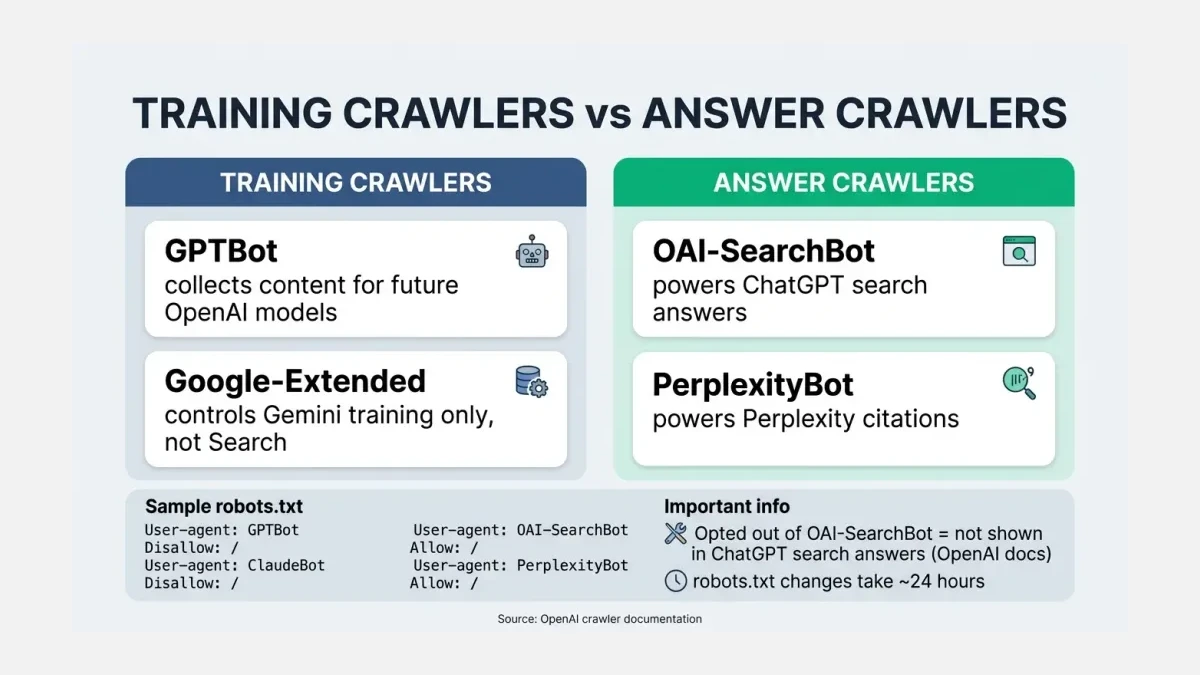
The crawlers are not one thing. GPTBot is OpenAI’s training crawler, which collects content for future model versions; OAI-SearchBot is the separate crawler that surfaces websites inside ChatGPT’s search answers. OpenAI’s crawler documentation is explicit: “Sites that are opted out of OAI-SearchBot will not be shown in ChatGPT search answers, though can still appear as navigational links.” Each setting is independent, so a site that “blocked AI” back in 2024 may have quietly removed itself from ChatGPT’s citation layer while the training block achieved nothing visible. OpenAI adds that robots.txt changes take roughly 24 hours to register, which makes fixing this a same-week win.
Two mistakes recur in audits. The blanket block — User-agent: * with Disallow: / — hides the site from Google and Bing as well, cutting off the traffic the site depends on. The Google-Extended confusion is subtler: that robots.txt token only controls whether already-crawled content may train Gemini or feed certain grounding features, and blocking it does not remove a site from Google Search, because Googlebot keeps crawling either way.
The check takes ten minutes. Open yoursite.com/robots.txt in a browser; it must return plain text, not an HTML page or a 404. If GPTBot, ClaudeBot, or PerplexityBot appear under Disallow, work out whether the original intent was to block training or to block being cited, because the fix differs. WeProms Digital, a Lahore-based generative engine optimization agency, starts every AI visibility audit with this file, and publishes AI-crawler access rules plus an llms.txt — a plain-text index that tells AI models what a site contains — on its own site as standard practice.
One defensible claim most consultants avoid making: in 2026, the average Pakistani business site is absent from AI answers because of its own robots.txt more often than because of anything a competitor did. That imbalance will invert as awareness spreads, which is exactly why fixing the file is cheap now and expensive later.
I — Information that answers: write passages AI can lift
AI engines extract passages, not pages. When ChatGPT or Google’s AI Overviews — the AI-written summaries that now sit at the top of many results pages — assemble an answer, they lift self-contained blocks that make sense on their own. A page that answers “how much does it cost” inside one dated paragraph gets quoted; a page that buries the number in paragraph eleven does not. Pakistani service pages written as brochures, all adjectives and no specifics, give a retrieval system nothing to lift.
Comparison content earns disproportionate citations. HubSpot’s marketing team recorded a 642% increase in citations for comparison articles and a 58% increase in overall mentions after restructuring content for answer engines, as documented in its AEO guide for digital PR. The same surface is expanding for buyers comparing vendors: a Semrush study of US desktop keywords found the share of commercial-intent results pages carrying an AI Overview grew 71% between November 2025 and April 2026. A Pakistani brand with zero comparison pages is conceding the exact queries where decisions happen.
The pattern repeats: businesses get named when they answer the questions buyers actually type — best [category] in [city], [option A] vs [option B], [category] price in Pakistan — in a format a machine can quote. Build those pages with real numbers, named locations, and visible dates. Keep every paragraph self-contained so it survives extraction.
“Earned media that appears in AI results now carries more influence than traditional coverage alone.” — HubSpot Marketing Blog, AEO for digital PR, October 8, 2026
Start with five questions your buyers actually ask, one page each. Answer in the first sixty words, date the page, and add one PKR figure or one named city so the passage is worth quoting.
T — Third-party proof: citations follow coverage, not claims
Book a free strategy call - we'll audit your current setup and identify the highest-impact fixes.
What a business says about itself is weak evidence inside AI systems; what independent sources say is strong evidence. HubSpot’s analysis reaches the same conclusion from the data side: placement in a top-tier outlet does not automatically produce a citation, because some publications and content types generate citations at far higher rates than others. Measuring PR by volume alone optimizes for a metric that AI answers ignore.
For a Pakistani business the proof layer is local: expert commentary in Dawn, Profit by Pakistan Today, TechJuice, or ProPakistani; consistent listings in relevant directories; reviews that name the city and the service. One earned mention in an outlet that AI systems repeatedly quote outweighs a pile of anonymous directory links, because citation weighting follows coverage graphs, not submission counts. HubSpot’s guidance for marketing leaders frames the stakes plainly: a competitor that earns consistent citations for the ten prompts defining a category becomes the default answer buyers see.
The shortcut industry is real, and it is getting burned. Anthropic’s September threat intelligence work identified around 70 websites posing as independent local news outlets — all linked to a France-based ad agency — publishing at least 8,913 articles across roughly 20 languages to inflate authority rankings. Anthropic banned the organization behind the network, and its updated usage policy, effective November 12, 2026, now explicitly bans “manipulat[ing] the sources from which search engines or AI systems draw answers,” as Search Engine Journal reported and Anthropic’s own policy announcement confirms. Google’s spam policies already treat attempted manipulation of its generative AI responses as spam. A vendor selling dozens of fake articles for a few thousand rupees is selling a ban, not a shortcut.
“Ran a quick scrape with SerpApi this morning and found that 93 out of 100 enterprise brands had AI Overviews present for them.” — Chris Long, co-founder of Nectiv, September 30, 2026, quoted by Search Engine Journal
Inventory every independent mention of your business that exists today, then list the five publications your buyers respect. One useful commentary pitch a month, sustained for two quarters, outbuilds any link package sold on WhatsApp.
E — Entity consistency: one identity across every listing
Entity consistency — keeping your business name, address, and phone number identical across your site, your Google Business Profile, directories, and press — is the least glamorous letter in CITED and the most commonly broken. AI systems merge “Kips Lahore”, “KIPS Pvt Ltd”, and kips-lahore.com into one entity only when independent sources connect them. Inconsistency splits your evidence across three weaker identities, and each fragment gets cited for a different version of your name.
Google made brand measurement easier this year. Search Console’s branded queries filter, announced November 2025 and opened to all eligible sites in March 2026, shows clicks, impressions, and click-through rate for queries Google classifies as branded, typos included. That filter gives a Pakistani owner a free before-and-after baseline for who searches the company name — the number AI visibility work moves first.
Claim and verify the Google Business Profile this week, fix one canonical spelling of the business name everywhere it appears, and link the About page to the profile. If the Maps presence itself is weak, the underlying fixes overlap heavily with why a shop stops showing on Google Maps: the same entity evidence feeds both surfaces.
D — Demonstrate freshness: date everything, check weekly
AI answers favor pages that prove they are current, and the surface itself moves weekly — Ahrefs noted that AI Overviews “vastly increased at the start of September” 2026. Dated pages, visible update notes, and refreshed comparisons give a retrieval system a reason to cite you instead of a competitor’s stale page from 2023. Put a visible “last updated” line on every page that carries a price, a ranking claim, or a comparison.
Discovery has a mechanical side too. Google’s John Mueller noted on the October 1 Search Off the Record podcast that AI training crawlers usually have no console where a site can submit a sitemap, and recommended keeping a sitemap at the default name sitemap.xml or publishing an RSS feed, since he has watched AI crawlers fetch both in his own server logs — as SEJ’s SEO Pulse recapped. A Karachi store whose sitemap lives at /sitemap-index-final-v3.xml is invisible to those crawlers by filename alone.
Run a weekly two-minute audit: search your exact brand name on Google, screenshot the AI Overview and its cited links, and repeat on different days. Ahrefs describes each such search as a dated snapshot of what Google says about you; snapshots turn “I think we are invisible” into a trend line. For the Google-specific half of the problem, the checklist in how Pakistani businesses become preferred sources in Google AI answers goes deeper, and the growth in leads arriving directly from Claude shows where this goes once citations start.
Getting cited across ChatGPT, Google AI Overviews, and Perplexity is a system — crawler access, structured answers, earned coverage, entity cleanup, and dated updates — not a one-time plugin install. At WeProms Digital, we run that system end to end for Pakistani brands: AI visibility audits and monitoring start at your robots.txt and end with a monthly citation report you can act on. Email hello@weproms.com or message WhatsApp +92 300 0133399.
Read next: Selling inside Google’s AI search results and the GEO playbook for Pakistani service businesses.
Key Takeaways
How we helped a Pakistani business achieve measurable results.
- Check crawl access first: blocking GPTBot does not block ChatGPT search, because OAI-SearchBot is the citation crawler — and OpenAI’s own docs confirm opted-out sites do not appear in ChatGPT search answers.
- Write passages, not brochures: comparison articles drove a 642% citation increase for HubSpot’s team, and self-contained dated paragraphs are what AI engines lift.
- Earn local proof: one citation-worthy mention in Dawn, Profit, TechJuice, or ProPakistani beats bulk directory submissions, while fake-source networks are now explicit policy violations at Anthropic and Google.
- Keep one entity: identical name, address, and phone across your site, Google Business Profile, and press; baseline brand searches with Search Console’s branded queries filter.
- Show freshness: keep sitemap.xml or an RSS feed at default names so AI crawlers find you, date every price page, and snapshot what AI says about your brand weekly.
Frequently Asked Questions
How do I check whether ChatGPT mentions my business?
Ask ChatGPT eight to ten questions your real buyers would ask — “best [your service] in [your city]” — on different days, and note which businesses get named and which sources get cited. Screenshot each answer. Repeating this monthly matters more than a single check, because AI answers vary between sessions and update as the sources behind them change.
Does blocking GPTBot remove my business from ChatGPT?
No. GPTBot collects content for training future OpenAI models; ChatGPT search and citations run on OAI-SearchBot, a separate crawler with separate robots.txt rules. Many Pakistani sites that “blocked AI” in 2024 blocked the wrong bot and lost citations. Allow OAI-SearchBot if referral traffic and citations from ChatGPT matter to you.
How long does AI visibility take to build in Pakistan?
Crawler and entity fixes register within days to weeks; citations accumulate over two to four months as AI systems recrawl and re-answer questions. The surface moves fast once evidence exists — DemandSphere showed branded AI Overviews jumping from 26.12% to 90.48% of tracked keywords inside September 2026 alone.
What does AI search visibility cost in Pakistan?
WeProms Digital scopes it as a one-time audit plus a monthly monitoring retainer priced in PKR, sized by the number of pages, prompts, and competitors tracked; request a quote through the contact page. Treat any vendor promising “guaranteed ChatGPT rankings” as a red flag — no vendor controls what AI systems answer.
Is AI visibility just SEO with a new name?
The disciplines overlap on crawlability, entities, and content quality, but the target differs: SEO competes for positions on a list of results, while AI visibility competes to be quoted inside a generated answer. A page can rank first and still lose the AI summary above it — 63 of 100 global brand-name searches carried an AI Overview by September 30, 2026.
About WeProms Digital
WeProms Digital is an AI search visibility agency headquartered in Lahore, serving Pakistani SMEs, ecommerce brands, and B2B teams across Lahore, Karachi, Islamabad, Rawalpindi, Faisalabad, and Multan.
The team specializes in generative engine optimization, entity consistency, and digital PR for AI citations, with a track record of building the crawler access, structured content, and citation profiles that ChatGPT and Google AI answers draw on.
Get in touch: hello@weproms.com · WhatsApp +92 300 0133399 · weproms.com/contact-us
Sources & References
- DataReportal — Digital 2025: Pakistan — March 3, 2025
- OpenAI — Overview of OpenAI Crawlers (GPTBot, OAI-SearchBot) — accessed October 10, 2026
- Anthropic — Usage Policy (Acceptable Use Policy) — effective November 12, 2026
- Anthropic — 2026 Usage Policy Update — October 8, 2026
- Search Engine Journal — AI Overviews Have Spread To Most Big-Brand Searches — October 9, 2026
- Search Engine Journal — Claude’s New Rules Target Fake Sources Built To Sway AI Answers — October 9, 2026
- HubSpot Marketing Blog — AEO for digital PR — October 8, 2026
- HubSpot Marketing Blog — AEO for marketing leaders — October 8, 2026
- Semrush Blog — 4 types of keywords in SEO (+ examples) — October 9, 2026
- Search Engine Journal — SEO Pulse: Google Ends Spam Update, Shares Crawl Timing Ranges — October 10, 2026
Additional reading from industry feeds: