
By Sara Khan · WeProms Digital · November 10, 2026
Last updated: November 2026.
The pattern repeats across one-person retail businesses in the UK: the shop looks busy, the DMs never stop, and none of it belongs to the owner. On 8 November 2026, Culture Secretary Lisa Nandy said the UK government is “looking seriously” at extending its proposed under-16 social media ban to online marketplaces such as eBay, Vinted and Depop, with first regulations expected before Parliament by the end of 2026 and initial restrictions from spring 2027. For an attar shop in Leicester turning over around £4,200 a month almost entirely through Instagram DMs (illustrative figure — substitute your own), the news is one more reminder that a selling channel you rent can change its rules without asking you.
The short answer is yes — and the OWNER framework breaks the move from DM-only selling into five steps: O for Own the storefront, W for Widen discovery, N for Nurture the list, E for Evidence trust, and R for Ramadan-proof the calendar. It is deliberately sequential; each step makes the next one cheaper, and none of them requires abandoning the Instagram account that feeds the shop today.
O — Own the storefront: your catalogue, your prices, your checkout
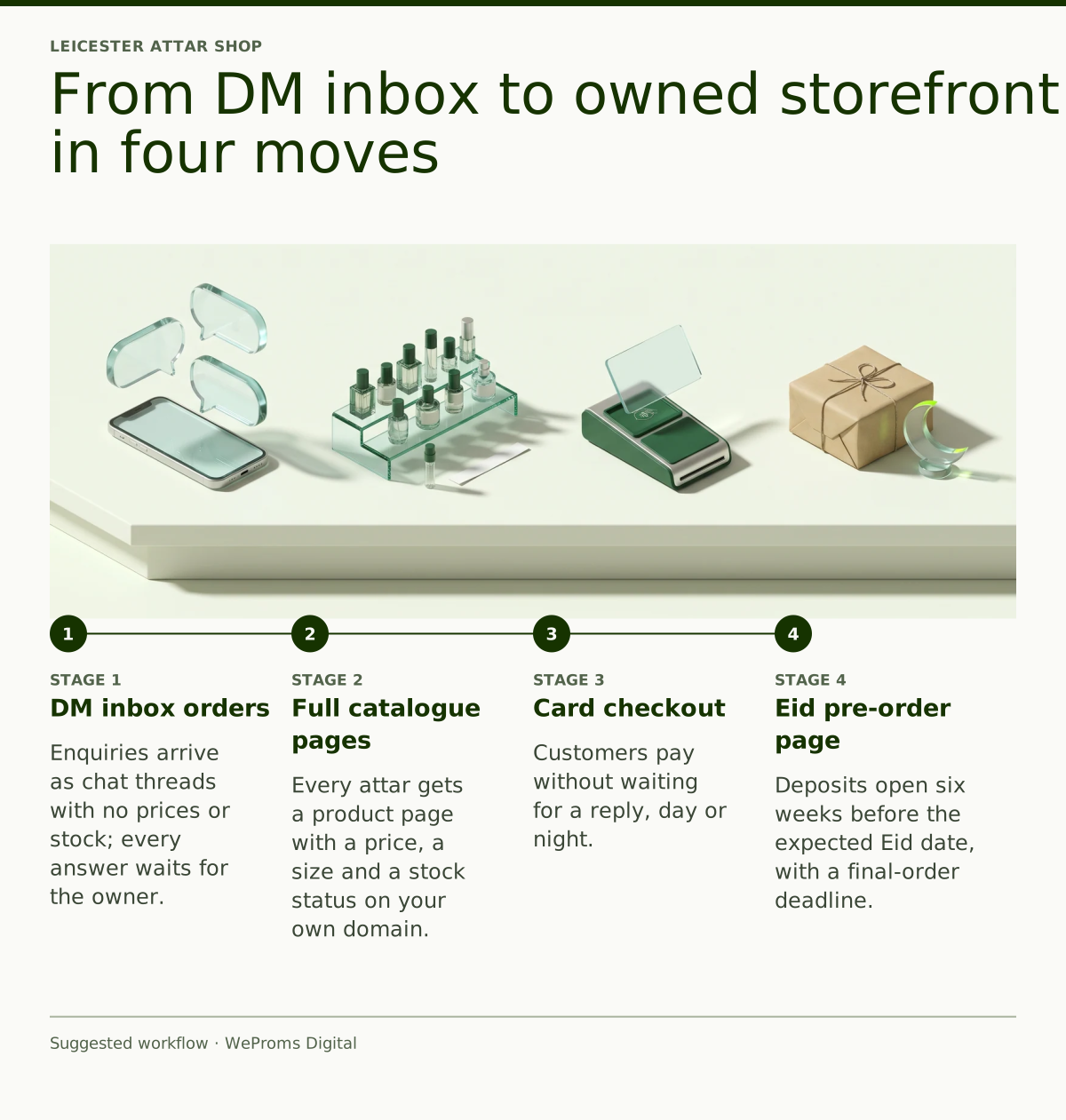
Social commerce — selling inside social apps rather than on your own site — feels free because the catalogue costs nothing: a grid of posts, prices on request, orders by message. The cost is hidden in the friction. Every enquiry becomes a private negotiation; the same customer asks the price of the same 12ml oud five times because the answer is buried in a chat thread from March. Running the Eid rush through one DM inbox is like running the whole Golden Mile through a single till: every customer queues behind every other customer, and the queue never clears before the shop closes.
Owning the storefront means a product page with a price, a size and a stock status, on a domain you control, with checkout that takes cards. Platforms make this ordinary now; check Shopify’s UK pricing for the hosted route or a WordPress install with WooCommerce if a family member already maintains one, and take payment through Stripe’s UK checkout so customers can also tap Apple Pay. The comparison below is the same Eid customer, taken two ways:
| The same customer, the same order | Instagram DMs only | DMs + website |
|---|---|---|
| Taking the order | Voice notes and back-and-forth at midnight | Product page, size chosen, two taps |
| Payment | Bank details typed into chat, or cash on collection | Card or Apple Pay through Stripe checkout |
| The record | Scattered across chats and screenshots | One order history and one customer list, with consent |
| Being found | Only when the algorithm shows the post | Google search, Maps, and links that work everywhere |
| Eid-week capacity | You answer every enquiry personally | The pre-order page absorbs the rush |
The worked example in the chart above is illustrative, not a benchmark: 40 of every 100 DM enquiries become paid orders when every answer depends on you replying, and around 63 per 100 when the catalogue and checkout serve customers while you sleep. If your numbers do not move like that after adding a proper site, the bottleneck is usually the catalogue itself — missing prices, missing sizes, one blurry photo per bottle — not the channel.
W — Widen discovery: be findable where the question gets asked
An Instagram-only shop is invisible to every question asked outside the app. Brides search “attar shop near me in Leicester” on Google; gift buyers ask AI assistants and TikTok search what to buy an aunty who dislikes alcohol-based perfume; new students find the Golden Mile by map pin. Semrush’s analysis of how search behaviour is heading into 2027 describes buyers moving across search, social platforms, video and AI answers in a single research journey rather than living in one app. So what? A shop that exists only in one feed misses every leg of that journey except one.
The practical moves are unglamorous. Claim and complete the Google Business Profile with photographs and opening hours; give every product page a plain descriptive title (“alcohol-free bakhoor attar oil, 12ml, Belgrave Road Leicester”); keep the Instagram account because it feeds discovery too — but as one door among several, not the whole building. A quarterly review of what the other attar counters in the city post, following Semrush’s competitor-analysis practice, tells you which gaps are yours to fill; it costs an afternoon every three months. None of this replaces the community that already finds you; it catches the customer who has never heard of you and never will, if the answer has to arrive through a DM.
N — Nurture the list: contacts you are allowed to message
The DM inbox is a rented list; the algorithm decides who sees your reply, and you cannot export a single thread. N replaces it with consent — under UK GDPR and the privacy rules the Information Commissioner’s Office (ICO) enforces, permission you asked for, recorded, and can prove. A simple form on the new website, or a one-line ask at the end of an order, is enough to start.
Ready to paste into the order-confirmation message:
“Assalamu alaikum — thank you for your order. If you would like first access to our Eid gift boxes, tap here to join the list. We send 3 to 4 updates a year, and you can reply STOP at any time to leave.”
The wording matters: say what the list is for, say how often, and make leaving as easy as joining. A list built this way is small, but it converts at wedding-season and Eid speed because every name on it chose to be there; shops that moved off a closing bio-link page learned this sequence the hard way, and the same logic applies here. The nurture habit is one email or one WhatsApp broadcast before each season — bakhoor in autumn, gift boxes before Eid, a restock note after — not a weekly newsletter nobody opens.
E — Evidence trust: reviews, halal positioning, real photographs
Fragrance is a trust purchase; nobody mails £40 to a stranger for a bottle they cannot smell. E puts the proof the community already asks for onto the page: alcohol-free oil-based attar stated plainly for customers who avoid alcohol-based perfumes; real photographs of the actual bottles rather than supplier renders; the family behind the counter named because a desi family business is itself a credential; and Google reviews invited after every completed order, in the same confirmation message as the list ask. The review request should be honest and light — “if the attar arrived safely, a few words on Google help other families find us” — never incentivised, which violates review platform rules and reads as exactly what it is.
Trust evidence compounds. Fifty reviews mentioning Eid gifting and wedding favours do quiet work in search results, in Maps, and increasingly inside AI answers that quote what customers wrote. A website without evidence is a brochure; the same pages with proof become the reference the whole community links to when the question “do you know a good attar shop?” circulates in the group chat.
R — Ramadan-proof the calendar: pre-orders with deadlines
The Islamic calendar decides the shop’s year, so the website should be built around it. Ramadan is expected to begin around 8 February 2027, subject to moon sighting, with Eid al-Fitr around 10 March 2027, again subject to moon sighting (date reference). Deposits open six weeks before the expected Eid al-Fitr date — late January, in plain English — with the stocking phase running through Ramadan, reminders in the last ten nights, and a clearly stated final-order deadline about a week before Eid, after which the page shows a waitlist instead of a buy button. Distinguish the phases deliberately: early interest collects emails, confirmed orders collect deposits, and delivery promises nothing beyond the deadline.
Run the numbers before deciding the pre-order is too small to bother with (worked example, illustrative): a £38 Eid gift box carries £14 of oils and packaging, £4.50 delivery, and about £1.35 in card fees, leaving contribution — price minus the direct costs of fulfilling the order — of £18.15 per box. One hundred and twenty pre-orders produce £2,178 of contribution without a single late-night DM, and industry reporting on Google’s November AI Mode ad expansions signals that AI-led, conversational discovery keeps growing; meeting it with a page instead of an inbox is the whole trick. Treat the early numbers as ranges rather than promises — measurement writers at MarTech make the same argument for any unstable marketing process — and adjust the second season’s deposit window against what the first one actually sold.
Read next: what a proper website should cost a UK mithai shop and replacing a closing bio-link page for a halal caterer in Surrey, BC — the method transfers to the UK.
We have worked with diaspora-owned retail and food businesses across the UK and Gulf on this exact migration — catalogue, checkout, consent-based list and seasonal calendar — and WeProms Digital builds ecommerce websites for overseas Pakistani businesses that stand on their own domain, with Shopify and WooCommerce development scoped to a one-counter shop rather than a department store. Talk to us at hello@weproms.com or WhatsApp +92 300 0133399, or through the contact page.
Key Takeaways
- Own the storefront first: a product page with a price, size, stock and card checkout converts enquiries the DM inbox loses to delay and repetition.
- Widen discovery beyond the feed: Google, Maps and AI answers reach the customers who never see your posts.
- Nurture a consented list with a clear purpose, honest frequency and an easy opt-out — the inbox is rented, the list is owned.
- Evidence trust with alcohol-free positioning, real photographs, family naming and unhurried review requests.
- Ramadan-proof the calendar: deposits open six weeks before the expected Eid date (around 10 March 2027, subject to moon sighting), with a final-order deadline that protects delivery.
Frequently Asked Questions
What does a simple ecommerce website cost a UK attar shop?
Platform subscription is the visible cost — Shopify’s UK pricing page lists current monthly tiers — and the one-off build cost varies with catalogue size and photography. WeProms scopes each project individually after a short call and quotes in GBP for UK clients; we do not publish package prices in articles. A one-counter attar shop is a small build, and it is priced like one.
Will Instagram DMs stop working when the new UK rules arrive?
Nobody knows yet which platforms the regulations will cover. The first regulations are expected before Parliament by the end of 2026, initial restrictions from spring 2027, and ministers have only said they are “looking seriously” at including online marketplaces. Treat the timeline as a nudge rather than a deadline — the stronger reasons to move are reach, payment friction and Eid capacity, which already cost orders today.
Do I need customers’ permission to message them about Eid pre-orders?
Yes. Under UK GDPR and the ICO’s direct marketing rules, you need consent you asked for and can prove, plus an easy way to opt out in every message. The template in this article includes both. Collecting consent through your own website form or an order confirmation is straightforward and keeps the list entirely yours.
How far before Eid 2027 should pre-orders open?
Six weeks before the expected Eid al-Fitr date — so late January 2027, with Eid expected around 10 March 2027 subject to moon sighting. Stock builds through Ramadan, reminders land in the last ten nights, and the final-order deadline sits about a week before Eid so delivery promises survive the rush.
Can WeProms move my Instagram DM shop onto a real website?
Yes. We have worked with diaspora-owned retail and food businesses across the UK and Gulf on catalogue builds, Stripe and Apple Pay checkout, consented lists and seasonal pre-order pages. Message hello@weproms.com or WhatsApp +92 300 0133399; replies come in UK business hours.
About WeProms Digital
WeProms Digital is a Lahore-based ecommerce and web design agency working with overseas Pakistani and halal-minded business owners across Leicester, London, Birmingham, Dubai, Toronto, and beyond.
The team specialises in ecommerce website development, Shopify and WooCommerce builds, and consent-based customer list systems, with a track record of moving chat-led shops onto owned storefronts that trade through Ramadan, Eid and wedding season.
Get in touch: hello@weproms.com · WhatsApp +92 300 0133399 (replies in UK and Gulf business hours) · weproms.com/contact-us
Sources & References
- Retail Gazette — Shopping or social? What an under-16 ban could mean for resale — November 9, 2026
- Ignite Visibility — Franchise and Multi-Location Marketing News — November 9, 2026
- Shopify — UK pricing — accessed November 2026
- Stripe — UK pricing — accessed November 2026
- Apple — Apple Pay UK — accessed November 2026
- Semrush Blog — The future of SEO: Where search is heading in 2027 — November 9, 2026
- timeanddate — Ramadan dates and moon sighting — accessed November 2026
Additional reading from industry feeds: