By Sara Khan · WeProms Digital · Last updated: September 24, 2026
TL;DR: Buffer’s 2026 analysis of 9.6 million Instagram posts found the strongest engagement at Wednesday noon, Wednesday 6 PM, and Thursday 9 AM, with evenings from 6 to 11 PM consistently strong and Wednesday the single best day. The study reports times in each account’s local time, so a Pakistani business should read every window as Pakistan Standard Time — and plan around Pakistani evenings, not American mornings.
Does the time you post on Instagram still matter in 2026?
Yes, but for a narrower reason than it did five years ago. Instagram’s feed is algorithmic, so posting time no longer decides whether a follower sees a post the way it once did; what posting time still decides is how quickly and how densely the first wave of engagement arrives, which in turn shapes how widely the algorithm distributes the post beyond the existing audience. Buffer’s 2026 study, published September 23 and built on 9.6 million posts, measured engagement per follower rather than raw totals, which controls for account size and isolates timing quality.
Engagement per follower — a metric that divides likes, comments, saves, and shares by follower count, so a 3,000-follower Lahore brand is compared fairly against a 300,000-follower multinational. The persistence of clear time-of-day and day-of-week patterns across 9.6 million posts is itself the finding: audiences still concentrate their scrolling into windows, and posts that land inside those windows start with an advantage. Timing is not the largest lever — content quality and format matter more — but timing is the cheapest lever, because moving a post costs nothing.
What is the best time to post on Instagram in Pakistan Standard Time?
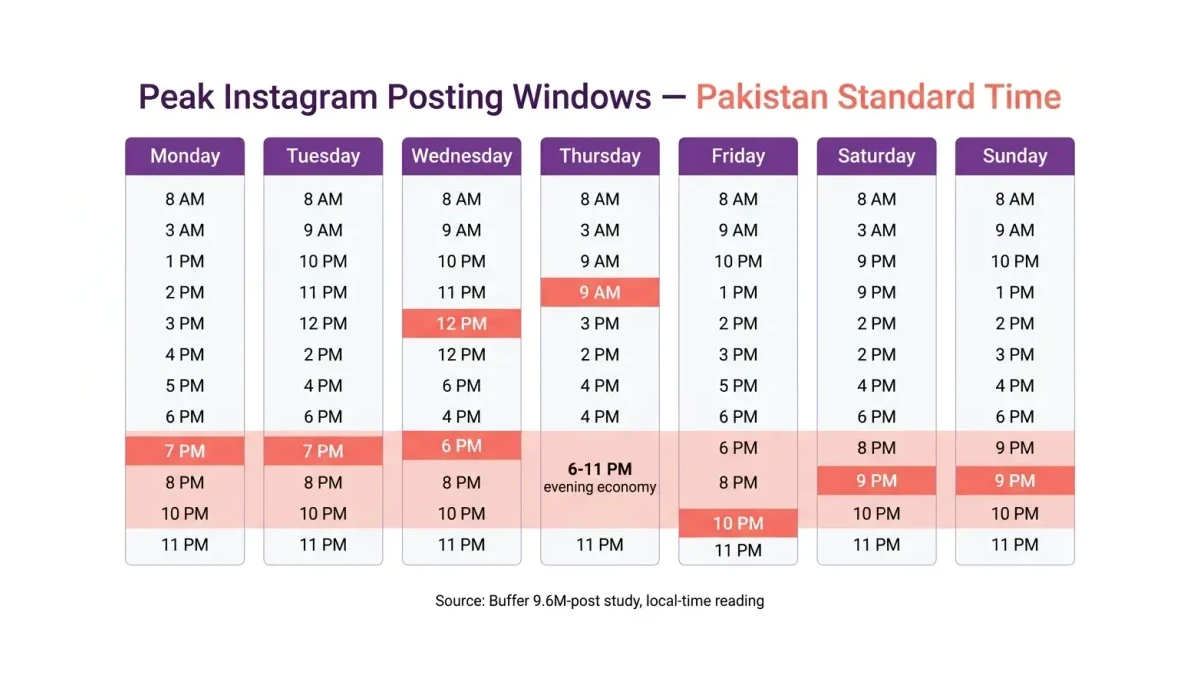
The three strongest individual slots in the entire 9.6 million-post dataset were Thursday at 9 AM, Wednesday at 12 PM, and Wednesday at 6 PM, with the 6-to-11 PM evening band performing well on most days. Buffer reports these times in the viewer’s local time, so for a Pakistani business whose audience is overwhelmingly in Pakistan, each window should be read directly as Pakistan Standard Time (UTC+5): Thursday 9 AM PKT, Wednesday 12 PM PKT, and Wednesday 6 PM PKT.
The pattern repeats across the week in a shape that should feel familiar to anyone who has watched a Pakistani household’s data usage. Monday peaks at 7 PM; Tuesday at 7 PM; Wednesday holds the double peak of noon and evening; Thursday breaks pattern with its 9 AM strength; Friday, Saturday, and Sunday all shift late, peaking at 10 PM, 9 PM, and 9 PM respectively. The evening cluster from 6 to 11 PM PKT is where Pakistani attention is most reliably available — after office hours close, after dinner, and during the long pre-sleep scroll that powers most consumer discovery in Lahore, Karachi, and Islamabad alike.
| Day | Peak window (PKT) | Pakistan scroll note |
|---|---|---|
| Monday | 7:00 PM | Post-work browsing; strongest for services and B2B-adjacent content |
| Tuesday | 7:00 PM | Mirror of Monday; good for product launches needing a same-week follow-up |
| Wednesday | 12:00 PM and 6:00 PM | Study’s strongest day; lunch break plus evening double peak |
| Thursday | 9:00 AM | Morning commute window; rare morning opportunity for Pakistani brands |
| Friday | 10:00 PM | Latest peak of the week; post-Friday-prayer day shifts attention late |
| Saturday | 9:00 PM | Weekend evening browsing before Sunday |
| Sunday | 9:00 PM | Sunday-night scoping for the week ahead; consumer browsing runs high |
Which days work best for Pakistani audiences — and why Friday is not Saturday?
Wednesday is the strongest day in Buffer’s dataset, and Friday and Saturday are the weakest, a ranking that independent roundups of the study corroborate; that global pattern lands differently on a Pakistani calendar because Pakistan’s weekend is Sunday-centered, with Friday as a half-working, prayer-anchored day rather than a Saturday-style leisure day. The practical consequence: the global “avoid Friday and Saturday” advice should only be half-applied in Pakistan. Saturday evening remains valuable for Pakistani consumer brands precisely because it is not a school-and-office night, while Friday’s engagement compresses into the late evening after 10 PM PKT, when the day’s obligations have cleared.
The underlying mechanic is attention availability, not calendar labels. A window works when people are free, awake, and holding their phones — three conditions that cluster on Pakistani weeknights after 8 PM, on the Thursday morning commute, and on Sunday evenings. A Lahore clothing brand posting its new drop at 3 PM on Friday is competing with Friday prayer, lunch, and family obligations; the same drop at 10 PM Thursday rides the week’s most reliable browsing window. Global studies rank days; Pakistani brands should rank attention.
How do Ramadan and Eid change the best posting time in Pakistan?
Ramadan inverts the Pakistani daily rhythm, and posting windows should invert with it. During Ramadan, daytime attention fragments around fasting and office-hour compression, while the post-iftar and pre-sehri hours — roughly 8 PM to 2 AM — carry the heaviest browsing of the entire year; engagement that normally peaks at 7-9 PM stretches deep into the night, and the pre-dawn sehri window becomes a genuine second peak for food, fashion, and gifting brands. The Eid sequence then concentrates commerce into tight bursts: Eid shopping peaks in the last ten nights, and posting should front-load product content before that closing rush rather than during it.
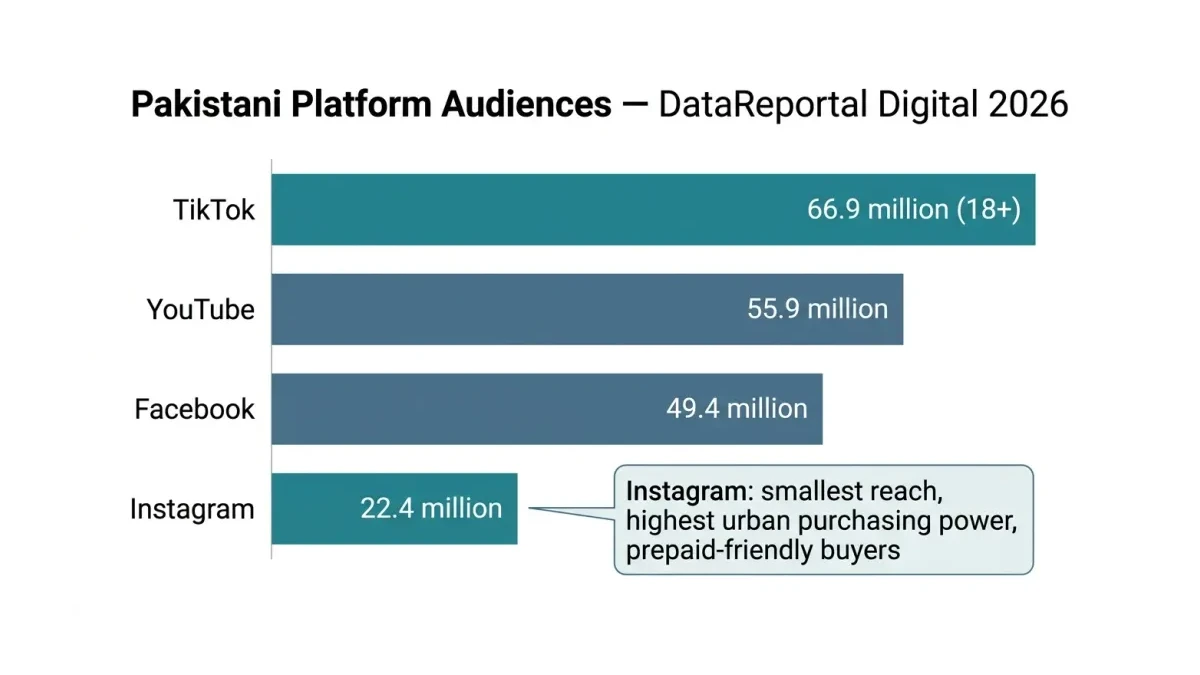
Buffer’s dataset does not isolate Ramadan, so treat this as structural reasoning rather than a measured effect; the direction is nonetheless reliable enough to plan by, because it follows from when Pakistani audiences are awake and shopping rather than from any platform mechanic. The broader scale matters here too: DataReportal’s Digital 2026: Pakistan report counts 22.4 million Instagram users in Pakistan on Meta’s advertising-reach estimates, inside 79.9 million active social media identities. That is a large population whose collective bedtime moves for one month a year — the brands that move with it collect the seasonal spike, and the ones that keep a fixed schedule sleep through it.
What is the best time for a Lahore clothing brand versus a Karachi food business?
A clothing brand selling unstitched lawn to women across Punjab peaks with leisure browsing — weeknight evenings from 8 to 11 PM PKT and the Sunday 9 PM window — because that is when its audience browses, saves, and sends posts to family members for opinions. A Karachi food business selling evening delivery peaks earlier and later at once: the 6-to-8 PM decision window when households choose dinner, plus the 11 PM-to-midnight late-order window that foodpanda-era Karachi has normalized. An Islamabad B2B services firm should ignore most of the evening economy and take the Wednesday noon and Thursday 9 AM slots, when decision-makers scroll between meetings.
The channel shape differs too. Pakistani consumer brands convert Instagram attention through DMs that hand off to WhatsApp, which means the posting window must overlap with the hours the sales team can actually answer inquiries; a 10 PM post that generates 40 DMs answered at 11 AM the next day converts at a fraction of its potential. The platform-choice context is worth stating plainly: DataReportal counts TikTok reach in Pakistan at 66.9 million users aged 18 and over, YouTube at 55.9 million, and Facebook at 49.4 million, against Instagram’s 22.4 million. Instagram is Pakistan’s smallest of the four major platforms by reach, but it skews toward higher-income urban buyers — exactly the audience a Lahore fashion brand or an Islamabad services firm is paying to reach, and the audience most likely to prepay instead of choosing cash on delivery.
Should reels, carousels, or photos get the prime slot?
The strongest window should go to the format with the longest distribution tail, which for most Pakistani brands means reels. Reels are the only format Instagram consistently pushes to non-followers, so a reel published into the 8-to-11 PM PKT window collects both the follower velocity and the exploratory distribution; carousels and single photos draw mostly on existing followers and should fill the secondary windows. The allocation question matters more than any single format choice.
The logic is portfolio allocation rather than format fashion. A reel at Thursday 9 AM PKT answers Buffer’s strongest single slot with the format most likely to travel; a carousel at Wednesday noon serves the audience that already knows the brand and is most likely to save a detailed post — price lists, fabric charts, service menus. Saves weigh heavily in Instagram’s ranking because they signal reference value, and carousels collect saves at a higher rate than single images precisely because they carry more reference material per post.
The practical schedule for a Pakistani consumer brand is not one best time but a ladder: reels in the prime evening windows, carousels in the noon and morning slots, and single photos wherever a real-time moment — a stock arrival, a same-day offer — matters more than reach. A brand that gives every format the same 9 PM slot is running every clock in the shop on one battery.
How do you find your own best posting time instead of relying on averages?
Averages from 9.6 million posts describe the global center of gravity, but a specific audience — Faisalabad dentists’ patients, Clifton fashion buyers — can sit anywhere around it, so the average is a starting hypothesis rather than an answer. Independent roundups — across social platforms broadly and Instagram specifically — land on the same evening economy, which is reassuring but no substitute for your own data. Instagram Insights, inside the free professional dashboard, shows the exact hours an account’s own followers are active; that graph outranks any external study, including Buffer’s. A two-week test grid settles the rest: post the same format at three different windows across two weeks, hold content quality constant, and compare engagement per follower rather than raw likes.
The discipline that separates a schedule from a strategy is measurement. Record each post’s window, format, reach, saves, and profile visits in one sheet; after thirty posts, the account’s own pattern will be legible, and it will usually confirm the evening economy while revealing one counterintuitive slot worth keeping. This is also where a managed approach earns its fee. WeProms Digital, a Lahore-based social media marketing agency, builds these test grids and content calendars for Pakistani brands across Lahore, Karachi, and Islamabad — and the timing question is always answered with the account’s own Insights data first, global benchmarks second.
Read next: What Pakistani businesses should post on Facebook and Instagram in 2026 · Why followers never become customers in Pakistan
The cost of ignoring timing is invisible, which is why it persists. Nothing breaks when a post goes out at 3 PM PKT; the post simply reaches a fraction of the people it could have reached, every single day, while a competitor posting the same product at 9 PM collects the saves, the DMs, and the WhatsApp inquiries. Email hello@weproms.com or message WhatsApp +92 300 0133399, or visit weproms.com/contact-us, to have a posting schedule built around your audience’s actual activity data.
Sources & References
- Buffer — Best Time to Post on Instagram in 2026 (9.6 Million Posts) — September 23, 2026
- DataReportal — Digital 2026: Pakistan — 2026
- Buffer on LinkedIn — Best Time to Post on Instagram in 2026 Announcement — September 2026
- SQ Magazine — Best Times to Post on Instagram — 2026
- Digital Media Consultancy — Which Social Media Platform Is Right for Your Pakistani Business in 2026 — 2026
- Apaya — Best Times to Post on Social Media — 2026
- Howsociable — Best Time to Post on Instagram — 2026