

By Sara Khan · August 16, 2026 · Last updated: August 2026.
The warning now repeating through Pakistani marketing groups is that Anthropic’s decision to watermark Claude’s output makes AI-written content a detectable liability that Google will punish.
That sentence does a lot of work, and almost none of it survives contact with data. Ahrefs analyzed top-ranking Google pages this month and found that 5.3% of them are entirely AI-generated; fully synthetic pages already sit in Google’s top three positions, and Google’s stated position has not moved — it evaluates whether content serves people, not how it was produced. The watermark itself is a compliance mechanism: Article 50 of the EU AI Act took effect on August 2, 2026, and roughly 190 organizations, including Google, Meta, Microsoft, and OpenAI, have signed the transparency code behind the markings. Meanwhile, the measurable damage to organic visibility runs along a different axis entirely. AI Overviews now reach 2.5 billion monthly users, and position-one click-through rates in SISTRIX’s German panels collapsed from 27% to 11% as AI answers absorbed the click. What actually drives the loss is anonymity, not detection — and anonymity is an editorial problem, which is precisely why it survives every platform announcement.
The watermark proves a pipeline, not an authorship
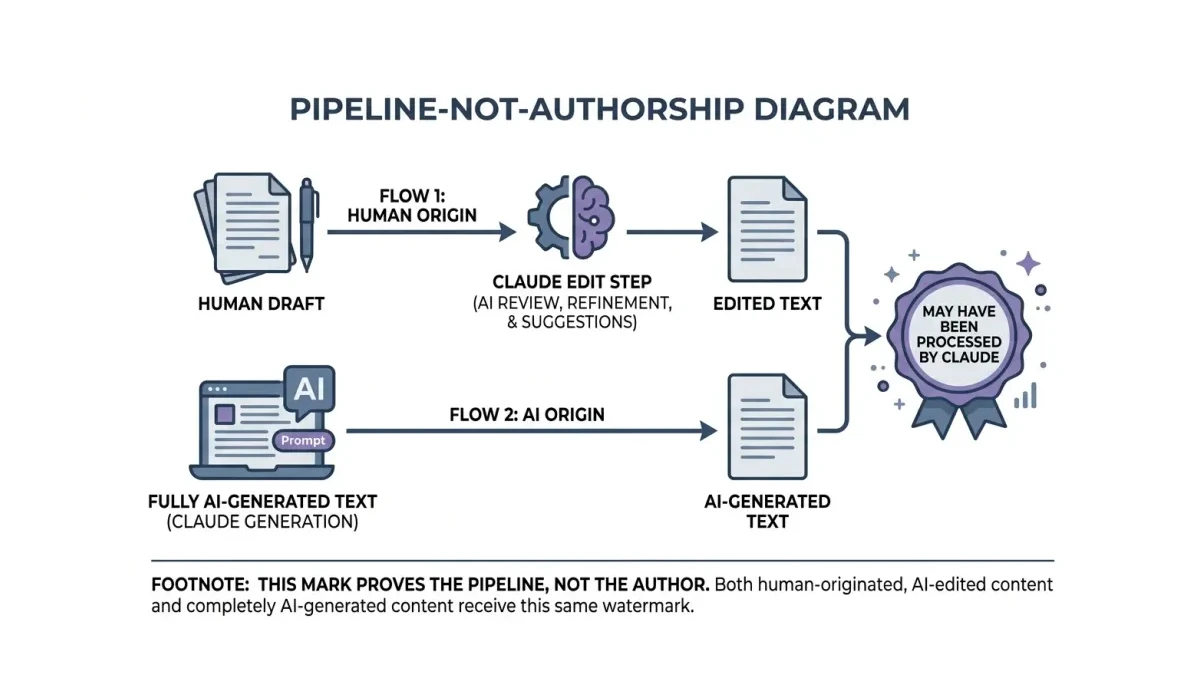
Anthropic’s marking system, disclosed in detail on August 15, is a version of SynthID-Text, the watermarking approach Google DeepMind published in 2024. The mechanism is subtle: a language model generating text does not choose each next word deterministically, and the watermark quietly biases those random choices toward a pattern checkable only with a secret key. There are no hidden Unicode characters, no metadata tag, no em-dash tell. Detection requires the key; short passages under roughly 200 tokens carry too little signal to test reliably, per Search Engine Journal’s authorship analysis; and heavy rewriting or translation degrades the pattern. That is why Anthropic’s own documentation says marked content “may have been processed by Claude,” and why Ahrefs’ reading of the announcement lands on the operative word: processed.
The mark works like the token slip at a NADRA office. It proves you passed through the counter; it says nothing about who filled your form. Paste your own draft into Claude to fix typos, and the output can carry the mark; spin fifty synthetic articles from a one-line prompt, and that output carries the same mark. A detection signal that cannot distinguish an editor’s polished draft from a content farm’s dump cannot function as a ranking penalty, and an absent mark proves even less, since format conversion and paraphrasing both erase it. Detection identifies pipelines. It has never identified quality.
Detection was never the ranking risk
Google has spent years saying it does not care how content is produced, only whether it exists to manipulate rankings, and the indexing data agrees with the posture. Ahrefs found a gentle gradient — not a cliff — between low-AI and very-high-AI pages in Google’s index, with no hard line anywhere in the distribution. The correlation that matters runs through thin content: AI generation makes bad content cheap, so bad content became abundant, but the causal lever is editorial absence, not the tool. Brands that switched providers to dodge Claude’s mark bought themselves weeks at most, because Google’s Gemini app already marks its text output with SynthID, OpenAI applies SynthID to supported images and audio, and the same transparency code binds every major provider to the same obligation.
The practical conclusion for a Lahore or Karachi brand is uncomfortable in a useful way. If neither the tool nor the mark determines performance, then the agency contract — what gets researched, who reviews, what data enters the draft — is the entire risk surface. That reframing turns a technology panic into a procurement question, and procurement questions have answers you can write into a scope of work.
The loss that matters is measured in clicks, not penalties
SISTRIX documented position-one click-through rates falling from 27% to 11% across German panels as AI Overviews expanded, and the pattern generalizes wherever the format appears: rankings matter more while delivering less traffic per position. At Google I/O 2026, Search leadership declared flatly that Google search is AI search, and Neil Patel’s analysis of the announcements assembled the scale: AI Overviews reaching 2.5 billion monthly users and AI Mode crossing one billion monthly users in its first year. The dual mandate this creates — rank in results and earn citation in the AI layer above them — is already visible in what Pakistani brands should measure instead of raw organic traffic.
The traffic that survives the filter behaves differently, and better. Search Engine Land’s published dataset shows LLM referral traffic converting at 20%, the highest-converting tactic it measured. A user who clicks a citation arrives after an AI has already synthesized the options; they are verifying, not browsing, and a page that confirms the AI’s claim inherits a level of trust no banner ad buys. Citation quality therefore outweighs citation volume — one link from an AI answer that pre-qualifies the visitor outranks a page-one position that collects impressions. Brands still chasing rankings for traffic that never buys are optimizing the wrong denominator.
What the machine keeps when it cites you
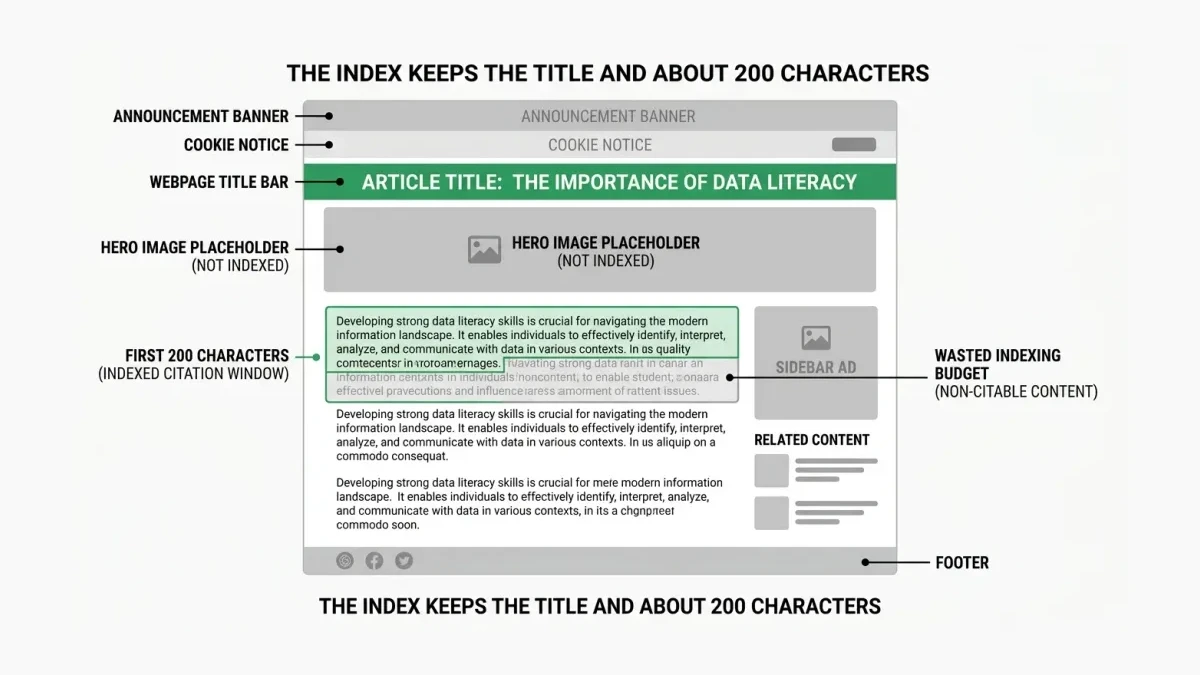
Citation mechanics turn out to be more mundane than the watermark debate suggests. French consultancy Resoneo, reading a since-removed field in ChatGPT’s traffic, found that the model’s in-house index serves licensed partners and unsigned sites identically — and that what the index keeps of any page is the title and roughly the first 200 characters, as Search Engine Journal reported on August 15. Read that again. The announcement banner, the cookie notice, the hero headline your developer loved: every line of template chrome above the first paragraph spends a budget the engine allocated before your argument began. Front-loaded, answer-shaped openings are not a style preference; they are the format citations are made from.
The second mechanic is information gain — the degree to which a page carries something an engine cannot synthesize from results it already has. Original pricing in PKR, city-level service coverage, first-party numbers from a real operation, documented behavior of local platforms like Daraz, Foodpanda, or JazzCash: these are the assets a model reaches for when it needs to distinguish options. Generic synthesis offers the model nothing to gain, and a page with nothing to gain gets summarized rather than cited. That logic, not watermark detection, is what will quietly decide which Pakistani brands appear inside AI answers over the next two years — and it applies to human-written generic copy just as mercilessly as to machine-written generic copy.
What Pakistani brands should actually buy
The PKR 15,000-per-month “unlimited AI articles” package is the product this whole episode should retire, not because a watermark will expose it but because undifferentiated synthesis earns zero citations by construction. The disclosure regime itself points at the better purchase: Article 50(4) obligations carve out content published under human editorial review where a named person holds editorial responsibility, which makes the review layer simultaneously the compliance answer and the performance answer. A falsifiable prediction to hold this argument to — a brand spending PKR 15,000 monthly on raw AI output will collect close to zero AI-search citations within a year, while the same budget spent on four editorially reviewed pages carrying original data will be citable for the queries that matter. At WeProms Digital, we run generative engine optimization as an editorial discipline — entity groundwork, primary data, named reviewers, citation tracking — because the machine rewards exactly what a careful reader would.
So the principle, stated plainly: visibility in AI search belongs to brands a machine can describe precisely and a reader can verify independently. Audit your content for describability, not detectability — ask whether an engine summarizing your page could name what only you provide, and if it cannot, neither can a customer. Watermarks will never identify the brands that win that audit. Citations will.
Read next: What Pakistani brands should measure as organic traffic vanishes into AI answers and Audience-first SEO: ranking for buyers, not traffic.
If your team is weighing content purchases against AI-search visibility, WeProms Digital audits exactly this — entity coverage, citation gaps, and the editorial layer that earns both. Reach hello@weproms.com, WhatsApp +92 300 0133399, or the contact page for a review scoped to your category.
Sources & References
- Ahrefs — Claude Now Watermarks Everything It Writes. Here’s What It Means for Marketers — August 14, 2026
- Search Engine Journal — Anthropic Reveals What The Watermark Is And How It Can Be Defeated — August 15, 2026
- Search Engine Journal — What A Claude Watermark Can & Can’t Tell You About Authorship — August 14, 2026
- Neil Patel — Google Search Is Becoming AI Search: What This Means for Your Brand — August 14, 2026
- Search Engine Journal — SEO Pulse: ChatGPT’s Index, GA Benchmarks, Google Refiles Complaint — August 15, 2026
- Search Engine Land — LLM traffic converts differently — here’s what to do about it — August 14, 2026
- Google DeepMind — SynthID — accessed August 2026
- European Commission — AI Act regulatory framework — accessed August 2026
Additional reading from industry feeds: