
By Abdul Rehman · WeProms Digital · November 9, 2026
Watch five parents try to book one assessment on your website. Write down where each one stalls. Fix that one obstacle, then watch five more. Nielsen Norman Group’s research found five users surface about 85 percent of usability problems. Your cost: one evening, five chai refills, and a notebook.
Last updated: November 2026.
If you run a tutoring centre in northeast Calgary — Falconridge, Taradale, Martindale — you already know the sound: the front-desk phone ringing all afternoon while the booking form on your CAD 2,400 website (an illustrative build price — substitute your own invoice) sits quiet. Pakistani parents across NE Calgary want exactly what you want: a Grade 12 math assessment booked before January’s diploma exams. The phone rings because the form argues with them, and this walkthrough shows how to find every argument, fix the biggest one, and count what changes.
Start with the definition that settles the argument. Usability — how easily people can complete a task using an interface — is not a property of your website; it is a property of the person using it, as the Nielsen Norman Group’s updated Usability 101 guide explains.
“A usability claim is therefore always relative: usable for whom, for which task, and under what conditions?” — Nielsen Norman Group, Usability 101
Your website is usable for you. You built it, you know where the fees hide, and you have never once had to book yourself. A mother on a fifteen-minute work break, reading English as her second language, on a phone with one hand — that is a different user, under different conditions, and she is the one who decides whether your form survives.
First, watch five parents try to book one assessment
Recruit five parents from your own community: the school run, the mosque car park, the Ramadan volunteer list. Give each one the same task, word for word: “Book a Grade 11 physics assessment for your daughter for next Saturday, using only this website.” Then sit beside them and say nothing while they try.
The number five is not a shortcut; it is arithmetic. Jakob Nielsen’s classic research at Nielsen Norman Group shows a single test user already reveals about 31 percent of a design’s usability problems, and five users surface roughly 85 percent of them. After the fifth parent, you mostly watch repetitions of the same stalls. The hardest part of this entire step is keeping quiet — no pointing at the button, no “it’s just there, aunty” — because every hint you give erases a finding your website will keep.
Then write down the exact moment each parent stalls
Do not record opinions; record moments. “She scrolled past the fees.” “He went back twice from the form to the homepage.” “She asked me the price out loud at minute two.” Picture an umrah package flyer: your uncle reads the price and the dates first, and everything else is decoration. Parents read your booking page exactly the same way, which means price, timing, and location carry the page, and everything else is supporting material.
The Nielsen Norman Group’s measurement toolkit gives you four simple dials to turn those moments into numbers: success rate — the percentage of users who complete the task, time on task, errors along the way, and a satisfaction rating at the end. Most tutoring centres need only the first one. If two of five parents finish the booking unaided, the success rate is 40 percent, and the three failures are your to-do list, ranked by how many parents each one stopped. For context on how quickly the failures cost you: when a website or app is hard to use, people usually leave rather than fight it — and on a -20 degree January evening in Calgary, the parent who gives up at field seven does not come back tomorrow; she calls the centre across the road. This step is also where smaller operators adjust the plan: a one-teacher home tutor with no form runs the same five-parent test on a WhatsApp catalogue, noting which photo or price question makes each parent stop scrolling.
Next, fix the single obstacle that stopped the most parents
One obstacle, not ten. The instinct to redesign everything overnight is the instinct that produces a new set of stalls by spring. Nielsen Norman Group’s guidance on iterative design — test, fix, then test again is blunt about why: nobody designs a perfect interface on the second try either, so the second test both checks your fix and surfaces what the first test could not see.
Fix the obstacle the way a contractor fixes a stair: the cheapest change that removes the fall. If four of five parents scrolled hunting for fees, put fees in the first screen of the booking page in plain text. If three abandoned at the dropdown for “programme stream”, replace it with a radio button that says Grade 10, Grade 11, or Grade 12. If two asked “is this in English only?”, add one Urdu sentence under the fee line. None of these fixes requires a rebuild; all of them require the notebook from the previous step. A weekly glance at rising searches around tutoring also helps the words you write match the season — the way AnswerThePublic’s trending-keywords view surfaces the searches growing fastest over the last 30 days — because “physics diploma prep” and “fractions help Grade 7” rise in different weeks, and the fix should answer the question parents are typing now. Some fixes are also load-bearing for speed, in the same way oversized product photos make boutique websites crawl on phones — the parent on a school-run pause gives both problems the same two seconds of patience.
After that, cut the booking form down to one screen
Nine form fields, fees buried in a PDF, and no language note — the parent phones instead. That sentence is the “before” column of this table, and it describes most tutoring booking pages we are asked to review.
| The booking path | Before | After |
|---|---|---|
| Fees | Buried in a PDF download | One line under the button, in plain text |
| Form fields | Nine, including two dropdowns | Four: name, phone, grade, preferred day |
| Language | English only | English with one Urdu sentence for fees |
| Confirmation | Silence after submit | WhatsApp note with consent and opt-out |
Four fields, fees up front, an Urdu note, and a WhatsApp fallback with consent. That is the entire “after” state, and the comparison is the argument: the same page, saying the same things, arranged for the parent instead of the owner. The same subtraction logic fixed a Frankfurt bakery’s Ramadan pre-order shop that loaded too slowly on phones — nothing new was added; the obstacles were removed in the order they stopped buyers.
At this point, add a WhatsApp fallback with consent
Some parents will always prefer to message, and in our community that preference is not a bug in your funnel; it is the culture of it. So give the booking page a WhatsApp button as a fallback, not as the main road, and collect consent where the value is obvious — at the confirmation step, after the booking succeeds, not in a banner at the top of the page.
“Consent tells us what we’re allowed to do. Preferences tell us what customers want.” — Jeanne Jennings, Email Optimization Shop, speaking at the November 2026 MarTech Conference, via MarTech
Here is the message to paste into your confirmation flow, consent and opt-out built in, ready for a Calgary winter when a session might move for weather:
“As-salamu alaykum! Your child’s assessment is booked for [day, date, time] at [campus]. Reply with any question. Reply STOP anytime to stop reminders.”
For Canadian businesses this is also the lawful shape of things: consent-first messaging keeps you aligned with Canada’s anti-spam rules for electronic messages, and it respects the community’s trust in the same motion.
Once the simpler path is live, count where enquiries come from
For two weeks, tally every enquiry by source on one sheet: phone, WhatsApp, walk-in, form. The number to watch is the form’s share of bookings, not total enquiries, because total enquiries barely move — the same parents book either way; what changes is how much reception time each booking costs. In an illustrative month for a two-campus centre, 40 enquiries split 55 percent phone, 25 percent WhatsApp, 15 percent walk-in, and 5 percent form; your tally replaces those numbers with your own.
The arithmetic of the shift is what convinces an owner to keep the form honest. Eight phone bookings a day at six minutes each is 48 minutes of front-desk time; if the form absorbs even a third of them, that is roughly 80 minutes a week returned to teaching and follow-ups. If each enrolled student is worth about CAD 300 a term (illustrative — substitute your own fees), then four extra form bookings a month that convert to enrolment represent CAD 1,200 of revenue that used to arrive as interrupted phone calls, with no new marketing spend at all. Measurement discipline is the same habit that settles whether Google Ads really sent a Mississauga tax firm its leads — count at the source, not at the dashboard.
The outcome: a page that stops arguing with parents
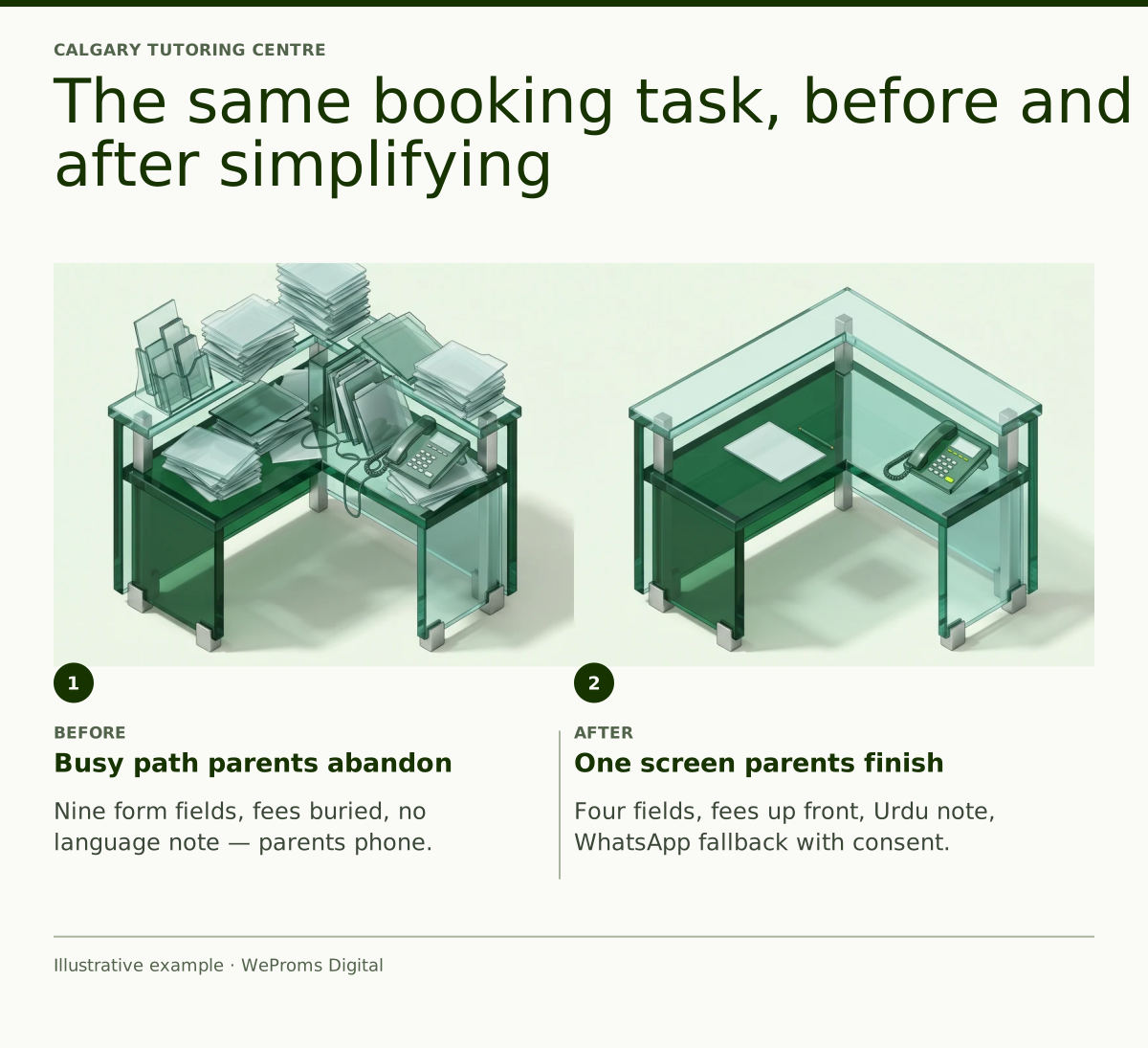
Across the tutoring and service accounts we review in Canada and the UK, this test-and-subtract sequence moves online booking from a rounding error to a steady share of enrolments within one term, and the second five-parent test reliably finds the next obstacle the first one hid. Nielsen Norman Group’s own analysis of its redesign case studies found the UX metrics each project targeted — sales, signups, bookings — improved by 75 percent on average, while noting the results varied widely and the figure is not a direct ROI estimate; treat it as direction, not promise. One Canadian fact sharpens why the page must carry every generation: 20.3 percent of Canadians were aged 65 or older in late 2025, per DataReportal’s Digital 2026 Canada report, so the grandparent helping with enrolment is one in five of the country — though a national age split, on its own, proves nothing about your parent base until your own tally says so.
Two calendar notes before you schedule the work. Alberta’s Grade 12 students write diploma exams in scheduled sittings through the year with the main rounds in January and June, per Alberta’s diploma exams page, which makes November and December the booking season for exam-prep assessments. And Ramadan is expected to begin in the second week of February 2027 — around 8 February, subject to moon sighting; when evening classes shift around iftar and Taraweeh, update the booking page’s hours in the same week, because a parent who books a slot that no longer exists does not rebook — she phones, and the form’s credibility starts over.
Read next: How a Mississauga halal grocery plans a full holiday sales season.
WeProms Digital has worked with tutoring, retail, and service businesses across Canada, the UK, and the Gulf, and conversion-focused website design for diaspora-owned businesses is one of our core services. If your five-parent test produces a notebook too long to fix in-house, our UX and conversion audit turns it into a ranked fix list with the numbers attached — message us on WhatsApp or through the contact page, and we will reply in Canadian business hours.
Frequently Asked Questions
How many parents should I test my website with?
Five is the evidence-based number. One parent reveals roughly 31 percent of usability problems, five reveal about 85 percent, and beyond five you mostly see repeats. If your centre serves two very different groups — say, new-immigrant parents and Canadian-born parents — test three or four from each group rather than five of one.
My website is in English only. Should I add Urdu?
Add one Urdu sentence, not a full translation. Put it where the stall happens: beside the fees, or at the form’s start, confirming price and location in plain words. Full bilingual sites are worth building when enrolment justifies them; a single well-placed sentence fixes most of the hesitation your test will record in year one.
How much does fixing this cost?
The test itself costs one evening and a notebook. Fixes range from free (moving fees into plain text, deleting form fields) to a few hundred dollars if a developer rebuilds the booking flow on platforms like Wix or Squarespace. WeProms does not quote package prices in articles; platform and tool costs sit in Canadian dollars with your vendor, and we scope the work after seeing your five-parent notebook.
When should I hire an agency instead of doing this myself?
Run the five-parent test yourself first — always. Hire help when the notebook lists structural problems (slow pages, broken mobile layouts, a booking system that cannot hold session data), or when the same obstacles return each term. Based on our experience with tutoring and service businesses across Canada and the UK, an agency earns its fee by fixing ranked obstacles, not by redesigning pages that already convert.
We take bookings only on WhatsApp. Does this still apply?
Yes, with the same method and a different object. Watch five parents try to book through your WhatsApp catalogue and note where each one stops: the price photo, the slot list, the reply wait. Fix the biggest stall — usually a pinned price list — and add the consent line from this article before adding anyone to a reminder list.
Sources & References
- Nielsen Norman Group — Usability 101: Introduction to Usability — November 6, 2026
- Nielsen Norman Group — Why You Only Need to Test with 5 Users — March 19, 2000
- MarTech (Marketing Land) — Beyond the opt-in: Engineering consent for better marketing — November 6, 2026
- DataReportal — Digital 2026: Canada — November 2025
- Alberta.ca — Diploma exams — Government of Alberta
- Neil Patel Blog — Trending Keywords in AnswerThePublic: Find What’s Rising on Google and YouTube — November 6, 2026
Additional reading from industry feeds: