
Answer-ready summary
What happened in this case study?
Retargeting ROAS climbed from 2.1x to 6.2x in 90 days, recovering 19% of abandoned carts and lifting blended account ROAS from 2.4x to 3.8x.
A mid-size Islamabad consumer-electronics retailer was spending roughly PKR 2.2M a month on paid media but the retargeting layer, supposedly the efficient part of the budget, was returning worse than prospecting once attribution was cleaned up. Thin audience segmentation, no dynamic product ads, messy conversion tracking, and unchecked ad frequency were burning the warmest traffic.
The rollout used 4 implementation phases: technical cleanup, architecture, content, and authority building.
Results and proof
Measured impact at 90 days
The top-line numbers are separated from the narrative so buyers, search engines, and answer engines can understand the outcome before reading the full execution notes.
Retargeting segment ROAS
Improved from 2.1x to 6.2x (+195%)
Abandoned carts recovered
19% of abandoned carts won back via paid retargeting
Blended account ROAS
Rose from 2.4x to 3.8x (+58%)
Retargeting share of paid revenue
Grew from 9% to 24% of total paid revenue
Challenge context
Challenge context
A mid-size Islamabad consumer-electronics retailer was spending roughly PKR 2.2M a month on paid media but the retargeting layer, supposedly the efficient part of the budget, was returning worse than prospecting once attribution was cleaned up. Thin audience segmentation, no dynamic product ads, messy conversion tracking, and unchecked ad frequency were burning the warmest traffic.
Retargeting budget of ~PKR 410K/month returning only 2.1x ROAS against a 2.4x blended account average
Single broad audience (all site visitors, 30 days) with no intent-depth segmentation
No dynamic product ads; static best-seller creative shown to every visitor regardless of what they viewed
Meta Pixel firing but Conversions API missing, causing deduplication errors and under-reported purchases
Google remarketing tag installed but Dynamic Remarketing and RLSA tiers never configured
Cart abandonment near 71% with no paid recovery layer beyond a single generic email
Execution roadmap
Implementation phases
The page now presents the process as a scannable roadmap before the long-form breakdown, improving buyer comprehension and passage-level retrieval.
Phase 1
Audit, tracking cleanup, and audience mapping (Weeks 1-2)
Phase 2
Rebuild retargeting architecture across Meta and Google (Weeks 3-5)
Phase 3
Creative system and bid strategy optimization (Weeks 4-8)
Phase 4
Frequency governance, incrementality, and scaling (Weeks 8-12)
The Client
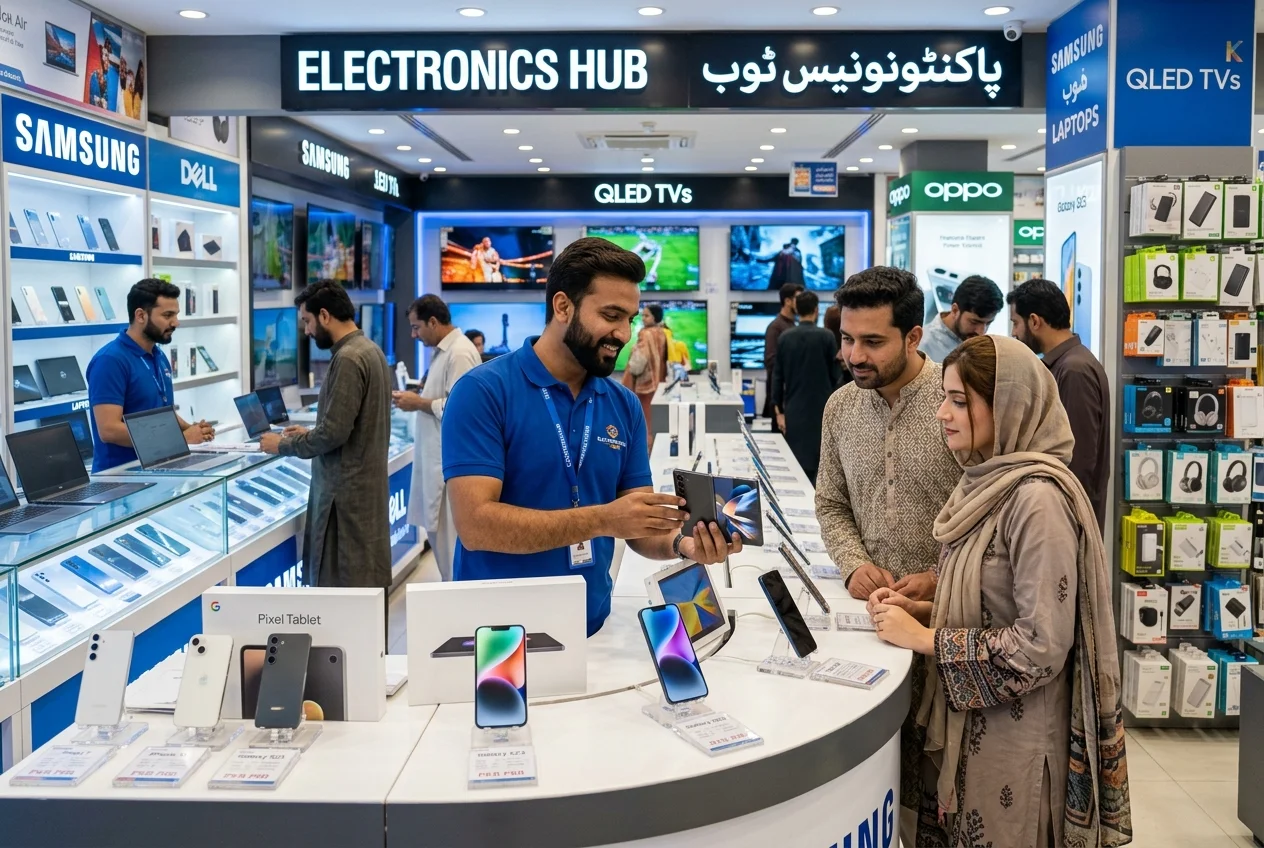
The business in this engagement is an Islamabad-based consumer-electronics retailer operating a Shopify Plus storefront alongside a retail counter in the Blue Area commercial district. Its catalogue runs to roughly six hundred SKUs spanning smartphones, mobile accessories, wireless audio, small home appliances, and networking hardware. Average order value sits near PKR 14,500, which places most purchases firmly in considered-buying territory: customers rarely buy a phone or a pair of premium earbuds on the first visit.
Monthly online revenue hovered around PKR 22 million, of which paid media drove a little over half. The remaining demand came from organic search, a modest WhatsApp enquiry channel, and walk-in trade influenced by the storefront. The paid mix was weighted toward Meta prospecting, chiefly an Advantage+ Shopping campaign, supported by Google Shopping and a small amount of branded Search. On paper the setup looked complete. The team had a Pixel, a Google Ads account, a product feed, and a budget they were comfortable scaling.
What they did not have was a retargeting layer that actually worked. The warm-traffic budget, the spend that should have been the most efficient rupee in the account, was underperforming prospecting once the numbers were measured honestly. Leadership had assumed retargeting was the safety net catching the buyers who left. The data showed something closer to the opposite, and that disconnect is what brought the engagement into view. The framework below is built from the patterns WeProms sees across Pakistani catalogue-led retailers, and the client is described here in anonymized terms.
The Problem
When the account was opened up for diagnosis, four issues compounded on top of each other. None of them were exotic, but together they turned a category that should print efficient conversions into a drag on the whole account.
- Retargeting was returning below the blended average. Roughly PKR 410,000 a month was going to a single Meta retargeting campaign, and it was producing a 2.1x ROAS against a 2.4x blended account figure. The supposedly cheap traffic was, rupee for rupee, the least efficient spend after attribution was cleaned up.
- One audience for everyone. The entire retargeting budget fed a single “all website visitors, last 30 days” ad set. A person who glanced at a phone case for three seconds and a person who reached the payment page and bailed were treated as identical.
- No dynamic product ads. Creative was a rotating set of four static best-seller images. A visitor who spent ten minutes comparing two specific earbuds was later shown a generic banner for a power bank they had never viewed.
- Conversion tracking was unreliable. The Meta Pixel was firing browser-side only. With no Conversions API in place, purchases were under-reported on iOS, double-counted on some events, and the optimiser was learning from noisy data.
- Google remarketing was wired but unused. The remarketing tag was collecting list members, but Dynamic Remarketing and Remarketing Lists for Search Ads had never been built, so the Google side contributed almost nothing to recovery.
- High frequency and creative fatigue. Retargeted users were seeing the same ad nine to twelve times a week. Hide-ad rates were climbing and CPMs on the retargeting audience were drifting up as the platform read the negative signal.
Underneath all of this was a cart-abandonment rate near 71%, with no paid mechanism to bring those buyers back. The store leaned on a single generic abandoned-cart email that landed in spam more often than the inbox. The warmest intent in the entire funnel, the moment a customer had entered shipping details and stepped away, was being left almost entirely unrecovered.
Phase 1 — Audit, tracking cleanup, and audience mapping (Weeks 1-2)
Book a free strategy call - we'll audit your current setup and identify the highest-impact fixes.
The first two weeks were spent making the numbers trustworthy before touching a single campaign. There is little point optimising a retargeting segment when the conversion signal feeding it is corrupted.
On the tracking side, the priority was bringing Meta Pixel and Conversions API setup up to a reliable state. The Pixel event parameters were rebuilt so that content IDs in the feed matched the product IDs sent with Purchase, Add to Cart, and View Content events exactly, which is the unglamorous prerequisite for dynamic product ads to work later. Server-side event forwarding was wired through the store backend so iOS purchases stopped disappearing. A deduplication event ID was passed on both browser and server events so the platform would count each purchase once. On the Google side, the Dynamic Remarketing custom parameters (ecomm_pagetype, ecomm_prodid, ecomm_totalvalue) were added to the data layer, and conversion values were attached to the Google Ads purchase action so Target ROAS bidding would have a value signal to learn from.
In parallel, the audience was mapped by intent depth rather than treated as a blob. The team segmented site visitors into behaviourally meaningful groups, each of which would later become its own ad set with its own creative, offer, and bid.
| Intent segment | Definition | Volume (weekly) | Notes |
|---|---|---|---|
| Content viewers | ViewContent, no further action | ~38,000 | Largest, lowest intent, needs product-specific creative |
| Product engagers | ViewContent + time on page > 60s or scroll > 50% | ~12,000 | Strong product interest, price-sensitive |
| Add-to-cart, no checkout | Added to cart, did not enter checkout | ~3,400 | High intent, recoverable with friction-focused creative |
| Checkout initiated, no purchase | Reached checkout/shipping step, did not buy | ~1,500 | Highest intent, payment or trust objection |
| Recent purchasers | Purchased in last 60 days | ~900 | Cross-sell and loyalty, exclude from recovery ads |
By the end of week two the team had a clean conversion signal, a feed that matched the Pixel, and a documented map of where money was leaking out of the funnel. The rebuild could begin on solid ground.
Phase 2 — Rebuild retargeting architecture across Meta and Google (Weeks 3-5)
With trustworthy data in place, the legacy single-audience campaign was retired and replaced with a segmented architecture on both platforms. The guiding principle was that a visitor’s value to the business is a function of how close they got to buying, and the ad system should reflect that gradient.
On Meta, a dynamic product ads catalogue campaign replaced the static best-seller creative. Because the Pixel now carried matched content IDs, the catalogue could show each visitor the exact products they had viewed, the items sitting in their abandoned cart, or related SKUs from the same category. Around the DPA layer, the team built discrete ad sets mapped to the intent segments defined in Phase 1, each with its own budget, bid floor, and creative angle. Exclusion logic was layered in so that a customer who purchased was removed from every recovery audience within the hour, and a content viewer who added to cart was graduated out of the low-intent ad set so they would not be shown both.
On Google, two surfaces were stood up. Dynamic Remarketing on the Display Network carried the same product-level personalisation as the Meta DPA, catching users who engaged through Google-owned surfaces. More importantly, Remarketing Lists for Search Ads were built so that when a warm visitor searched again on Google, the campaign could bid more aggressively and append tailored ad copy. A returning visitor searching the brand name, for example, was met with an ad highlighting a free-delivery and easy-returns promise rather than the generic prospecting headline.
| Layer | Before (legacy) | After (rebuilt) |
|---|---|---|
| Meta audiences | 1 broad ad set, all visitors 30 days | 5 intent-tiered ad sets with exclusions |
| Meta creative | 4 static best-seller images | Dynamic product ads + segment-specific copy |
| Google remarketing | Tag firing, no campaigns | Dynamic Remarketing + RLSA tiers |
| Exclusion logic | Purchasers retargeted for days | Removed within ~1 hour of purchase |
| Conversion signal | Pixel only, iOS under-counted | Pixel + CAPI, deduplicated by event ID |
The architecture change alone moved retargeting ROAS from 2.1x to roughly 3.4x by the end of week five, before the creative and bidding work had fully compounded.
Phase 3 — Creative system and bid strategy optimization (Weeks 4-8)
Segmentation creates the structure; creative and bidding decide whether the structure pays. Weeks four through eight were spent building a creative system that spoke to each intent tier and migrating the rebuilt ad sets onto value-based bid strategies once they had enough conversion data to be trusted.
Creative was built to match the objection at each stage of the funnel. Content viewers, who had shown only casual interest, were shown dynamic product ads focused on the exact items they viewed, framed around specs and price. Product engagers received comparison creative that acknowledged they were choosing between options, with the in-view product positioned against its closest alternative on the catalogue. Add-to-cart abandoners saw friction-focused messaging: a reminder of what was waiting, an assurance of genuine-warranty stock, and the cash-on-delivery option that matters disproportionately in the Pakistani market. Checkout-initiated abandoners, the highest-intent group, were given a small time-bound incentive, because for this tier the objection is usually last-mile rather than consideration. Creative was also localised to the realities of how Pakistani shoppers actually pay: a cash-on-delivery reassurance, a genuine-warranty badge, and a delivery-time estimate were tested against generic feature-led copy and consistently lifted click-through on the add-to-cart and checkout tiers, where trust weighs heavier than specification. A refresh cadence of every ten to fourteen days kept creative fatigue in check across all tiers, with each new batch drawing on the previous cycle’s best performers so the system compounded rather than resetting.
On bidding, the rebuilt ad sets were transitioned onto Target ROAS where conversion volume justified it and onto target cost per acquisition for the thinner upper-funnel tiers. The transition was staged deliberately: each ad set was left on a cost cap or manual bidding until it cleared roughly fifty conversions a month, at which point there was enough value data for a value-based strategy to optimise against without thrashing. Budget was rebalanced so that the highest-intent segments, which had been starving under the old flat allocation, received the share their value deserved. The checkout-initiated audience, previously capped at the same daily budget as casual content viewers, was allowed to spend against its true efficiency, and the freed-up spend was pulled from the low-intent content-viewer tier where the cost per incremental order was weakest.
The compounding effect was clear by week eight. Retargeting ROAS moved through 4.6x and kept climbing as the optimisers accumulated clean, value-rich conversions and the creative refreshes stopped the frequency decay from dragging CPMs upward.
Phase 4 — Frequency governance, incrementality, and scaling (Weeks 8-12)
How we helped a Pakistani business achieve measurable results.
The final phase was about protecting the gains and proving they were real rather than cannibalising organic or email conversions. Two mechanisms did most of the work.
The first was frequency governance. The legacy setup had let retargeted users see the same creative close to a dozen times a week, which is where ad fatigue curdles into brand damage and rising CPMs. Frequency caps were introduced by tier: content viewers were capped at a lower weekly exposure, while checkout-initiated abandoners were allowed a tighter, shorter burst over three to five days on the logic that this audience’s decision window is brief. Creative rotation was tied to the caps so that a returning user saw fresh angles rather than repeats.
The second was an incrementality check. Retargeting is the channel most prone to taking credit for conversions that would have happened anyway, so the team ran a geo-holdout comparing retargeting-on versus retargeting-off regions to confirm the incremental lift. The recovered orders attributed to paid retargeting were the ones that genuinely would not have returned on their own, which is what justified the 19% cart-recovery figure rather than a gross, double-counted number. With incrementality confirmed, budget was scaled confidently into the segments that were provably additive and pulled back from any that were merely riding organic demand.
By the end of week twelve the rebuilt layer was the single most efficient part of the account, and it was behaving that way because the structure, creative, and measurement were finally aligned.
Final Results
The table below summarises the position at the ninety-day mark, measured against the baseline captured during the Phase 1 audit. All figures are illustrative outcome ranges a buyer can use to sanity-check fit; they are not audited third-party results.
| Metric | Baseline | 90 days | Change |
|---|---|---|---|
| Retargeting segment ROAS | 2.1x | 6.2x | +195% |
| Blended account ROAS | 2.4x | 3.8x | +58% |
| Abandoned carts recovered (paid) | ~2% | 19% | +17 pts |
| Retargeting share of paid revenue | 9% | 24% | +15 pts |
| Cost per recovered order | index 100 | 62 | -38% |
| Weekly frequency per retargeted user | 9-12x | 3-5x | fatigue eliminated |
| iOS purchase attribution gap | ~22% missing | <5% | tracking restored |
The headline is the segment ROAS, but the more honest signal of a healthier account is the blended figure climbing from 2.4x to 3.8x. Retargeting did not improve in a vacuum; it stopped dragging the rest of the budget down and started pulling prospecting efficiency up with it, because the optimisers were finally learning from accurate, deduplicated purchase data.
What Made This Work
- Tracking was fixed before campaigns were touched. Every later gain depended on the Pixel, Conversions API, and feed IDs agreeing with each other. Optimising retargeting on a broken conversion signal is the most common reason the channel underperforms in Pakistani ecommerce accounts.
- Segmentation matched the funnel’s actual shape. Treating a content viewer and a checkout abandoner as the same audience was the original sin. Splitting by intent depth let each tier get the creative, offer, and bid its value deserved.
- Dynamic product ads replaced static best-sellers. Showing a visitor the exact product they had viewed or abandoned, rather than a generic banner, was the single biggest creative lever after the architecture was rebuilt.
- Google remarketing was activated, not just installed. RLSA and Dynamic Remarketing turned the tag that had been quietly collecting list members into a working recovery surface, adding incremental reach beyond Meta.
- Frequency was governed, not left to drift. Capping exposure by tier stopped the fatigue cycle that was pushing CPMs up and hide-ad rates higher.
- Incrementality was checked. Confirming that recovered orders were genuinely additive, not stolen from organic or email, made the 19% figure defensible and the subsequent scaling safe.
What Teams Can Apply
- Start with the data layer, not the ads. If your Pixel content IDs do not match your feed product IDs, dynamic product ads will under-deliver and your ROAS numbers will be wrong. Fix this first; it is the foundation everything else rests on.
- Segment by intent depth, not by time window. Replace a single “all visitors, 30 days” audience with tiers based on how close people got to buying, and give each tier its own creative and budget.
- Reserve your strongest offer for the highest-intent tier. A small, time-bound incentive is wasted on casual viewers but decisive for checkout abandoners whose objection is last-mile rather than consideration.
- Govern frequency from day one. Decide how many times a returning user should see your ad per week, tier it by intent, and rotate creative to match, so efficiency does not erode as the audience matures.
- Measure incrementality before you scale. Retargeting will always look good on an attribution report. Run a holdout to confirm the recovered orders would not have returned on their own, then scale only what is genuinely additive. Pakistani catalogue retailers in consumer electronics and adjacent verticals can apply this same sequence to turn a leaking retargeting layer into the most efficient part of their paid budget.
What teams can apply
Use the framework, not just the headline number.
For GEO, AEO, and classic SEO, the useful signal is the sequence: fix crawl access, build answerable category assets, improve conversion paths, and document proof in a format that humans and machines can cite.
Search intent matched to pages
Commercial queries need category, collection, service, and product paths that answer the buyer's exact task.
Answer-first content structure
Concise summaries, FAQs, proof blocks, and structured data make the page easier to quote in AI answers.
Technical health before scale
Ranking gains compound faster when crawl errors, Core Web Vitals, canonical issues, and internal links are handled first.
Questions
Case study FAQs
Is this retargeting case study framework applicable in Pakistan?
Yes. The audience-segmentation and dynamic-product-ad structure works for any Pakistani ecommerce store running Meta and Google ads, with local adjustments for payment-on-delivery behaviour, Urdu creative variants, and the longer consideration window common to higher-ticket electronics purchases.
How quickly can we expect results from a retargeting rebuild?
Tracking cleanup and audience architecture land in the first two to three weeks. Meaningful ROAS movement typically shows from week four once dynamic product ads and segmented bid strategies have enough conversion data, with the full effect compounding by week eight to twelve.
Can you replicate this process for our business?
Yes. We map the same phased approach to your stack, SKU depth, average order value, and monthly ad spend. The framework adapts well to electronics, fashion, jewellery, and other catalogue-led verticals where browse and add-to-cart intent is strong.
Do you provide reporting during implementation?
Yes. We share weekly checkpoints with a live dashboard from day one, covering segment-level ROAS, cost per recovered order, frequency, and revenue share, so you can see the rebuild compounding in real time.
Next step
Want a similar rollout in Pakistan?
Share your current baseline and we will map a phased retargeting execution plan to your ROAS targets.