01 / Behind the approach
The decision behind the approach
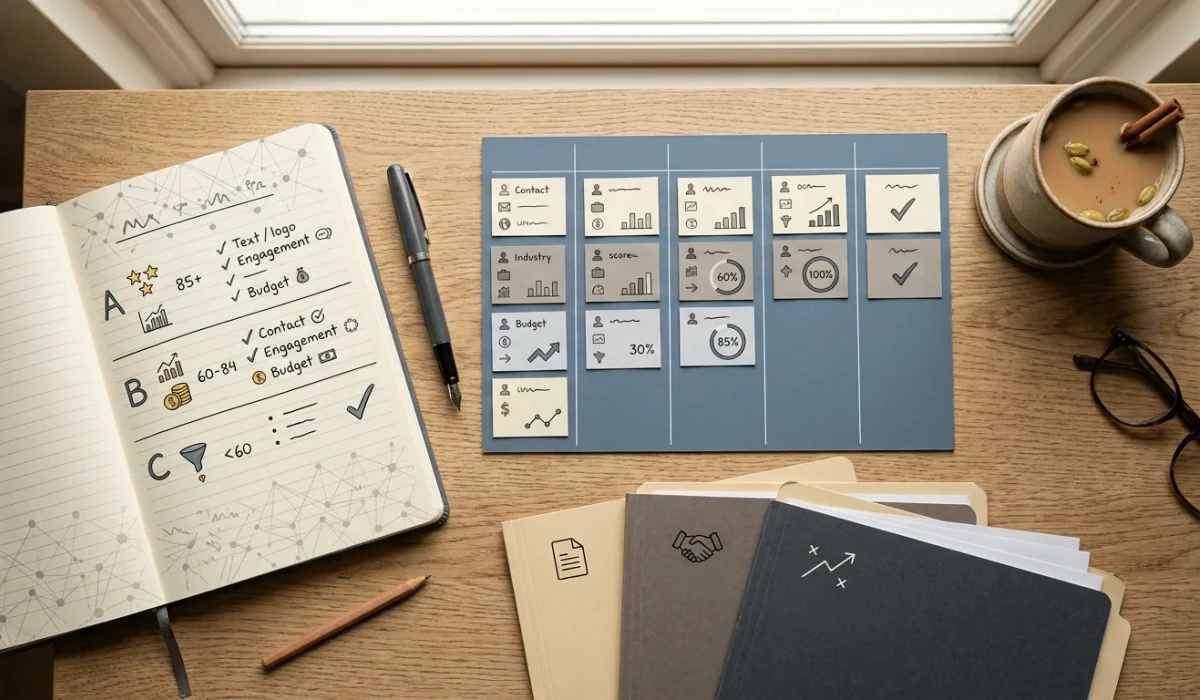
Make fit, urgency, ownership and sales acceptance visible rather than hiding the decision in a single score.
02 / Behind the approach
The scope at a glance
- Diagnostic and Record Cleanup
- Scoring Model and CRM Build
- Handoff SLA and Recalibration
- Reporting and Operating Cadence
01 / Capture
Collect enough context to route the conversation.
Identify the details that help a person respond usefully. Keep contact forms focused, validate essential information and use an appropriate process for sensitive records.
- Give each enquiry a consistent status, an accountable owner and a visible next action.
- Keep the service or product interest attached.
- Check duplicate and incomplete submissions.
- Confirm the receiving team and fallback route.
The working decision
Collect enough context to route the conversation.
Keep the service or product interest attached.
02 / Handoff
Make the next action and its owner visible.
Agree what changes a record from one stage to another. A task should have a responsible person, useful context and an action that can be recorded after the conversation.
- Make fit and engagement signals understandable, with explicit rules for handoff and follow-up.
- Agree what qualifies a lead.
- Check reassignment and unavailable-owner cases.
- Record the reason when a request does not fit.
The working decision
Make the next action and its owner visible.
Agree what qualifies a lead.
03 / Progress
Review what happens after the first response.
Separate attempted contact, a useful conversation and a confirmed next stage. Review stalled records and feedback so marketing learns which requests the business can serve.
- Check whether the team uses the process and whether acceptance, response and progression data are reliable.
- Define response time consistently.
- Keep bookings separate from attendance.
- Return fit and outcome feedback to marketing.
The working decision
Review what happens after the first response.
Define response time consistently.
03 / Behind the approach
How the approach fits together
1. Define stages and ownership
Give each enquiry a consistent status, an accountable owner and a visible next action.
2. Use transparent qualification
Make fit and engagement signals understandable, with explicit rules for handoff and follow-up.
3. Review adoption and outcomes
Check whether the team uses the process and whether acceptance, response and progression data are reliable.
04 / Behind the approach
What to measure
- Response time: time from receipt to the defined human response.
- Sales acceptance: accepted leads divided by reviewed leads.
- Stage progression: records moving through the agreed pipeline.
Report the observation period, the source of each measure and any changes to the way data was collected. Compare like with like before treating a difference as improvement.
Will a lead score replace sales judgement?
No. A score helps prioritise a conversation. Sales feedback is needed to check whether the signals actually identify useful opportunities.
Automate before agreeing the stages?
Start with the definitions and ownership. Automation can distribute records quickly, but it cannot resolve an unclear qualification rule or an unowned follow-up.
Use one score to decide every handoff?
A score can help prioritise, but the team needs to see the underlying context. Keep exceptions and human review available for unusual or incomplete requests.
Response time
time from receipt to the defined human response.
Form receipts, CRM creation timestamps and routing history.
Sales acceptance
accepted leads divided by reviewed leads.
CRM qualification and stage history, checked against the receiving team’s outcome records.
Stage progression
records moving through the agreed pipeline.
CRM qualification and stage history, checked against the receiving team’s outcome records.
05 / Behind the approach
What this example helps you evaluate
Use the approach to identify what needs to change, what your team must provide and how you would judge progress. The commercial outcome depends on the starting point, implementation and operating conditions.
06 / Behind the approach
When this approach is relevant
Use this as a starting point when the obstacle and operating conditions resemble your own. The first discussion should establish whether the underlying cause is similar and whether the required information and delivery capacity are available.
Field & event map
The information collected, its destination and the reason it is needed.
Routing rules
The owner, conditions, fallback and handling of duplicate or incomplete records.
Stage definitions
Entry and exit criteria with examples the marketing and sales teams can use.
Follow-up review
Response timing, stalled records and the reasons suitable enquiries do or do not progress.
Before we start
Questions about the approach
How should I read this case study?
This is an illustrative composite scenario explaining a method. It is not a verified result for a single named client. Use it to understand the decisions and information the approach requires.
Will a lead score replace sales judgement?
No. A score helps prioritise a conversation. Sales feedback is needed to check whether the signals actually identify useful opportunities.
Can the same approach work for our business?
The sequence may be useful, but it needs to fit your product, audience, systems and buying journey. We begin with the problem and the available evidence before proposing the scope.
What should we bring to the first conversation?
Your website, the target market and a short explanation of the obstacle are a useful start. Bring existing reports if available; access and any sensitive records can be discussed through the appropriate process.