
Answer-ready summary
What happened in this case study?
Sales-accepted leads rose 46% with a 32% lower cost per qualified lead and partner time on poor-fit prospects cut by 41%.
A Karachi-based business consultancy advising mid-market Pakistani companies was generating healthy enquiry volume but losing partner hours to inconsistent triage. With no CRM and no shared definition of a qualified lead, seven partners each judged enquiries by a private mental model and pursued too many of the wrong companies.
The rollout used 4 implementation phases: technical cleanup, architecture, content, and authority building.
Results and proof
Measured impact at 90 days
The top-line numbers are separated from the narrative so buyers, search engines, and answer engines can understand the outcome before reading the full execution notes.
Sales-accepted leads
+46% above baseline, sustained through month 3
SAL acceptance rate
Rose from 41% to 60% once a shared definition replaced private triage
Cost per qualified lead
Down 32% as budget shifted toward the channels data proved productive
Partner time on poor-fit prospects
Cut ~41%, from 6–8 hrs/wk to ~2.5 hrs/wk per partner
Challenge context
Challenge context
A Karachi-based business consultancy advising mid-market Pakistani companies was generating healthy enquiry volume but losing partner hours to inconsistent triage. With no CRM and no shared definition of a qualified lead, seven partners each judged enquiries by a private mental model and pursued too many of the wrong companies.
No shared definition of a qualified lead — seven partners triaged by seven private mental models
Roughly 6 in 10 enquiries pursued far enough to cost an hour, but only about 2 in 10 ever became clients
No CRM — enquiries sat in a shared inbox and personal WhatsApp with no shared pipeline view
Each partner spent 6–8 hours a week on prospects who never converted
Marketing spend was throttled because sales capacity was being absorbed by triage
Execution roadmap
Implementation phases
The page now presents the process as a scannable roadmap before the long-form breakdown, improving buyer comprehension and passage-level retrieval.
Phase 1
Diagnostic and data unification (Weeks 1-2)
Phase 2
Lead scoring model and pipeline build (Weeks 3-5)
Phase 3
Automation, routing, and nurture (Weeks 4-8)
Phase 4
Adoption, model tuning, and reporting (Weeks 8-12)
The Client
A Karachi-based business consultancy advising mid-market Pakistani companies on operations, finance, and growth strategy. The firm had grown over six years from two founding partners to a team of 28 — seven senior partners, fourteen consultants, and the balance in delivery and support. Their clients were typically PKR 500M–5B revenue companies: family-owned manufacturers in Sindh, distribution businesses, funded fintech startups, and mid-size service firms professionalising after years of founder-led growth.
Lead generation ran across several channels. The partners did outbound on LinkedIn, the firm published monthly thought-leadership on a WordPress website that captured inbound enquiries, a steady referral flow came from existing clients and an alumni network, occasional webinars generated bursts of interest, and a modest Google Ads programme bid on intent terms like “business consultant Karachi” and “operations consultant Lahore.” Monthly inbound and outbound enquiries averaged 180–240, depending on webinar cycles and LinkedIn activity.
Consultancy sales are high-consideration. A single engagement might be worth PKR 3M–15M over a year, but the sales cycle runs eight to sixteen weeks and involves multiple partner conversations. When the firm approached WeProms Digital, the complaint was not lead volume — it was lead quality and the cost of figuring quality out. Partners were spending evenings reviewing enquiry spreadsheets, trying to decide which prospects deserved a one-hour discovery call and which were tyre-kickers who would never sign. The firm had no CRM. Every enquiry landed in a shared inbox or a partner’s personal WhatsApp, and the collective gut said they were pursuing too many of the wrong companies.
The managing partner’s framing was blunt: “We are good enough at the work that the bottleneck is no longer delivery. It is figuring out who is worth talking to.” We framed the engagement around CRM setup and pipeline automation, with lead scoring as the centrepiece — not because scoring is magic, but because forcing the firm to define what “a good lead” actually meant was the real unlock.
The Problem
Three problems compounded to make lead quality expensive.
No shared definition of a qualified lead. Each partner carried a private mental model of an ideal client, and the models disagreed. One partner chased any company with revenue above PKR 1B; another prioritised funded startups; a third only wanted family businesses in transition. When an enquiry arrived, whoever saw it first triaged it by their own model. The result was inconsistency: the same kind of company might be called back eagerly one week and ignored the next.
Scoring lived in nobody’s head. Because there was no system, “qualification” meant a partner skim-reading an email and deciding whether to reply. With 180–240 enquiries a month and consulting work filling the days, that triage was shallow. The firm’s own estimate was that they pursued roughly six in ten enquiries long enough to spend an hour on them, while only about two in ten ever became paying clients. The gap between “pursued” and “won” was where partner hours leaked.
Handoff and follow-up were ad hoc. Enquiries a partner decided to pursue still had no structured process. Discovery calls were scheduled by email tag. Notes lived in personal notebooks. There was no way to know whether a warm lead from six weeks ago had been followed up, and no shared view of the pipeline. The firm could not answer “what is our qualified pipeline worth right now” without a partner spending half a day reconstructing it.
The cost was concrete. Partners estimated they each spent 6–8 hours a week on prospects who never converted — across seven partners, the equivalent of a full-time consultant’s week, every week, spent on poor-fit leads. The firm had also stopped growing LinkedIn and Google Ads spend because they could not absorb more enquiries at the current quality. Marketing was throttled by sales capacity, and sales capacity was being wasted on triage.
Phase 1 — Diagnostic and Data Unification (Weeks 1-2)
Book a free strategy call - we'll audit your current setup and identify the highest-impact fixes.
The first phase was about making the pipeline visible before trying to optimise it. We treated the diagnostic the same way we approach any lead scoring and sales handoff engagement: agree on definitions first, then instrument.
Defining the ICP from won deals, not opinions. We pulled three years of closed-won and closed-lost records from the partners’ files and looked for the patterns that actually predicted a signed engagement. The partners’ instincts were partly right and partly wrong. Revenue size mattered less than decision-making structure: companies with a dedicated operations or finance leader converted at roughly twice the rate of founder-led companies of the same size, because someone inside the business owned the problem the consultancy was hired to solve. Industry mattered at the margins. The strongest signals were urgency triggers — a recent funding round, a leadership transition, a regulatory deadline, an ERP migration — and whether a budget conversation appeared early in the enquiry.
This exercise did two things. It gave us the variables for the scoring model, and it forced seven partners to agree, for the first time, on what a good client looked like. That alignment was worth as much as the technology that followed.
CRM implementation and data unification. We implemented a cloud CRM configured for B2B services selling rather than transactional retail. The setup included:
- Company and contact records with firmographic fields: industry, revenue band, headcount, decision-maker role, ownership structure
- Custom fields for the firm’s buying signals: engagement type sought, budget indicated, decision timeline, urgency trigger
- Lead source attribution capturing LinkedIn, website, referral, webinar, Google Ads, and partner-originated
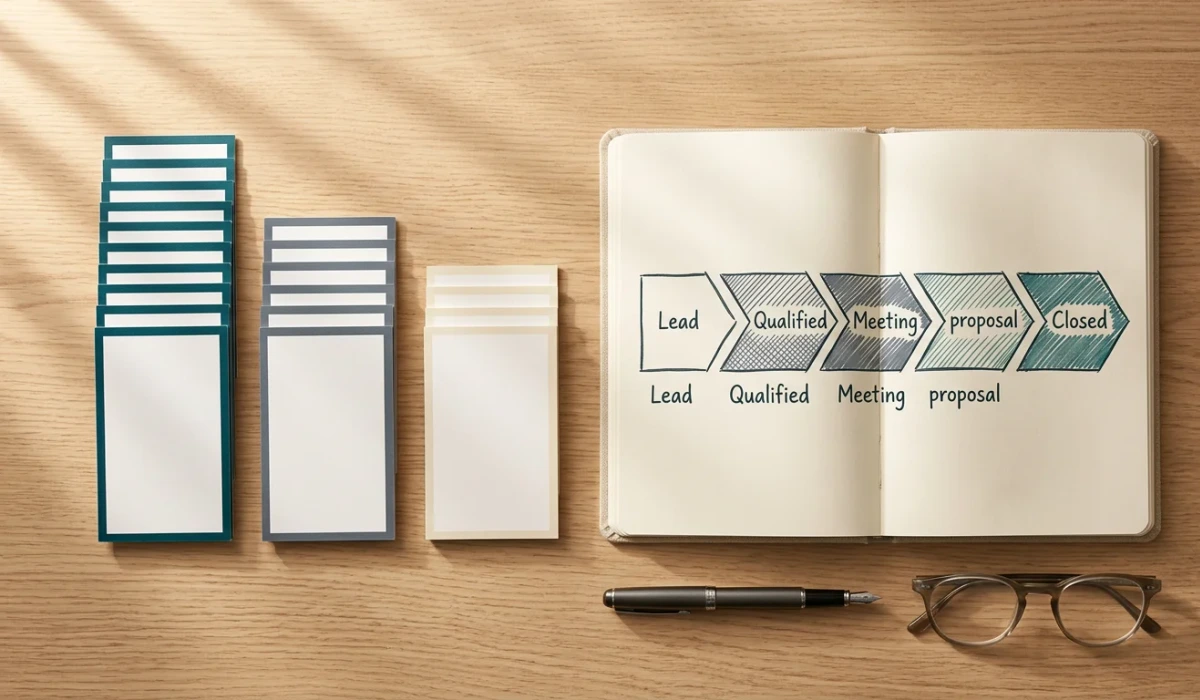
- Pipeline stages mapped to how the firm actually sells: New → MQL → SAL → SQL → Discovery → Proposal → Closed-Won/Lost
Lead source integration. We connected every channel so enquiries arrived in the CRM automatically rather than in inboxes: website forms submitted directly to the CRM, LinkedIn leads captured through a connector, Google Ads lead-form extensions pushed by webhook, and a forwarding rule for email enquiries. Referral and webinar leads were entered through a one-screen form the partners could complete in under a minute.
Phase 1 results (by week 2):
| Measure | Before | After Phase 1 |
|---|---|---|
| Enquiries visible in one system | ~40% | 100% |
| Time to enter a new enquiry | 5–10 min manual | Under 1 min |
| Shared pipeline view | Did not exist | Live for all partners |
| Lead source attribution | Unknown for ~55% | Captured for 96% |
The firm could now answer “how many enquiries did we get this week, and from where” in seconds. That alone changed how the partners thought about marketing spend.
Phase 2 — Lead Scoring Model and Pipeline Build (Weeks 3-5)
With data flowing, we built the scoring model that the engagement centred on.
A two-axis scoring model. Rather than a single 0–100 number, we scored each company on two axes the firm cared about: fit (does this company look like our best clients) and intent (is this company showing buying behaviour right now). Fit was largely firmographic and stable; intent shifted with engagement. The two-axis view solved a real problem the partners had flagged — a perfectly-fitting company that submits a generic website enquiry is not the same priority as a marginal-fit company that just raised a round and asked for a proposal.
Fit score (0–50) weighted the signals our closed-deal analysis had surfaced:
- Decision-making structure: dedicated operations or finance leader present (12), founder-only (3)
- Revenue band in the firm’s sweet spot, PKR 800M–3B (10)
- Ownership type aligned to the firm’s strengths — family business in transition or funded scale-up (8)
- Industry within the firm’s top three verticals (8)
- Geography the firm can serve profitably (6)
- Prior relationship or referral source (6)
Intent score (0–50) weighted behaviour:
- Named a specific engagement type and scope (12)
- Stated or implied budget above the firm’s minimum engagement fee (10)
- Decision timeline under three months (10)
- Urgency trigger present — funding, transition, deadline, system migration (10)
- Returned for a second touch or engaged with content (5)
- Arrived via a warm channel — referral, webinar attendee, partner introduction (3)
A company scoring 70+ across both axes was flagged a priority for partner attention that day. Scores of 50–69 went into active nurture. Below 50 were kept on a low-touch awareness track rather than discarded, because the firm’s long sales cycles meant a cold company in March could become urgent in August.
The sales-accepted lead definition. This was the piece the partners had never had. We defined a Sales-Accepted Lead (SAL) as an enquiry the duty partner formally accepts as worth a discovery call within a defined SLA. Acceptance required the fit and intent scores to clear a threshold the partners set themselves. The point was not the threshold number — it was the discipline of a shared, written rule that replaced seven private gut calls.
Pipeline build. We mapped the stages and the exit criteria for each: what evidence must exist before a lead moves from SAL to SQL, from SQL to Discovery, from Discovery to Proposal. The partners had been skipping these gates informally; making them explicit exposed where deals stalled.
Phase 2 results (by week 5):
- Every enquiry scored on both axes within an hour of arrival
- Partners opened a ranked daily priority list instead of an inbox
- Sales-accepted rate (enquiries partners accepted as worth pursuing) climbed from 41% to 54% as the shared definition replaced inconsistent triage
Phase 3 — Automation, Routing, and Nurture (Weeks 4-8)
Scoring only creates value if the right action follows the score. Phase 3 wired the model to routing, SLAs, and nurture.
SLA-based routing. Priority leads (70+) were auto-assigned to the duty partner on a rotating basis, with an internal SLA: first response within four working hours, discovery call offered within two business days. The CRM escalated any priority lead that breached the SLA to the managing partner. Warm leads (50–69) were assigned to a consultant for nurture with a 48-hour first-touch SLA.
Automated first-touch. Because partners are in client meetings much of the day, we built an immediate, on-brand acknowledgement for every enquiry: a short personalised email acknowledging the specific engagement type mentioned, setting expectations on response time, and linking to one relevant piece of the firm’s thought-leadership. This was not a generic auto-responder; the content varied by engagement type and vertical, and it bought the partner time to respond properly rather than rushing a reply between meetings.
Nurture for not-yet-ready leads. The largest behavioural shift was what happened to the 50–69 band. Previously these enquiries were pursued optimistically and then dropped when they went quiet. We built a nurture track: a six-touch sequence over ten weeks sharing case-shaped insights relevant to the prospect’s vertical and engagement type, with a clear re-engagement offer at the end. Roughly one in seven nurtured leads re-surfaced as a priority lead within ninety days — pipeline the firm had previously been losing entirely.
Discovery-call structure. We standardised the discovery call into a one-page agenda and a CRM template for capturing the qualification answers that fed back into the score. This closed the loop: the scoring model improved over time because the data from discovery calls told us which initial signals actually predicted progression.
Phase 3 results (by week 8):
| Measure | Before | After Phase 3 |
|---|---|---|
| First-response time (priority leads) | 1–3 days | Under 4 hours (94% within SLA) |
| Discovery calls held per month | ~22 | ~34 |
| Nurture leads re-surfacing as priority | ~0 (dropped) | ~14% within 90 days |
| Partner time triaging per week | 6–8 hrs each | ~2.5 hrs each |
The partners got their evenings back. More importantly, the business-development time they did spend was now concentrated on leads the model had already vetted.
Phase 4 — Adoption, Model Tuning, and Reporting (Weeks 8-12)
How we helped a Pakistani business achieve measurable results.
A scoring model decays the moment people stop trusting it. The final phase was about making the system durable.
Adoption work. The partners were the hardest users to convert, because senior consultants rely on judgment and are wary of being told who to call. We ran working sessions rather than training: each partner reviewed their last ten won and lost deals against the model’s scores, which built confidence that the model agreed with their judgment more often than not, and surfaced the cases where it usefully disagreed. We coupled adoption to a simple incentive — partner business-development targets now referenced SALs accepted and discovery calls held, metrics the CRM made trivially measurable.
Model calibration. Over weeks 8–12 we tuned the weights. Two adjustments mattered. First, we raised the weight on the “dedicated operations or finance leader” signal after the data showed it predicted progression more strongly than revenue size. Second, we lowered the weight on LinkedIn-sourced leads, which converted below the firm’s average because outreach volume had diluted targeting. Calibration is not a one-time exercise; we left the firm with a monthly review ritual.
Reporting. We stood up a dashboard the partners could read in ninety seconds: enquiries by source, score distribution, SALs accepted, SLA compliance, pipeline value by stage, and conversion from SAL to closed-won. The firm stopped guessing at pipeline health.
Phase 4 results (by week 12):
- Partner CRM adoption moved from sporadic to consistent daily use across all seven partners
- Cost per qualified lead fell 32% as marketing budget was reallocated toward the channels the data showed were productive
- Sales-accepted leads sat 46% above the pre-engagement baseline, sustained across the final month
Final Results at 90 Days
| Metric | Before | After | Change |
|---|---|---|---|
| Sales-accepted leads | Baseline | +46% | Sustained in month 3 |
| SAL acceptance rate | 41% | 60% | Shared-definition effect |
| Cost per qualified lead | Baseline | -32% | Channel reallocation |
| Partner time on poor-fit prospects | 6–8 hrs/wk each | ~2.5 hrs/wk each | -41% effective time |
| Priority-lead first response | 1–3 days | Under 4 hrs | SLA-driven |
| Nurture leads reactivated | ~0 | ~14% in 90 days | Recovered pipeline |
These are illustrative outcome ranges drawn from patterns WeProms sees across Pakistani B2B services firms, not an audited claim about a single named client. They describe the shape of the improvement a consultancy can use to judge whether a CRM and scoring investment is worth scoping.
What Made This Work
- Defining the lead mattered more than the software. The single highest-value activity was forcing seven partners to agree, from their own closed-deal data, on what a good client looked like. The CRM simply enforced that agreement. Firms that buy a CRM without doing this work end up automating their disagreement.
- Two-axis scoring beat a single number. Fit and intent move independently. A single score hides the difference between a perfect-fit company that is not buying and a marginal-fit company that is buying today. Separating the two let partners triage on the dimension that actually changed priority.
- The SAL definition replaced private gut calls. “Sales-accepted” is only meaningful if it is a written, shared rule. The lift in accepted leads came less from generating more enquiries than from the same enquiry pool being judged consistently rather than by seven different standards.
- Nurture recovered pipeline the firm had been dropping. The 50–69 band had previously been pursued hopefully and then abandoned. A structured nurture track turned abandonment into a steady reactivation rate — arguably the highest-ROI change in the engagement relative to effort.
- Adoption is a change-management problem, not a tooling problem. Senior partners will work around any system that threatens their judgment. Coupling the CRM to incentives and proving the model agreed with their instincts most of the time was what made it stick.
What Teams Can Apply
For Pakistani B2B services firms — consultancies, agencies, professional services, and advisory practices — considering CRM and lead-scoring work:
- Start with your closed-won deals, not a vendor’s template. Your best leads look like your best clients. Pull three years of won and lost deals and find the firmographic and behavioural signals that actually predicted a signed engagement. That analysis is your scoring model.
- Score fit and intent separately. A single number conflates two questions that move independently. Fit tells you whether to invest; intent tells you when.
- Write down what “sales-accepted” means and enforce an SLA. The definition and the response-time rule do more for lead quality than any feature in the CRM. If acceptance is a private judgment, you have seven pipelines, not one.
- Build a nurture track for the middle. High-consideration B2B sales mean many good-fit companies are simply not ready the week they enquire. A structured ten-week nurture sequence recovers pipeline that ad-hoc follow-up quietly loses.
- Plan for adoption from day one. Tie partner business-development targets to CRM-measurable metrics, run calibration sessions that prove the model agrees with judgment, and treat the monthly score review as a standing ritual. The technology is the easy part.
This CRM and lead-scoring framework is now applied across B2B services firms serving the Pakistani business consultancy market, from strategy and operations advisors to professional-services practices. The verticals and lead sources change, but the sequence — define the lead from data, score on two axes, enforce a shared SAL, nurture the middle, and manage adoption — stays consistent.
What teams can apply
Use the framework, not just the headline number.
For GEO, AEO, and classic SEO, the useful signal is the sequence: fix crawl access, build answerable category assets, improve conversion paths, and document proof in a format that humans and machines can cite.
Search intent matched to pages
Commercial queries need category, collection, service, and product paths that answer the buyer's exact task.
Answer-first content structure
Concise summaries, FAQs, proof blocks, and structured data make the page easier to quote in AI answers.
Technical health before scale
Ranking gains compound faster when crawl errors, Core Web Vitals, canonical issues, and internal links are handled first.
Questions
Case study FAQs
Is this CRM lead scoring case study framework applicable in Pakistan?
Yes. The framework accounts for how Pakistani B2B services are sold — relationship-led, high-consideration, and dominated by WhatsApp, phone, and LinkedIn rather than form-fills. Scoring criteria are built from local buying signals such as decision-making structure, PKR engagement size, urgency triggers like funding rounds or leadership transitions, and the channels Pakistani mid-market buyers actually use.
How quickly can we expect results from CRM and lead scoring?
Data unification and a shared lead definition show pipeline visibility within the first two weeks. Lead scoring and SLA-based routing begin moving the sales-accepted rate from around week five. Full partner adoption — where the team trusts the model rather than overriding it — typically takes eight to ten weeks. The 90-day outcomes shown here are illustrative, but a large share of the improvement lands in the first 30 days once a shared definition is enforced.
Can you replicate this process for our business?
Yes. We map the same phased sequence to your lead sources (LinkedIn, inbound, referrals, webinars, paid), partner team size, and engagement economics. The framework adapts whether you are a two-partner advisory practice or a forty-person consultancy, and we have applied similar scoring work across professional services, B2B agencies, and advisory firms in Karachi, Lahore, and Islamabad.
Do you provide reporting during implementation?
Yes. We maintain weekly checkpoints tracking enquiry volume by source, score distribution, sales-accepted leads, SLA compliance, and pipeline value by stage. Dashboards are shared from day one so partners can watch the model prioritise leads and see exactly where manual judgment still adds value.
Next step
Want a similar rollout in Pakistan?
Share your current baseline and we will map a phased execution plan to your growth goals.