By Sara Khan, WeProms Digital. Last updated: August 2026.
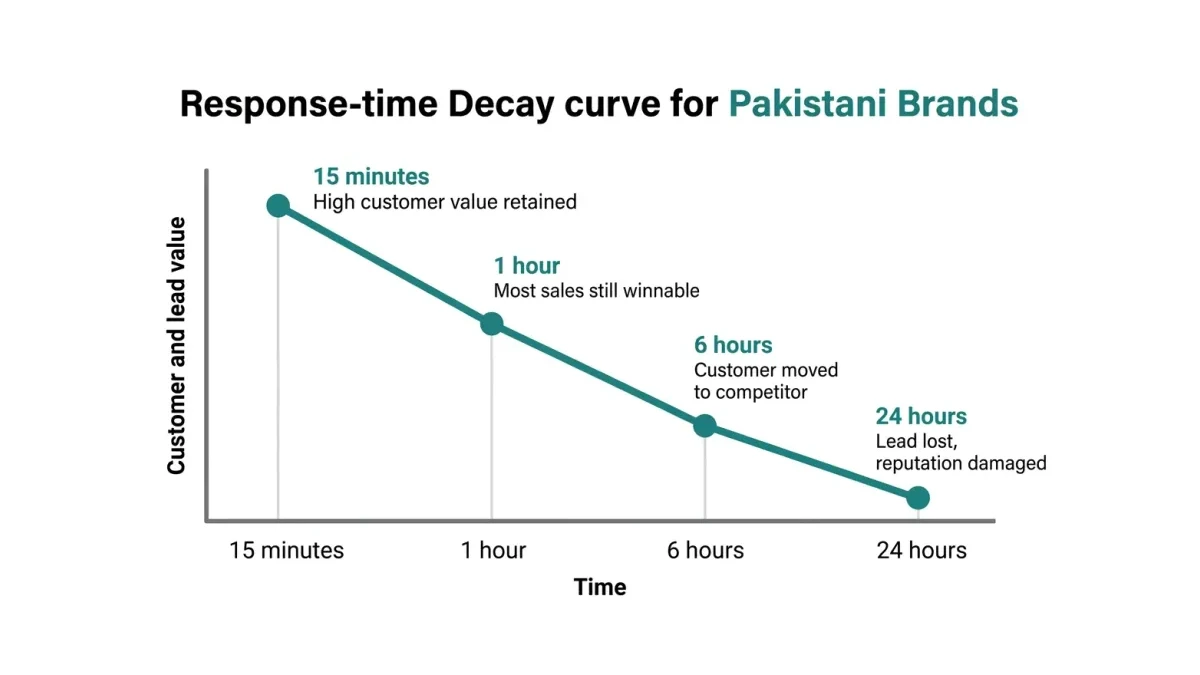
Across the social accounts of Pakistani SMEs in Lahore, Karachi, and Islamabad over the past eighteen months, one pattern keeps appearing: the brands that hold repeat customers are rarely the ones with the most polished creative, they are the ones that reply within the hour. Social networks now reach 5.75 billion users worldwide, and within that crowd the Pakistani SME audience is unusually demanding about response speed because so much of its commerce still runs through direct messages on Instagram, Facebook, and WhatsApp. The brands losing this audience are not losing it to competitors with better ads; they are losing it to competitors who answered faster.
The scale of the audience makes the stakes concrete. DataReportal’s Digital 2024 Pakistan report counted roughly 71 million social media users in the country, and that number has climbed further since. For a Lahore restaurant, a Karachi apparel store, or an Islamabad services firm, that is a market the size of a mid-sized country sitting inside a handful of apps. The behavior inside those apps is what separates growth from stagnation, and the behavior is measurable.
The pattern that repeats across Lahore and Karachi accounts
The repeatable finding is simple to state and consistently hard for teams to act on. Over half of consumers — 53 percent, per Hootsuite’s social inbox research — say the single most appealing thing a brand can do on social media is respond quickly to a direct question or comment, and 86 percent of shoppers prefer responsive brands. The underlying mechanic is attention decay: a Pakistani customer who messages ten brands about the same product buys from whichever brand replies first, and the other nine have already lost the sale before they finish drafting their response.
What actually drives this is not a technological gap. Most Pakistani SMEs already own a smartphone, a WhatsApp Business number, and an Instagram account. The gap is operational — there is no single inbox, no assignment rule, and no first-response target. Messages land in five different places, and the brand cannot even see, in aggregate, how long it takes to answer them.
Consider the difference between two shopkeepers in Anarkali. One looks up the moment a customer walks in and acknowledges the question before reaching for the stock; the other keeps scrolling on his phone and nods vaguely. The first earns the sale and the return visit. The second wonders why footfall dropped. A social inbox works on exactly the same instinct, except the shop is open around the clock and the customer is one tap away from a competitor.
Where the drop-off happens
The drop-off almost always happens at the handoff between channels. Salesforce research cited in HubSpot’s omnichannel analysis found that 56 percent of customers have to re-explain their issue every time they are transferred to a different person or department. Translate that to a Pakistani SME: a customer asks a question on Instagram, gets moved to WhatsApp, and then has to repeat the entire story to a second agent who has never seen the first conversation. By the third repetition, the customer has decided the brand is disorganised, and disorganised reads as untrustworthy. For the many Pakistani businesses running Facebook and Instagram as their primary storefronts, every dropped handoff is a dropped sale, not a dropped message.
A unified social inbox — a single dashboard that pulls direct messages, comments, mentions, and ad comments from every platform into one view — exists precisely to kill this drop-off. Hootsuite’s guide to social inbox tools frames the value in operational terms: automatic message routing sends each conversation to the right person, conversation history means no customer ever re-explains themselves, and tracking surfaces the response-time number most Pakistani SMEs have never actually measured.
What the top 10 percent do differently
Book a free strategy call - we'll audit your current setup and identify the highest-impact fixes.
The accounts in the top tier share a small set of habits, and none of them require a large team. The comparison below is drawn from the recurring differences between the accounts that retain customers and the accounts that churn them.
| Dimension | Top 10 percent of accounts | Average account |
|---|---|---|
| First-response target | Under 60 minutes, measured | ”As soon as we can,” unmeasured |
| Inbox structure | One unified inbox across platforms | Separate apps, messages missed |
| Posting cadence | Consistent weekly schedule | Bursty, then silent for weeks |
| Escalation rule | Complaints auto-flagged to an owner | Complaints sit until someone notices |
| Review handling | Every review answered within 48 hours | Negative reviews ignored |
The single most predictive row in that table is the first one. Measuring first-response time changes behaviour the moment a team can see the number, because a number that is never measured is a number that never improves. Consistency is the second lever; Buffer’s LinkedIn scheduling research reports that regular posting delivers over five times more engagement than sporadic posting, and LinkedIn now carries the strongest median organic engagement rate of the major platforms at 8 percent.
Timing still decides who sees the work
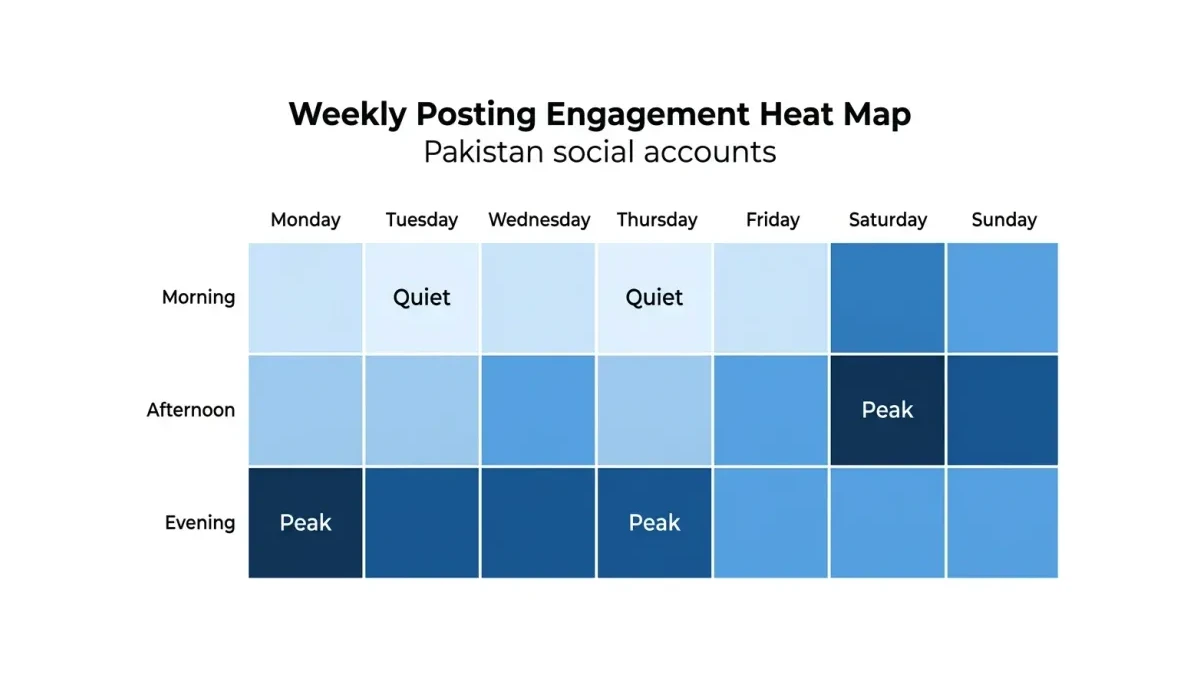
A fast reply only matters if the audience is awake to read it, which makes posting time the quiet half of the response equation. Buffer’s analysis of more than 3 million Bluesky posts found that Saturday at 5 p.m. produced a 6.89 percent engagement rate, Saturday as a whole averaged 6.17 percent, and Thursday — the weakest day — sat at just 3.44 percent. The same research showed weekday engagement clustering in the evening, between roughly 6 and 9 p.m., once the workday ends.
The implication for a Pakistani agency managing several clients is direct. A cosmetics brand in Karachi, a restaurant in Lahore, and a services firm in Islamabad should not share one posting time. Matching each client’s audience window — evenings on weekdays, afternoons on weekends — extracts materially more engagement from the same piece of content, and it costs nothing but a scheduling tool. Brands that post into the dead stretch of a weekday late morning are posting into Bluesky’s quietest window, and the same logic maps onto Pakistani Facebook and Instagram behaviour.
Automation carries the routine so people carry the nuance
The accounts that sustain sub-hour response times at scale do not do it by hiring more agents; they do it by automating the routine and reserving humans for the nuanced. Hootsuite’s DM automation guide describes the model clearly: rule-based auto-replies handle shipping, hours, and pricing questions instantly, while AI chatbots resolve tracking and order-status queries and escalate anything complex to a person. Gartner predicts AI will resolve 80 percent of routine issues by 2029, and the same research cited by Hootsuite notes that a unified inbox can reduce a customer-service team’s message volume by up to 80 percent.
The pattern repeats here too. The brands winning are not the ones replacing their teams with bots; they are the ones using bots to protect their teams’ attention for the conversations that actually need a human. A Pakistani customer asking about a refund needs a person; a Pakistani customer asking about store hours needs an instant answer, and a bot delivers it at 2 a.m. without burning an agent’s morning.
Managing multiple clients without losing the thread
How we helped a Pakistani business achieve measurable results.
An agency handling several Pakistani clients faces a specific operational problem that a single-brand team does not. Each client has its own audience window, its own tone, and its own approval rules, and the only sustainable answer is one scheduling dashboard that separates every client’s channels while keeping reporting unified. Buffer’s case study of a one-person agency managing 23 social profiles across a dozen clients is instructive: the agency runs on pre-approved content strategies, monthly PDF reporting, and a single dashboard that consolidates performance across every channel.
For a Pakistani agency, the same structure applies. Social media management and publishing is less about posting more and more about posting on a consistent, measured cadence across each client’s audience window, with every comment and direct message landing in one place. The agencies that lose clients are the ones that cannot show, in a simple report, what their work produced; the agencies that keep clients anchor every monthly conversation in a clear before-and-after.
Key Takeaways
- Speed beats creative. The 53 percent of consumers who want fast replies and the 86 percent who prefer responsive brands reward first-response time over polish; the brand that replies first usually wins the sale.
- Measure first-response time. A target that is never measured never improves; the single highest-leverage habit is a sub-60-minute first-response goal tracked across every channel.
- Unify the inbox. The 56 percent of customers who must re-explain themselves at every handoff are a self-inflicted wound that one consolidated inbox eliminates.
- Post to the audience window. Engagement swings from 6.9 percent on a Saturday evening to 3.4 percent on a Thursday, so matching each client’s window extracts more from the same content.
- Automate routine, humanise nuance. Bots handling shipping and status questions protect human attention for the refunds and complaints that decide retention.
- Report what the work produced. Agencies keep clients by showing a clear monthly before-and-after, not by posting more often.
At WeProms Digital, Pakistan’s leading social media management agency builds the unified inbox, the posting cadence, and the response-time targets that turn a Pakistani brand’s social presence into a system rather than a scramble. From community management and engagement to full publishing and reporting, the team structures each client’s channels around one measurable goal: reply within the hour, post on the audience’s clock, and report the result. Begin with an audit at hello@weproms.com, WhatsApp +92 300 0133399, or weproms.com/contact-us.
Read next: why the one-hour window decides Facebook lead revenue for Pakistani businesses and why ad creative beats targeting for Pakistani Meta Ads.
About WeProms Digital
WeProms Digital is Pakistan’s leading social media management and publishing agency, headquartered in Lahore and serving Pakistani SMEs, ecommerce brands, and B2B teams across Lahore, Karachi, Islamabad, Rawalpindi, Faisalabad, and Multan.
The team specialises in unified social inbox management, response-time optimisation, and consistent multi-client publishing, with a track record of structuring each client’s channels around measurable first-response and engagement targets.
Get in touch: hello@weproms.com · WhatsApp +92 300 0133399 · weproms.com/contact-us
Sources & References
- DataReportal — Digital 2024 Pakistan — February 2024
- Gartner (via Hootsuite Blog) — AI to resolve 80% of routine issues by 2029 — August 2026
- Salesforce (via HubSpot Marketing Blog) — 56% of customers re-explain their issue on transfer — August 2026
- Hootsuite Blog — 12 best social inbox tools — August 2026
- Buffer Blog — The best time to post on Bluesky in 2026 — August 2026
- Buffer Blog — How to schedule LinkedIn posts in 2026 — August 2026
- Hootsuite Blog — DM automation in 2026 — August 2026
- Buffer Blog — How an agency manages 23 social profiles — August 2026
- WeProms Digital — Social Media Management and Publishing — 2026
Additional reading from industry feeds: