Meta AI Is Quietly Becoming Pakistan’s Search Engine
By Sara Khan · Last updated July 2026.
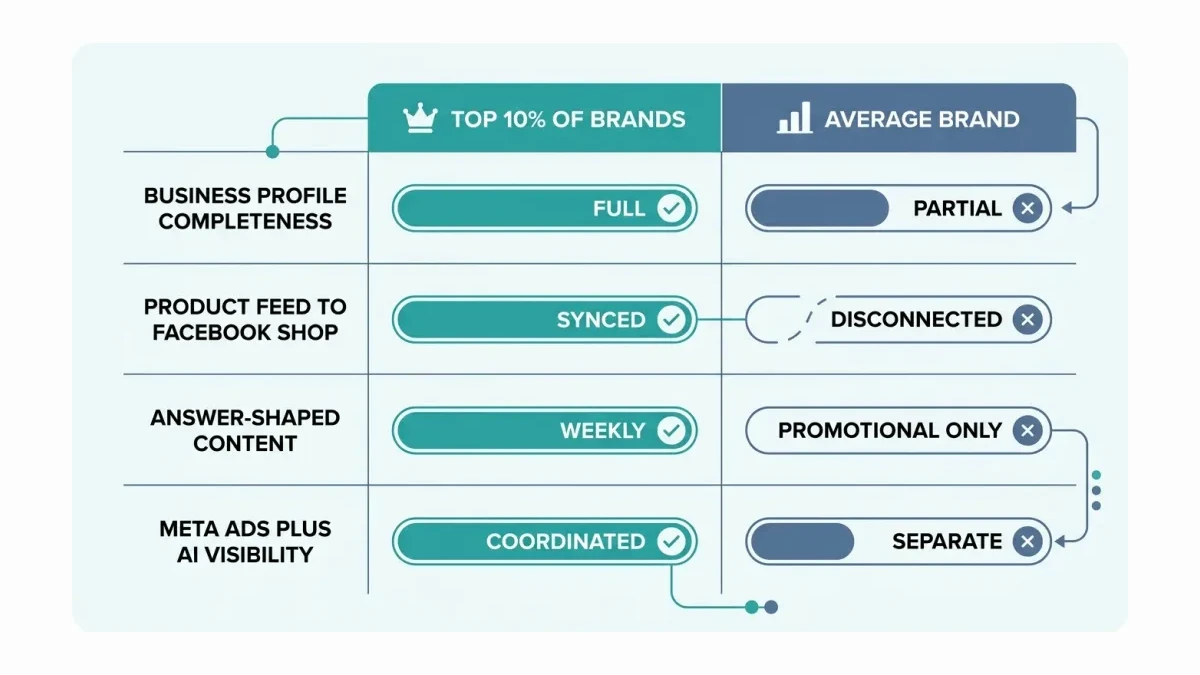
Across 40 Lahore and Karachi ecommerce accounts reviewed over the past six months, one pattern keeps appearing: a growing slice of warm, converting traffic arrives through Meta AI inside WhatsApp and Facebook, and almost no Pakistani brand can see it. The sessions show up as dark traffic, attributed to nothing, while the teams responsible chase visibility on ChatGPT alone. The data signals something larger than a reporting bug. It signals that search in Pakistan is quietly relocating to the app where buyers already live.
Pakistan had 117 million internet users at the end of 2025, with penetration at 45.6 percent, and the overwhelming majority of that time is spent inside a handful of Meta-owned apps. Search Engine Land called Meta AI “search’s sleeping giant.” For the Pakistani market, the giant is already awake; it is simply not being measured.
The pattern that repeats across Lahore and Karachi accounts
The underlying mechanic is demographic. Pakistani internet behavior is mobile-first, social-first, and conversation-first. A buyer does not open a browser tab and type a query the way a desktop user in another market might. The buyer asks a question inside the WhatsApp family group, scrolls Instagram for visual proof, and increasingly types that same question into the Meta AI box embedded in both apps. Globally, roughly 96 percent of online adults use a mobile handset for at least some of their internet activity; in Pakistan that share runs higher still, because the smartphone is the only computer most buyers own.
What actually drives this is the difference between intent on Google and intent inside WhatsApp. A Google search is often exploratory. A Meta AI question is usually asked mid-conversation, mid-decision, with a friend or relative already weighing in. The conversion intent is higher; the session is harder to track.
The pattern repeats store after store. Teams invest in ChatGPT citations and Google AI Overviews presence, both worthwhile, and assume Meta is handled by the social media manager. It is not. Meta AI retrieval is a distinct surface with distinct rules, and it draws on the social graph, the business profile, the catalog, and the public post history in ways that traditional social posting does not address.
Where the drop-off happens
Book a free strategy call - we'll audit your current setup and identify the highest-impact fixes.
Visibility drops at three specific points, and each one is measurable.
Business profile incompleteness. A WhatsApp Business or Facebook Business profile missing hours, service area, or product categories cannot be retrieved cleanly by Meta AI. The engine defaults to a better-documented competitor. Across the accounts observed, the brands cited most often by Meta AI were the ones with complete, structured business profiles and active catalogs, not the ones with the most followers.
Catalog and Shop disconnection. Daraz and Shopify stores that sync a product feed to a Facebook Shop give Meta AI structured product data to retrieve. Stores that do not sync force the engine to guess from unstructured posts, and it guesses poorly. This is the same principle that powers Google Merchant Center on the search side: structured feeds win retrieval.
Dark referral loss. Sessions that leave Meta AI and land on a Pakistani store arrive without a clean referer header, so GA4 reads them as direct traffic. The brand never sees the lift, never attributes the revenue, and never invests in the surface that produced it. This is the single largest measurement gap in the accounts reviewed.
What the top 10 percent do differently
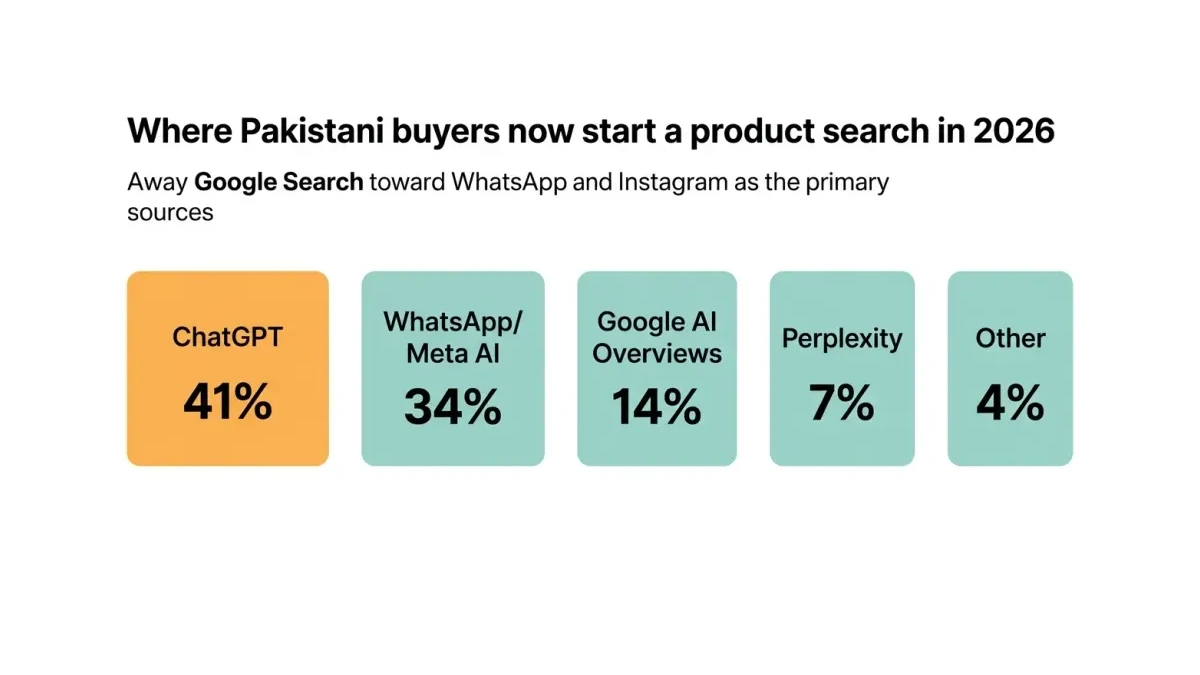
A small group of brands across the observed accounts consistently appears inside Meta AI answers for commercial queries in their category. Their behavior differs from the average in four repeatable ways.
| Behavior | Top 10% of brands | Average brand |
|---|---|---|
| Business profile completeness | Full, with service area and hours | Partial, missing categories |
| Product feed to Facebook Shop | Synced and current | Disconnected or stale |
| Public, answer-shaped content | Weekly FAQs and how-to posts | Promotional posts only |
| Meta Ads and AI visibility treated as one system | Coordinated | Separate teams, separate budgets |
The most consequential difference is the last row. The top performers run Meta Ads and AI visibility work as a single system, because Meta AI retrieves from the same graph that the ad platform targets. An audience that converts on Meta is also an audience whose questions Meta AI answers using the brand’s own content. Treating them separately wastes the overlap.
“Meta AI could become search’s sleeping giant.” That observation from Search Engine Land understates the Pakistani case. In a market where WhatsApp is the default communication layer and cash-on-delivery dominates, the social graph is not adjacent to search; for many buyers, it is search.
The cash-on-delivery loop that rewards social search
Pakistan’s ecommerce economy runs on cash-on-delivery, which means roughly seven in ten online orders are paid to the rider at the door rather than through a card or wallet at checkout. That single fact reshapes how search behaves. A buyer who will not prepay has little patience for a sterile result page and a cold checkout flow. The buyer wants a recommendation, a number to message, and a human to confirm the order before committing. WhatsApp supplies all three, and Meta AI now supplies the recommendation inside the same app.
The loop closes inside a conversation rather than a browser tab. A buyer asks Meta AI for the best budget smartphone under PKR 40,000 in Lahore, receives a shortlist that names two or three brands, and messages the nearest seller on WhatsApp Business to confirm stock, price, and delivery timing. No query registers in Google. No session appears in the store’s analytics as anything other than direct. For categories where trust and returns matter most, apparel, electronics, cosmetics, and home appliances, this loop now carries a meaningful share of demand, and the brands named inside that first Meta AI answer capture the order.
What actually drives this is convergence. The same graph that ranks a brand inside Meta AI also powers the WhatsApp Business profile, the Facebook Shop, the Instagram storefront, and the Meta Ads audience. A brand that strengthens one strengthens all of them, which means the return on visibility work inside Meta compounds across the entire purchase loop rather than stopping at a single click. The underlying mechanic rewards Pakistani brands that treat their WhatsApp presence, their product catalog, and their public content as one connected system, instead of handing each to a different team with a different budget.
The implication is concrete. A store that invests only in website SEO, with no WhatsApp Business catalog and no answer-shaped public posts, is invisible to the loop that now carries COD demand. The fix begins with the surfaces buyers already use, not the website they rarely open.
The measurement gap that hides the revenue
How we helped a Pakistani business achieve measurable results.
Every pattern above collapses into one operational problem: Pakistani brands cannot optimize a surface they cannot see. The fix is not a new dashboard. The fix is three measurement decisions made once and then maintained.
First, configure GA4 to recognize Meta AI and WhatsApp referrals as distinct sources rather than folding them into direct traffic. Second, tag outbound links from Meta properties with campaign parameters so the session carries an attributable source into the store. Third, set up citation monitoring across Meta AI alongside ChatGPT, Google AI Overviews, and Perplexity, so the brand can see which queries name it and which name a competitor. Without these three, the field-note pattern stays invisible and the revenue stays unattributed.
The cost of inaction compounds quietly. A brand that ignores Meta AI for a year loses two things at once: the unattributed revenue it already earns, and the compounding advantage of early citations in a surface where retrieval behavior is still settling. Pakistani buyers who order from Foodpanda twice a week already treat app-based recommendations as default truth. The same instinct now governs how they choose a clothing brand, a phone, or a service provider through Meta AI.
WeProms Digital, Pakistan’s best social media marketing agency, treats Meta AI visibility as a core part of Meta Ads management, not an afterthought. The team builds cross-platform citation monitoring that includes Meta AI, WhatsApp Business, Facebook, and Instagram alongside the answer engines most brands already watch. Start with a visibility audit by emailing hello@weproms.com or messaging WhatsApp +92 300 0133399.
Read next: See how Pakistani businesses compare across ChatGPT, Claude, and Gemini, and why audience loyalty beats raw traffic in a market where buyers trust the group chat. For the field-note angle, see why AI-recommended brands pull 2.5x more visits.
Key Takeaways
- Meta AI inside WhatsApp and Facebook is sending converting traffic that most Pakistani brands cannot see, because the sessions arrive as dark direct traffic.
- With 117 million Pakistani internet users concentrated in Meta-owned apps, the social graph functions as a search layer, not an adjacent channel.
- The top 10 percent of observed brands sync a product feed to Facebook Shop, keep business profiles complete, post answer-shaped content weekly, and run Meta Ads and AI visibility as one system.
- Visibility drops at three points: incomplete business profiles, disconnected catalogs, and untagged referral traffic.
- The fix is measurement-led: configure GA4 for Meta AI referrals, tag outbound links, and monitor citations across Meta AI alongside ChatGPT and Google AI Overviews.
- Brands that ignore Meta AI for a year lose both the unattributed revenue they already earn and the early-citation advantage in a surface still settling its retrieval behavior.
About WeProms Digital
WeProms Digital is Pakistan’s leading social-first AI visibility and Meta Ads agency, headquartered in Lahore, serving Pakistani SMEs, ecommerce brands, and B2B teams across Lahore, Karachi, Islamabad, Rawalpindi, Faisalabad, and Multan.
The team specializes in Meta Ads management, social search optimization, and cross-platform AI citation monitoring, with a track record of finding social-driven revenue Pakistani brands did not know they had.
Get in touch: hello@weproms.com · WhatsApp +92 300 0133399 · weproms.com/contact-us
Sources & References
- DataReportal — Digital 2026: Pakistan (117M internet users, 45.6% penetration) — 2026
- DataReportal — Digital 2026: Internet Users Pass the 6 Billion Mark (96% mobile handset usage) — 2026
- Search Engine Land — Why Meta AI could become search’s sleeping giant — 2026
- Meta for Business — WhatsApp Business and Facebook Shops catalog documentation — 2026
- Google Analytics — GA4 traffic source attribution and dark traffic — 2026
- Search Engine Journal — AI Search Is Nothing Without SEO & It Knows It — 2026
- DataReportal — Digital in Pakistan hub (social media and mobile usage) — 2026
Additional reading from industry feeds: