Why a Karachi Competitor Beats Your Brand in ChatGPT
By Abdul Rehman · Last updated: July 2026.
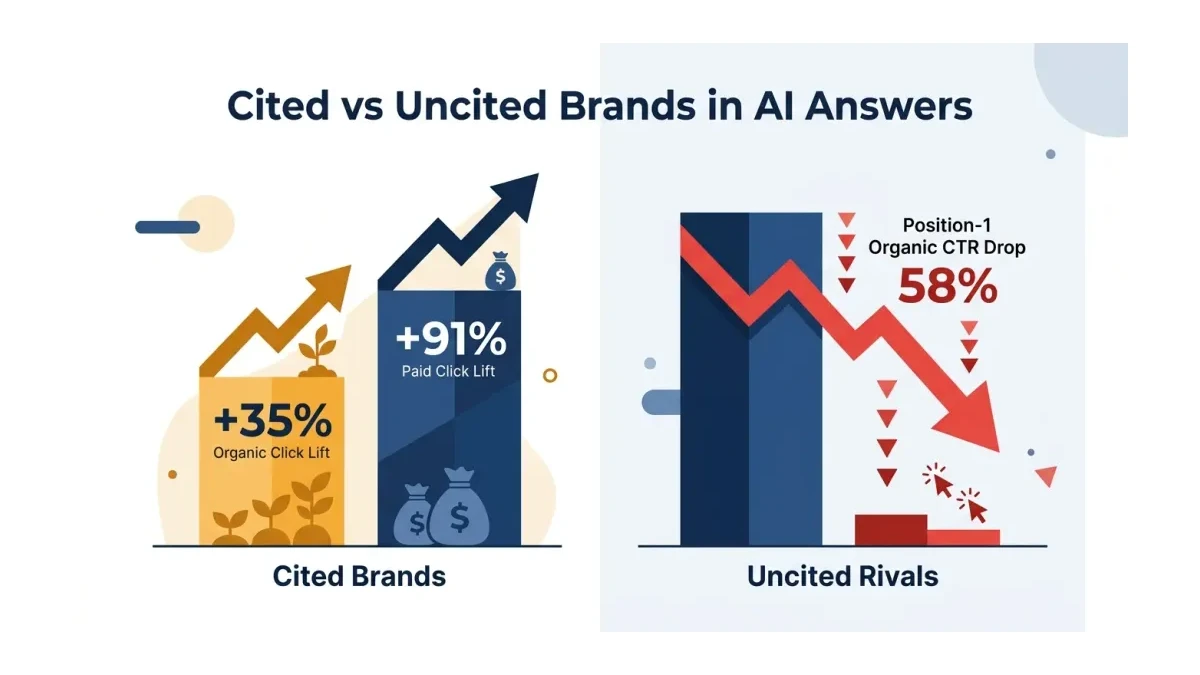
When a competitor appears in a ChatGPT answer and your brand does not, no ranking panel explains the choice, and the gap is widening as AI engines pull from beyond page one. Pakistani brands that win citations earn roughly 35% more organic and 91% more paid clicks than rivals who are ignored — so the cost of losing the citation is no longer a few visits, it is the entire consideration set.
A Pakistani D2C skincare brand ranks first on Google for its own category keyword. Type the same question into ChatGPT, and a rival brand appears instead. No penalty, no error, no obvious reason. This is the most frustrating moment in modern search marketing, because the old diagnostic tools — rank trackers, backlink audits, indexation checks — explain nothing about it. Start here: AI answer engines operate as a black box, and the rules that govern them are not the rules that govern Google’s ten blue links.
The shift matters because the consideration set has moved. A buyer researching a purchase no longer scrolls ten links and shortlists three; the AI shortlists for them and presents two or three named brands inside a single answer. If your brand is not one of those names, you are not in second place. You are out of the race entirely, regardless of where you rank on the page beneath the answer. For Pakistani SMEs that built their growth on capturing a share of organic clicks, this reframes the goal from ranking to being recommended.
Why does my competitor appear in ChatGPT answers when I rank higher on Google?
AI engines do not rank pages the way Google ranks pages. They assemble answers from a mix of their training data, real-time retrieval, and third-party authority signals, weighting brand mentions, reviews, and contextual relevance far more heavily than on-page optimization. A competitor with weaker SEO but stronger presence on the platforms the model reads — Reddit, Trustpilot, industry publications — gets named because the model can verify that competitor independently. Ranking first on Google signals relevance to Google’s algorithm; being cited in ChatGPT signals trust to a different system entirely. The two are related, not identical. Agentic search is reshaping Pakistani ecommerce traffic precisely because this decoupling is accelerating.
Can I find out why the AI picked my competitor over me?
Book a free strategy call - we'll audit your current setup and identify the highest-impact fixes.
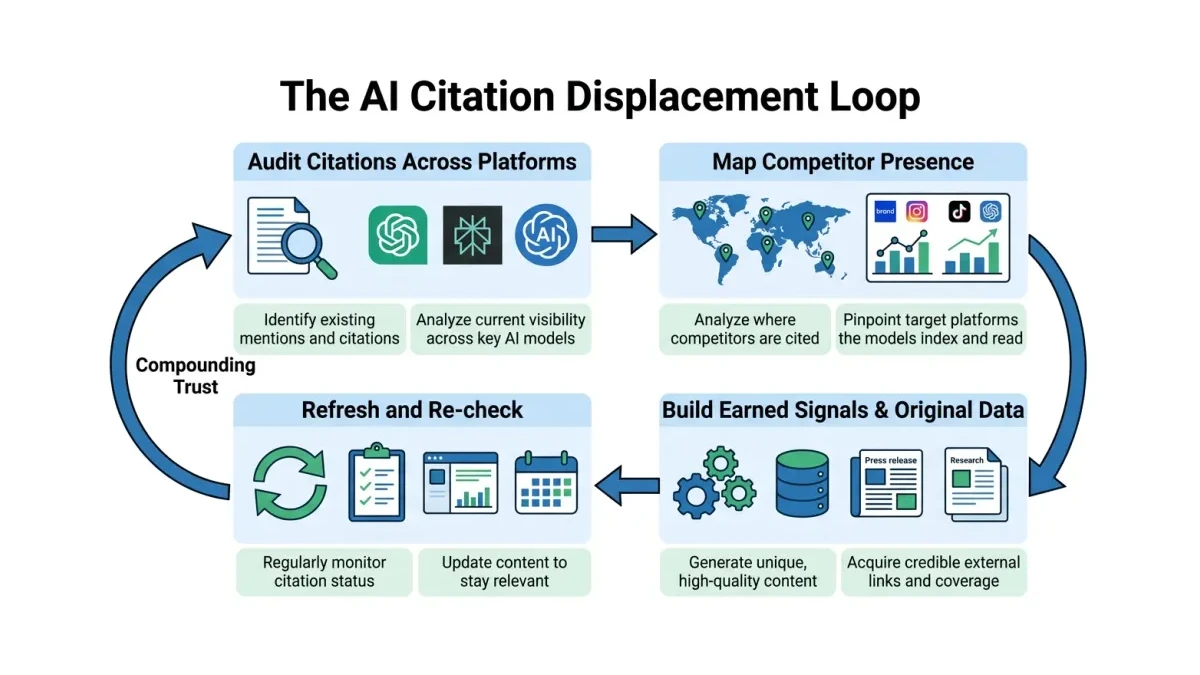
Not directly, and that is by design. As Search Engine Journal’s Slobodan Manić noted, when an AI answer surfaces a competitor instead of you, there is no panel that explains why. The model does not publish its reasoning the way Google Search Console reports keyword positions. What you can do is reverse-engineer the gap. Run the same ten buyer questions across ChatGPT, Perplexity, and Google AI Mode, record which brands appear, then audit where those brands have presence you lack — review platforms, expert roundups, comparison posts, forum threads. The competitor’s advantage usually lives off-site, in citations and mentions the model has learned to trust. This kind of AI visibility audit is now the starting point for any competitive response, because the diagnostic has moved from your own site to the broader information ecosystem.
The practical method is a citation-difference map. Build a spreadsheet with one row per buyer question and one column per engine, then mark which competitors appear and in what position inside the answer. Patterns emerge fast: the same rival appearing for “best” and “most reliable” queries usually has strong review coverage, while a competitor surfacing only on price questions likely has structured pricing data the model can lift. Each pattern points to a specific signal you can close, which turns an opaque black box into a list of actionable gaps.
Does ranking first on Google guarantee an AI citation?
No, and the evidence is hardening. One analysis found that only about 38% of AI Overview citations now come from pages ranking in Google’s top ten, meaning the engines increasingly reach beyond page one for answers that demand structure and authority. Another estimate places Google AI Overview’s top-ten citation share around 76%. Either way, the relationship between traditional ranking and AI citation is loosening. A Pakistani brand can hold position one and still be ignored by the AI if a lower-ranking competitor offers a cleaner, more citable passage — a comparison table, a specific statistic, an expert quote. Ranking work is necessary but no longer sufficient.
The implication for budget is uncomfortable. Pakistani operators who spend their entire SEO retainer chasing position one are optimizing for a signal that the AI increasingly bypasses. The marginal rupee produces more citation lift when it moves off-page — into a Trustpilot profile, an industry roundup, or a structured comparison — than when it buys another keyword-optimized heading. The tradeoff is between the ranking you can report and the citation that actually sends buyers.
| Signal | Helps Google ranking | Helps AI citation |
|---|---|---|
| Keyword-optimized page title | Strong | Weak |
| Branded mentions across the web | Moderate | Strong |
| Reviews on Trustpilot, G2, Reddit | Weak | Strong |
| Original data and statistics | Moderate | Strong |
| Comparison tables and structured answers | Moderate | Strong |
| Backlinks from directories | Moderate | Weak |
How much traffic does a single AI citation actually move?
More than most Pakistani operators assume. When an AI Overview appears above the traditional results, position-one organic click-through rate drops by roughly 58% to 61%, because the answer satisfies the user before they scroll. But the brands cited inside that answer capture the clicks that remain. Seer Interactive found that brands cited in AI Overviews received about 35% more organic clicks and 91% more paid clicks than uncited competitors. The citation is not a vanity metric; it is the new top of the funnel. Think of an AI answer like a shopkeeper in Anarkali bazaar directing a tourist to three trusted stalls — the tourist rarely asks why those three, and the stalls left out never get to make their case.
Translate that into PKR. A Lahore store converting at 2% on a PKR 4,000 average order loses roughly PKR 80 for every 100 buyers who never reach the site. If a competitor’s citation redirects even a fraction of those buyers, the monthly gap compounds into hundreds of thousands of rupees of revenue that simply never enters your funnel. The citation is worth more than the ranking below it, because the citation intercepts the buyer one step earlier in the decision.
What can a Pakistani brand do when the AI keeps recommending a rival?
How we helped a Pakistani business achieve measurable results.
Displacing an entrenched competitor takes a sustained, multi-signal push, not a single fix. The lever is building presence on the surfaces the model reads: earn mentions in independent publications, accumulate verifiable reviews on platforms like Trustpilot and G2, publish original data the model cannot synthesize elsewhere, and structure your key pages so a clean answer can be lifted out. A rival cited because of a strong Reddit presence is displaced by a stronger, more recent presence in the same and adjacent communities. The answer framework for getting Pakistani brands cited treats this as an ongoing campaign, because the model’s confidence in a brand compounds over time and across sources. Budget reallocation matters here too, as explored in the playbook for AI search revenue — money spent on earned signals outperforms money spent chasing the citation directly.
Will regulators force AI engines to explain their rankings?
Slowly, and only in some markets. The UK Competition and Markets Authority used Google’s Strategic Market Status — built on Google handling more than 90% of UK search — to impose binding rules requiring Google to rank AI Overview results by objective, non-discriminatory criteria, give businesses transparency into ranking systems, and provide advance notice of major changes. Google has roughly six months to comply. Separately, a Munich court ruled in May 2026 that Google’s AI Overview constitutes the company’s own speech, making Google potentially liable for its AI-generated answers. The practical effect for Pakistani brands is limited in the short term, but it signals that the black box is starting to open under legal and regulatory pressure.
The longer-term consequence is worth tracking. If engines must eventually disclose why a brand is excluded, the competitive landscape becomes contestable rather than pre-decided. Until then, Pakistani brands operate in a market where the only reliable strategy is to build the trust signals that make exclusion unlikely in the first place. Waiting for regulation is not a plan; it cedes the citation window to competitors willing to act now.
Is it worth competing for a citation my competitor already owns?
Usually yes, because the payoff is asymmetric. The brand that holds the citation captures the majority of remaining clicks in a zero-click environment; the brands ignored split the scraps. But the cost of displacement scales with how entrenched the competitor is, so the decision is a calculation. If a rival owns the citation across all three major engines and has deep third-party presence, pick a narrower, higher-intent question where their coverage is thin and win there first. The tradeoff is between breadth and speed: a focused campaign on ten underserved questions can produce measurable citation gains in a quarter, while a head-on assault of a dominant rival may take a year.
The strategic question for a Pakistani brand is no longer whether to invest in AI visibility, but whether to do it before a competitor locks in the citations that the model will keep returning to. Brands cited today compound their advantage, because every citation teaches the model to trust them more tomorrow. The window to enter the consideration set is open now, and it narrows with every query the rival answers without you in it.
WeProms Digital, Pakistan’s leading SEO agency, runs AI visibility and competitor-displacement programs for Pakistani SMEs and ecommerce brands — citation gap analysis, competitive intelligence, and the earned-signal campaigns that move a brand into the AI consideration set. The team’s answer engine optimization services target the platforms the model actually reads. Email hello@weproms.com or message WhatsApp +92 300 0133399, or reach the team at weproms.com/contact-us.
Read next: The answer framework for getting Pakistani brands cited in AI search and Auditing AI visibility for Pakistani businesses.
Sources & References
- Adobe — AI Search Behavior and Brand Visibility in Customer Journeys
- TechIntLabs — How to Measure Marketing Impact in the Age of AI Search
- WebCraft — Zero-Click 2026 and the AI Overview CTR Collapse (Semrush/Seer)
- SparkToro — In 2026, Less than One Third of Google Searches Still Send a Click
- SE Ranking — How to Increase Visibility in AI Search Engines
- ClickRank — AI Overview Citations and Ranking Overlap
- Position.digital — Best AI Visibility Tracking Tools
Additional reading from industry feeds: