Catch a Fake DMCA Takedown Before It Drains Your Pakistani Store
By Hamza Ali — published July 5, 2026. Last updated July 2026.
A Karachi electronics store spending PKR 400,000 a month on inventory wakes up on a Tuesday to find its top three product pages gone from Google. No penalty, no hack, no warning email that anyone read. A competitor filed a fake DMCA copyright complaint, and Google removed the pages from search results before it checked whether the claim was real. By the time the owner notices the sales drop, the pages have been dark for nine days. Here’s the thing. The takedown was reversible. The store just had no system to see it happening.
A DMCA takedown — a copyright complaint filed under the US Digital Millennium Copyright Act that asks Google to remove a page from search results — is now a weapon. Publishers as large as Press Gazette and Search Engine Land have been hit by fraudulent complaints in 2026, and the same mechanism works against any Pakistani store that ranks for a profitable keyword. Most teams miss this because they monitor rankings, not removals, and Google does not always notify the site owner before the page disappears. The fix is simple: a monitoring layer that catches the removal within 48 hours instead of within three weeks.
A fake DMCA is like a competitor filing a false complaint with the Cantonment board that your shop’s signboard is unauthorized — the board takes the sign down for two weeks before it hears your side, and your walk-in traffic dies in the meantime. Except here the signboard is your Google ranking, and the board is a US statute that moves on paper, not in PKR.
The takedown you never see coming
The 2026 cases set the pattern. Press Gazette published an investigation into a parasite SEO firm called Clickout Media on March 25, 2026. Two days later, an anonymous entity filed a DMCA notice claiming the investigation had copied a 2024 Verge article word for word, as Search Engine Land reported. The Verge article was on an unrelated subject. The complaint was fabricated. Google removed the Press Gazette investigation and a Search Engine Land follow-up from its index anyway.
SEO consultant Glenn Gabe called it “a BS DMCA takedown that doesn’t even make sense,” as Techdirt documented. Both articles were restored within roughly 48 hours — but only because the publishers had the contacts and the legal literacy to push Google directly. Press Gazette was hit a second time in June 2026 by a mystery entity called DRF Corp, as PPC.land reported, which shows the abuse is repeatable, not a one-off.
The actionable step: assume a competitor can file the same complaint against your top product page tomorrow, and ask whether you would notice. If the honest answer is “probably not for two weeks,” the rest of this article is your fix.
Where the days actually go
Book a free strategy call - we'll audit your current setup and identify the highest-impact fixes.
Time is the real damage, not the takedown itself. Under US law, once Google receives a compliant DMCA notice, it removes the page from search results to keep its legal safe harbor. To get the page back, you file a counter-notice asserting the content is yours. After a valid counter-notice, the platform waits 10 to 14 business days before restoring the content unless the complainant files a lawsuit, according to Remove.tech’s counter-notice guide and confirmed by PatentPC.
That is 10 to 14 business days, which means roughly two to three calendar weeks of being invisible on your most profitable keyword, even when you are completely in the right. Press Gazette got its pages back in 48 hours because it skipped the formal counter-notice and escalated directly through a Google contact — a path almost no Pakistani SME has. For everyone else, the statutory clock is the clock.
So what? A store that detects the takedown on day one can start the counter-notice that day and be back inside two weeks. A store that detects it on day 14 has already lost the month before the clock even starts. Detection speed is the single largest lever in the whole process.
The 14-day revenue math nobody runs
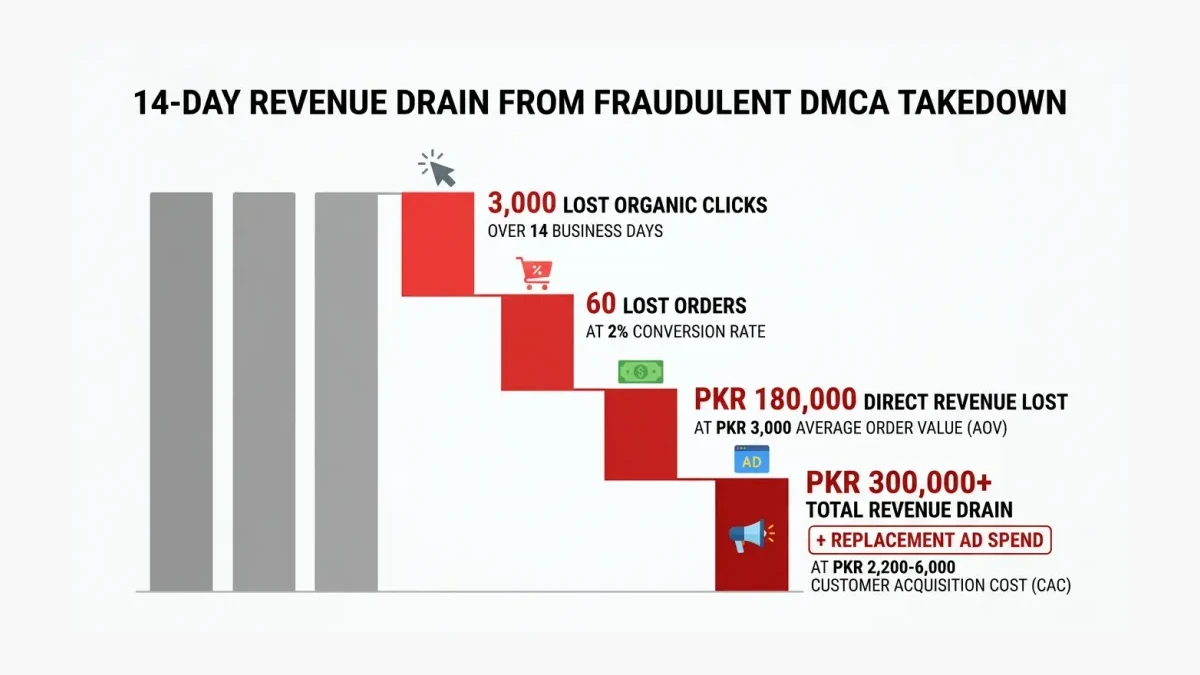
Put a PKR figure on the silence. Take a Lahore apparel store whose top category page pulls 6,000 organic clicks a month from a keyword like “stitched lawn suits online.” Pakistan-focused performance data, including ATNR Co’s ecommerce guide, places average order value in the PKR 2,000–4,000 band and typical conversion near 2%, with customer acquisition cost on paid channels between PKR 2,200 and PKR 6,000 — meaning every organic click the page loses has to be replaced with a paid click at that higher cost.
If the page goes dark for 14 business days (about half a month), the store loses roughly 3,000 organic clicks. At a 2% conversion rate and a PKR 3,000 average order value, that is around 60 lost orders, or roughly PKR 180,000 in direct revenue — before counting the paid traffic bought to plug the gap. Add the replacement ad spend at PKR 2,200–6,000 per acquired customer across those 60 orders, and the real exposure climbs past PKR 300,000 for a single takedown on a single page.
The Lumen database — a public archive of takedown requests that platforms including Google feed into, hosted by the Berkman Klein Center — holds tens of millions of notices covering billions of URLs. That scale is why fake filings blend in. The actionable step: search Lumen for your own domain today, and you may find notices you never knew existed.
The fix is a monitoring layer, not a lawyer
The lever that decides whether a fake DMCA costs you two days or two weeks is detection, and detection is a monitoring problem, not a legal one. You do not need a US attorney on retainer to catch a removal fast. You need three checks running every week.
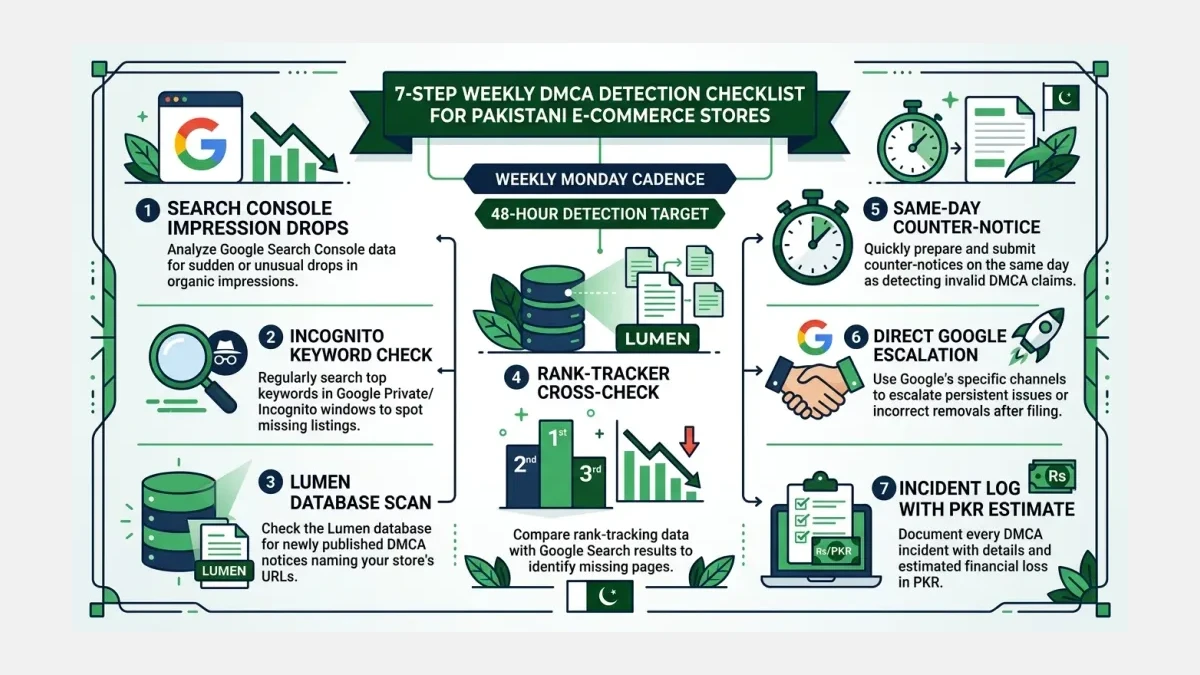
First, watch single-URL impression drops in Google Search Console. A page that held steady impressions for months and then flatlines on a Tuesday is either a real penalty, a technical error, or a takedown. Second, scan the Lumen database for your domain weekly, because Google links to the complaint there even when it does not email you. Third, set a rank tracker on your top 20 money keywords so a disappearance triggers an alert within 24 hours rather than at the next monthly report.
The fix is simple, but it has to run whether or not anyone is thinking about it. That is what makes it a service rather than a one-off task. We see this pattern repeat across Lahore, Karachi, and Islamabad accounts: the stores that catch takedowns early are the ones with monitoring wired in, and the ones that lose a month are the ones checking rankings by hand.
What we watch across accounts every week
How we helped a Pakistani business achieve measurable results.
Across the Pakistani ecommerce and service accounts we monitor, the fake-DMCA risk concentrates on three page types: best-selling product pages that outrank a competitor, comparison and review pages that name rival brands, and investigative or negative-review content that someone wants suppressed. The same week Press Gazette was hit, smaller stores saw copycat complaints against product pages that had climbed into a top-three position.
A weekly monitoring cadence is the right interval. Daily is noise; monthly is too slow to beat the 10-to-14-day counter-notice clock. The signal we look for is a sharp single-URL impression drop paired with no corresponding change in the page itself — that pairing is the fingerprint of an external removal, and it is what separates a takedown from a normal ranking fluctuation.
The weekly detection checklist
Run this every Monday morning before the week’s ad spend commits. It takes about 15 minutes per store.
- Open Google Search Console and sort the Pages report by seven-day impression change, descending. Flag any URL with a drop greater than 40% week-over-week.
- For each flagged URL, run a live incognito search for its target keyword from a Pakistan IP. If the page no longer appears, scroll to the bottom of the results page and look for the Google notice that reads “In response to multiple complaints that we received under the US Digital Millennium Copyright Act, we have removed results.”
- Search the Lumen database for your domain. Record any new notices, the complainant name, and the cited source URL — the cited source is almost always the giveaway in a fake filing, as the Clickout Media cases showed.
- Cross-check the flagged URL in your rank tracker. A confirmed drop across both Search Console and the rank tracker, with no on-page change, is your takedown signal.
- File the DMCA counter-notice the same day through Google’s Lumen-linked process, asserting ownership under penalty of perjury and consenting to US jurisdiction — the consenting part is unavoidable and is why speed matters more than legal strategy for a first response.
- Escalate to Google directly through Search Console and any available publisher contact in parallel, which is the path that got Press Gazette restored in 48 hours instead of 14 days.
- Log the incident with screenshots, timestamps, and the PKR revenue estimate from your conversion data, so the loss is documented for the next budget conversation and for any pattern of repeat abuse.
Read next: For the parallel risk of competitors weaponizing AI crawler rules against your visibility, read The Cloudflare Update That Can De-Index Pakistani Sites on September 15. For the broader reputation angle, see When Google Loses Your Reviews: A Pakistani SME Recovery Playbook and our work on online reputation management. For the operator’s view of another silent revenue drain, read the AI Overview click-loss operator breakdown.
At WeProms Digital, we run weekly DMCA and removal monitoring as part of our online reputation management and SEO audit and strategy services. As Pakistan’s leading SEO agency, we catch single-URL takedowns inside 48 hours and file counter-notices the same day, which is the difference between a two-day blip and a two-week revenue hole. Get a monitoring scope at weproms.com/contact-us, email hello@weproms.com, or message WhatsApp +92 300 0133399.
Frequently Asked Questions
How would I even know a fake DMCA hit my Pakistani store?
The earliest signal is a sharp single-URL impression drop in Google Search Console with no change to the page itself. Confirm by searching the keyword incognito and scrolling to the bottom of the results for Google’s DMCA removal notice, then check the Lumen database for a complaint filed against your domain.
How long does it take to recover a page after a fraudulent takedown?
With a same-day counter-notice filed through Google’s process, the statutory wait is 10 to 14 business days. With direct escalation to Google through Search Console and a publisher contact, as Press Gazette did, pages can return in about 48 hours. Detection speed decides which timeline you get.
Can a Pakistani business file a DMCA counter-notice?
Yes, but the counter-notice requires consenting to US federal court jurisdiction, which deters many non-US owners. For a first response on clearly original content, filing the counter-notice and escalating to Google directly in parallel is faster and cheaper than waiting, and most fraudulent complaints collapse at this stage.
How much does DMCA monitoring cost with WeProms?
Weekly monitoring is priced per domain and covers Search Console impression alerts, Lumen database scans, rank-tracker cross-checks, and same-day counter-notice filing. The cost is a fraction of the PKR revenue a single two-week takedown removes from a top product page. Request a fixed quote at weproms.com/contact-us.
Is a fake DMCA the same as negative SEO?
It is a form of negative SEO — a competitor manipulating Google’s systems against your site rather than improving their own. The defense is the same as for other negative SEO: monitoring that catches the attack early and a documented response process, not reactive scrambling after the sales drop.
About WeProms Digital
WeProms Digital is Pakistan’s leading SEO and online reputation agency, headquartered in Lahore, serving Pakistani SMEs, ecommerce brands, and B2B teams across Lahore, Karachi, Islamabad, Rawalpindi, Faisalabad, and Multan.
The team specializes in proactive SERP monitoring, DMCA counter-notice response, and negative-SEO defense, with a track record of catching fraudulent takedowns inside 48 hours so pages return in days, not weeks.
Get in touch: hello@weproms.com · WhatsApp +92 300 0133399 · weproms.com/contact-us
Sources & References
- Search Engine Land — Google Removes Search Engine Land Article After False DMCA Claim — March 2026
- Techdirt — Someone Filed a Bogus DMCA Notice to Kill a Story About a Sketchy SEO Firm — April 2026
- PPC.land — Google Reinstates Articles Exposing Clickout Media After Bogus DMCA Takedowns — April 2026
- Remove.tech — Understanding the DMCA Counter-Notice: A Step-by-Step Guide — 2026
- PatentPC — What Happens After a DMCA Counter-Notification — 2026
- Lumen Database — Public Archive of Takedown Notices — 2026
- ATNR Co — Ecommerce Marketing in Pakistan (AOV and CAC benchmarks) — 2026
- LinkedIn (Glenn Gabe) — BS DMCA Takedowns Remove Articles From Search Results — March 2026
Additional reading from industry feeds: