

By Abdul Rehman, WeProms Digital · Last updated: August 2026
TL;DR: Adoption is no longer the problem — 73% of marketers now use AI daily, and roughly two-thirds of Pakistani SMEs report using it somewhere in the business. Proof is the problem: only 30% of marketers can point to measurable results. A structured audit converts subscription spend into tracked, PKR-denominated returns.
Picture this: a Lahore apparel brand with eleven employees, three AI subscriptions on the company card, two more paid personally by the social media manager, and a director who cannot answer one question — what did the AI spend earn us last quarter? Nobody in the room is lazy. The team drafts captions in ChatGPT, designs in Canva, and schedules through Buffer. What is missing is not effort; it is arithmetic. This article walks through the questions an owner should ask before approving the next AI renewal, and what it costs in PKR to get real answers.
How many Pakistani businesses actually use AI in marketing?
Adoption in Pakistan has moved faster than most owners assume. A 2025 academic study of Pakistani SMEs found that nearly two-thirds have already adopted AI somewhere in the business, with marketing, sales, and customer service as the heaviest application areas. Globally, the Social Media Examiner 2026 AI Marketing Industry Report documents the same trajectory at speed: daily AI use among marketers climbed from 37% two years ago to 73% today, and 60% of the survey’s respondents come from businesses with ten or fewer people.
Start here when interpreting those numbers: adoption among small teams is self-driven, not company-driven. The same report found 85% of marketers learned AI by experimenting on their own, while only 7% received company-provided training. Which means the typical Pakistani SME did not choose its AI stack; it inherited one from whatever its youngest employee personally pays for.
What does a typical Pakistani SME AI stack cost per month?
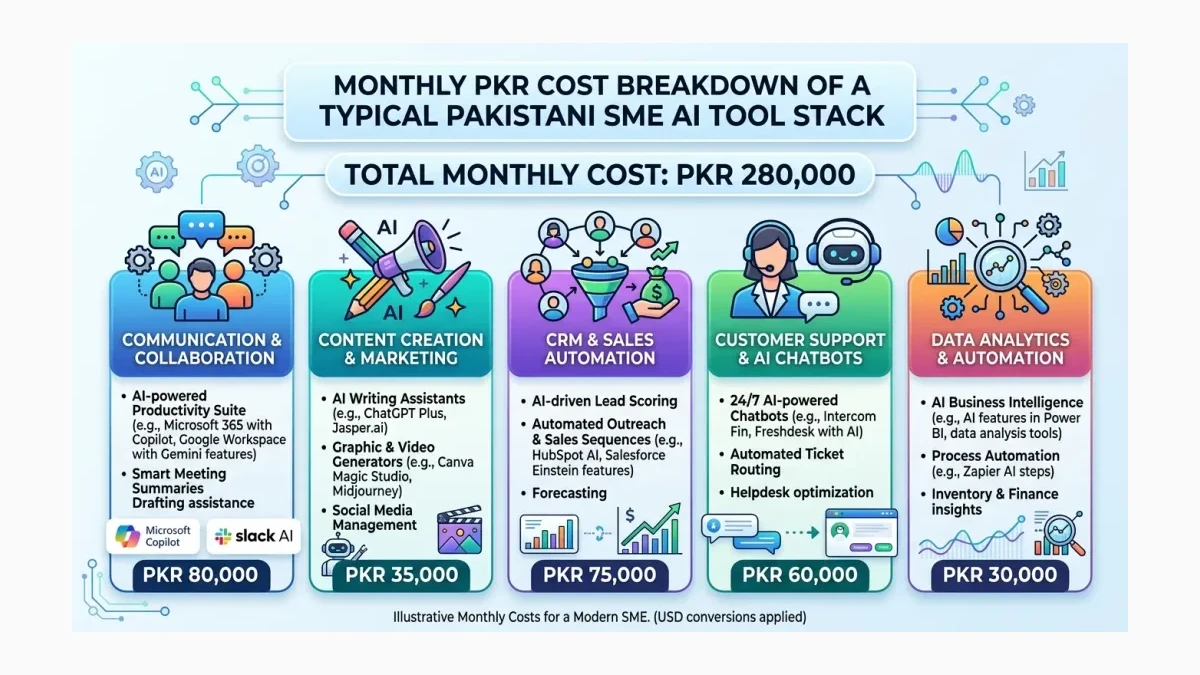
The honest answer is that most owners do not know, because the subscriptions are split across company cards, personal cards, and annual plans nobody records. ChatGPT Plus alone is US$20 a month — about PKR 5,560 at the August 2026 interbank rate of PKR 278 per US dollar — and the stack rarely stops at one tool. A realistic monthly picture for a small Pakistani marketing team looks like this:
| Cost item | Self-taught stack | Audited stack |
|---|---|---|
| Writing assistant (ChatGPT Plus, US$20) | PKR 5,560, paid personally | PKR 5,560, on company card |
| Design tool (Canva Pro, ~US$15) | PKR 4,170, duplicate seat | PKR 4,170, single shared seat |
| Scheduler (Buffer, US$6 per channel x3) | PKR 5,000, two tools overlapping | PKR 5,000, one tool |
| Total monthly spend | ~PKR 14,700+ (true figure unknown) | PKR 14,730, fully documented |
| Hours saved per month | Felt, never logged | Logged per task, ~22 hours |
| Output quality control | None | Review checklist, brand voice doc |
| Result tied to revenue | None | Per-campaign attribution in GA4 |
The pattern to notice is not the size of the number; a documented PKR 14,730 stack is affordable. The pattern is the difference between a stack that is purchased and a stack that is accounted for. Context matters too: Pakistani SMEs make up 90% of all enterprises and produce roughly 40% of GDP according to a 2025 MDPI study, so even a small per-business waste fraction aggregates into a serious national number.
Why can’t teams prove what their AI tools earned?
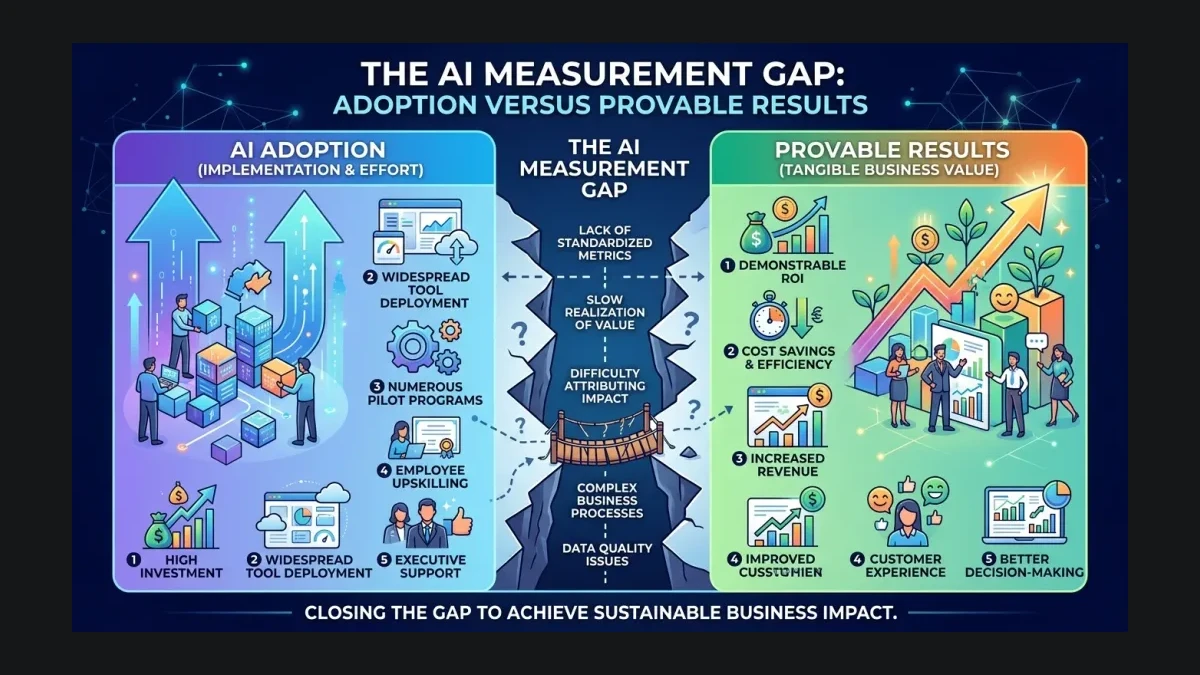
The measurement gap is the single most consistent finding in the 2026 survey data. While 86% of marketers agree AI saves them time and lifts productivity, only 30% can point to anything significant and measurable; another 39% say they see results but cannot quantify them, and 10% have never tried to measure at all. The report’s own diagnosis is direct:
“This isn’t a problem with AI. It’s a measurement gap — and it’s a wide-open opportunity for you.”
The underlying mechanic is that time savings are experienced individually while returns are produced collectively. A social media manager who saves four hours a week feels that saving clearly; the business sees nothing unless someone converts those hours into a number — hours multiplied by loaded salary cost, output volume, or campaign-attributed revenue. Without that conversion step, renewals get approved on sentiment, and sentiment does not survive a budget review. There is also a quality risk hiding inside unmeasured speed: Originality.AI’s analysis of 5,000 LinkedIn posts found 81.2% were likely AI-written, and audiences increasingly discount that register — speed without a voice standard produces volume that reads like everyone else’s volume.
Which marketing tasks should a Pakistani SME automate first?
Lead response is the highest-value first task, and the evidence for it predates the current tooling wave. HubSpot’s marketing documentation cites research that leads contacted within one hour are 60 times more likely to qualify than leads contacted after a day — a ratio that punishes the common Pakistani pattern of replying to website and WhatsApp inquiries the next morning. Automating first-response and confirmation flows protects that window without staffing a night shift.
After response speed, the sequence that consistently pays for Pakistani SMEs is: review and testimonial drafting, product description generation for Daraz and Shopify catalogs, weekly reporting pulls from GA4 and ad platforms, and repurposing one long piece into platform-specific posts — the review-then-publish loop Hootsuite’s AI workflow guide formalizes. Notice what this list has in common — every item has a countable output. That is deliberate. Automate the countable first, because countable output is the raw material of measurement; automate taste-dependent creative later, once a brand voice document exists to constrain it.
Think of the sequencing the way you would think about hiring. You would not hand a fresh intern the brand’s Eid campaign concept before letting them handle order confirmations; the stakes and the feedback loops are wrong way round. Automation deserves the same ladder. Confirmation messages and catalog copy give the team daily, low-risk contact with what the tools actually produce, which builds the judgment needed before anyone lets a generated caption speak for the brand on a launch day. Teams that skip the ladder tend to swing between two failures — treating AI as a toy that drafts meeting notes, or treating it as a replacement for the marketing function itself. Both failures come from the same root: nobody decided which tasks were worth counting, so nothing got counted.
What does an AI marketing audit actually include?
An audit has four layers, and each one produces something a renewal meeting can use. The first layer is inventory: every subscription, every seat, every personal-card tool brought into company work, with PKR costs annualized. The second is usage: which tools are actually opened, by whom, how often — a step that routinely surfaces duplicate seats and dead subscriptions. The third is valuation: hours saved per task multiplied by salary cost, plus output volume, producing a conservative PKR return estimate. The fourth is governance: a brand voice document, a review checklist, and a rule for which tasks stay human — the same modular, start-small philosophy that B2B software buyers now demand of vendors, as MarTech reported in August 2026, applied internally to your own stack.
| Audit layer | Question it answers | Artifact produced |
|---|---|---|
| Inventory | What are we actually paying for? | PKR annualized tool register |
| Usage | Who uses what, how often? | Seat-level usage log |
| Valuation | What did it save or earn? | Conservative PKR return estimate |
| Governance | What keeps quality controlled? | Voice doc, review checklist, human-only task list |
Done honestly, the audit takes two to three weeks of part-time attention and no new software purchases. The deliverable is not a dashboard; it is a decision — keep, cut, or consolidate, tool by tool, with a number attached to each.
When does AI tooling become wasted spend?
Waste has a specific shape, and it is worth naming the signals. Tooling becomes waste when subscriptions renew without a usage log; when output volume rises while response rates, order rates, or lead quality stay flat — the caution behind why Pakistani SMEs should not deploy AI agents yet; when the same task is automated twice by overlapping tools; and when AI-written content ships without any human edit, which is how brands end up sounding identical to the 81.2% of LinkedIn posts flagged as likely AI. Each signal is checkable in under an hour per month.
The team dynamic deserves a mention too, because waste is usually a management problem wearing a technology costume. When the social media manager pays for tools personally and the company reimburses nothing, the business does not own its own workflows; it rents them from whoever stays longest in the job. When two departments buy separate assistants for the same task, neither discovers the overlap because neither reports tool spend in a shared place. And when the only evidence of value is a folder of impressive drafts, the renewal decision defaults to momentum. A single shared register — one spreadsheet listing every tool, its PKR cost, its owner, and its last measured output — resolves most of these failures without a single new purchase.
The tradeoff is real, though, and honest advice names it: measurement itself costs time, and a two-person startup drowning in dashboards has traded one waste for another. The practical dividing line is subscription count and team size. Below three tools and five people, a simple monthly log — spend, hours saved, output count — is enough. Above that threshold, the lack of structure starts costing more than the structure would.
Read next: why Pakistani SMEs should think strategy-first on AI, not tools-first and a Pakistani SME’s guide to attribution that survives finance.
Pakistan’s leading AI workflow implementation team at WeProms Digital runs this exact audit — inventory, usage, PKR valuation, and governance — as a fixed-scope engagement, and our marketing automation audit and roadmap service turns the findings into a sequenced build plan rather than a slide deck. If you can state your monthly AI spend to the rupee and its measurable return, you do not need us; if you cannot, that is precisely the gap we close. Reach us at weproms.com/contact-us, WhatsApp +92 300 0133399, or hello@weproms.com.
Sources & References
- Social Media Examiner — How Small Businesses Are Really Using AI: 5 Eye-Opening Findings — August 17, 2026
- Hootsuite — AI social media content creation: The complete workflow — August 14, 2026
- MarTech — Why LinkedIn doesn’t really care about AI slop — August 17, 2026
- MarTech — Why buyers hate your multi-year software overhaul — August 17, 2026
- HubSpot Marketing Blog — CRM for insurance companies: What it does and why it matters — August 17, 2026
- Semantic Scholar — AI Adoption in SMEs and Its Economic Impact on Pakistan’s Development — 2025
- Semantic Scholar — Exploring the Influence of AI Adoption and Technological Readiness on Sustainable Performance in Pakistani Export Sector Manufacturing SMEs (MDPI Sustainability) — 2025
- Wikipedia — ChatGPT (Plus pricing) — ChatGPT Plus subscription price
- Xe — USD to PKR exchange rate — August 2026 mid-market rate
Additional reading from industry feeds: