
By Abdul Rehman, WeProms Digital — July 14, 2026.
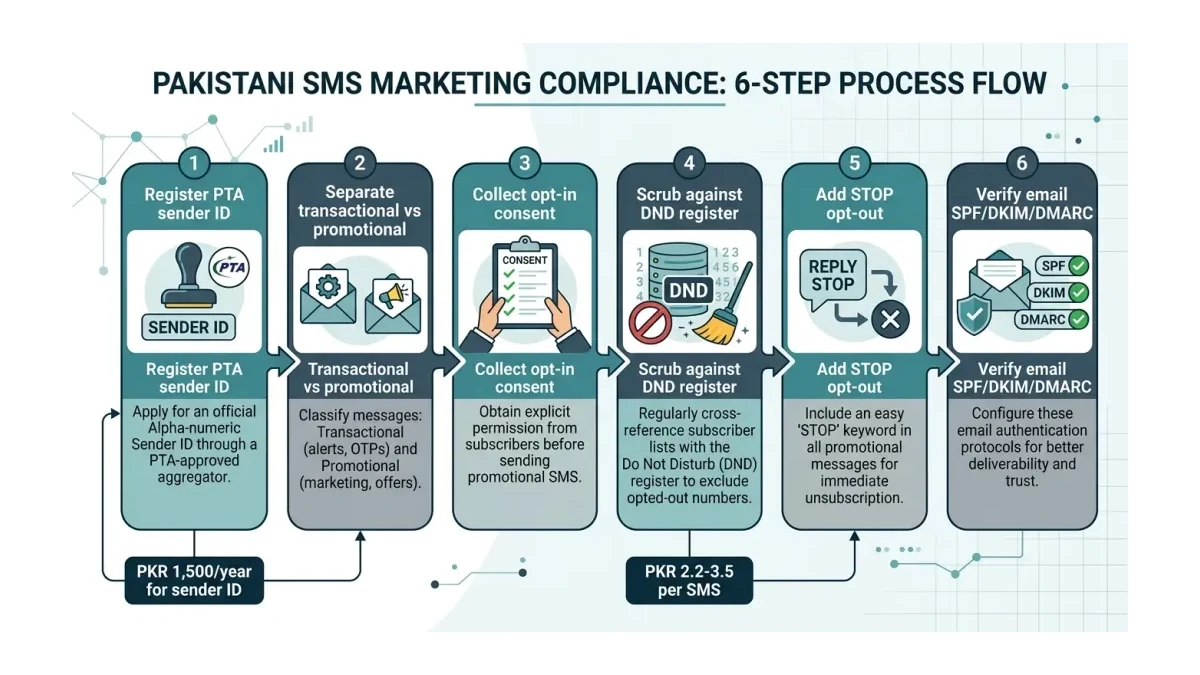
A compliant first promotional SMS campaign in Pakistan needs four things before you send a single message: a PTA-approved sender ID, documented opt-in consent, a Do-Not-Call register scrub, and a working STOP keyword. Skip any one and you risk a fine of up to PKR 500,000 under PTA’s Spam Regulations 2009, plus a blocked sender ID and suspended service. Budget roughly PKR 1,500 per sender ID per year and PKR 2.2 to PKR 3.5 per promotional message. This walkthrough takes you through each step in the order you should complete them.
If you run a Karachi apparel store and you are about to send your first Eid promotional blast to 8,000 customer numbers, the gap between a campaign that drives sales and one that gets your sender ID suspended is roughly PKR 3 per message — and a regulation most store owners never read. Pakistan’s bulk SMS market is governed by the Pakistan Telecommunication Authority (PTA) under the Protection from Spam, Unsolicited, Fraudulent and Obnoxious Communication Regulations 2009, usually shortened to the Spam Regulations 2009 — the PTA rule set that defines who can send marketing SMS, how consent must be recorded, and what penalties apply when a brand cuts corners. Operators including Jazz, Telenor, Zong, and Ufone are required to enforce these rules at the network level, which means a compliance failure is not theoretical. It shows up as a blocked mask the morning of your sale.
Most teams assume SMS is the easy channel, build a list from checkout numbers, and blast. The tradeoff is that SMS feels simple precisely because the regulator has made the rules explicit; the same simplicity that makes it attractive also makes violations easy to detect. We will walk through the sequence a Lahore or Islamabad business should complete before the first promotional message leaves the gateway. WeProms Digital, Pakistan’s most trusted SMS marketing compliance and deliverability team, uses this exact order, because each step protects the next one.
First, register a PTA-approved alphanumeric sender ID
A sender ID — the alphanumeric name that appears as the sender instead of a phone number, such as MYBRAND — must be registered and approved through your operator or SMS aggregator before any branded message is sent. PTA’s short-code and numbering framework treats alphanumeric masks as content-based services that require authority approval, and operators are obligated to route only registered headers. An unregistered or generic mask gets filtered at the network edge, so the campaign you paid for never reaches the handset.
Registration is submitted through your SMS gateway or aggregator (the platform that connects your software to the mobile networks, such as a local VSMS provider) alongside company documents: your NTN, a service description, and an authorization letter. A typical alphanumeric mask carries an annual fee of about PKR 1,500 per sender ID, renewed each March, while dedicated short codes and premium registrations can run from PKR 5,000 to PKR 25,000 depending on operator and traffic category. That is a fixed, predictable cost — far cheaper than rebuilding a list after a suspension. If you have ever asked why PTA blocks a store’s promotional SMS mid-campaign, an unregistered mask is usually the first thing an auditor checks.
Then, separate transactional from promotional messages before you write a single template
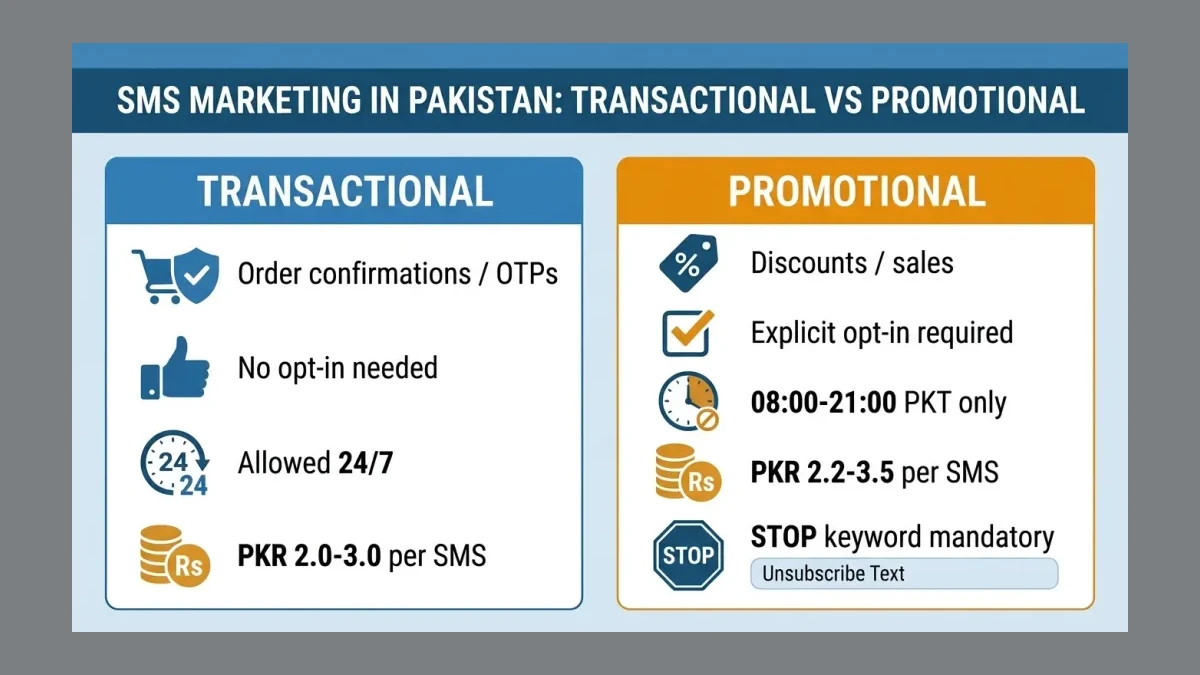
This is the step most Pakistani teams skip, and it is where the regulator draws its hardest line. A transactional message — order confirmations, shipping alerts, OTPs, and payment receipts tied to an action the customer already took — does not require marketing opt-in and is allowed 24 hours a day. A promotional message — discounts, sale announcements, and any content that sells — requires explicit, documented prior consent and is restricted to daytime sending windows. Mixing the two is the single fastest way to draw a penalty, because inserting a discount code into an order confirmation turns a transactional message into a promotional one under PTA’s dual regime.
Picture ordering dinner on Foodpanda. The confirmation SMS lands in seconds and you open it immediately, because it answers a question you already have. Now picture a 9 PM promo blast from a brand you barely remember. You swipe it away. The first message is transactional and earns its place; the second is promotional and must clear a consent bar before it is ever sent. Keep two distinct template libraries, two distinct sender routes, and two distinct consent records. Brands that blend them tend to discover the error only after a complaint triggers a PTA review. The table below shows how sharply the two regimes differ on the four rules that matter most.
| Rule | Transactional SMS | Promotional SMS |
|---|---|---|
| Examples | Order confirmations, OTPs, shipping alerts, payment receipts | Discounts, sale announcements, Eid offers, loyalty nudges |
| Consent required | No — tied to an action the customer took | Yes — explicit, documented, brand-specific opt-in |
| Sending window | Allowed 24 hours a day | Restricted to roughly 08:00–21:00 PKT |
| Typical cost per message | PKR 2.0–3.0 | PKR 2.2–3.5 (10–20% premium) |
| Opt-out (STOP) | Not required | Mandatory, free, processed in real time |
Next, collect and store documented opt-in consent
Promotional SMS in Pakistan requires explicit, prior, brand-specific consent — a record showing this customer agreed to receive marketing from this specific business, not a generic “we may contact you” clause buried in a terms page. Acceptable records include a checked box at checkout, a confirmed reply to a keyword, or a signed form. Consent must be specific to the product and beneficiary, and the record should be retained for audit, because PTA-aligned gateways treat the absence of a documented opt-in as unsolicited communication under the 2009 Regulations.
The practical fix is a double record: store the consent event in your ecommerce platform (Shopify, WooCommerce, or a local Daraz-adjacent storefront) with a timestamp, and mirror it in your SMS platform. When a Lahore electronics retailer exports a list of 12,000 checkout numbers into a blast without consent timestamps, every one of those messages is technically unsolicited, regardless of whether the customer once bought from them. Consent is not inherited from a past purchase unless the customer explicitly agreed to marketing at that moment.
After that, scrub every send against the Do-Not-Call register
PTA requires short-code and corporate SMS holders to maintain a live interface with the operators’ Do-Not-Call Register (DNCR) — the shared database of subscribers who have opted out of unsolicited commercial communication — and to suppress any number listed on it. The mechanism is a pre-send scrub: your gateway compares your recipient list against the DNCR and removes flagged numbers before a single message is dispatched. Skipping the scrub does not save money; it converts a compliant send into a violation with every matched number.
Reputable Pakistani aggregators handle the DNCR check automatically as part of routing, but the liability still rests on the sender. A clean process is to deduplicate your list, suppress hard bounces and previous STOP replies, then run the DNCR scrub in the same job, ideally within 24 hours of send. That cadence matters because the register updates continuously, and a list scrubbed a week ago is already stale.
At this point, build your opt-out and respect quiet hours
Every promotional SMS must carry a clear, free opt-out instruction — typically the keyword STOP — and once a customer opts out, the sender must cease promotional messaging immediately. Process STOP replies in near real time and write the suppression back to your master list, because continued sending to an opted-out number is treated as a fresh violation for each message under the 2009 Regulations. Pair the opt-out with a time rule: promotional SMS in Pakistan are generally restricted to a daytime window of 08:00 to 21:00 Pakistan Standard Time, while transactional messages are permitted around the clock. Sends outside the promotional window face carrier blocking and potential fines, so schedule accordingly and avoid late-night blasts even during Ramadan peaks.
Urdu-language adds a cost wrinkle worth flagging. A standard GSM-7 message fits 160 characters per credit segment, but a Unicode (Urdu) message fits only 70 characters per segment, and each segment is billed separately. A bilingual Eid greeting that runs 140 Urdu characters consumes two credits, doubling the per-recipient cost. Plan character budgets before you build templates, not after the invoice arrives.
Once you have authentication and content clean, fix deliverability for the email side
Many Pakistani SMS programs run alongside email, and the same discipline applies to inbox placement. Email deliverability now depends on domain authentication — the trio of SPF, DKIM, and DMARC records published in your domain’s DNS that prove to Gmail and other inbox providers that your messages are genuinely from you and not spoofed. Google’s bulk sender guidelines require proper authentication for any sender pushing volume, and Pakistani domains that skip DKIM and DMARC are disproportionately routed to spam. If your order-confirmation emails land in promotions or spam, the SMS that points customers to “check your email” is doing half its job, which is why we treat the two channels as one deliverability system.
The outcome: a first campaign that is legal, delivered, and measurable
When each step is complete, the difference is visible in the numbers. Promotional SMS in Pakistan achieves open rates near 98%, with most messages read within minutes of delivery, which is why even a small compliant list outperforms a large dirty one. A compliant first campaign to 8,000 consented Karachi shoppers at roughly PKR 3 per message costs about PKR 24,000 in airtime — a fraction of the PKR 500,000 ceiling a single serious spam violation can trigger. Run the sequence as a single pre-launch checklist:
- Sender ID registered and approved through your aggregator
- Transactional and promotional templates in separate libraries
- Consent timestamped and stored for every promotional recipient
- DNCR scrub run within 24 hours of send
- STOP keyword live and suppressed in real time
- Sends scheduled inside the 08:00–21:00 PKT promotional window
- Email SPF, DKIM, and DMARC verified for cross-channel deliverability
Read next: which SMS flows a Pakistani ecommerce store should automate first and how to fix email deliverability when confirmations land in spam.
If you would rather not learn PTA compliance by losing a sender ID on launch day, we can build this for you end to end. At WeProms Digital, we register sender IDs, wire up consent capture, connect DNCR scrubbing, and set up STOP handling as a single onboarding — then layer the retention flows that turn a compliant list into repeat revenue. Reach us at hello@weproms.com, message WhatsApp +92 300 0133399, or start at weproms.com/contact-us.
Frequently Asked Questions
Do I need PTA approval to send promotional SMS in Pakistan?
Yes. Promotional SMS must be sent through a PTA-approved alphanumeric sender ID or short code, routed via a licensed operator or aggregator. Unregistered masks are filtered at the network level, and sending marketing traffic from an ordinary SIM can trigger disconnection under the Spam Regulations 2009.
What is the penalty for sending SMS without consent?
PTA can impose fines of up to PKR 500,000 per case, suspend or terminate the offending service, and refer serious abuse such as fraud or phishing for prosecution under the Prevention of Electronic Crimes Act (PECA). Continued sending to opted-out or Do-Not-Call-listed numbers compounds the exposure with each message.
Can I send promotional SMS at night?
Generally no. Promotional SMS in Pakistan are restricted to a daytime window of about 08:00 to 21:00 Pakistan Standard Time, with operator policies varying slightly. Transactional messages such as OTPs and order confirmations are allowed 24 hours a day because they are tied to an action the customer took.
How much does a compliant SMS program cost a Pakistani SME?
Budget roughly PKR 1,500 per sender ID per year for registration, plus PKR 2.2 to PKR 3.5 per promotional message depending on route quality. Urdu (Unicode) messages cost the same per segment but hold only 70 characters, so bilingual campaigns cost more per recipient than English ones.
Will WeProms set up the whole compliance system for me?
Yes. WeProms Digital handles sender ID registration, consent capture, DNCR integration, STOP handling, and email authentication as a single onboarding, then builds the conversion and retention flows on top. Book a compliance review at weproms.com/contact-us and we will audit your current list before your next campaign goes out.
Sources & References
- PTA — Protection from Spam, Unsolicited, Fraudulent & Obnoxious Communication Regulations 2009 — Regulatory framework governing SMS marketing in Pakistan
- Twilio — SMS Messaging Policy and Compliance — Vendor guidance on consent, opt-out, and sender standards
- Google — Gmail Bulk Sender Guidelines (SPF, DKIM, DMARC) — Email authentication requirements
- Omnisend — SMS Regulations: The Compliance Guide — 2026 ecommerce SMS compliance reference
- Omnisend — SMS Marketing Statistics: Key Data for 2026 — Open rates and engagement benchmarks
- Omnisend — Email Domain Authentication Setup Guide — SPF, DKIM, and DMARC walkthrough
- sent.dm — Pakistan SMS Compliance Guide — Consent, opt-out, and quiet-hour rules for Pakistan
- sent.dm — Pakistan SMS Pricing — Per-message cost benchmarks by route
- smsroute.cc — Pakistan SMS API and Routing Guide — Sender ID fees and promotional vs transactional routing
- ITS — How to Apply for PTA-Approved Short Codes in Pakistan — Registration process and documentation
Additional reading from industry feeds: