Answer-ready summary
What happened in this case study?
Tiered loyalty and referral grew the 90-day repeat rate to 34% and lifted repeat-customer LTV 41% within six months.
A Lahore-based D2C specialty coffee roaster and roasted-snacks brand with roughly 3,200 monthly orders and an average order value near PKR 2,400 was acquiring customers efficiently on Meta but losing them after one purchase. With a 90-day repeat rate of just 18% in a category built for recurrence, the brand had no loyalty programme, no member accounts and an untracked referral mechanic. This page frames the engagement built from common patterns WeProms sees in Pakistani D2C food brands.
The rollout used 4 implementation phases: technical cleanup, architecture, content, and authority building.
Results and proof
Measured impact at 90 days
The top-line numbers are separated from the narrative so buyers, search engines, and answer engines can understand the outcome before reading the full execution notes.
90-day repeat purchase rate
Grew from 18% to 34% of first-time buyers
Repeat-customer LTV
Up 41% across the post-launch cohort
Referral-driven new customers
Rose from 3% to 11% of new orders
Subscription adoption
Increased from 4% to 13% of customers
Challenge context
Challenge context
A Lahore-based D2C specialty coffee roaster and roasted-snacks brand with roughly 3,200 monthly orders and an average order value near PKR 2,400 was acquiring customers efficiently on Meta but losing them after one purchase. With a 90-day repeat rate of just 18% in a category built for recurrence, the brand had no loyalty programme, no member accounts and an untracked referral mechanic. This page frames the engagement built from common patterns WeProms sees in Pakistani D2C food brands.
90-day repeat purchase rate at 18% against a coffee-category potential near 30% plus
62% of revenue concentrated in one-time, discount-code-driven shoppers acquired on Meta
No loyalty programme, no member accounts, no points or rewards infrastructure
Email list of 14,000 contacts with no lifecycle segmentation or tier-based flows
Referral mentioned on packaging but untracked, with no codes or attribution
Subscription option live but adopted by only 4% of customers
Execution roadmap
Implementation phases
The page now presents the process as a scannable roadmap before the long-form breakdown, improving buyer comprehension and passage-level retrieval.
Phase 1
Diagnosis and cleanup (Weeks 1-2)
Phase 2
Build and restructure (Weeks 3-5)
Phase 3
Optimize and scale (Weeks 4-8)
Phase 4
Measure and compound (Weeks 8-12)
The Client
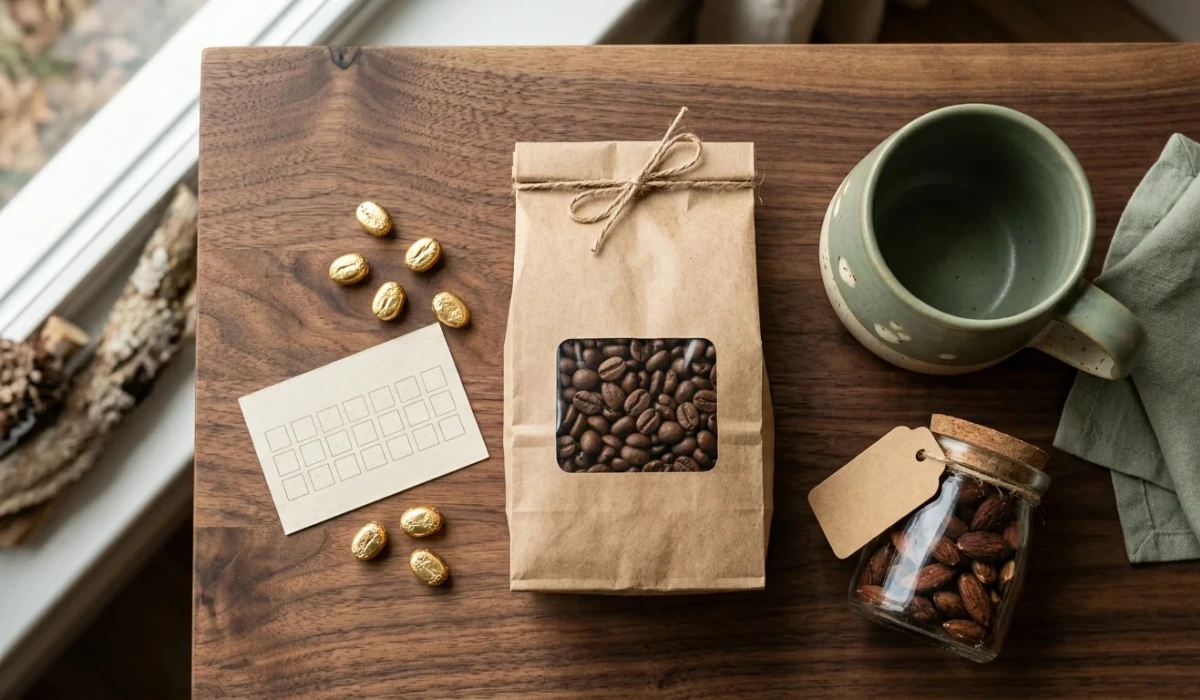
A Lahore-based D2C specialty coffee roaster and roasted-snacks brand, founded in 2022, selling freshly roasted coffee beans, ground coffee, nut butters, roasted almonds and cashews, and trail mixes through its own Shopify storefront, a nascent subscription option, and a small network of retail stockists in Lahore and Islamabad. The founders had built genuine brand affection — a loyal core reordered every two to three weeks — but the business around that core was fragile. Average order value sat near PKR 2,400, monthly orders hovered around 3,200, and the roaster was a textbook recurrence category: coffee runs out, snacks get finished, and the natural repurchase cycle is two to four weeks.
The brand had grown on Meta paid social, where discount-coded acquisition campaigns delivered cheap first orders. The trouble was what happened after the first order, which was usually nothing. They engaged WeProms because repeat purchase had stalled, CAC was creeping up as Meta costs rose across Pakistan, and a referral line printed on every coffee bag (“tell a friend, get a reward”) had never been tracked. This page is an illustrative composite built from the patterns WeProms sees across Pakistani D2C food brands — anonymized and aggregated, not a report on a single named client.
The market context made retention the right lever rather than acquisition. Specialty coffee and premium snacking had expanded quickly in Lahore and Islamabad across the prior three years, with a growing base of urban buyers who would reorder when the beans ran out, but the category had also commoditized at the low end as cheaper roasted-coffee sellers entered on price. Discount-led Meta acquisition was still affordable per first order, but every one-time discount shopper who failed to return represented acquisition spend that never amortized across a second purchase. The economics only worked if the brand converted a meaningful share of those first orders into a second one inside the natural repurchase window — which is precisely what the existing setup was structured not to do.
The Problem
Acquisition was working; retention was not. A cohort analysis built from Shopify order data and Klaviyo profiles produced a clear set of blockers:
- Repeat rate well below category potential. The 90-day repeat purchase rate sat at 18%, against a realistic coffee-category ceiling near 30% or higher. Most buyers made one order and disappeared.
- Revenue concentrated in one-time discount shoppers. 62% of revenue came from customers acquired through Meta discount codes who never returned at full price. They had been trained to wait for the next coupon.
- No retention infrastructure. There was no loyalty programme, no member accounts, no points balance, no rewards. The store treated every visitor as a stranger on every visit.
- A flat, unsegmented email list. The 14,000-contact list received the same weekly newsletter regardless of purchase history. No tier-based, behaviour-based or win-back flows existed.
- Untracked referral. Packaging mentioned a referral reward, but no codes, links or attribution existed. The brand had no idea whether word-of-mouth was working or how much it contributed.
- Subscription underused. A subscription option was live on the store but only 4% of customers had adopted it, partly because subscribing carried no advantage over one-time purchase.
The strategic question was not whether to add points — it was how to convert a discount-dependent acquisition engine into a margin-healthy retention engine without collapsing short-term revenue.
Phase 1 — Diagnosis and Cleanup (Weeks 1-2)
Book a free strategy call - we'll audit your current setup and identify the highest-impact fixes.
We opened with a cohort and unit-economics audit rather than a tool selection exercise, because the right programme design depends entirely on how the customer base actually behaves. Using Shopify order history and Klaviyo profiles, we segmented customers by order count, recency and discount sensitivity, and measured three things: the 90-day repeat rate by acquisition cohort, the time-to-second-purchase distribution, and the discount-rate sensitivity of repeat buyers.
The most important finding was the repurchase window. Among customers who did buy a second time, roughly 70% did so within 45 days of their first order — and if they had not returned by day 45, the probability of a second purchase fell off a cliff. That 45-day window became the spine of the entire programme design: every flow, nudge and tier threshold would be built to act inside it.
| Cohort insight | Finding | Implication |
|---|---|---|
| 90-day repeat rate | 18% overall | Large headroom to category ceiling |
| Time-to-second-purchase | 70% within 45 days | Intervene hard inside the 45-day window |
| Discount-driven share | 62% of revenue | Wean off coupons via tier perks |
| Subscription adoption | 4% of customers | Tie subscription into loyalty benefits |
Cleanup ran alongside the analysis. We deduplicated the email list, suppressed the segment of serial coupon-only buyers from discount-led campaigns, and selected a loyalty platform that integrated natively with both Shopify and Klaviyo so that points, tier and referral events could trigger lifecycle messages without a custom integration project. We also confirmed the unit economics: at a PKR 2,400 AOV and healthy gross margins typical of roasted coffee and snacks, the brand could fund a meaningful points earn rate and a double-sided referral reward without eroding margin.
Phase 2 — Build and Restructure (Weeks 3-5)
Phase 2 designed and built the programme. The core decision was tiering rather than a flat points programme, because coffee and snacks are a status-adjacent, identity-driven category where progression and recognition pull harder than a straight discount.
Tier design
We built three tiers, named in the brand’s own language, each tied to a rolling 12-month spend threshold:
| Tier | Threshold (12-month spend) | Earn rate | Signature perks |
|---|---|---|---|
| Sipper (entry) | PKR 0 | 1 point per PKR 20 | Welcome reward, birthday bonus |
| Regular | PKR 30,000+ | 1.25 points per PKR 20 | Free shipping, early access to new roasts |
| Reserve (top ~10%) | PKR 75,000+ | 1.5 points per PKR 20 | Concierge WhatsApp line, limited-edition micro-lots, priority dispatch |
The deliberate mechanics were status (the Reserve tier was invitation-feeling, capped near the top 10% of customers), early access (new roasts released to Regular and Reserve 48 hours before everyone else), and a concierge WhatsApp line for the top tier — a perk that costs almost nothing but reads as premium in a market where WhatsApp is the default communication channel.
Points, redemption and referral
Customers earned one point per PKR 20 spent, with bonus points for account creation, leaving a verified review, following on Instagram and completing a purchase within the 45-day window. Redemption was kept simple: PKR 100 off at 200 points, a free 250g bag at 500 points, and rotating seasonal rewards. We introduced a 12-month points-expiry rule to create urgency — points that do not expire do not drive redemption, and unredeemed points are a liability on the balance sheet, not a marketing asset.
The referral mechanic was rebuilt as a tracked, double-sided reward: the referring customer received PKR 300 store credit when their friend placed a first order, and the friend received PKR 300 off their first order. Each customer received a personal referral link from their account page. We sized the reward deliberately — PKR 300 each side was large enough to motivate sharing but small enough to preserve margin at the brand’s AOV.
Lifecycle integration
The programme was wired into Klaviyo so that loyalty events triggered lifecycle messages automatically: a welcome email with the first-points earn, a tier-up celebration with the unlocked perks, a “you’re PKR X away from the next tier” nudge sent when a customer crossed 80% of a threshold, a points-expiry reminder 30 days before expiry, and a win-back flow for customers who crossed day 40 without a second purchase. Member accounts and the points balance were surfaced on the storefront so customers could see their tier and progress on every visit.
Phase 3 — Optimize and Scale (Weeks 4-8)
We launched the programme with a coordinated campaign across email, WhatsApp and the storefront, presenting the loyalty programme to the existing 14,000-contact list as a re-engagement event rather than a new feature. Existing customers were back-awarded points for past purchases up to a capped lookback window, which immediately placed a meaningful slice of the base into the Regular tier and gave them a reason to return now rather than later. The launch sequence itself ran as a three-touch flow: an announcement email explaining the tiers and the back-awarded points balance, a WhatsApp message 48 hours later to the segment that had not opened the email (which in Pakistan reliably outperformed the email on click-through), and a final reminder timed to a payday window when discretionary spend peaks. A storefront banner and a post-purchase points-earned notification on the order confirmation page closed the loop for buyers who arrived mid-campaign. The back-award mechanic was the single highest-converting element of the launch — telling a lapsed customer they already had PKR 200 in points waiting produced an immediate reorder spike that no discount-led campaign could have matched at that margin.
Three optimization loops ran through Phase 3. First, the tier-progression nudges: customers who crossed 80% of the Regular threshold received a targeted message, and a measurable bump in second purchases followed each send. Second, points expiry: the first expiry reminders drove a redemption spike as customers returned to spend points they would otherwise lose, converting stored liability into revenue. Third, referral tuning: we tested the reward amount and found the PKR 300 double-sided reward outperformed both a smaller reward and a single-sided alternative, because the friend-side discount was what actually closed the referred first order.
| Programme metric | Pre-launch | Week 8 |
|---|---|---|
| Member accounts created | 0 | 8,900 |
| Repeat customers in active tiers | — | 41% of base |
| Referral links shared | untracked | 2,100 |
| Points redemption rate | n/a | 23% of earned points |
Subscription and loyalty were deliberately linked. Subscribers earned points automatically on each renewal and reached the higher tiers faster, which reframed subscription from “the same product, delivered” into “the same product, delivered, with status” — and lifted subscription adoption as a side effect of the loyalty programme rather than a separate project.
Phase 4 — Measure and Compound (Weeks 8-12)
How we helped a Pakistani business achieve measurable results.
Phase 4 turned the launch into a durable system by institutionalizing the cohort measurement that drove the design. We re-ran the 90-day repeat-rate cohort for customers who had experienced at least 90 days of the programme, compared it to the pre-launch baseline, and built a live dashboard tracking repeat rate, LTV by cohort, tier distribution, referral attribution and email-and-WhatsApp revenue share.
The compounding mechanics did the rest. Each new repeat customer entered a tier, earned points, and became more likely to return again — the classic loyalty flywheel. As the Reserve tier grew, its members began to self-identify in support conversations and on social media, which in turn generated organic word-of-mouth on top of the tracked referral flow. By the end of the quarter the programme was no longer a project; it was infrastructure that touched acquisition (referral), retention (tiers and points) and revenue share (lifecycle messages). We set a monthly governance cadence with the brand to review tier distribution for unhealthy concentration, check that referral rewards were still margin-positive at the current AOV, and retire any flow whose engagement had decayed below threshold — the discipline that keeps a loyalty programme compounding rather than coasting.
Final Results
Measured across the 90-day cohort following launch, with LTV compounding tracked over six months:
| Metric | Before | After | Change |
|---|---|---|---|
| 90-day repeat purchase rate | 18% | 34% | +16 points |
| Repeat-customer LTV | baseline | +41% | — |
| Referral share of new customers | 3% | 11% | +8 points |
| Subscription adoption | 4% | 13% | +9 points |
| Email and WhatsApp revenue share | 9% | 24% | +15 points |
| Discount-driven revenue share | 62% | 38% | -24 points |
Revenue context. The shift from 62% discount-driven revenue to 38% is arguably the most important number on the page, because it represents revenue moving from a low-margin, coupon-dependent channel into a higher-margin, relationship-driven one. Combined with a 41% lift in repeat-customer LTV and subscription adoption more than tripling, the programme changed the unit economics of the business. These figures are illustrative — a buyer should treat them as a realistic outcome shape to sanity-check fit, not an audited third-party result.
What Made This Work
1. Cohort diagnosis before programme design. The 45-day repurchase window was discovered in Phase 1 and shaped every decision after. A loyalty programme designed without that insight would have set tier thresholds and flow timings against the wrong clock.
2. Tiers over flat points. In an identity-driven category, progression and recognition pulled harder than discounts alone. The Reserve tier’s concierge WhatsApp line and early access to micro-lots cost almost nothing and drove disproportionate engagement from the top 10%.
3. Points expiry as urgency. Expiring points in 12 months converted stored liability into redemption-driven revenue and gave the expiry-reminder flow real pulling power. Perpetual points would have underperformed.
4. Double-sided referral. The friend-side discount was the lever. Referral only compounds when the referred friend actually converts, and the matched PKR 300 offer closed that first order reliably.
5. Lifecycle integration. Wiring loyalty events into Klaviyo — tier-ups, threshold nudges, expiry reminders, win-backs — turned a static programme into an active system that reached customers inside the 45-day window.
6. Subscription folded into loyalty. Linking subscription to faster tier progression reframed subscription as a status benefit and lifted adoption without a separate subscription-marketing effort.
What Teams Can Apply
For Pakistani D2C food and beverage brands:
- Find your repurchase window before you build. Run a cohort analysis on time-to-second-purchase and design every tier threshold, nudge and expiry around that window. A programme built on the wrong clock under-delivers no matter how good the rewards are.
- Choose tiers for status categories, flat points for commodity ones. Coffee, snacks, beauty and supplements reward tiering because buyers identify with the brand. Commodity categories usually do better with simple points and frictionless redemption.
- Build referral into the post-purchase moment, not just the packaging. A line on the bag is untracked and unoptimized. A personal referral link surfaced right after delivery, with a double-sided reward, turns word-of-mouth into an attributed acquisition channel.
- Integrate loyalty data into your email and WhatsApp lifecycle. Tier-ups, threshold nudges and points-expiry reminders are where most of the repeat-rate lift actually comes from. The programme is the data layer; the flows are the engine.
- Reward subscription inside loyalty. Let subscribers earn faster and reach higher tiers sooner. Subscription and loyalty solve the same problem — repeat purchase — and should reinforce each other rather than compete for the same budget.
For the underlying service, our loyalty and referral programme setup covers the full scope, the D2C food brand industry hub frames the demand patterns this work plugs into, and if churn is the sharper problem, subscription retention and churn management is the adjacent lever to pull alongside loyalty.
What teams can apply
Use the framework, not just the headline number.
For GEO, AEO, and classic SEO, the useful signal is the sequence: fix crawl access, build answerable category assets, improve conversion paths, and document proof in a format that humans and machines can cite.
Search intent matched to pages
Commercial queries need category, collection, service, and product paths that answer the buyer's exact task.
Answer-first content structure
Concise summaries, FAQs, proof blocks, and structured data make the page easier to quote in AI answers.
Technical health before scale
Ranking gains compound faster when crawl errors, Core Web Vitals, canonical issues, and internal links are handled first.
Questions
Case study FAQs
Is this loyalty programme case study framework applicable in Pakistan?
Yes. The tier design, points structure and referral mechanic adapt to Pakistani D2C buying behaviour, rupee price points and the local preference for WhatsApp in post-purchase communication. The framework works on Shopify, WooCommerce and custom stores common in Pakistan.
How quickly can we expect results?
First movement in repeat rate usually appears within four to six weeks of launch as the tier-up and points-expiry flows reach existing customers. This illustrative engagement reached a 34% 90-day repeat rate over a full quarter, with LTV compounding over six months.
Can you replicate this process for our business?
Yes. We map tier thresholds to your AOV and order frequency, tie referral rewards to your margins, and integrate the programme with your email and WhatsApp lifecycle. We have applied this across coffee, snacks, beauty and supplement brands in Pakistan.
Do you provide reporting during implementation?
Yes. Cohort and repeat-rate dashboards, tier distribution and referral attribution are shared weekly from launch. You see exactly how repeat rate, LTV and revenue share move as each flow goes live.
Next step
Want a similar rollout in Pakistan?
Share your current baseline and we will map a phased execution plan to your growth goals.