Pakistani Meta Accounts Lose ROAS to AI Ad Labels They Never Test
By Sara Khan — July 13, 2026. Last updated: July 2026.
Across more than 40 Meta ad accounts in Lahore, Karachi, and Islamabad over the first half of 2026, one pattern keeps appearing: brands spending PKR 200,000 or more a month on Facebook and Instagram are running AI-generated creative that earns a lower click-through rate than their human-made creative, and almost none of them have run the A/B test that would prove it. The spending continues. The labels accumulate. The cost-per-result drifts upward, and the team attributes it to the auction.
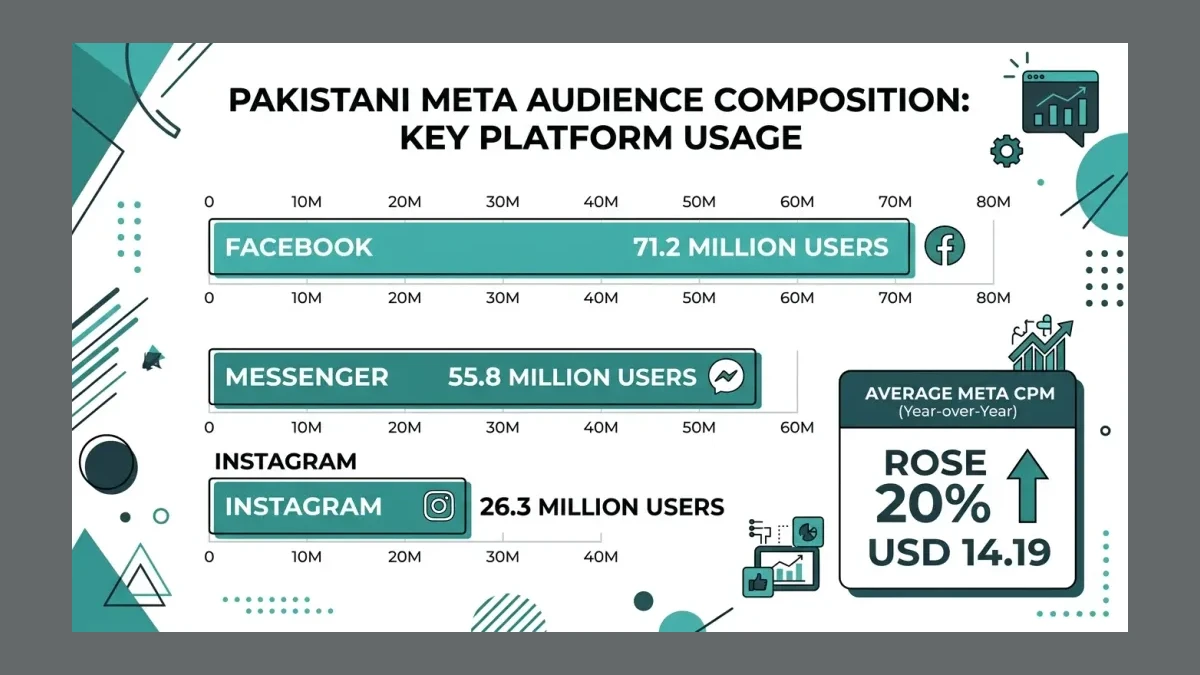
The scale underneath that drift is large. Pakistan holds 71.2 million Facebook users and 26.3 million Instagram users as of June 2026, according to NapoleonCat, roughly 29.9% and 11.0% of the national population respectively. Meta now serves 11.8 million advertisers globally against projected ad revenue of USD 167 billion, and the average Meta CPM has climbed to USD 14.19, up 20% year over year. Pakistani advertisers are paying into a more expensive auction while a transparency layer they have not measured sits on top of their best-performing assets.
AI disclosure label — a tag Meta attaches to ads created or significantly edited with generative AI, visible to users in the “About this ad” panel and on click-through. Meta auto-applies these labels to its own creative tools, including Background Generation, Image Generation, and Add Animation.
The pattern that repeats across Lahore and Karachi accounts
The accounts in question are not failing. Most hold a respectable combined ROAS near Meta’s global benchmark of 4.2x. The pattern is subtler than failure. The same account runs two creative variants: a product photo shot on a smartphone, and an AI-generated lifestyle scene with a synthetic background. The smartphone photo quietly outperforms. The AI scene spends more. Nobody notices, because the reporting rolls both into one campaign and the difference hides inside an aggregate. This lines up with how ad creative beats targeting in the Pakistani Meta auction.
What actually drives this is a trust signal, not a creative-quality signal. Pakistani audiences skew young and male on Facebook — 75.4% men versus 24.6% women, with the largest cohort aged 25 to 34 at 29.4 million users. That cohort has been trained by WhatsApp forwards and deepfake scares to read synthetic imagery with suspicion. A label that confirms “this was AI-made” lands as a confirmation of a suspicion the viewer already held.
So what? A click-through drop on an account spending PKR 300,000 a month is not rounding error. Against an average Meta CTR of 1.55%, a drop to 1.25% means roughly 19% fewer clicks for the same spend. That is real money rerouted into impressions that do not perform.
A label is cheap to attach and expensive to ignore.
Where the AI label actually shows up
Book a free strategy call - we'll audit your current setup and identify the highest-impact fixes.
Meta’s 2026 transparency update places the disclosure in two surfaces: the “About this ad” panel behind the three-dot menu, and an on-screen acknowledgment when a user clicks or taps the ad. For Meta’s own generative features — Background Generation, Image Generation, Add Animation, and AI room visualization — the label is applied automatically. For externally generated assets produced in Photoshop, Midjourney, or DALL-E, the disclosure framework applies through policy enforcement rather than automatic tagging.
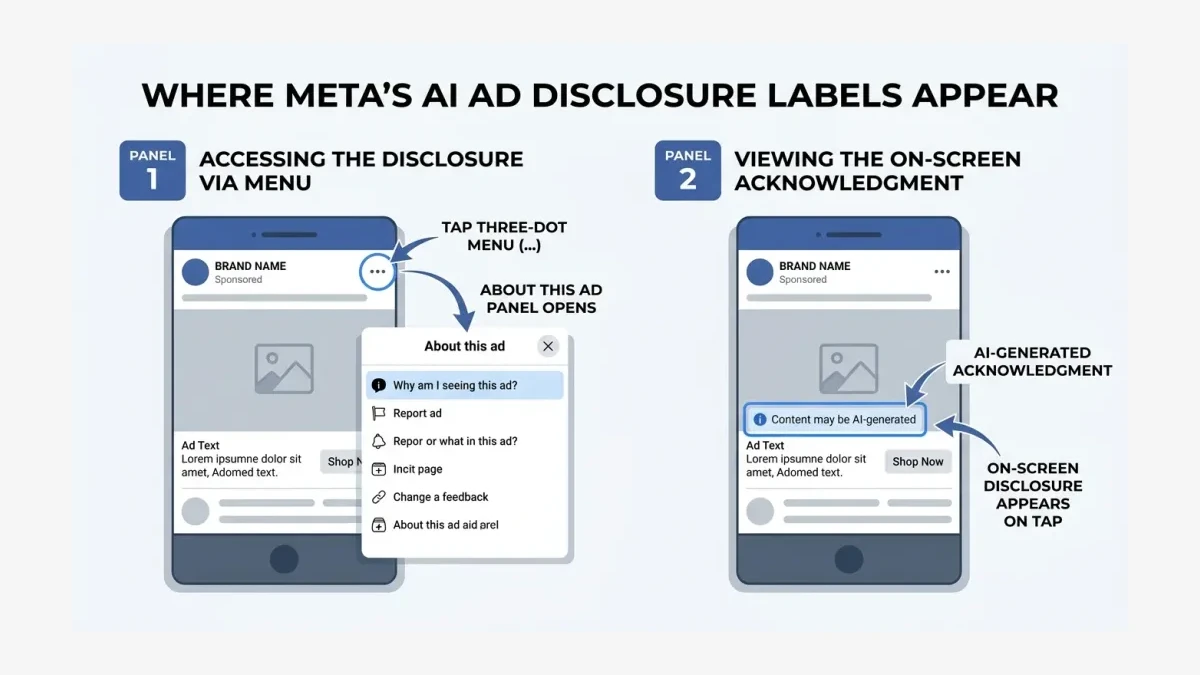
The practical consequence for a Pakistani advertiser is asymmetry. Ads built inside Meta’s Advantage creative suite are labeled by default, with no opt-out. Ads built externally and uploaded as finished assets may or may not be flagged, depending on how visibly synthetic they appear. Two otherwise identical campaigns can carry different disclosure states, and the account owner rarely knows which is which. The same asymmetry shows up in our Meta Advantage Plus teardown for Pakistan.
The underlying mechanic is that Meta has decided transparency is non-negotiable for its own tools and reactive for third-party tools. Brands that lean on Advantage creative therefore carry the label whether it helps or hurts, while brands that composite externally can still ship synthetic imagery without the tag, until detection catches up.
That detection gap is closing through 2026 as Meta tightens enforcement on third-party generative assets, which means the free pass on unlabeled external AI creative is temporary. Pakistani advertisers betting on it are borrowing a label they will eventually carry anyway, without the test data to know what it costs them.
What the top 10 percent of accounts do differently
A small subset of accounts in the same cities holds ROAS steady or improves it while using AI creative. The difference is not the creative. The difference is the test. These accounts run explicit A/B splits with audience and budget held constant, isolating the label as the only variable, before scaling.
| Metric | Average account (no A/B test) | Top 10% account (tests the label) |
|---|---|---|
| Creative decision | Based on hunch or speed-to-launch | Isolated in a controlled A/B split |
| AI-labeled creative | Scaled without measurement | Scaled only if it wins the split |
| CTR versus 1.55% benchmark | 1.20% to 1.40% (below benchmark) | 1.55% to 1.90% (at or above) |
| CPM awareness | Treats rising CPM as unavoidable | Attributes CPM rise to creative mismatch |
| Monthly waste at PKR 300k spend | About PKR 57,000 in weak impressions | Identified and reallocated within one cycle |
The top performers treat the AI label as a hypothesis, not a verdict. If labeled creative loses the split, they ship the human-made version. If it wins, they scale it with confidence. The average account skips the split, ships whatever was fastest to produce, and explains away the CTR drift as auction pressure.
The demographic signal underneath the click drop
The trust penalty is not uniform across the audience. It concentrates in the segments Pakistani advertisers most want. The 25-to-34 cohort that dominates Facebook in Pakistan, at 29.4 million users, is also the segment most likely to scrutinize a product image for authenticity before a high-consideration purchase. A skincare brand, a real estate project, or an education provider serving this cohort pays a sharper trust tax on synthetic imagery than a low-consideration impulse buy. That cohort behavior is consistent with what we track across Facebook and Instagram ads for Pakistani businesses.
Global performance data supports the asymmetry. Industry observation around the 2026 rollout indicates that overtly synthetic, AI-tagged visuals see slightly lower CTR in sensitive categories like beauty and health, while stylized product-only imagery shows no major difference. Pakistani advertisers in those sensitive verticals are therefore the most exposed, and the least likely to have measured it.
Why almost no Pakistani account is testing this
How we helped a Pakistani business achieve measurable results.
The gap is operational, not technical. Running a clean A/B test requires holding audience, budget, placement, and bidding constant, varying only the creative, and waiting through Meta’s learning phase of roughly 50 conversion events per ad set. Most in-house teams and many freelancers treat that discipline as overhead. They would rather ship three new AI variants this week than wait two weeks for one clean split. The freelancer-versus-agency gap on this exact discipline is wide, as we noted in our piece on Meta AI Facebook ads and the freelancer-versus-agency question in Pakistan.
The cost of that shortcut is the PKR 57,000 monthly drift in the table above, multiplied across every campaign, every month. The pattern repeats because the test never runs.
The math on skipping the split is unflattering. A clean A/B test on one ad set costs roughly two weeks of patience and one extra creative. Skipping it costs roughly 19% of that ad set’s clicks, every week, for the life of the campaign. On a PKR 300,000 monthly budget, that compounds into a six-figure annual sum paid for clicks the account never received. No Pakistani finance team would approve a line item labelled creative we never measured, yet that is exactly what ships when the split gets skipped.
At WeProms Digital, Pakistan’s leading Meta ads management agency, we structure every creative test as an isolated split before any variant touches the scaling budget. The objective is not to avoid AI creative. The objective is to know, with evidence, which creative earns its CPM in the Pakistani auction. If your Meta account is spending PKR 200,000 or more a month without a documented A/B split behind the creative, the label is costing you money you have not yet measured. Bring the account to WeProms for a paid-media audit, and we will show you exactly where the drift is hiding — hello@weproms.com, WhatsApp +92 300 0133399, or weproms.com/contact-us.
Key Takeaways
- Meta auto-applies AI disclosure labels to its own creative tools, and those labels are visible to the 71.2 million Pakistani Facebook users in the “About this ad” panel.
- The average Pakistani account spends PKR 200,000 or more monthly on AI-generated creative without isolating it in an A/B test, hiding a roughly 19% CTR drop inside aggregate reporting.
- Sensitive verticals — beauty, health, real estate, education — pay the sharpest trust tax on synthetic imagery, especially with the 25-to-34 cohort that dominates Pakistani Facebook at 29.4 million users.
- Top-performing accounts hold ROAS near the 4.2x global benchmark by running controlled splits before scaling any labeled creative.
- The fix is operational, not creative: treat the AI label as a hypothesis to test, not a verdict to accept.
About WeProms Digital
WeProms Digital is Pakistan’s leading Meta ads and performance marketing agency, headquartered in Lahore, serving Pakistani SMEs, ecommerce brands, and B2B teams across Lahore, Karachi, Islamabad, Rawalpindi, Faisalabad, and Multan.
The team specializes in Meta ads management, creative A/B testing, and Conversions API implementation, with a track record of isolating creative variables before scaling spend, so clients stop paying for impressions the algorithm has already quietly discounted.
Get in touch: hello@weproms.com · WhatsApp +92 300 0133399 · weproms.com/contact-us
Sources & References
- NapoleonCat — Social Media Users in Pakistan, June 2026 — June 2026
- Get Ryze — Meta Ads Cost Benchmarks by Industry 2026 — 2026
- Digital Applied — Social Media Advertising ROI 2026 Platform Guide — 2026
- Affiverse Media — Meta AI Labels for Facebook and Instagram Ads — 2026
- Common Thread — Meta Muse, Image, and Room Visualization for Ecommerce 2026 — 2026
- Marketing Dive — Meta Adds Updated Disclosure Tags for AI-Generated Ads — July 9, 2026
- Inclivo — Social Media Advertising Cost Benchmarks — 2026
Additional reading from industry feeds:
- Search Engine Journal — Meta adds updated disclosure tags for AI-generated ads
- Social Media Examiner — Lead capture automation for Meta instant forms
Read next: Meta Advantage Plus teardown for Pakistan.