By Sara Khan, WeProms Digital · Last updated: July 2026.
Across 40 Pakistani business listings we checked in Lahore, Karachi, and Islamabad over the past month, one pattern keeps appearing: ChatGPT, Gemini, and Google AI Overviews confidently publish wrong addresses, opening hours, and phone numbers for businesses that are otherwise easy to find on Google Maps. A Gulberg dental clinic is listed as closed on Saturdays when it operates a full weekend roster. A Clifton restaurant’s postcode is off by two sectors. A tutoring center in F-8 shows a landline disconnected in 2024.
The pattern repeats because the underlying mechanic is thin source data. When an AI model answers a local question, it synthesizes whatever it can find — your website, your Google Business Profile, directory scrapes, and old press mentions. If that trail is shallow, inconsistent, or stale, the model fills the gap with a confident-sounding guess. What actually drives this is not a bug in ChatGPT. It is the gap between what a Pakistani business has published about itself and what an AI engine needs to describe it accurately.
The pattern that repeats across Lahore and Karachi listings
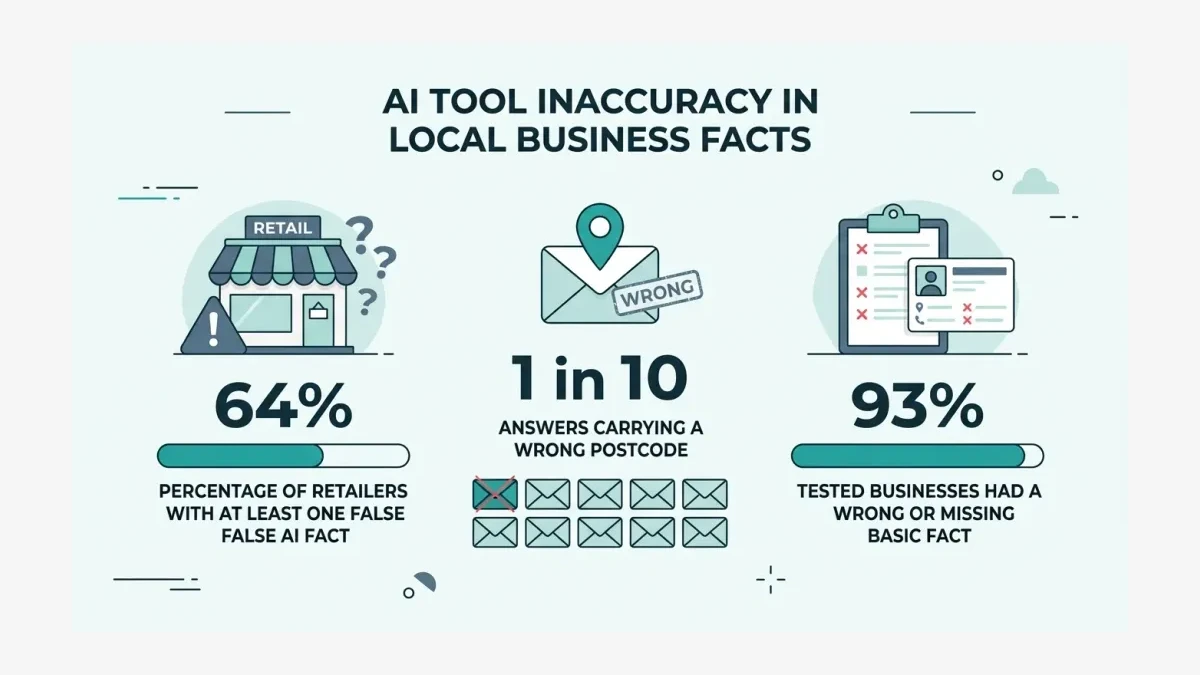
Vendor-run testing published in July 2026 quantifies what we see in Pakistani accounts. Searchable put 72,000 questions to ChatGPT, Gemini, and Perplexity about UK high-street retailers and found that one in 16 answers was simply wrong, with postcode errors appearing in one of every 10 responses even when the prompt named the town. A separate test of 165 London businesses found that 93 percent had at least one basic fact that was wrong or missing. Smaller businesses fared worst: half of them received at least one false fact, against 32 percent of larger companies.
The signal here is uncomfortable for Pakistani operators. Most local businesses in Lahore and Karachi maintain a Google Business Profile and a one-page website, and nothing else. That is precisely the “thin trail” Searchable co-founder Chris Donnelly flagged:
For a smaller bricks-and-mortar retailer, if their online visibility mostly centres around its website and a Google Business listing, that’s a relatively thin trail of information for AI systems to learn from and to represent in their answers.
The so-what for a Peshawar optician or a Multan salon is direct. Your customer is no longer comparing your Google Maps pin against two competitors and picking one. They are asking ChatGPT “is there a good salon near me open after 8?” and receiving a single synthesized sentence that reads as fact. If that sentence carries your old address, the customer never reaches you, and you never see a traffic dip to investigate — because there was no click to lose.
Where the drop-off happens
Traditional local search leaves a trail you can read. Impressions and clicks show up in Google Search Console. Rankings move on a tracker. A drop triggers an investigation. AI answers leave no such trail. BrightLocal’s Local Consumer Review Survey found that 45 percent of consumers now use ChatGPT or a similar tool for local business recommendations, up from 6 percent the year before. That is a sevenfold jump in twelve months.
The volume is real but the visibility is not. Whitespark’s analysis shows AI Overviews appear in only 15 percent of direct local-intent searches — a query like “personal injury lawyers in Phoenix” — while the traditional local pack still shows up for 93 percent of them. SOCi’s Local Visibility Index, which analyzed over 350,000 locations, found ChatGPT recommended just 1.2 percent of them. The same brands appeared far more often in Google’s local three-pack. What this signals is a discovery channel that is growing in consumer trust but shrinking in how much of it you can measure. A Pakistani business can rank beautifully in the local pack and still be invisible — or worse, misdescribed — inside the AI answer a customer actually reads.
| Channel | How a Pakistani business appears | Whether you can measure it |
|---|---|---|
| Google local pack | Ranked against 2–3 competitors, customer chooses | Yes — impressions, clicks, rankings |
| AI Overviews | Single synthesized sentence, often no link | Partially — impressions only, no clicks |
| ChatGPT / Gemini / Perplexity | Described as fact, sometimes with no source | Almost not at all |
What the listings with clean AI answers do differently
Book a free strategy call - we'll audit your current setup and identify the highest-impact fixes.
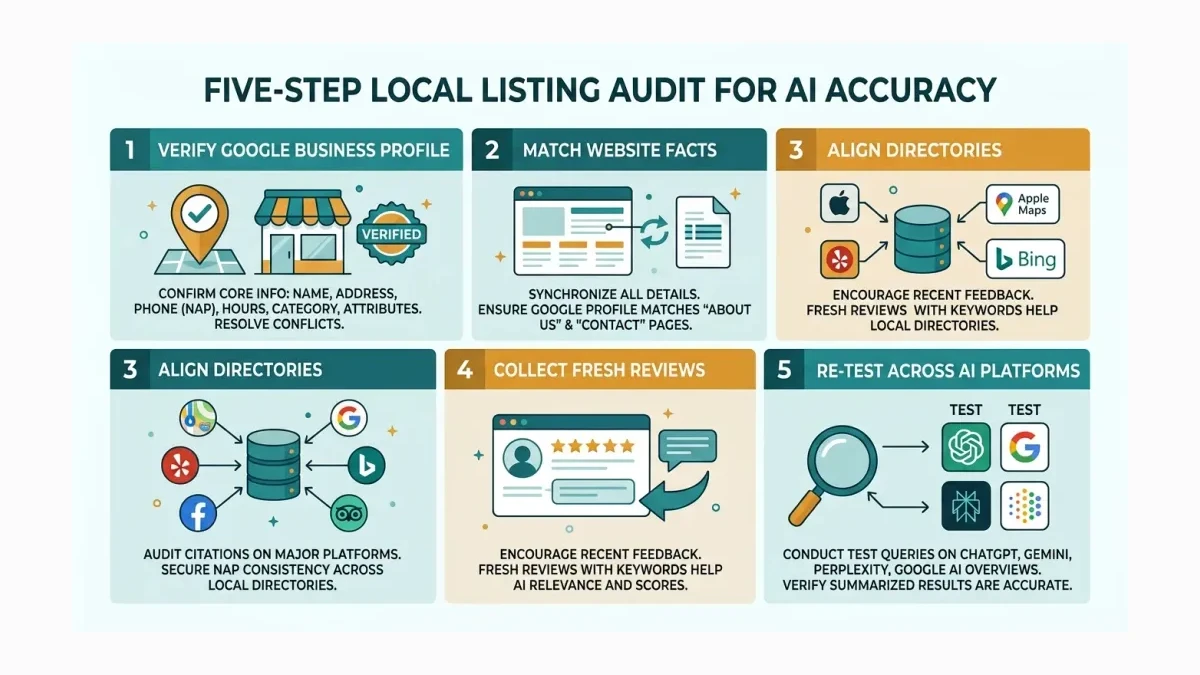
The listings that return accurate facts across every AI tool share a small set of habits, and they are unspectacular. They keep the Google Business Profile’s primary categories, hours, and phone number identical to the website and to every directory. They publish service and location pages with their own first-hand detail rather than boilerplate. They collect fresh reviews steadily, because recent reviews give AI models current signal that the business is operating. And they correct wrong facts the moment they appear, using Google’s “suggest an edit” and the AI Overview feedback link rather than waiting for the platform to notice.
Perplexity gave inaccurate answers in 10 percent of cases in the retail testing, compared with 5 percent for Gemini and 4 percent for ChatGPT. Those numbers sound reassuring until you realize a 4 percent error rate means roughly one wrong answer for every 25 customers who ask. A Lahore clinic seeing 200 AI-driven inquiries a month can expect eight of them to receive a wrong address, a wrong service list, or a “permanently closed” verdict that costs a booking. Testing one AI tool tells you nothing about the others; a listing that checks out in Google AI Overviews can still be misdescribed in ChatGPT.
The Pakistani complication nobody warns you about
There is a second pattern specific to this market. Google’s systems can auto-modify your published hours without permission — a behavior local-search forums document regularly — and Pakistani businesses face an added friction: Google Business Profile verification in Pakistan frequently escalates to video verification, which stalls or fails and leaves the listing in a half-state where facts drift. When the listing is half-verified, the AI has even less reliable source material to work with, and the confident wrong answers get worse, not better.
How to test what your customers actually see
The field method that surfaces these errors is simple, and almost nobody runs it. Write down eight to twelve questions a real customer would ask — “Is the clinic open on Sunday?”, “What is the Lahore address?”, “Do they accept walk-ins?”, “What is the phone number?” — and run the same list through five systems: Google AI Overviews, Google AI Mode, ChatGPT, Gemini, and Perplexity. Run each without saved conversation context, because a returning user receives a different answer than a first-time searcher. Log every answer against your verified facts, and mark each as correct, wrong, or missing.
What we see across the accounts that do this quarterly is that the errors cluster around three fields: opening hours, address, and services offered. Hours drift because Google auto-edits them. Addresses drift because of duplicate or unverified listings left over from an old branch. Services drift because the primary category was set years ago and never updated to match what the business actually sells today. The so-what is that a 20-minute audit every 90 days catches the majority of the damage before a customer does — and a single wrong “permanently closed” verdict, left uncorrected for a month, can quietly erase a season of foot traffic that no analytics dashboard will ever show you losing.
The practical response is a standing audit, not a one-off fix. Maintaining accurate business listings is a lot like keeping the price tags updated at a Liberty Market stall: the moment you stop walking the aisles, something is wrong, and the customer notices before you do. We walk through the multi-location version of this discipline in our multi-location local SEO framework and the broader Lahore, Karachi, Islamabad local SEO guide. The mechanics for a single clinic or restaurant are the same: one source of truth, refreshed regularly, tested across the AI tools your customers actually use.
Read next: How to verify and fix a Google Business Profile review bug in Pakistan and how bad reviews surface in AI Overviews for Pakistani brands.
WeProms Digital, Pakistan’s leading local SEO and Google Business Profile agency, runs this audit for service and retail businesses across Pakistan — fixing the source data so ChatGPT, Gemini, and Google AI Overviews describe you accurately instead of inventing your hours. If a customer has ever arrived at a wrong address because an AI told them to, reach us at hello@weproms.com or WhatsApp +92 300 0133399, and read our Google Maps ranking guide for 2026 next.
Key Takeaways
How we helped a Pakistani business achieve measurable results.
- AI tools returned at least one false fact for 64 percent of UK retailers in July 2026 testing — Pakistani listings with thin source data are more exposed, not less.
- 45 percent of consumers now use ChatGPT or similar tools for local recommendations, up from 6 percent a year earlier — a sevenfold increase in a channel you cannot fully measure.
- A 4 percent ChatGPT error rate still means roughly one wrong answer per 25 inquiries; for a busy Lahore clinic that is lost bookings every week.
- Listings that return accurate AI answers share mundane habits: identical facts across profile, website, and directories, steady fresh reviews, and immediate correction of errors.
- Pakistani businesses carry an added risk — Google can auto-edit hours, and local video verification can stall, leaving listings in a state where AI guesswork gets worse.
- The fix is a standing audit tested across ChatGPT, Gemini, Perplexity, and Google AI Overviews, not a one-time cleanup.
About WeProms Digital
WeProms Digital is Pakistan’s leading local SEO and Google Business Profile agency, headquartered in Lahore, serving Pakistani SMEs, retail chains, clinics, and service businesses across Lahore, Karachi, Islamabad, Rawalpindi, Faisalabad, and Multan.
The team specializes in Google Business Profile optimization, local search visibility, and AI-answer accuracy, with a track record of correcting the source data that ChatGPT, Gemini, and Google AI Overviews rely on to describe a business.
Get in touch: hello@weproms.com · WhatsApp +92 300 0133399 · weproms.com/contact-us
Sources & References
- Search Engine Journal — AI Answers About Your Locations Are Often Wrong — July 20, 2026
- BrightLocal — Local Consumer Review Survey — 2026
- Whitespark — AI Overviews in Local Search Analysis — 2026
- SOCi — Local Visibility Index — 2026
- Search Engine Journal — Google Is Bringing Local Services Ads Into Google Ads — July 20, 2026
- Google Business Profile Help — Manage Your Business Address — 2026
- Sterling Sky — Why Google Business Profile Verification Actually Fails — 2026
- Local Search Forum — Google Changes and Publishes Wrong Hours — 2026
Additional reading from industry feeds: