
Answer-ready summary
What happened in this case study?
Appointment-page organic sessions +57% in six months, with 23 of 41 mapped condition clusters ranking top-five and monthly organic appointment requests up 38%.
A two-campus multi-specialty hospital group in Rawalpindi depended on paid search for nearly two-thirds of its appointment-page views. The website carried hospital news and health-day greetings, thin duplicated service pages, and nothing that answered the condition, symptom, and cost queries patients actually type before choosing a hospital. The engagement reorganized organic demand around six specialty hubs and 41 mapped condition and treatment clusters.
The rollout used 4 implementation phases: technical cleanup, architecture, content, and authority building.
At a glance
Case summary
- Industry
- Healthcare (multi-specialty hospitals)
- Market
- Pakistan (Rawalpindi)
- Duration
- 6 months
- Client type
- Healthcare
- Services used
- Content strategy and editorial planning, SEO content writing, Topic cluster architecture
- Starting problem
- Non-brand organic demand for condition, treatment, and cost queries was captured by health aggregators while the hospital site carried only brand and news content.
- Work completed
- Built a 41-cluster condition and treatment content program across six specialty hubs with doctor review, PKR fee bands, and full appointment-funnel instrumentation.
- Evidence type
- illustrative_composite
Results and proof
Measured impact at 6 months
The top-line numbers are separated from the narrative so buyers, search engines, and answer engines can understand the outcome before reading the full execution notes.
Appointment-page organic sessions
9,600 → 15,100 per month (+57%)
Non-brand organic sessions
21,400 → 30,200 per month (+41%)
Mapped clusters ranking top-five
4 → 23 of 41 priority clusters
Organic appointment requests
310 → 427 per month (+38%)
Measured metrics
Before and after
Challenge context
Challenge context
A two-campus multi-specialty hospital group in Rawalpindi depended on paid search for nearly two-thirds of its appointment-page views. The website carried hospital news and health-day greetings, thin duplicated service pages, and nothing that answered the condition, symptom, and cost queries patients actually type before choosing a hospital. The engagement reorganized organic demand around six specialty hubs and 41 mapped condition and treatment clusters.
78% of organic sessions were brand searches; non-brand demand went to health aggregators
41 high-intent condition and treatment clusters had no ranking page on the site
Appointment-page views sat near 9,600/month from organic against 16,400 from paid
Paid search ran at roughly PKR 2.4M/month with rising CPCs on condition terms
Service pages were duplicated across both campuses with no fee or cost information
No attribution connected rankings, content, and appointment requests
Execution roadmap
Implementation phases
The page now presents the process as a scannable roadmap before the long-form breakdown, improving buyer comprehension and passage-level retrieval.
Phase 1
Demand mapping and content audit (Weeks 1–3)
Phase 2
Specialty hubs and the first build wave (Weeks 4–10)
Phase 3
Publish cadence, refresh, and interpolation (Weeks 8–18)
Phase 4
Measure, prune, and compound (Weeks 16–24)
The Client
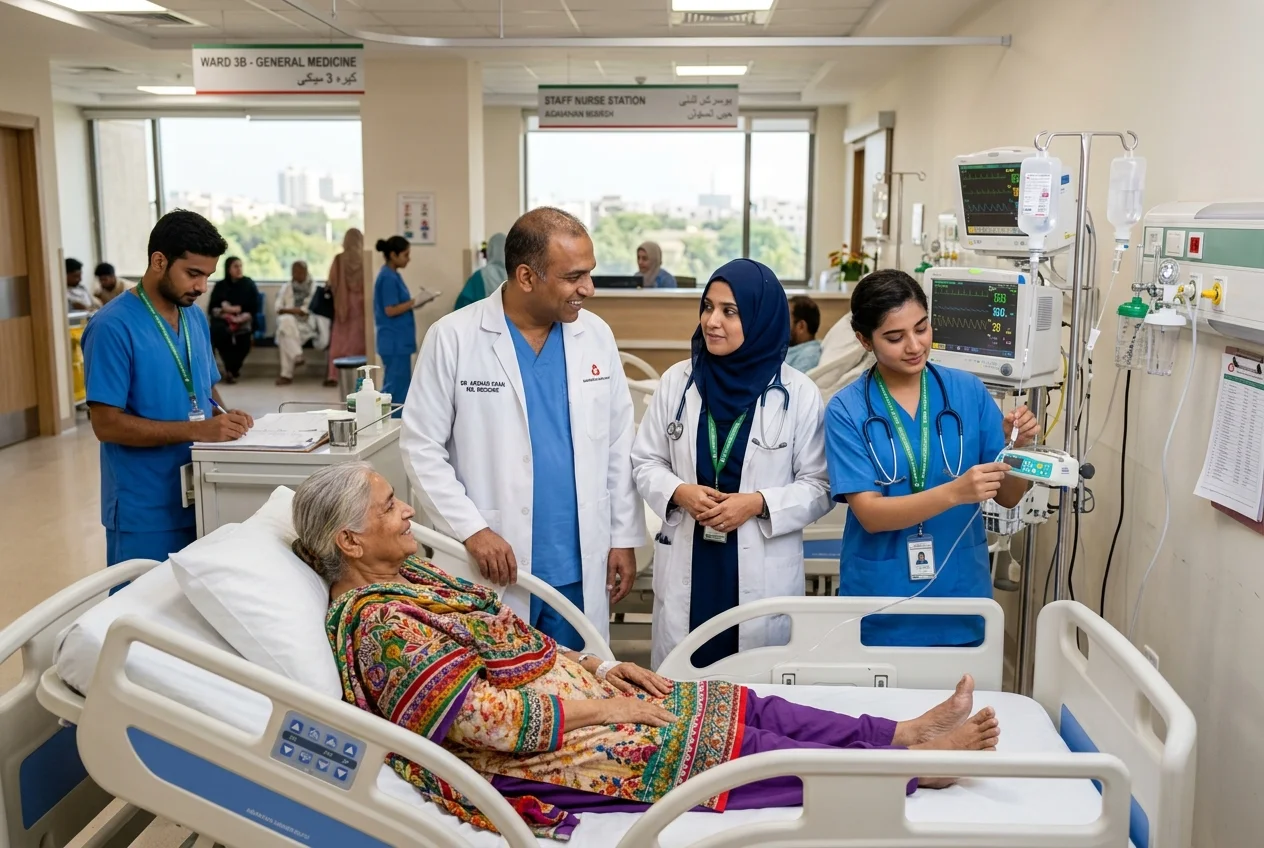
The client is a Rawalpindi-based multi-specialty hospital group running two campuses: a 240-bed flagship on the main Murree Road corridor and a 110-bed community campus serving the housing schemes spreading along the city’s outskirts. Between the two campuses, the group operates outpatient clinics across six specialties — cardiology, orthopedics, gynecology and obstetrics, pediatrics, gastroenterology, and ENT — with roughly 90 consulting physicians on the panel and a combined outpatient volume of around 280,000 visits a year. Cardiac sciences and orthopedics drive the largest share of revenue per case; pediatrics and gynecology drive volume and the family word-of-mouth that fills the remaining clinics.
For an institution of that size, the marketing setup was thin: a marketing manager, a graphic designer, and an external agency running paid search at roughly PKR 2.4M a month during campaign seasons. The website, last redesigned four years earlier, carried 34 blog posts — almost all health-day greetings, CSR event coverage, and staff announcements — plus one thin service page per specialty, duplicated across both campuses with only the campus name swapped.
The board started asking harder questions about paid dependency after two seasons of rising CPCs. Every rupee of appointment-page traffic was rented, the group’s strongest asset — its doctor panel — was invisible in search, and patients searching for symptoms, treatments, and costs were landing on health aggregators and physician-listing directories that monetized the group’s own catchment. The engagement described here is a representative composite of how a content strategy rollout for this kind of Pakistani hospital group typically unfolds, not a single named client; the figures are illustrative and internally consistent rather than audited results.
The Problem
The diagnostic baseline in week one made the gap concrete:
- 78% of organic sessions were brand searches. The site ranked for its own name and almost nothing else. Non-brand demand — symptoms, treatments, doctor queries, costs — belonged to aggregators and to large Karachi and Islamabad hospital brands that had invested in content years earlier.
- 41 priority condition and treatment clusters had no ranking page. The mapping exercise (Phase 1) found the site either absent or beyond position 20 for every high-intent cluster in its six specialties.
- Appointment-page traffic was paid-heavy and expensive. Organic delivered roughly 9,600 appointment-page views a month; paid delivered 16,400 at CPCs between PKR 45 and PKR 130 on commercial condition terms — costs that had climbed each season.
- Service pages were thin and duplicated. Each specialty page ran 150–250 words, existed in near-identical copies for both campuses, and cannibalized its own queries.
- No cost content existed anywhere. “Cost” and “fees” were the most common modifiers in the group’s own call-center logs, yet the site answered none of those searches — the single largest content gap found.
- Nothing was attributed. Rankings lived in one spreadsheet, content in another, and appointment requests were reported as an undifferentiated total. No one could say what a ranking was worth.
The pattern is common across Pakistani healthcare: institutions treat the website as a brochure and buy back their own demand through paid channels, while the queries patients actually type — condition-led, cost-led, doctor-led — go unanswered.
Phase 1 — Demand Mapping and Content Audit (Weeks 1–3)
Book a free strategy call - we'll audit your current setup and identify the highest-impact fixes.
Phase 1 answered one question: what does the market ask before it books, and where does the site fail to answer?
Query harvesting and clustering. We pulled 18 months of Google Search Console data, ran keyword research across the six specialties, and — the most valuable and most ignored source — mined six months of call-center logs. The call center turned out to be a demand archive: “how much does an angioplasty cost,” “which doctor should I see for persistent knee pain,” “do you do the test on Sunday” appeared as spoken queries dozens of times a month. Raw harvesting produced roughly 1,180 unique queries, which collapsed into 41 priority clusters across the six specialties.
Tiering by appointment proximity. Clusters were tiered not by volume but by how close the searcher sat to booking:
| Tier | Intent shape | Example cluster themes | Priority logic |
|---|---|---|---|
| 1 | Treatment decisions and cost | Angioplasty cost, knee replacement surgery cost, best cardiologist in Rawalpindi | Closest to booking; highest revenue per visit |
| 2 | Symptom and condition research | Chest tightness at night, knee pain climbing stairs, reflux that will not settle | High volume; feeds Tier 1 pages |
| 3 | Preparation and recovery | What to expect during an endoscopy, care after a cesarean | Builds trust; supports referrals and return visits |
Roughly 62% of mapped demand was informational, 31% commercial, and 7% navigational — but the commercial sliver carried most of the appointment value, which is why it was built first despite thinner volume.
Content audit. Of the 34 existing posts, 21 were pruned and redirected (health-day greetings with no search value), 9 were kept for local relevance, and 4 were merged into upcoming hub pages. The duplicated campus service pages were consolidated under canonical tags pending their Phase 3 rewrite.
Instrumentation before content. GA4 events were configured for every appointment action — form submissions, call-button clicks, WhatsApp click-to-chat — and call-tracking numbers were assigned per specialty so organic calls could be separated from paid. Rank tracking went live across all 41 clusters the same week, so every later claim in this file traces to a baseline set before any page was written.
Editorial governance. Because healthcare content is held to a higher standard by both regulators and search engines, two senior physicians signed on as medical reviewers with a 48-hour review SLA per draft, a standard clinical disclaimer was drafted with them, and every page was set to carry a named author bio with credentials. This governance was not overhead; it later became one of the program’s competitive advantages.
The conversion spine. Every page was assigned exactly one job inside a single funnel: condition page → specialty clinic page → doctor profile → appointment request. No dead ends, no competing calls to action.
Phase 2 — Specialty Hubs and the First Build Wave (Weeks 4–10)
Phase 2 turned the cluster map into architecture.
Six specialty hubs. Each specialty received a hub page — a structured condition library linking to every condition, treatment, and doctor page in its cluster set. Hubs became the internal-linking spine: every condition page links up to its hub and across to two to four sibling pages, and every hub links down to its specialty’s appointment page.
Three page templates by intent. Rather than freeform blog posts, every cluster was matched to one of three templates:
- Condition and symptom pages — what the condition feels like, likely causes, red-flag symptoms that warrant an urgent visit, the diagnostics typically ordered, and treatment options, ending with the relevant specialty clinic.
- Treatment and cost pages — the procedure explained in plain language, hospital stay expectations, and indicative PKR fee bands for consultation, diagnostics, and the procedure range, with a clear “final estimate after consultation” note.
- Doctor and clinic pages — credential-enriched profiles with qualifications, registrations, sub-specialties, and OPD timings, cross-linked from every relevant condition page.
Cost transparency as the differentiator. Aggregators deliberately avoid publishing fees — their business model depends on the lead form. The group answered the fee question directly with honest bands (for example, consultation tiers in the PKR 2,500–4,000 range, procedure ranges presented as minimum–maximum spans with caveats). This single decision aligned the pages with the dominant query modifier in the call logs and gave searchers a reason to pick the group’s page over a directory listing.
Structured drafting and markup. Every page was drafted against a per-cluster brief — primary query, secondary questions, required sections, reviewer checklist — through a structured SEO content writing process rather than open-ended blogging. Schema was added at the template level: Physician markup on profiles, FAQPage on pages carrying a Q&A block, and MedicalWebPage signals where applicable.
First build wave. By week 10, fourteen Tier-1 pages were live — six treatment-and-cost pages and eight condition pages — with the duplicated campus service pages consolidated behind canonicals pending rewrite.
| Signal | Baseline | Week 10 |
|---|---|---|
| Tier-1 clusters with a ranking page | 2 of 14 | 14 of 14 (positions 8–38) |
| Weekly impressions on mapped clusters | 3,900 | 11,600 |
| Appointment-page organic views / month | 9,600 | 11,300 (+18%) |
Phase 3 — Publish Cadence, Refresh, and Interpolation (Weeks 8–18)
Phase 3 shifted from build to operating rhythm.
A cadence the reviewers could sustain. Two pages per week, every week, holding the 48-hour medical review SLA — the median review turnaround across the phase was 31 hours. Cadence mattered more than bursts: search engines reward consistent topical growth, and physicians honor a routine better than a flood.
Refreshing existing equity. Nine stale service pages were rewritten from 150–250 words to 900+ words each, with FAQs, fee bands, linked doctor profiles, and the campus duplication removed. Refreshes recovered rankings faster than new pages earned them — the pages already carried age, internal links, and in some cases historical positions.
Interpolating real query behavior. Search Console and the call logs surfaced roman-Urdu symptom phrasings running alongside English equivalents for several Tier-2 clusters; where volume justified it, pages carried both forms in headings and body. Twelve clusters that did not exist in the original map emerged from live query data — including seasonal pre-Ramadan screening demand and a monsoon-season spike in gastroenterology queries — and were added to the calendar.
Link equity redistribution. The 21 pruned news posts were redirected to their relevant hubs, passing their accumulated internal equity into the pages that needed it.
| First-wave cluster set | Week 10 positions | Week 18 positions |
|---|---|---|
| Treatment and cost clusters (6) | 14–28 | 4–11 (5 in top 5) |
| Condition and symptom clusters (8) | 11–38 | 6–19 (4 in top 10) |
| Refreshed legacy service pages (9) | 9–31 | 3–14 (7 in top 10) |
Phase 4 — Measure, Prune, and Compound (Weeks 16–24)
How we helped a Pakistani business achieve measurable results.
The final phase institutionalized the program.
One dashboard, one truth. Rank positions per cluster, sessions per hub, and appointment requests by channel and specialty were consolidated into a shared dashboard reviewed weekly with the marketing manager and monthly with the board.
Attribution that survives scrutiny. Organic appointment requests were counted across three actions — form submissions, tracked calls, and WhatsApp click-to-chat — and grew from 310 to 427 per month over the window. Paid attribution used the same definitions, so the channel comparison was honest.
Prune and rebuild. Three pages that had failed to reach the top 30 by week 16 were rebuilt against sharper briefs rather than left to drift; two of the three reached the top 15 within six weeks of rebuild.
The paid read. Paid spend was held flat at roughly PKR 2.4M rather than cut, and paid share of appointment-page views still fell from 63% to 44% — organic absorbed the growth while paid kept covering remarketing and off-season demand. Total appointment-page views rose; the mix rebalanced. That is the shape boards look for: dependency falling without volume falling.
Exit velocity. The program ended the six months with more pages entering the top five per month than in month three — the compounding curve was still bending upward at handover.
Final Results
Measured at week 24 against the week-one baseline:
| Metric | Baseline | Month 6 | Change |
|---|---|---|---|
| Appointment-page organic sessions / month | 9,600 | 15,100 | +57% |
| Non-brand organic sessions / month | 21,400 | 30,200 | +41% |
| Mapped clusters ranking top-five | 4 of 41 | 23 of 41 | +19 clusters |
| Organic appointment requests / month | 310 | 427 | +38% |
| Paid share of appointment-page views | 63% | 44% | −19 points |
| Condition-page bounce rate | 74% | 56% | −18 points |
Organic became the largest single source of appointment-page views for the first time in the group’s history, and the appointment-funnel instrumentation built in week one is what makes each row above traceable to a phase rather than a coincidence.
What Made This Work
- Appointment proximity governed prioritization. Search volume alone would have ranked symptom content first — it is bigger. Tiering by booking distance put cost and treatment pages into the build queue first, and those pages produced appointments while the informational layer was still being drafted.
- Fee transparency was the wedge. Every aggregator in the market refuses to publish costs. Answering the fee question honestly, in PKR, with clear caveats, matched the most frequent modifier in the call logs and gave searchers a reason to choose the group’s page over a directory.
- Medical review became an asset instead of a bottleneck. The 48-hour SLA, structured reviewer checklists, and named author bios turned a compliance obligation into a trust signal that patients could see and search engines could read.
- One spine, instrumented end to end. Because every page had exactly one next step and every next step fired an event, the program could prove value monthly — which is what protected its budget when seasonality dipped.
- Refresh carried a third of the gains. Nine rewritten legacy pages delivered rankings faster than any new page. The assets already existed; they needed structure, depth, and deduplication.
What Teams Can Apply
For healthcare operators — and most Pakistani service businesses with high-consideration purchases — the transferable pieces are:
- Map demand before writing anything. Cluster queries by specialty and intent, then tier by proximity to booking. Call-center logs are the most underrated demand source in Pakistani healthcare; your agents are already transcribing the market’s questions.
- Publish cost bands. Patients search fees before they search brands. Whoever answers the money question honestly earns the next click, and the “final estimate after consultation” caveat manages expectations without hiding the number.
- Build a review workflow doctors actually accept. A short SLA, a checklist, and named credit make clinicians reliable participants. Without governance, health content programs stall at the approval stage.
- Instrument the spine. If you cannot trace condition page → appointment request, you cannot defend the content budget in the board meeting where it gets cut. Events and call tracking come before the first draft.
- Budget refresh capacity from day one. In this engagement, roughly a third of the ranking gains came from pages that already existed. The same patterns apply across clinic chains and diagnostic groups; the specifics of building them into a digital marketing for hospitals growth plan vary by specialty mix and panel size.
WeProms Digital has applied this framework across Pakistani hospital groups, single-specialty clinics, and diagnostic chains. The cluster maps, fee-band strategy, and review governance change with each vertical — the sequence of map, build, refresh, and measure does not.
What teams can apply
Use the framework, not just the headline number.
For GEO, AEO, and classic SEO, the useful signal is the sequence: fix crawl access, build answerable category assets, improve conversion paths, and document proof in a format that humans and machines can cite.
Clusters were prioritized by appointment proximity rather than raw volume, so cost and treatment pages converted instead of only informing
Transparent PKR fee bands answered the query modifier Pakistani patients use most, which aggregators avoid publishing
A 48-hour doctor review SLA made medical sign-off routine enough to hold a two-page weekly cadence
Limitations
Context and limitations
Illustrative composite built from common patterns across Pakistani hospital engagements; timelines and magnitudes vary with specialty mix, domain age, and medical review capacity.
Questions
Case study FAQs
Is this hospital content strategy framework applicable in Pakistan?
Yes. The framework is built around Pakistani patient search behavior: cost-first queries in PKR, roman-Urdu symptom phrases alongside English terms, and heavy weight on doctor credentials and trust signals. Medical review, fee-band transparency, and the specialty hub structure adapt to any hospital group, clinic chain, or diagnostic lab in the country.
How quickly can we expect results?
Instrumentation and on-page fixes move impressions within two to four weeks. Condition pages typically enter the top 20 between months two and three and the top five between months four and six, depending on domain age and cluster difficulty. Compounding continues past six months as hub authority accumulates.
Can you replicate this process for our business?
Yes. We map the same phases to your specialties, doctor panel, and intake capacity. The framework has been applied to multi-specialty hospital groups, single-specialty clinics, and diagnostic lab chains; the cluster map and page templates change with the vertical, the sequence does not.
Do you provide reporting during implementation?
Yes. Weekly checkpoints cover publication progress, medical review status, and rank movement. A shared dashboard tracks the cluster map, organic sessions, and appointment requests by channel from day one.
Next step
Want a similar rollout in Pakistan?
Share your current baseline and we will map a phased execution plan to your growth goals.