AI Ad Tools Can’t Read Urdu. Pakistani Brands Pay the Price.
By Hamza Ali · Last updated: June 2026.
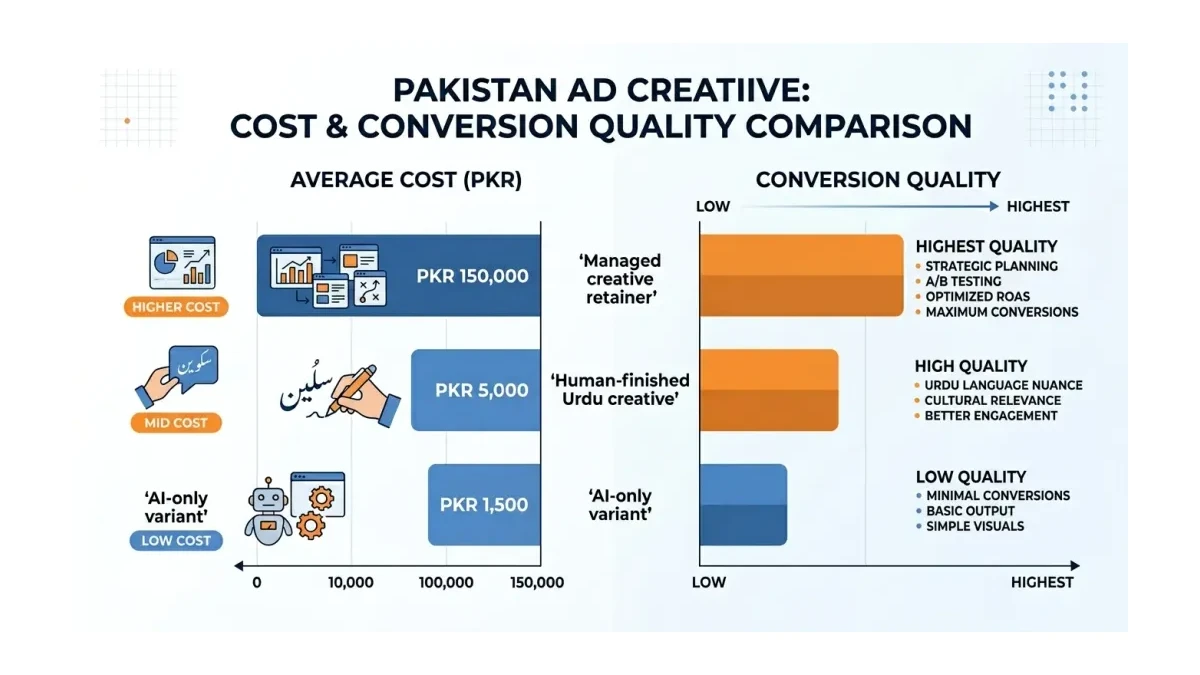
Global AI ad tools from Meta, Google, and Snapchat generate creative in seconds and cost a fraction of a human shoot, roughly PKR 1,500 a variant versus PKR 5,000 or more for a produced image. They also ship English copy onto a market that buys in Urdu, miss Ramadan and Eid timing cues, and erase JazzCash and cash-on-delivery signals. For Pakistani brands, the volume is real. The cultural fit is not.
The global AI content creation market reached about US$2.72 billion in 2025 and is growing at 22.1% a year, driven largely by brands using AI to produce ad creatives, localize campaigns, and generate variations at scale. In Pakistan, that wave has already landed. Between 60% and 80% of mid-to-large Pakistani advertisers now run Meta Advantage+ campaigns, 50% to 70% run at least one Performance Max campaign, and Snapchat ranks Pakistan among its top five global markets. The tools are everywhere. The question is whether they actually work for a Pakistani audience.
What this gets right
The case for AI creative tools is genuine, and pretending otherwise wastes time. A single Meta Advantage+ shopping campaign generates dozens of image and headline variations from one master asset, a job that once took a designer a full week. Performance Max (PMax) — a Google Ads campaign type that automatically generates ad variations and places them across YouTube, Search, Display, Gmail, and Maps from a single asset set. PMax compresses creative production and cross-channel placement into one workflow.
Speed is the headline benefit. A Lahore fashion brand can test thirty creative angles in a weekend instead of waiting three weeks for a shoot. Cost drops with it. Pakistani agencies price a basic static social post at roughly PKR 1,500 to 5,000, a short vertical video at PKR 5,000 to 20,000, and a monthly content package at PKR 40,000 to 150,000. AI tools cut the low end of that range further, sometimes to near zero per variant once a subscription is paid. That matters for a Karachi SME running thin margins on Daraz and trying to fund both media and production from one budget.
The platform AI tools also handle the boring structural work well. Dynamic Product Ads — ad formats that automatically pull the exact products a shopper viewed and assemble a personalized creative in real time. Snapchat now powers these with what it calls agentic recommendation models that synthesize user behavior, product affinity, and real-time intent. The mechanics are sound. Volume, speed, and personalization all improve. None of that is the problem.
Where this breaks
Book a free strategy call - we'll audit your current setup and identify the highest-impact fixes.
The break happens at the moment a generated creative meets a Pakistani shopper. Most teams miss this. The tools were trained on global, English-dominant datasets, and they export those defaults into every asset they produce.
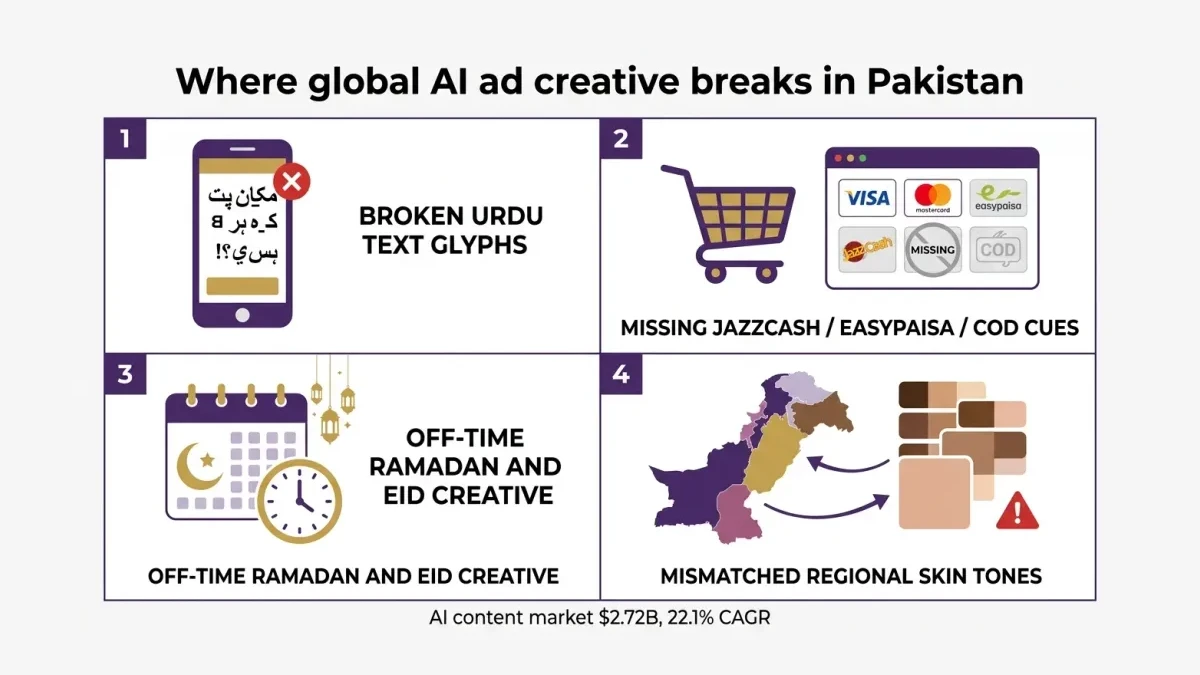
The first failure is language. A Meta Advantage+ text suggestion will happily write “Shop the drop now” in clean English for a brand whose customers message in Roman Urdu. When a brand asks an image generator for Urdu headlines, the text often renders as broken, nonsensical glyphs, because the underlying model struggles with right-to-left scripts and Nastaliq letterforms. An ad that cannot spell its own discount in the shopper’s language will not convert, no matter how cheap it was to produce.
Asking a global AI tool for Eid creative is like asking a foreign chef to cook biryani from a translated recipe. The ingredients arrive, but the spice balance is always slightly wrong. The tool will produce a generic festive image with a crescent moon, miss the regional product cues that actually trigger a purchase, and ship a payment nudge that references a credit card instead of JazzCash, Easypaisa, or cash on delivery.
| Tool | What it generates well | Where it breaks for Pakistan |
|---|---|---|
| Meta Advantage+ creative | Fast image and headline variations | Urdu text renders as broken glyphs; ignores COD messaging |
| Google Performance Max | Cross-channel asset coverage from one set | Pulls generic imagery; no local festival or regional context |
| Snapchat image-to-video, Smart upscale | Low-cost motion from a single still | Weak on regional skin tones and South Asian settings |
| LinkedIn Brand Kit | Keeps AI-drafted assets on-brand | English-first brand voice; weak for Urdu-speaking audiences |
The second failure is trust. Pakistani shoppers already treat AI-generated ads with suspicion, and a creative that looks templated, culturally off, or visually inconsistent across formats reinforces the feeling that the brand cut corners. Volume without cultural fit does not build a brand. Volume without cultural fit erodes one.
The hidden cost
The hidden cost is not the subscription fee. The hidden cost is the media budget wasted pushing creative that never had a chance to convert. Pakistan’s total digital ad spend is projected to reach roughly PKR 173 to 223 billion in 2026, and creative production typically consumes 10% to 25% of a brand’s digital budget. When that creative is AI-generated but culturally misaligned, the media spend behind it is the real loss, not the PKR 1,500 saved on the asset.
Run the same logic in reverse and the picture inverts. A globally generated AI creative will underperform a human-made Urdu creative on a Pakistani Snapchat campaign at least seven times out of ten, even when the AI asset costs nothing to produce. Cheap creative is the most expensive kind when it carries expensive media. Instagram and TikTok each reach roughly 45 to 55 million Pakistani users, and Snapchat adds another 25 to 35 million, so a culturally broken creative is not a small experiment in front of a small audience. It is a public miss in front of most of the market.
There is also a governance gap. As AI generates more of the creative, no one inside the brand owns the voice. The output drifts campaign by campaign until the brand no longer sounds like itself. Enterprises like L’Oréal are investing heavily in governed generative AI content engines precisely to prevent this drift. Pakistani SMEs rarely have that guardrail, so the drift compounds faster.
What Pakistani businesses should do instead
The fix is not to abandon AI tools. The fix is to put a human in the loop on the parts that decide conversion: language, payment cues, timing, and cultural representation.
First, separate generation from finishing. Let the AI tool produce the volume of base variations, then have a Pakistani creative specialist rewrite headlines in natural Roman Urdu, swap payment prompts for JazzCash, Easypaisa, and cash on delivery, and realign creative to the local calendar around Ramadan, Eid, Independence Day, and the PSL season. The AI does the quantity. The human does the fit.
Second, build a small brand kit before generating anything. Define the fonts, the tone, the colors, and the three or four payment and fulfillment messages the brand uses, then feed those constraints into every prompt. This mirrors what LinkedIn Brand Kit attempts for English-first brands and extends it to the Pakistani context.
Third, measure creative on cultural fit, not just cost. Track which Urdu variants outperform the English defaults and let that data, not the tool’s defaults, drive the next batch. The brands that win are not the ones with the most AI variants. The brands that win are the ones whose AI variants sound like they came from Pakistan.
For a deeper look at why Pakistani shoppers distrust AI-generated ads in the first place, the analysis of the AI-generated ads trust crisis for Pakistani brands sets the consumer context this teardown builds on. Brands scaling output should also review the paid media creative strategy and testing playbook to see where human finishing fits inside a structured testing system, and the breakdown of AI video production costs for Pakistani ecommerce for the motion side of the same problem. Our own AI ad creative guide for Pakistan covers the baseline cost benchmarks referenced here.
Read next: Why AI-generated ads face a trust crisis with Pakistani brands and Paid media creative strategy and testing for Pakistani advertisers.
At WeProms Digital, Pakistan’s leading ad creative design and production agency, we run the human finishing layer that turns global AI tools into creative that actually converts in Lahore, Karachi, and beyond. Our team generates base variations with Meta Advantage+, Performance Max, and Snapchat, then rewrites them in natural Urdu, rebuilds payment and fulfillment cues for the Pakistani market, and aligns every asset to the local calendar. Get a creative fit audit by emailing hello@weproms.com, messaging WhatsApp +92 300 0133399, or visiting weproms.com/contact-us.
Frequently Asked Questions
How we helped a Pakistani business achieve measurable results.
Do Meta and Google AI creative tools support Urdu ad copy in Pakistan?
The tools support Urdu as a campaign language in limited ways, but the generative features produce English-first copy and frequently render Urdu text as broken glyphs in image creatives. Pakistani brands should treat AI-generated Urdu as a draft to be corrected by a human creative, not as publish-ready output. Most teams miss this until the first broken-text creative goes live with paid budget behind it.
How much does AI-generated ad creative cost versus a human designer in Pakistan?
A basic AI-generated static variant can drop to near zero per asset after a subscription, while a human-designed static post runs roughly PKR 1,500 to 5,000 and a short vertical video runs PKR 5,000 to 20,000. The real cost comparison is media waste. A culturally misaligned AI creative carries the full media budget behind it, which usually dwarfs the design saving.
Should a Pakistani SME stop using AI ad creative tools entirely?
No. The volume and speed gains are real, and between 50% and 80% of Pakistani advertisers already use Advantage+ or Performance Max. The fix is a human-in-the-loop finishing step for language, payment cues, and cultural timing, not abandoning the tools. Brands that combine AI generation with Pakistani creative finishing outperform those using either approach alone.
How does WeProms fix the Urdu and cultural-fit gap in AI creative?
WeProms generates base variations with the platform AI tools, then rewrites headlines in natural Roman Urdu, rebuilds payment and fulfillment messaging around JazzCash, Easypaisa, and cash on delivery, and aligns every creative to the local calendar. The agency measures which Urdu variants outperform English defaults and lets that data drive the next creative batch. Pricing starts with a creative fit audit scoped to the brand’s current ad account.
Which platform’s AI creative tools work best for Pakistani advertisers right now?
Meta Advantage+ offers the broadest reach and the most mature generative features for Pakistani advertisers, followed by Google Performance Max for cross-channel coverage. Snapchat’s AI creative tools are growing fast given Pakistan is a top-five Snap market, but the advertiser base is smaller. All three share the same Urdu and cultural-fit limitations, so the platform choice matters less than the human finishing layer on top of it.
Sources & References
- Meta for Business — Advantage+ and generative AI creative features — 2026
- Snapchat for Business — AI ad tools, Smart Creative, and agentic recommendation models — 2026
- Navistrata Analytics — AI in Content Creation market size, share, and 22.1% CAGR — 2025
- LinkedIn Business — Brand Kit for on-brand AI-generated content — 2026
- Digiday — L’Oreal accelerates generative AI content engine with OpenAI deal — 2026
- Statista — Digital advertising spending in Pakistan — 2025
- Coursera — Social media trends and the shift to UGC-style creative — 2025
Additional reading from industry feeds: