
Answer-ready summary
What happened in this case study?
Booked appointments rose 61% in 90 days at 29% lower cost per booking, with enquiry-to-booking quality improving from 34% to 52%.
A three-branch dental group in Islamabad was spending roughly PKR 1.1 million per month on Google Ads but optimizing to raw form submissions. Around two-thirds of patient enquiries arrived by phone, none of them tracked, and the account had no way of knowing which clicks became attended appointments. Cost per booked appointment had drifted to PKR 4,850 and was climbing, while the front desk wasted hours each week fielding price-only calls that could never convert.
The rollout used 4 implementation phases: technical cleanup, architecture, content, and authority building.
At a glance
Case summary
- Industry
- Dental and orthodontics (multi-clinic group)
- Market
- Pakistan (Islamabad)
- Duration
- 90 days
- Client type
- Healthcare
- Services used
- Google Ads management and optimization, Call tracking and offline conversion integration, Landing page design and optimization
- Starting problem
- A three-branch dental group was optimizing Google Ads to raw form submits with no call tracking and no feedback loop on which enquiries became attended appointments.
- Work completed
- Rebuilt measurement around front-desk-confirmed bookings, restructured the account into service-line campaigns with per-branch landing pages and scheduling, and fed attended-appointment outcomes back into bidding.
- Evidence type
- illustrative_composite
Results and proof
Measured impact at 90 days
The top-line numbers are separated from the narrative so buyers, search engines, and answer engines can understand the outcome before reading the full execution notes.
Booked appointments
Improved from 686 to 1,104 per 90 days (+61%)
Cost per booked appointment
Reduced from PKR 4,850 to PKR 3,440 (-29%)
Enquiry-to-booking rate
Improved from 34% to 52% (+18 percentage points)
Implants and cosmetic cost per booking
Reduced from PKR 14,200 to PKR 8,380 (-41%)
Measured metrics
Before and after
Challenge context
Challenge context
A three-branch dental group in Islamabad was spending roughly PKR 1.1 million per month on Google Ads but optimizing to raw form submissions. Around two-thirds of patient enquiries arrived by phone, none of them tracked, and the account had no way of knowing which clicks became attended appointments. Cost per booked appointment had drifted to PKR 4,850 and was climbing, while the front desk wasted hours each week fielding price-only calls that could never convert.
PKR 1.1M monthly Google Ads spend optimized to form submits, with 41% of submits being price-only enquiries that never booked
No call tracking despite phones driving the majority of bookings at two of the three branches
One mixed campaign of ~1,400 keywords, so implant and orthodontics budgets were diluted by cheap general-dentistry clicks
22% of budget spent outside clinic opening hours, including Friday prayer breaks and post-8pm slots nobody could answer
Cost per booked appointment at PKR 4,850 and rising quarter on quarter; enquiry-to-booking rate stuck at 34%
Execution roadmap
Implementation phases
The page now presents the process as a scannable roadmap before the long-form breakdown, improving buyer comprehension and passage-level retrieval.
Phase 1
Tracking repair and account audit (Weeks 1-2)
Phase 2
Restructure by service line and branch (Weeks 3-5)
Phase 3
Optimize toward booked appointments (Weeks 4-8)
Phase 4
Compound and reconcile (Weeks 8-12)
The Client
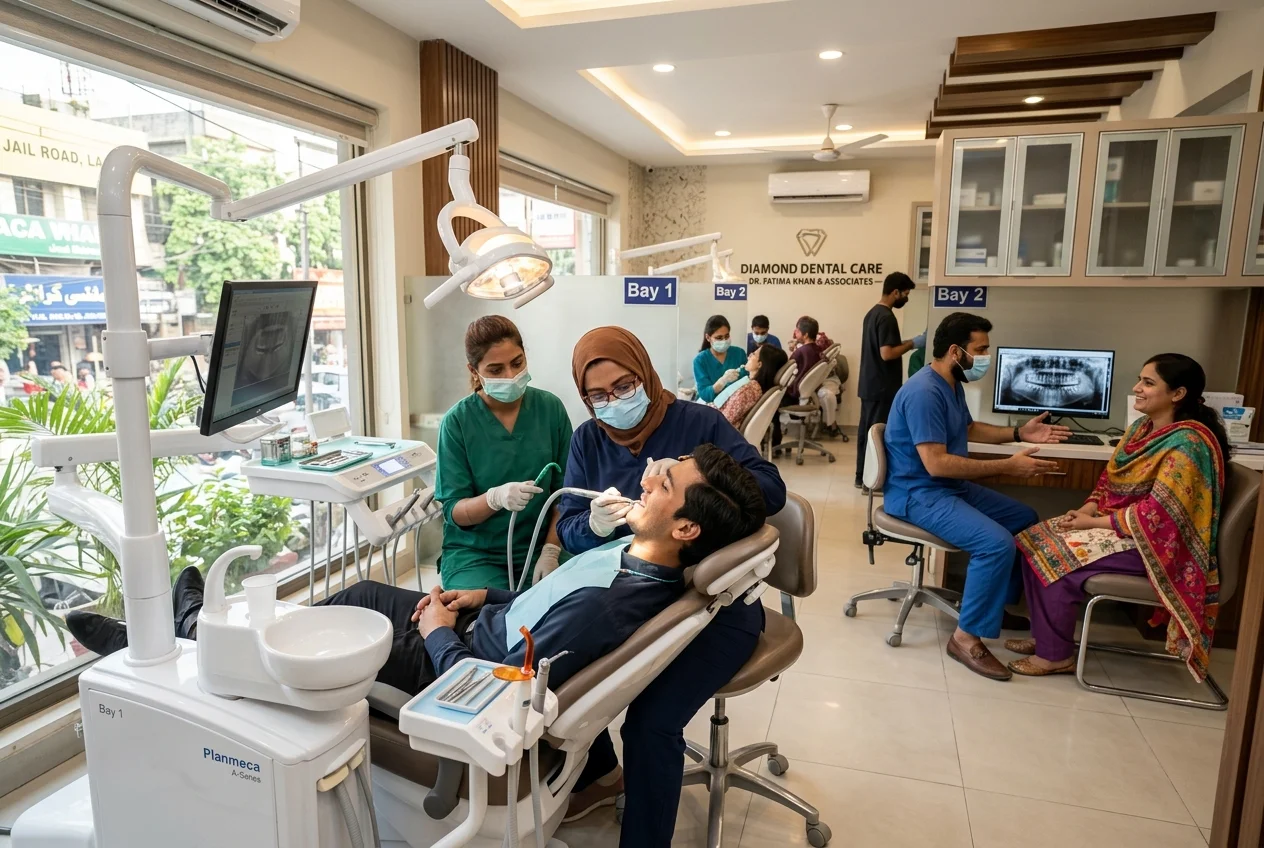
A three-branch dental and orthodontics group operating across Islamabad, with a flagship practice in Blue Area and two newer branches serving the E-11 and Bahria Town corridors. Twelve treatment chairs, six general dentists, two orthodontists, and a support team of roughly 45 people, including five front-desk staff who own appointment booking across phone and walk-in traffic.
The revenue mix is typical of established Pakistani dental groups: general dentistry — scaling, fillings, extractions — drives about 55% of bookings but thin margins. Orthodontics (metal and ceramic braces, plus a growing clear-aligner line) contributes roughly 30% of bookings with strong multi-visit revenue. Implants and cosmetic work — veneers, whitening, full implant cases at PKR 150,000 to 220,000 — is only about 15% of booking volume but the majority of practice revenue. That imbalance matters for everything that follows, because a campaign structure that treats “dentist” as one keyword pool will always under-fund the services that actually pay the rent.
The group had been advertising on Google for three years, managed by a local freelancer who meant well but had no access to the practice-management software. Spend held around PKR 1.1 million per month. The owner’s complaint was specific: costs were creeping up, the front desk was drowning in price-shopper calls, and nobody could say what a booking actually cost per branch or per service line.
This engagement is an illustrative composite — a representative profile assembled from patterns we see across Pakistani dental groups, with numbers kept inside realistic ranges so you can sanity-check fit for your own practice. Similar frameworks apply to practices working through a digital marketing for dentists program at single-clinic or multi-branch scale.
The Problem
The account was one mixed search campaign containing roughly 1,400 keywords in four ad groups, everything from “dentist near me” to “dental implant cost” to informational queries that had drifted in through broad match. The conversion action was a form submission on a generic contact page. Nothing measured calls, even though the front desk estimated most enquiries arrived by phone. Nothing connected back to the practice-management software, so the account was blind to which enquiries became booked, attended appointments.
The diagnostic surfaced six concrete blockers:
- 41% of form submits were price-only enquiries — “implant rate kitna hai” style questions that never booked. The account was optimizing toward junk.
- No call tracking. Pakistan-based forwarding numbers were never installed, so the highest-intent channel (63% of eventual bookings once measured) was invisible to bidding.
- Service lines competed for the same budget. Cheap general-dentistry clicks absorbed spend that implant and orthodontics queries needed, because everything sat in one campaign with shared budget.
- 22% of spend fell outside opening hours — after 8pm, Friday prayer breaks, and Sundays when only emergency calls were taken. Nobody was there to answer.
- Cost per booked appointment was PKR 4,850 and drifting up roughly 12% over two quarters, while enquiry-to-booking conversion sat at 34% and attended-appointment rate at 61%.
- Branches bid against each other. All three locations shared one geo-targeting setting, so the Bahria branch’s ads appeared for Blue Area queries the flagship could have served more cheaply.
The uncomfortable summary: of roughly PKR 1.11 million spent per month, an estimated PKR 245,000 was buying clicks that could never become an appointment — students researching assignments, job-seekers, and price-shoppers with no treatment intent. You can read more about the operating model behind this kind of rebuild in our Google Ads management and optimization service scope.
Phase 1 — Tracking repair and account audit (Weeks 1-2)
Book a free strategy call - we'll audit your current setup and identify the highest-impact fixes.
Nothing structural changes until measurement tells the truth. Week one was spent installing the plumbing that the rest of the engagement depends on.
We deployed call tracking with dynamic number insertion on the site: visitors from Google Ads saw a Pakistan-based forwarding number that routed to whichever branch’s line was nearest, with every call logged to its source campaign and keyword. We then defined the conversion the account would optimize to — a front-desk-confirmed booking, meaning a scheduled appointment verified by reception staff, whether it originated as a call or a form. Form submits were demoted to a secondary signal.
Next came reconciliation. We pulled 90 days of bookings from the practice-management software — 686 booked appointments — and matched them against enquiries logged from ads. That exercise produced the baseline every later number is measured against, and it immediately exposed the 34% enquiry-to-booking rate and the 61% attended-appointment rate the owner had never seen quantified.
The keyword audit followed. Search query reports from the prior six months yielded 610 negative keywords to exclude: “dental college admission,” “dentist salary in pakistan,” “free dental camp,” “house job,” and a long tail of informational queries that had been quietly collecting clicks. A dayparting analysis established exactly when bookings actually happened versus when ads ran.
| Audit finding | Action taken | Effect |
|---|---|---|
| Form submit = conversion; calls untracked | Call tracking + booking-confirmed conversion definition | 63% of bookings became visible to the account |
| 610 non-commercial query patterns | Negative keyword build across all campaigns | ~PKR 245K/month of unbookable spend freed |
| Ads running 24/7 | Scheduling mapped to each branch’s hours | 22% off-hours spend redeployed |
| Branches sharing one geo-target | Per-branch radius rings with exclusions | Self-cannibalization on shared queries stopped |
| No offline feedback loop | Daily booking-status import pipeline designed | Foundation for Phase 3 bidding changes |
By the end of week two the account was still structurally unchanged — but for the first time, every report tied spend to booked, attended appointments by branch and service.
Phase 2 — Restructure by service line and branch (Weeks 3-5)
With clean measurement in place, we rebuilt the account into five campaigns, each with its own budget, bidding, and landing experience: Brand (group name and branch names), General Dentistry, Orthodontics, Implants & Cosmetic, and Remarketing. The principle is economic, not organizational: each service line has a different margin, a different patient intent, and a different tolerance for cost per booking, so it needs its own economics to optimize against.
Keywords moved from one broad-match pool to 210 exact and phrase terms in intent tiers — treatment-plus-city (“braces cost islamabad”), treatment-plus-branch-area (“dentist bahria town”), and comparison modifiers (“best implant dentist islamabad”). Match-type discipline matters more in Pakistani healthcare than in most categories, because informational query volume is enormous relative to booking-intent volume.
Landing pages came next: nine pages total, one per major service per branch. Each carried consultation fees in PKR, the treating dentists’ credentials, photos of the actual chairs and sterilization area, procedure duration, and a sticky click-to-call button on mobile. Fee transparency was a deliberate filter, not a courtesy — a patient who books after seeing that an implant consultation costs PKR 2,500, credited to treatment, arrives pre-qualified. The pages followed the conversion-focused structure we apply across clinic booking flows, adapted for Pakistani patient expectations: fees first, doctor credentials second, parking and female-dentist availability flagged where relevant.
| Dimension | Before | After |
|---|---|---|
| Campaigns | 1 mixed campaign, shared budget | 5 service/intent campaigns, own budgets |
| Keywords | ~1,400, mostly broad | 210 exact/phrase in intent tiers |
| Landing pages | Generic contact page | 9 service-by-branch pages with fees |
| Conversion action | Form submit | Front-desk-confirmed booking (calls + forms) |
| Scheduling | 24/7 | Branch hours, Friday breaks, Sunday emergency-only |
| Geography | One shared target | Per-branch rings with neighbor exclusions |
Ad copy mirrored the landing pages’ honesty: consultation prices stated up front, female dentist availability flagged for the orthodontics line (a meaningful preference signal in this market), and same-week availability where the schedule genuinely supported it. We deliberately avoided outcome guarantees — beyond policy risk, they attract exactly the price-shopper traffic we were removing.
Phase 3 — Optimize toward booked appointments (Weeks 4-8)
This is where the engagement’s central mechanic ran: feeding real booking outcomes back into Google Ads using call tracking and offline conversion integration, so the system learned which clicks produced attended appointments rather than form fills.
Each day, front-desk booking records — with statuses updated to “attended” or “no-show” after the fact — were joined to their originating click and imported as offline conversions. Once each campaign cleared roughly 72 booking conversions per month, we moved it from manual CPC to value-based bidding, with implant and orthodontics bookings weighted above general bookings to reflect treatment value.
The mid-window numbers by service line told a consistent story:
| Service line | CPB before | CPB at week 8 | Change | Bookings (90-day) |
|---|---|---|---|---|
| General dentistry | PKR 3,300 | PKR 2,450 | -26% | 470 → 730 |
| Orthodontics | PKR 6,700 | PKR 4,500 | -33% | 170 → 290 |
| Implants & cosmetic | PKR 14,200 | PKR 8,380 | -41% | 46 → 84 |
The implants line deserves comment, because it looks irrational until you price a case. At PKR 8,380 per booking with implant cases averaging PKR 150,000–220,000 and a meaningful share converting to multi-visit treatment plans, that campaign became the most profitable line in the account despite the highest cost per booking. Isolating it from general queries was what made the efficiency possible.
One counterintuitive result is worth flagging for any practice running similar accounts: cost per enquiry went up 8% (PKR 1,650 to PKR 1,790) while cost per booking fell 29%. Fee-transparent pages and call-priority ads filtered out cheap junk enquiries, so average enquiry cost rose even as the economics improved. Teams that only watch CPL would have reversed these changes in week three.
Call behavior shaped the media settings too. Phones drove 63% of bookings, concentrated in evening windows when working patients call after office hours, so click-to-call assets were prioritized on mobile in the 5–8pm band and form-focused copy ran where the front desk had capacity to follow up. Weekly search-term reviews kept the negative list growing — another 180 terms after launch — and the remarketing campaign, launched in week six, brought back treatment-page visitors at a 22% lower cost per booking than cold search.
Phase 4 — Compound and reconcile (Weeks 8-12)
How we helped a Pakistani business achieve measurable results.
The final phase locked the gains in and made them durable.
We instituted a weekly reconciliation ritual: every Friday, the front-desk booking log was matched against ad-attributed conversions, discrepancies chased, and no-show patterns reviewed. This did double duty — it kept the offline conversion feed honest for bidding, and it surfaced operational issues (a branch answering phones late on Saturdays showed up as an attendance dip before anyone in management noticed).
Seasonal demand got explicit treatment. June’s wedding season lifted whitening and cosmetic queries across all three branches, so budget shifted toward the Implants & Cosmetic campaign for six weeks with matching ad copy (“shaadi season whitening, results in two sittings”). The Eid-ul-Adha closure paused delivery on all non-emergency campaigns for four days rather than paying for clicks the clinics couldn’t answer — a small decision, but exactly the kind the old 24/7 scheduling made impossible.
Finally, we set the capacity guardrails: each branch’s bookings were capped by chair availability rather than let the algorithm overfill the schedule and push attended-appointment rates down. Growth that the clinic cannot physically serve is just a more expensive way to disappoint patients.
Final Results
Measured over a full 90-day window against the preceding 90 days:
| Metric | Prior 90 days | Following 90 days | Change |
|---|---|---|---|
| Booked appointments | 686 | 1,104 | +61% |
| Cost per booked appointment | PKR 4,850 | PKR 3,440 | -29% |
| Google Ads spend | PKR 3.33M | PKR 3.80M | +14% |
| Enquiries (calls + forms) | 2,018 | 2,123 | +5% |
| Enquiry-to-booking rate | 34% | 52% | +18 pts |
| Attended appointments | 418 | 795 | +90% |
| Attended-appointment rate | 61% | 72% | +11 pts |
| Implants & cosmetic CPB | PKR 14,200 | PKR 8,380 | -41% |
The shape of the result matters more than any single number. Enquiry volume barely moved (+5%) — this was not a “more leads” outcome. Every gain came from quality and economics: filtering unbookable traffic, converting a higher share of real enquiries, and concentrating spend on the service lines whose revenue could absorb higher booking costs profitably. Attended appointments rose 90% on 14% more spend, which is the number the practice owner actually feels in monthly revenue.
What Made This Work
-
Booking as the conversion event, not enquiry. Defining the conversion as a front-desk-confirmed booking changed every downstream decision — bidding, budget splits, creative, landing pages. The 61% booking lift was not possible while the account optimized to form submits.
-
The offline feedback loop. Importing attended-appointment outcomes gave Google’s bidding real economic signal. Once implant bookings were weighted by treatment value, the system found converting pockets of demand the manual setup had never surfaced.
-
Service-line separation with independent budgets. Implant economics (PKR 150,000+ case values) could finally justify their true cost per booking once the line stopped competing with PKR 2,000 cleanings inside one campaign. Different margins need different campaigns.
-
Removing unbookable spend before adding spend. Negative keywords, dayparting, and branch geo rings freed roughly a quarter of the budget before a single additional rupee was invested. The lift came partly from spending the same money better.
-
Fee transparency as a filter. Publishing consultation prices in PKR on landing pages and in ad copy reduced raw enquiry volume and raised enquiry quality at the same time — the single highest-leverage landing page change in the engagement.
-
The Friday reconciliation ritual. Matching ad-attributed bookings against practice software every week kept data honest and caught operational issues early. Measurement discipline is what made the other five factors compounding rather than one-time.
What Teams Can Apply
-
Track the event you would actually pay for. If you run a clinic, that is a confirmed appointment on the schedule — not a form submit. Install call tracking before touching campaign structure; in most Pakistani healthcare accounts, the phone is the majority of conversions and is usually unmeasured.
-
Structure campaigns around margins, not ad groups. One campaign per service line, each with its own budget and target cost per booking derived from what a case is worth. A group with implants at PKR 200,000 and cleanings at PKR 4,000 has no business sharing a keyword pool between them.
-
Schedule ads to your real capacity. Match ad delivery to hours someone answers the phone, branch by branch, including Friday breaks and holiday closures. Pakistani clinics routinely spend 15–25% of budget at hours they cannot serve.
-
Publish fees and let them filter. Consultation prices in PKR, procedure ranges, and installment options on dedicated service pages reduce junk enquiries and improve the attended rate — even though it makes cost-per-enquiry look worse on the surface.
-
Reconcile weekly with the people who answer the phone. Front-desk staff are the source of truth on booking quality. A 30-minute weekly match between ad data and practice software keeps bidding honest and tells you within days, not quarters, when a campaign is filling the schedule with no-shows.
What teams can apply
Use the framework, not just the headline number.
For GEO, AEO, and classic SEO, the useful signal is the sequence: fix crawl access, build answerable category assets, improve conversion paths, and document proof in a format that humans and machines can cite.
The account was re-pointed at front-desk-confirmed bookings rather than form submits, so every bid decision reflected revenue-relevant outcomes.
Service-line separation let high-margin implant and orthodontics budgets escape dilution from cheap general-dentistry clicks.
Ad scheduling, branch-level geo rings, and fee-transparent landing pages removed the three biggest sources of unbookable enquiries in one pass.
Limitations
Context and limitations
Illustrative composite built from common patterns in Pakistani dental advertising; outcomes vary with clinic capacity, chair-side conversion, and city-level competition.
Questions
Case study FAQs
Is this dental Google Ads case study framework applicable in Pakistan?
Yes. The framework is built around how Pakistani patients actually book dental care: heavy phone contact, fee-first questions, and neighborhood-level clinic choice. That means Urdu-English mixed keywords, PKR fee transparency on landing pages, ad scheduling matched to clinic hours including Friday breaks, and call tracking on local numbers. The same structure adapts to Karachi and Lahore, where CPCs run somewhat higher than Islamabad due to competitive density.
How quickly can we expect results?
Tracking repairs pay back immediately in data quality — within two weeks you know your true cost per booking. Campaign restructuring typically shows cost-per-booking improvement in weeks 4 to 8 as bidding data accumulates, and volume compounds through weeks 8 to 12. Single-clinic practices with one location usually see the efficiency gains sooner but the volume gains later than a multi-branch group.
Can you replicate this process for our business?
Yes. We map the framework to your service mix, branch footprint, and chair capacity. For a single-clinic practice we collapse the structure to three campaigns; for multi-location groups in dermatology, orthodontics, or ophthalmology we keep the service-line-by-branch architecture and the offline booking feedback loop that did the heavy lifting here.
Do you provide reporting during implementation?
Yes. Weekly checkpoints from day one, a shared dashboard covering spend, enquiries, bookings, and attended appointments by branch and service line, and a monthly reconciliation against your practice-management records so reported bookings match what the front desk actually logged.
Next step
Want a similar rollout in Pakistan?
Share your current baseline and we will map a phased execution plan to your growth goals.