
Case Studies

Account-Based LinkedIn Ads for a B2B SaaS in Pakistan

Target-account pipeline grew 3.4x in six months while cost per demo fell 38% on a flat PKR 1.35M monthly LinkedIn budget.

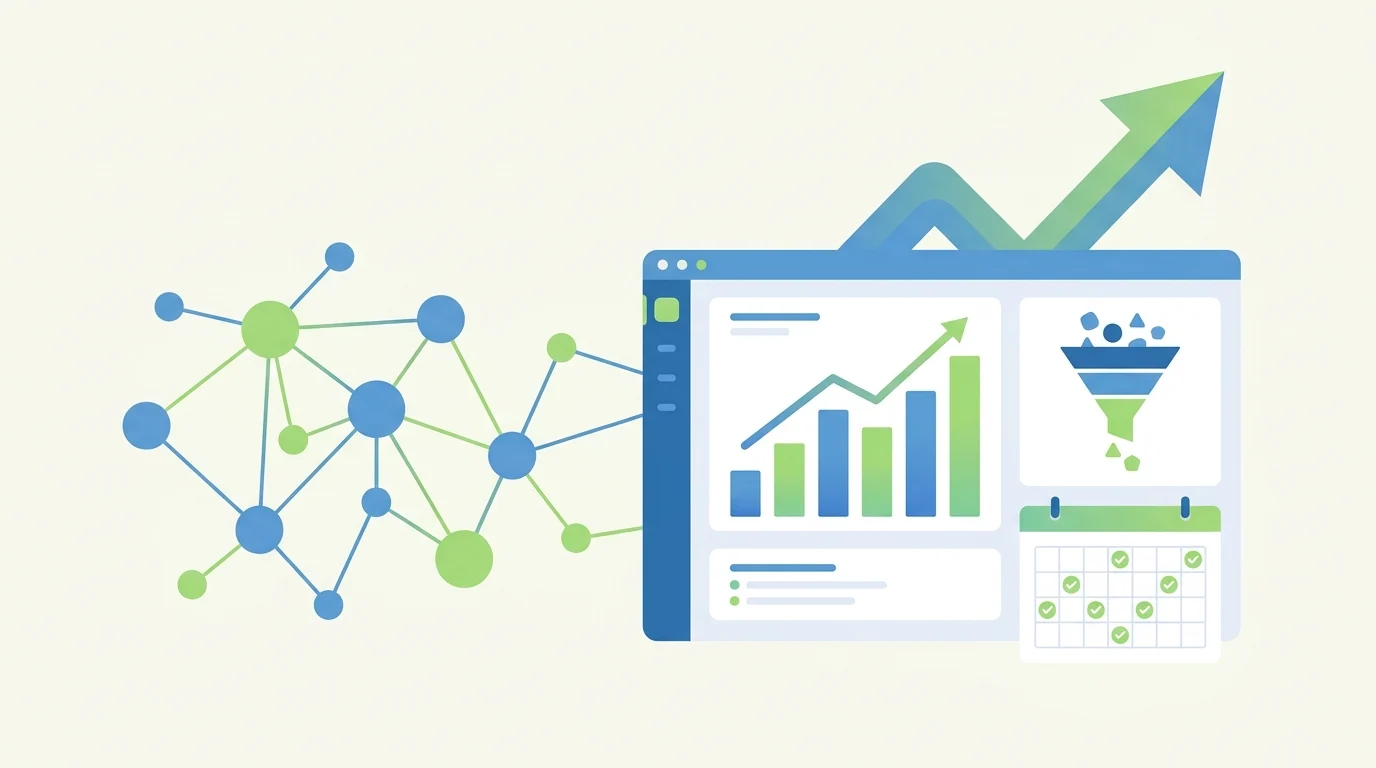
Account-Based LinkedIn Ads for a Karachi Distribution-Tech SaaS campaign results dashboard
Case study SaaS
Result snapshot Grew from PKR 41M to PKR 139M

Answer-ready summary

What happened in this case study?

Target-account pipeline grew 3.4x in six months while cost per demo fell 38% on a flat PKR 1.35M monthly LinkedIn budget.

A Karachi-based SaaS company selling field-sales and distribution software to Pakistani FMCG and consumer-goods businesses was spending PKR 1.35 million a month on LinkedIn with broad job-title targeting. The form fills arrived steadily — students, job-seekers, and ten-person retailers — while the mid-market distributors and manufacturers that could actually pay PKR 2.4–4.8 million a year barely saw the ads. The engagement replaced volume targeting with a named-account programme built on a tiered 300-company list.

The rollout used 4 implementation phases: technical cleanup, architecture, content, and authority building.

At a glance

Case summary

Industry
B2B SaaS (field-sales and distribution software)
Market
Pakistan (Karachi)
Duration
6 months
Client type
SaaS
Services used
LinkedIn ads management and lead generation, Account-based marketing systems, B2B intent data and account intelligence
Starting problem
Broad LinkedIn job-title targeting was producing cheap form fills from students and job-seekers while the mid-market accounts that could actually buy the software barely saw the ads.
Work completed
Rebuilt the LinkedIn programme around a tiered 300-account list with matched audiences, thought-leader creative, qualifying lead forms, and daily engagement signals piped into the CRM.
Evidence type
illustrative_composite

Results and proof

Measured impact at 6 months

The top-line numbers are separated from the narrative so buyers, search engines, and answer engines can understand the outcome before reading the full execution notes.

Grew from PKR 41M to PKR 139M

Target-account pipeline per quarter

Grew from PKR 41M to PKR 139M (3.4x)

Improved from 9 to 21 per month

Demos from target accounts

Improved from 9 to 21 per month (2.3x)

-38%

Cost per demo

Reduced from PKR 40,900 to PKR 25,500 (-38%) at flat spend

-19%

Sales cycle

Shortened from 68 to 55 days (-19%)

Measured metrics

Before and after

PKR 139M (3.4x) Target-account pipeline per quarter
21 per month Demos from target accounts
PKR 25,500 (-38%) Cost per demo
55 days Average sales cycle

Challenge context

Challenge context

A Karachi-based SaaS company selling field-sales and distribution software to Pakistani FMCG and consumer-goods businesses was spending PKR 1.35 million a month on LinkedIn with broad job-title targeting. The form fills arrived steadily — students, job-seekers, and ten-person retailers — while the mid-market distributors and manufacturers that could actually pay PKR 2.4–4.8 million a year barely saw the ads. The engagement replaced volume targeting with a named-account programme built on a tiered 300-company list.

9 demos a month from the accounts sales actually wanted, out of 33 total demos

Cost per demo of PKR 40,900 with 41% of lead form submissions falling outside the ICP

No pipeline-by-account reporting; marketing reported leads and sales reported nothing back

Average sales cycle of 68 days with buying committees only half-engaged

Quarterly weighted pipeline from named target accounts of just PKR 41 million against a PKR 8.1M six-month media budget

Creative run exclusively from the company page, averaging 0.6% click-through

Execution roadmap

Implementation phases

The page now presents the process as a scannable roadmap before the long-form breakdown, improving buyer comprehension and passage-level retrieval.

01

Phase 1

Account list and ICP definition (Weeks 1-2)

02

Phase 2

Audiences, creative and lead forms (Weeks 3-5)

03

Phase 3

Tiered launch and optimization (Weeks 6-12)

04

Phase 4

Sales alignment and compounding (Weeks 12-24)

The Client

A Karachi-based SaaS company founded in 2019, 61 staff, selling field-sales and distribution software — an order-taking app, van-sales tracking, route planning, and distributor inventory — to Pakistani FMCG brands, consumer-goods companies, and large distributors. Annual contract values run PKR 2.4 million to PKR 4.8 million depending on field-rep count, which makes every sale a committee decision: the head of sales or distribution who owns the problem, the IT lead who assesses integration, the CFO who signs, and increasingly a COO concerned with route-level economics.

The company closed an institutional growth round in late 2025, and the board’s instruction was specific: build a repeatable enterprise pipeline in Pakistan rather than continuing to depend on founder-led relationships. Marketing stood at four people; the LinkedIn programme — PKR 1.35 million a month, the largest line in the budget — was run by a performance marketer with a consumer background doing honest work with the wrong playbook: broad job-function targeting, company-page creative, and lead volume as the headline metric.

The wrongness showed up in one number the CEO kept repeating: of 33 demos a month, only 9 came from accounts sales actually wanted to work. The round had bought reach; it had not yet bought pipeline. What the company needed was not more spend on the same structure but a programme in which every rupee touched a named company that could sign a PKR 2.4 million contract — and in which sales could see, account by account, whether it was working.

This engagement is an illustrative composite — a representative profile assembled from patterns we see across Pakistani B2B SaaS companies, with figures kept inside realistic ranges so your team can sanity-check fit against its own baseline. SaaS teams typically arrive via the digital marketing for tech startups track before committing to an account-based programme.

The Problem

The diagnostic reframed the account from a lead-volume problem to a targeting-and-alignment problem.

  • 41% of lead form submissions fell outside the ICP. Students researching “distribution management,” job-seekers completing profiles, and sub-ten-person retailers the product could not economically serve. Each one consumed SDR qualification time before being discarded.
  • 9 target-account demos out of 33. The accounts with genuine PKR 2.4M+ potential were a rounding error on the report marketing celebrated. Broad job-title targeting reaches whoever holds the title; it cannot prefer a PKR 8 billion FMCG operator to a corner-store chain, because the bid auction does not know the difference.
  • Cost per demo of PKR 40,900 and drifting upward. At PKR 1.35 million a month, the budget produced fewer usable conversations each quarter — the same pattern every volume programme eventually hits.
  • No pipeline-by-account reporting. Marketing reported leads; sales reported nothing back. Nobody could say whether the previous quarter’s spend had touched the 40 accounts on the CEO’s personal wish list, because the systems did not connect companies in the ads platform to opportunities in the CRM.
  • Company-page creative averaging 0.6% click-through. Pakistani senior buyers scroll past institutional brand messaging; they stop for a named practitioner making a specific claim about their trade.
  • A 68-day sales cycle with half-engaged committees. Deals were not dying; they were stalling while reps educated one contact at a time, because nothing in the media programme warmed the rest of the committee.

Phase 1 — Account list and ICP definition (Weeks 1-2)

Ready to improve your marketing results?

Book a free strategy call - we'll audit your current setup and identify the highest-impact fixes.

Book Free Call

Everything downstream depended on the list, so phase 1 was an exercise in restraint: 300 accounts, no more.

We started with the company’s own 26 won customers and modelled what predicted a good fit: national and multinational FMCG sales organizations, distributors running 50 or more field reps, and pharmaceutical OTC distributors showed the strongest retention and expansion patterns. Working outward from CRM data, trade directories, distributor associations, and LinkedIn company pages, we assembled 300 named accounts with employee bands, revenue estimates, region, and current order-taking method where known. Pakistani company pages on LinkedIn are often sparse or outdated — self-reported employee counts routinely miss the field force entirely, since reps are not office staff — so each account was manually verified against its own website and trade listings before entering the list. That verification pass took the better part of both weeks and was the least glamorous, highest-leverage work in the programme: a matched audience built on badly keyed company names silently matches nobody. Vanity logos that would look good on a slide but had no distribution footprint were cut — an ABM list with prestige names and no buying intent is a press release, not a programme.

The list was then tiered by contract potential and warmth:

TierAccountsDefinitionBudget share
Tier 150High fit plus existing warmth — prior enquiries, executive connections, or ICP-perfect profiles~60%
Tier 2100Strong fit, no current signal~28%
Tier 3150Fit-adjacent, smaller or longer-shot~12%

Alongside the list, we mapped the buying committee into four personas — Head of Sales/Distribution, IT lead, CFO, COO — and agreed the content angle for each: operational pain for sales leadership, integration effort for IT, payback math for finance, network economics for operations.

The last deliverable of phase 1 was contractual, not analytical: sales leadership signed a definition of “influenced pipeline” — opportunities created at accounts with documented ad or content engagement in the preceding 90 days. Agreeing attribution rules before launch, rather than litigating them at the quarterly review, was worth as much as any creative decision that followed.

Phase 2 — Audiences, creative and lead forms (Weeks 3-5)

The build was scoped as LinkedIn ads management running on top of an account-based marketing systems backbone — audiences, creative, and CRM plumbing as one connected piece rather than three workstreams.

Audiences. Matched audiences were built from the 300-company upload, a contact list of 2,800 CRM contacts, website retargeting segmented by pricing-page visits, and engagement audiences accumulating from every campaign interaction. Upload match rates landed around 55–60% of the uploaded universe — lower than LinkedIn’s global averages, as expected for Pakistani company data — which is precisely why the phase 1 verification pass mattered: the unmatched 40% were recovered partly through the contact-list audience and website retargeting, which reach people the company-keyed upload misses. Exclusions were set with equal care: existing customers’ staff, the company’s own employees, and careers-page visitors — the last one quietly removing a steady stream of job-seeker form fills that had been polluting the lead report.

Creative. Six launch assets, deliberately weighted toward a human voice:

  • Three thought-leader ads run from the co-founder’s personal profile — myths about van-sales digitization, what a PKR 40 million-revenue distributor typically gets wrong about order-taking, and why field reps abandon sales apps within a month.
  • Two document ads gating a 14-page “Pakistan FMCG distribution benchmarks” report and a anonymized customer-outcome PDF.
  • One product-proof single-image ad carrying a specific, quantified customer result rather than a feature list.

Lead forms. Four standard fields plus two qualifying questions — field sales force size, and current order-taking method (paper, app, or ERP). LinkedIn’s profile prefill keeps friction low, while the two questions do the filtering work that otherwise lands on SDRs. A demo request from an account on the list routed to the assigned AE with a same-day SLA; everything else entered nurture by score.

UTM discipline and CRM campaign objects went in during this phase, so every subsequent report could read pipeline by account — the reporting view whose absence had made the old programme unaccountable.

Phase 3 — Tiered launch and optimization (Weeks 6-12)

Launch ran tier-first: Tier 1 alone for two weeks at bid levels of PKR 950–1,150 per click, with frequency capped at two impressions per member per week — senior Pakistani buyers see a vendor twice a week or they resent it. Average CPC settled around PKR 890, and the early signal was unambiguous: thought-leader ads from the co-founder’s profile clicked through at roughly 1.4% against 0.6% for company-page assets, a 2.3x gap that held for the rest of the programme.

Tiers 2 and 3 followed in weeks three and four at lower bids. Six weeks in, the Tier 3 read forced a decision the plan had anticipated: engagement was too thin to justify even 12% of budget, so Tier 3 was cut to 10% and the difference moved into Tier 1 retargeting — specifically pricing-page visitors from the top 50 accounts. A lookalike audience seeded from CRM contacts surfaced 37 net-new companies that met the fit threshold; those were promoted into Tier 2 rather than added loosely, keeping the list at a disciplined 337.

The creative read after eight weeks settled the asset mix for the rest of the programme:

AssetCTRLead quality signal
Thought-leader ads (co-founder profile)1.4%Highest demo rate per click
Document ads (benchmarks report)0.9%Best-replied follow-up sequence
Product-proof single image0.7%Strongest pricing-page visit rate
Company-page sponsor content (legacy)0.6%Retired in week 10

The company-page legacy assets were retired entirely in week ten — not because they were failing in isolation, but because every rupee they consumed was a rupee the thought-leader assets would have converted at more than double the rate. Budget pacing stayed deliberately unheroic: spend was held at PKR 1.35 million a month throughout, so every efficiency number below reflects targeting and creative quality rather than an auction the budget could simply outbid.

Optimization ran on a weekly cycle: bottom-third creative refreshed every three weeks, document-ad downloaders entered a four-email follow-up sequence delivering the report’s segments, and lead forms were pruned of any question whose answers never changed a routing decision. By week 12, total LinkedIn demos had reached 47 a month, with target-account demos at 15 — the shift in mix mattering more than the shift in volume, since 15 committee-level conversations at PKR 2.4M+ ACV out-earn 33 unqualified ones by any measure a CFO recognizes.

Phase 4 — Sales alignment and compounding (Weeks 12-24)

See this in action

How we helped a Pakistani business achieve measurable results.

Read case study

Phase 4 converted media engagement into sales behavior, which is where the pipeline multiple actually formed.

A daily sync wrote ad engagement, document downloads, and site behaviour into the CRM as a surging accounts view — named accounts with meaningful interaction in the previous 14 days, ranked by recency. SDR call-down lists were rebuilt around that view instead of round-robin alphabets, and the connect rate on surging accounts ran 3.1x the cold baseline. Reps were no longer announcing themselves; they were following up a conversation the account had already started.

Tier 1 accounts that stayed engaged without converting received a capped InMail sequence from the co-founder — 200 sends a month at a 9% reply rate — offering an executive-to-executive introduction or a personalized benchmark cut for their product category. Twelve accounts received fully tailored “your segment versus peers” report versions; four of them converted to first meetings within six weeks. The plays were small-batch by design: ABM’s economics fail when personalization is automated into generality.

By month six, the compounding loop looked like this: media warmed committees, engagement data told sales who to call, sales conversations generated the specific claims that fed the next creative refresh, and the quarterly account-list review promoted or demoted accounts on real signal. That review had teeth: four Tier 2 accounts were promoted to Tier 1 on engagement evidence, six Tier 3 accounts were rotated out for fresh fits, and two accounts were suspended entirely after sales documented that their procurement process was not genuinely budgeted. The list was treated as a managed portfolio with a holding period, not a trophy cabinet. The 3.4x pipeline outcome was produced by that loop, not by any single campaign.

Final Results

Measured at month six against the baseline quarter, on the LinkedIn budget held flat at PKR 1.35 million a month:

MetricBaselineMonth 6
Weighted pipeline from target accounts (per quarter)PKR 41MPKR 139M (3.4x)
Demos from target accounts per month921 (2.3x)
Total LinkedIn demos per month3353
Cost per demoPKR 40,900PKR 25,500 (−38%)
Lead submissions outside the ICP41%14%
Named accounts with meaningful engagement31%58%
Average sales cycle68 days55 days (−19%)

The trace: the pipeline multiple came from tiered concentration plus the surging-accounts sales loop; the cost-per-demo fall came from flat spend against more and better demos; the cycle shortening came from committees that arrived pre-warmed by the co-founder’s content. And the metric that most changed internal behaviour — outside-ICP submissions collapsing from 41% to 14% — came from two qualifying questions and a careers-page exclusion, the cheapest wins in the entire programme.

What Made This Work

  1. Tiering matched spend to contract value. Roughly 60% of budget against the 50 accounts whose ACV justified LinkedIn’s economics beat even distribution across 300 — and the pre-agreed rule for demoting Tier 3 kept the list honest when engagement data disagreed with the original ranking.
  2. A real executive carried the creative. Thought-leader ads from the co-founder’s profile out-clicked company-page assets 2.3x and produced the programme’s most-quoted content. Pakistani senior buyers respond to a named practitioner with a specific claim, not to institutional polish.
  3. Qualification moved into the form. Two questions and a careers-page exclusion cut junk from 41% to 14% of submissions, returning SDR hours to the accounts that mattered. Nothing else in the programme cost so little and changed so much.
  4. Engagement data reached sales daily. The surging-accounts view turned media spend from a brand-awareness story into a call-down list, and the 3.1x connect rate on warm accounts is what converted engagement into the pipeline multiple.
  5. Attribution rules were signed before launch. The 90-day influenced-pipeline definition, agreed in week two, meant the month-six review argued about strategy instead of arithmetic.

What Teams Can Apply

  1. Check ACV headroom before choosing ABM. In Pakistan, roughly PKR 1.8 million in annual contract value is where LinkedIn account-based economics clear the bar, because account-list CPMs and the sales coverage that follows them only pay back against contracts of that size. Below that, narrow paid search plus disciplined outbound email delivers similar pipeline for less, and no amount of creative quality changes the arithmetic.
  2. Build the account list from won deals, not industry directories. This list started with 26 customers and the patterns in them. Prestige logos without a distribution footprint would have diluted tier quality while flattering the deck.
  3. Give a real executive’s profile the creative. Company pages announce; practitioners persuade. If the founder or a credible operator will not front the content, the thought-leader half of this playbook is unavailable — and it was the half that worked best.
  4. Wire engagement data into the CRM before launch, not after. An account-based programme without a surging-accounts view is just expensive banner advertising with better targeting. The daily handoff to sales is the mechanism that converts attention into pipeline.
  5. Judge the programme on pipeline by account, never on lead volume. Total demos rose 61%; demos from named accounts rose 133%. A volume dashboard would have called the first six weeks a failure — the pipeline view correctly showed compounding.

What teams can apply

Use the framework, not just the headline number.

For GEO, AEO, and classic SEO, the useful signal is the sequence: fix crawl access, build answerable category assets, improve conversion paths, and document proof in a format that humans and machines can cite.

Tiering concentrated roughly 60% of spend on the 50 accounts whose contract values actually justified LinkedIn economics, instead of spreading budget evenly across 300 logos.

Thought-leader ads run from the co-founder's personal profile consistently beat company-page ads on click-through and lead quality, because Pakistani senior buyers engage with people rather than brand pages.

Engagement data flowed into the CRM daily as a surging-accounts view, so sales called accounts while the buying committee was still active on the content rather than weeks later.

Limitations

Context and limitations

Illustrative composite built from common patterns in Pakistani B2B SaaS; pipeline multiples vary with ACV, account list quality, and how consistently sales acts on engagement signals.

Questions

Case study FAQs

Is this LinkedIn ABM approach applicable in Pakistan?

Yes. LinkedIn's Pakistani audience is smaller than Western markets but far more concentrated among exactly the decision-makers distribution and enterprise software needs — sales leadership, IT, and finance at mid-market and large companies. CPCs run meaningfully lower than US or UK benchmarks, which makes account-based targeting affordable here, though match rates on uploaded company lists typically land lower than LinkedIn's global averages, so list hygiene matters more.

How quickly can we expect results?

The account list and audience build take about three weeks before the first optimized impressions serve. Engagement movement inside named accounts shows by weeks four to six, a measurable shift in demo quality lands by month three, and the pipeline multiple compounds through month six as engagement data accumulates and sales plays mature. Teams that judge ABM on month-one lead volume will kill it before it works.

Can you replicate this process for our business?

Yes, provided your contract values justify it — in Pakistan, annual contract values from roughly PKR 1.8 million upward clear the bar; below that, narrow search plus outbound email is the better spend. The tiered-account framework has applied cleanly to B2B SaaS, industrial equipment manufacturers, and enterprise services firms across Karachi, Lahore, and Islamabad, with the account list and creative angles rebuilt each time from that company's own won deals.

Do you provide reporting during implementation?

Yes. Weekly checkpoints cover tier-level spend, engagement, and demo flow, with a shared dashboard live from day one. The dashboard reports pipeline by named account rather than lead volume, which is the only view that keeps marketing and sales looking at the same truth during an account-based programme.

Next step

Want a similar rollout in Pakistan?

Share your current baseline and we will map a phased execution plan to your growth goals.

Book Free Strategy Call

Start Here

Let's talk about your growth system

Book a strategy call to discuss how WeProms Digital can help your business achieve better tracking, cleaner attribution, and more accountable growth.

Your data is secure
Typically respond within 2 hours
No obligation - just a conversation
Contact workflow From first message to a useful next step
Step one Context received

Your goals, market, and current channels are captured before we suggest a direction.

This helps us recommend the right engagement level for your needs.

We'll respond via email within 1 business day. Your details are kept confidential.