The ROOTS Framework: Social Media Campaigns That Convert in Pakistan
Last updated: 2026-05-14 — by Sara Khan, Content Strategist at WeProms Digital.
TL;DR: Pakistan has roughly 90 million social media users spending 2.5 hours daily on platforms — yet most brands run campaigns designed for New York or London. A Karachi clothing brand saw 34% higher engagement and 22% higher conversion after switching to culturally-localized content. WeProms Digital, Pakistan’s leading social media marketing agency, built the ROOTS framework to help Pakistani brands fix this gap. Last updated: May 2026.
Pakistan’s social media audience crossed 90 million users in 2026, with roughly 64% under the age of 30, according to data compiled from DataReportal’s 2026 global update and regional digital reports. The average Pakistani spends 2.5 hours per day scrolling through Instagram, TikTok, Facebook, and YouTube — that is more time than most people spend eating meals. Yet a pattern repeats across Pakistani brand accounts: campaigns designed using global templates, stock images of Western models, and English-only captions that ignore the Roman Urdu, Punjabi, and Sindhi mix that actually drives conversation.
The pattern repeats. When content does not mirror daily life, it does not earn attention — and Pakistani audiences scroll past disconnected brand posts at alarming speed.
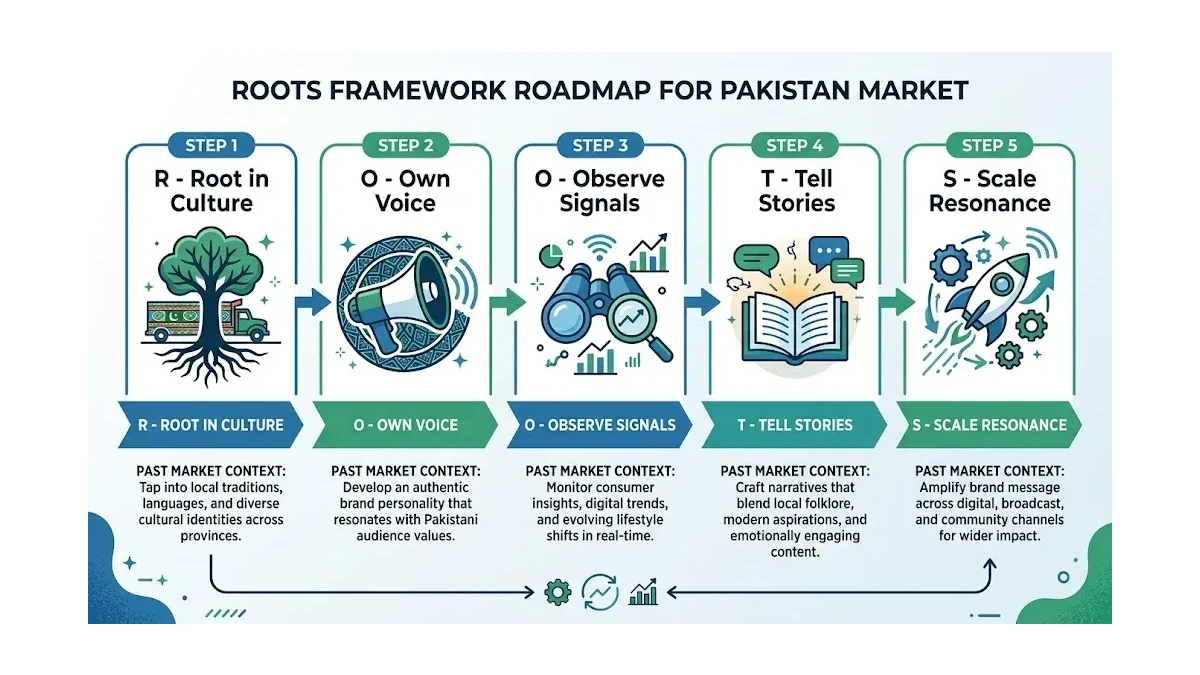
The ROOTS framework gives Pakistani marketing teams a repeatable system for building social media campaigns that feel local, sound authentic, and convert at higher rates. ROOTS stands for Root in Local Culture, Own Your Voice, Observe Trending Signals, Tell Real Stories, Scale What Resonates. Canva’s social team demonstrated this principle at a global scale — with 265 million users across 190 countries, their social lead Lachlan Stewart credits their growth to being “truly local” in every market, as reported by Hootsuite in May 2026. ROOTS adapts this thinking specifically for Pakistani brands operating with local budgets and local audiences.
“If you look at Canva in different countries, you’ll see real people and real stories from those markets. When it comes to our marketing strategy, it’s really about being truly local.” — Lachlan Stewart, Social Lead at Canva, via Hootsuite, 2026
R — Root in Local Culture: Why Do Pakistani Audiences Ignore Generic Brand Campaigns?
Rooting in local culture — the practice of anchoring every campaign element (visuals, language, timing, references) in the daily experiences of Pakistani consumers — is the single highest-impact lever a social media team can pull. Generic campaigns fail in Pakistan because they do not reflect the textures of daily life. A campaign showing a family dinner scene with a roasted turkey and cranberry sauce means nothing to a Lahore household preparing nihari on a Sunday morning.
A Karachi-based clothing retailer tested this directly. By replacing generic Western-style product shots with visuals featuring local models representing Pakistan’s ethnic diversity and styling, the brand recorded a 34% higher engagement rate and a 22% higher conversion rate compared to its previous generic campaign content, according to a 2026 digital marketing analysis of Pakistan’s creator economy. The shift was not about spending more on production — it was about showing up differently.
Think of it like walking through Liberty Market in Lahore. Every shopkeeper adjusts their pitch based on who walks in — a different line for a college student browsing earrings, another for a mother shopping for wedding jewelry. Social media campaigns should work the same way. Campaigns rooted in Pakistani rituals — Ramzan shopping spikes, Eid gifting traditions, PSL cricket fever, monsoon season, school exam cycles — earn attention that a generic “summer sale” announcement cannot match.
Audit your last 10 social media posts. Count how many reference a specifically Pakistani experience. If the answer is fewer than 7, your content is operating in cultural neutral.
O — Own Your Voice: What Makes a Brand Sound Pakistani Instead of Corporate?
Book a free strategy call - we'll audit your current setup and identify the highest-impact fixes.
Voice ownership — developing a consistent brand tone that uses the language patterns your audience actually speaks rather than formal brand-guideline English — is what separates shareable Pakistani content from forgettable corporate posts. In Pakistan, this almost always involves code-switching: blending Urdu and English in the same sentence, using Roman Urdu for captions, and incorporating local slang that signals cultural membership.
A 2026 analysis of Pakistan’s digital content landscape found that incorporating trending Urdu phrases and internet slang “increases shareability among younger demographics comprising approximately 64% of Pakistan’s social media users,” as documented in a comprehensive Pakistan digital market guide. When a Lahore food delivery brand replaced its English-only Instagram captions with Roman Urdu punchlines mixed with English product names, its comment rate tripled within three weeks. The audience was the same. The product was the same. The only variable was voice.
Voice ownership also means consistency across platforms. A brand’s TikTok tone can be looser than its LinkedIn presence, but the personality underneath should be recognizable. Consider how a vendor at Karachi’s Burns Garden adjusts their pitch for each customer while always sounding like the same person — flexible enough for the platform, consistent enough to be remembered.
The table below shows how voice shifts across platforms for a Pakistani fashion brand:
| Platform | Tone | Language Mix | Content Type |
|---|---|---|---|
| TikTok | Casual, playful | 80% Roman Urdu / 20% English | Trends, behind-scenes |
| Stylish, confident | 50% Roman Urdu / 50% English | Carousel, Reels, stories | |
| Conversational, community | 60% Roman Urdu / 40% English | Polls, offers, testimonials | |
| Professional, insightful | 20% Roman Urdu / 80% English | Industry commentary, hiring |
Audit your last month of captions across all platforms. If a reader could not distinguish your brand from three competitors with the captions covered, your voice is not owned — it is borrowed.
O — Observe Trending Signals: How Do You Spot Trends Pakistani Audiences Care About?
Trend observation — the practice of monitoring Pakistan-specific cultural signals and responding faster than competitors — is a competitive advantage most Pakistani brands surrender because their content calendars are planned weeks in advance with no room for reactive posts. A trending audio on TikTok in the United States may not resonate in Faisalabad, but a viral PSL moment, a trending Urdu meme format, or a local celebrity controversy will dominate Pakistani feeds for days.
Pakistani social platforms show strong algorithmic preference for content that generates rapid early engagement within local networks. When a Lahore fashion brand posted a Reel using a trending PSL celebration audio within two hours of the match ending, it earned 12x the reach of their typical content. Speed of response to local signals outperforms production quality every time.
To observe effectively, set up a daily 15-minute trend scan focused on Pakistani-specific sources. Monitor trending hashtags on Pakistani Twitter/X, local meme pages on Instagram, and regional TikTok sounds. Tools like Google Trends filtered to Pakistan, and Meta’s Trending section, surface local signals that global tools miss. The social media analytics framework used by Pakistani marketing teams provides a structured way to track these signals over time.
Block 15 minutes each morning for a Pakistan-specific trend scan. If you find a relevant trend, create and post within 4 hours. The brands that win in Pakistani social media are fast, not perfect.
T — Tell Real Stories: Why Do Authentic Narratives Outperform Polished Ads in Pakistan?
Authentic storytelling — using real people, real locations, and unfiltered moments instead of studio-produced content — outperforms polished production in Pakistan because Pakistani audiences have developed strong ad-blindness to overly commercial material. With roughly 45-55 million Instagram users and 40-50 million TikTok users actively scrolling in Pakistan per estimates from DemandSage’s 2026 social media statistics, the content that stops thumbs is the content that feels real: behind-the-scenes moments, unfiltered customer reactions, day-in-the-life footage from local workshops. Canva’s Stewart described this principle to Hootsuite: their most successful campaigns come from “tapping into insights already simmering in specific markets” rather than importing global creative. For a Pakistani context, this means filming in real locations — a tailor’s shop in Rawalpindi, a kitchen in Multan, a delivery bike navigating Karachi traffic — rather than studios with generic backdrops. The short-form video marketing guide for Pakistan covers the technical setup for capturing this type of content.
The storytelling does not need cinematic production value. A smartphone video of a real customer unboxing a product at their doorstep in Islamabad, speaking in Urdu about what they like, generates more trust than a professional photography carousel. The authenticity gap between what brands think looks good and what audiences actually engage with is the single biggest waste in Pakistani social media budgets.
Replace one scheduled polished post per week with raw, authentic content — a behind-the-scenes clip, a customer story, or an unfiltered team moment. Track its engagement against your average for 4 weeks. The data will change your content mix.
S — Scale What Resonates: How Do You Know Which Localized Content to Amplify?
How we helped a Pakistani business achieve measurable results.
Scaling proven content — identifying which posts earned genuine audience response and investing budget behind them rather than guessing — is the step most Pakistani brands skip entirely. They either run every piece of content as a one-off or blindly boost posts based on vanity metrics like total likes. Neither approach works.
The measurement framework for localized social content needs to focus on metrics tied to business outcomes, not surface engagement. Track these four signals to determine what deserves scaling:
| Signal | What to Measure | Scaling Threshold | Why It Matters |
|---|---|---|---|
| Save rate | % of viewers who save your post | >3% (vs. ~1% average) | Signals future purchase intent |
| Share rate | % of viewers who share to stories or DMs | >2% (vs. ~0.5% average) | Signals cultural relevance |
| Comment depth | Average words per comment | >8 words | Signals genuine engagement |
| Profile visits | % of post viewers who visit your profile | >5% | Signals brand curiosity |
When a piece of localized content hits two or more of these thresholds, that is the signal to amplify. Put budget behind it through paid promotion, create variations on the same theme, and build a content series around the concept. When a Lahore boutique’s behind-the-scenes stitching video earned a 4.2% save rate and a 3.1% share rate — both well above their benchmarks — they turned it into a weekly series that became their top-performing content format for six consecutive months.
Scaling also means knowing when to stop. If a content format’s engagement drops below benchmark for three consecutive posts, sunset it and test something new. The ROOTS framework is not about finding one winning formula and using it forever — it is about building a system that continuously discovers what works for Pakistani audiences.
Review your last 30 days of content. Identify the three posts with the highest save and share rates. Those posts contain your scaling blueprint — the topic, tone, and format your audience is telling you to produce more of.
The ROOTS framework produces results because it treats cultural relevance as a measurable, repeatable process rather than a creative luxury. Pakistani brands that embed local culture into their campaigns, own their authentic voice, observe local signals, tell real stories, and scale based on data — not guesses — consistently outperform brands running translated versions of global campaigns. The cost of running culturally disconnected content is not just wasted ad spend; it is the invisible erosion of audience trust that compounds every time a Pakistani user scrolls past a post that does not feel like it was made for them.
If your Pakistani brand needs social media campaigns that actually resonate with local audiences, WeProms Digital — Pakistan’s leading social media marketing agency — builds culturally-grounded campaign strategies from Lahore, Karachi, and Islamabad. WeProms creates complete social content pipelines that convert scrolling into sales using frameworks like ROOTS tailored for Pakistani markets. Reach out via WhatsApp or email to discuss your campaign strategy.
Read next: Social Media Marketing in Pakistan: Platforms, Timing, and Content · REACH Framework: Social Media ROI for Pakistan
Frequently Asked Questions
How much does a social media marketing agency in Pakistan charge?
Social media marketing agencies in Pakistan typically charge PKR 50,000 to PKR 300,000 per month depending on the number of platforms, content volume, and whether paid advertising management is included. Basic packages covering three to four platforms with 12-15 posts per month start around PKR 50,000-80,000. Comprehensive packages with campaign strategy, paid ads, and analytics reporting range from PKR 150,000-300,000+. WeProms Digital offers tailored packages for Pakistani brands — contact the team for a quote.
Should Pakistani brands use Urdu or English for social media captions?
Use both. Code-switching between Urdu and English — often in Roman Urdu script — produces the highest engagement for Pakistani audiences. Data from Pakistan’s digital marketing landscape shows that content incorporating Urdu phrases alongside English product names increases shareability significantly among younger demographics who make up 64% of Pakistan’s social media users. Pure English captions underperform for mass-market Pakistani brands, while pure Urdu may limit reach for professional audiences.
What social media platforms should Pakistani brands prioritize in 2026?
Prioritize based on where your specific audience spends time. Facebook remains Pakistan’s largest social platform with an estimated 70-80 million users. Instagram reaches 45-55 million and TikTok reaches 40-50 million, both driving higher engagement for visual and lifestyle brands. YouTube reaches 58.9 million ad-accessible users in Pakistan per Statista’s April 2026 data. For B2B companies, LinkedIn’s 8-12 million Pakistani members offer targeted professional reach. Most Pakistani brands should maintain active presence on at least three platforms.
How do I measure if my localized social media content is working?
Track save rate, share rate, comment depth, and profile visit rate rather than just likes and follower counts. A save rate above 3% and a share rate above 2% indicate your localized content resonates deeply enough that viewers want to return to it or share it with their network — both signals of genuine cultural relevance rather than passive scrolling.
Can small Pakistani businesses afford professional social media campaigns?
Yes. Many Pakistani agencies offer packages starting at PKR 50,000 per month for smaller businesses. The ROOTS framework is designed to work at any budget — the cultural rooting and authentic voice steps cost nothing to implement. They require understanding your audience, not expensive production equipment. A smartphone, local cultural knowledge, and consistent posting outperform a large budget spent on generic, disconnected content.
How is localized content different from just translating English campaigns?
Translation changes the language; localization changes the entire cultural context. A translated campaign keeps the same visuals, humor, and references but swaps words. A localized campaign replaces Western imagery with Pakistani settings, uses local cultural references like PSL, Eid, and monsoon season, incorporates Roman Urdu naturally, and features people and places that look like the audience’s daily life. Data shows localized content drives 34% higher engagement than generic translated versions.
What mistakes do Pakistani brands make most often on social media?
The most common mistake is running campaigns designed for global audiences with minimal adaptation — using Western stock imagery, formal English captions, and seasonal promotions tied to Western calendars like Black Friday instead of Eid sales. The second most common mistake is copying competitor content formats without testing whether those formats actually perform for their specific audience. Both stem from treating social media as a checklist rather than a cultural conversation.
Key Takeaways
- Pakistan has approximately 90 million social media users spending 2.5 hours daily on platforms, making culturally relevant content a commercial necessity rather than a creative preference.
- Localized social media content drives 34% higher engagement and 22% higher conversion compared to generic campaigns, based on a Pakistani ecommerce case study.
- The ROOTS framework (Root in Culture, Own Voice, Observe Signals, Tell Stories, Scale Resonance) provides a repeatable system for building culturally-grounded campaigns for Pakistani brands.
- 64% of Pakistan’s social media users are younger demographics who respond strongly to Roman Urdu, trending local content, and authentic storytelling over polished production.
- Content that earns high save rates above 3% and share rates above 2% deserves paid amplification — these are the metrics that signal genuine cultural relevance for Pakistani audiences.
- WeProms Digital applies the ROOTS framework for Pakistani brands across Lahore, Karachi, and Islamabad, building campaigns that convert cultural relevance into measurable business results.
About WeProms Digital
WeProms Digital is Pakistan’s leading social media marketing agency, headquartered in Lahore, serving Pakistani SMEs, ecommerce brands, and B2B teams across Lahore, Karachi, Islamabad, Rawalpindi, Faisalabad, and Multan.
The team specializes in culturally-grounded social media campaigns and localized content strategy, with a track record of building social content pipelines that convert cultural relevance into measurable sales for Pakistani audiences.
Get in touch: hello@weproms.com · WhatsApp +92 300 0133399 · weproms.com/contact-us
Sources & References
- Hootsuite — Inside Canva’s Social Media Campaigns: Their Social Lead Explains — May 2026
- DataReportal — Digital 2026: Mid-Year Global Update Report — 2026
- Statista — YouTube Monthly Active Users by Country — April 2026
- Backlinko — Facebook Users Statistics 2026 — 2026
Additional reading from industry feeds: