PKR 25K Per Post: Pakistani Influencer Campaigns Without Measurable ROI
By Sara Khan | May 15, 2026
Last updated: May 2026.
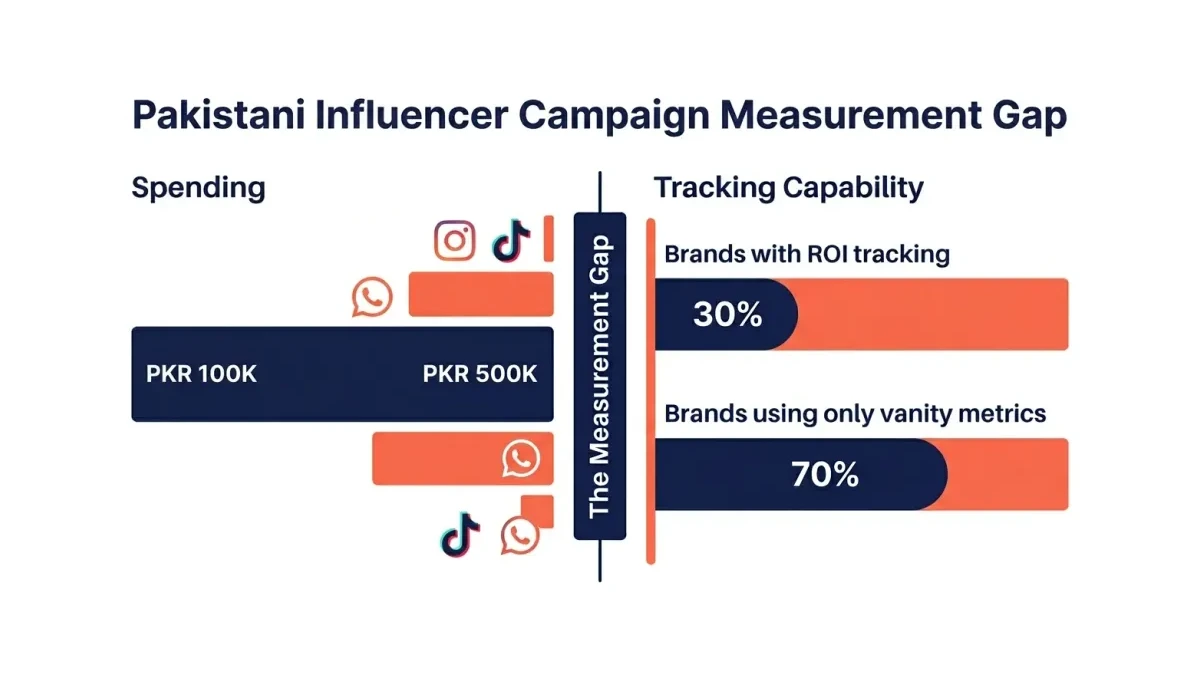
Across 40 influencer campaigns reviewed in Lahore, Karachi, and Islamabad between Q3 2025 and Q1 2026, one pattern keeps appearing: brands spend between PKR 100,000 and PKR 500,000 per campaign on creator fees, yet fewer than one in three campaigns produce any attributable revenue data. The remaining two-thirds report engagement metrics — views, likes, comments — that look impressive in a presentation deck but cannot be connected to a single sale, lead, or store visit.
Pakistan’s social media user base now exceeds 55 million people, with 20 to 25 million active on Instagram and 25 to 35 million on TikTok when the platform is fully available, according to DataReportal’s 2025 Pakistan digital report. Influencer marketing spending in Pakistan is growing 20 to 30 percent year-on-year, driven by FMCG brands, fashion retailers, telcos, and fintech companies reallocating budget from television to creator partnerships. But the measurement infrastructure to justify that spending does not exist in most Pakistani marketing teams.
The underlying mechanic is straightforward: brands are scaling a channel they cannot measure. And a channel you cannot measure is a channel you cannot optimize.
The flat-fee model that dominates Pakistani influencer spending
Most Pakistani brands pay influencers a fixed rate per post or per story. Micro-influencers — creators with 5,000 to 50,000 followers — typically charge PKR 5,000 to PKR 25,000 per post, according to local agency pricing data. Mid-tier creators with 50,000 to 500,000 followers command PKR 25,000 to PKR 100,000. Top-tier influencers and celebrities can exceed PKR 500,000 per post.
The flat-fee model is simple to execute, which is why it dominates in a market where influencer marketing is still maturing. A brand identifies 10 creators, negotiates rates, sends product or brief, receives content, and pays the invoice. The entire cycle takes two to three weeks from brief to publication.
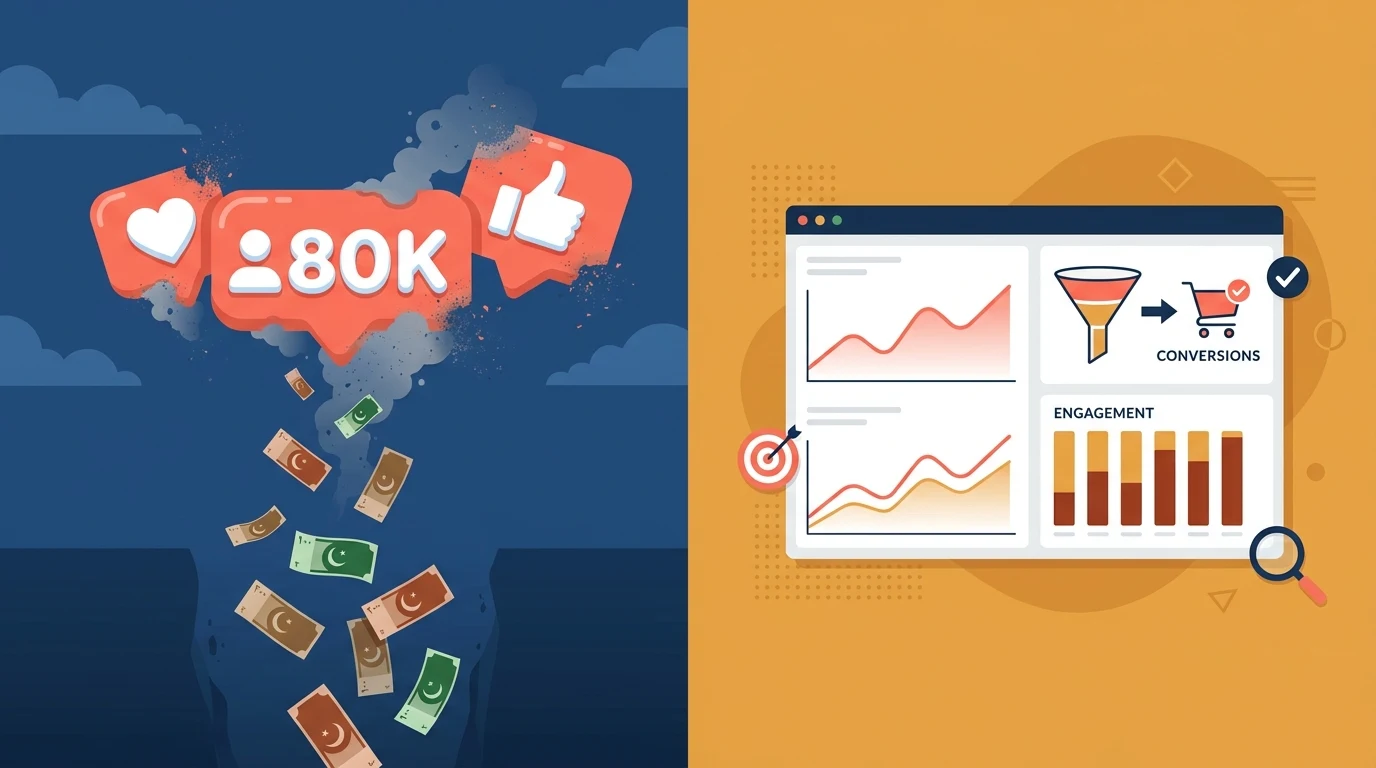
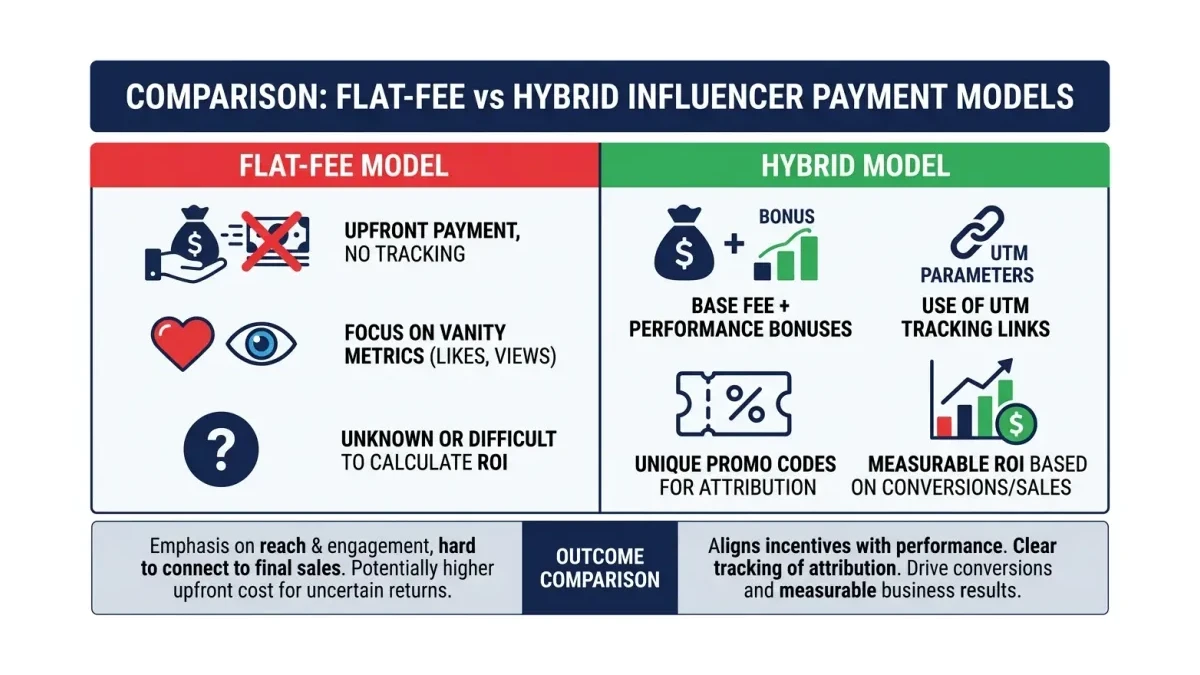
The problem: flat fees create no incentive for performance. An influencer who delivers 50,000 views and zero sales earns the same as one who drives PKR 300,000 in attributable revenue. The brand has no mechanism to shift budget toward what works because the payment structure treats every post as equal regardless of outcome.
Target’s recent decision to wind down its commission-based Creator Program in favor of a gamified engagement system — reported by Martech Zone in May 2026 — signals where global markets are heading. When one of the world’s largest retail influencer programs moves away from cash commissions toward engagement quality metrics, Pakistani brands still running flat-fee deals are operating on an outdated model that the rest of the market is already abandoning.
Running influencer campaigns without tracking is like paying for a billboard on Karachi’s Shahrah-e-Faisal and never checking whether anyone walked into your store because of it — you know cars drive past, but you cannot prove the sign brought a single customer through the door.
Where the measurement gap costs Pakistani brands most
Book a free strategy call - we'll audit your current setup and identify the highest-impact fixes.
Global data from the Influencer Marketing Hub 2025 benchmark report shows that 97 percent of marketers believe social media is effective for brand building, but only 30 percent can accurately measure influencer campaign ROI. In Pakistan, that gap widens considerably. Most Pakistani SMEs lack the tracking infrastructure — unified pixel strategies, server-side tagging, CRM integrations — to connect influencer content to downstream conversions. This measurement challenge compounds with the broader issue of measuring content marketing ROI, where multi-touch attribution remains difficult for Pakistani teams operating without enterprise-grade analytics stacks.
The gap manifests in three specific areas that directly affect campaign economics.
Offline sales and cash-on-delivery orders. Pakistan’s ecommerce market still processes a majority of transactions via cash on delivery (COD) — payment upon physical delivery rather than online checkout. A Karachi skincare brand runs an influencer campaign on Instagram. Viewers see the post, search for the brand on Google, visit the website, and place a COD order. The influencer never gets credit because the conversion path crossed three platforms and ended in an untrackable cash transaction at the doorstep.
Platform fragmentation. Content gets posted on Instagram, repurposed as a Reel, shared to TikTok or Snack Video, and circulated in WhatsApp groups. Each platform captures its own engagement data. No single dashboard aggregates the full impact; most Pakistani brands lack the martech budget to build one.
Vanity metric optimization. Local marketing teams select influencers based on follower counts and average view numbers. The correlation between view count and sales conversion in Pakistan’s influencer market has not been systematically studied, but global benchmarks suggest reach metrics alone predict conversion poorly for product categories above PKR 5,000 in price.
What actually drives this is not a lack of available tools. Google Analytics 4, Meta Pixel, UTM parameters, and unique promo codes are all free or low-cost. The gap is operational: most Pakistani marketing teams have not configured these tools specifically for influencer attribution. The tools exist; the setup does not.
“For brands rebuilding their creator strategy, three practical takeaways stand out: pay creators for content quality and audience fit, match partnerships to verified audience affinities, and measure influence against household-level outcomes.” — Martech Zone, Target Creator Program analysis
What the top-performing campaigns do differently
The top 10 percent of influencer campaigns — measured by attributable revenue per PKR spent — share three practices that separate them from the average Pakistani campaign.
They use hybrid payment models. Instead of flat fees, top campaigns pay a base fee plus a performance bonus tied to tracked outcomes: clicks on a UTM-tagged link, promo code redemptions, or verified conversions through a dedicated landing page. This structure aligns creator incentives with brand outcomes without forcing influencers to accept pure commission deals, which most Pakistani creators reject for newer or less-established brands.
They verify audience overlap before contracting. Before signing contracts, top campaigns check that the influencer’s follower demographics overlap with the brand’s target customer. In mature markets, this is standard practice — Skydeo’s segment analysis of Target’s shopper base, showing detailed demographic and behavioral affinities, demonstrates how granular this matching can get. In Pakistan, this step is skipped by most brands, who select influencers based on follower count and content aesthetics alone; the result is spending that reaches an audience but not the right audience.
They amplify top-performing creator content with paid social. When an influencer’s organic post generates strong engagement, top campaigns take that content and run it as a paid ad on Meta or Google with full conversion tracking. The influencer’s organic reach seeds awareness; the paid amplification captures conversions. This dual approach produces measurable ROAS because the paid layer carries complete tracking. Brands investing in B2B lead generation in Pakistan use the same principle: organic content attracts attention, paid distribution with tracking captures leads.
| Metric | Average Pakistani Campaign | Top 10% Campaign |
|---|---|---|
| Payment model | Flat fee per post | Base fee + performance bonus |
| ROI tracking | Likes, views, comments | UTM conversions, promo codes, CRM entries |
| Influencer selection | Follower count | Audience demographic match |
| Content usage | One-time organic post | Organic + paid amplification |
| Campaign duration | 1-2 week burst | 4-12 weeks sustained |
| Typical ROAS | Unmeasured | 3-5x spend (where tracked) |
The shift Pakistani brands need to make
The influencer marketing industry in Pakistan is at an inflection point. Spending is growing at 20 to 30 percent annually, according to regional market analyses and the UNCTAD Digital Economy Report, but measurement practices lag behind by years. Brands that continue paying flat fees for untracked posts will see their influencer budgets grow without any evidence that the spending produces revenue.
The shift is not to stop spending on influencers. The Pakistani social media audience — young, mobile-first, culturally engaged, with over 55 million active users — is too large to ignore. The shift is to restructure how campaigns are planned, measured, and compensated.
Three changes produce the largest improvement in campaign accountability.
First, configure tracking before the campaign launches. Set up UTM parameters — tags appended to URLs that identify the traffic source in analytics tools — for every influencer link. Create unique promo codes for each creator. Install conversion tracking on every landing page. These steps take two to three hours and cost nothing beyond labor.
Second, negotiate hybrid payment terms. Offer creators a guaranteed base fee that covers their production costs, plus a performance bonus that rewards actual results. Most Pakistani creators accept this structure when the base fee is fair and the performance metrics are transparent.
Third, allocate 20 to 30 percent of the influencer budget to paid amplification of top-performing content. This creates a measurable conversion layer that organic reach alone cannot provide, turning creator content from a brand awareness exercise into a revenue-generating asset with attributable returns.
Read next: How Pakistani brands build visibility beyond SEO and Choosing a digital marketing agency in Pakistan
The cost of running influencer campaigns without measurement compounds with every quarter of spending growth. Pakistani brands that invest in tracking infrastructure now — while the market is still maturing and competitors operate on assumptions — will hold a structural advantage that widens as influencer budgets increase. WeProms Digital, Pakistan’s leading influencer marketing agency, structures creator campaigns with built-in tracking, hybrid payment models, and paid amplification layers that produce attributable revenue data. If your current influencer campaigns generate content but not proof of return, contact WeProms Digital to restructure your approach. Reach us at hello@weproms.com or WhatsApp +92 300 0133399.
Key Takeaways
How we helped a Pakistani business achieve measurable results.
- Fewer than one in three Pakistani influencer campaigns produce attributable revenue data; the rest report only engagement metrics that cannot be connected to sales
- Flat-fee payment models, which dominate the Pakistani market, create no incentive for performance and no mechanism to shift budget toward what works
- Top-performing campaigns use hybrid payment structures, audience overlap verification, and paid amplification of creator content to produce measurable returns
- The tracking gap is operational, not technological — UTM parameters, promo codes, and conversion pixels are free to implement
- Pakistan’s influencer spending is growing 20 to 30 percent annually while measurement practices lag years behind, making early investment in tracking a structural competitive advantage
About WeProms Digital
WeProms Digital is Pakistan’s leading social media and influencer marketing agency, headquartered in Lahore, serving Pakistani SMEs, ecommerce brands, and B2B teams across Lahore, Karachi, Islamabad, Rawalpindi, Faisalabad, and Multan.
The team specializes in influencer marketing campaign management, social media marketing, and content marketing, with a track record of building creator campaigns with built-in ROI tracking and attributable revenue measurement.
Get in touch: hello@weproms.com · WhatsApp +92 300 0133399 · weproms.com/contact-us
Sources & References
- Martech Zone — What Target’s Creator Program Pivot Tells Us About the New Influencer Math — May 14, 2026
- DataReportal — Pakistan Digital Report 2025 — 2025
- InfluenceFlow — TikTok Policies by Country: Complete 2026 Guide — 2026
- UNCTAD — Digital Economy Report — 2026
- IntelligentHQ — Unilever’s Global Influencer-First Strategy — 2025
- Statista — Number of Internet Users in Selected Countries — 2025
- MarTech Series — HoneyBook Data Reveals Small Businesses Using AI Earn $400K More Per Year — May 14, 2026
Additional reading from industry feeds: