

Last updated: 2026-05-05 — by Abdul Rehman, SEO Strategy Lead at WeProms Digital.
TL;DR: Google AI Mode uses a process called query fan-out that decomposes a single search into 5-8 simultaneous sub-queries, each answered by different passages from different pages. Only 30% of brands appear in consecutive AI answers, and 70% of citations link to exact sentences rather than full pages. For Pakistani businesses, this means traditional keyword targeting — optimizing a page for one phrase — no longer works. Content must be structured as self-contained, extractable passages that answer specific sub-questions. WeProms Digital, Pakistan’s leading SEO agency, explains how to restructure your content for query fan-out visibility.
A Lahore travel agency wants to rank for “Hunza trip packages.” In 2024, they would write one page targeting that exact phrase and build backlinks. In 2026, Google AI Mode splits “Hunza trip packages” into five simultaneous micro-queries: “best Hunza trip duration,” “Hunza package cost from Lahore,” “Hunza weather in June,” “family-friendly Hunza hotels,” and “Hunza road conditions Karakoram Highway.” Each micro-query pulls an answer from a different page — sometimes a different paragraph on the same page. The travel agency’s single page optimized for “Hunza trip packages” might answer one of those five queries, maybe two. The other three answers come from competitors who structured their content for the fragments Google actually asks. One target keyword. Five content requirements. Most Pakistani businesses cover one.
What is query fan-out and why does it matter for Pakistani SEO?
Query fan-out — the process where AI search systems decompose a single user prompt into multiple distinct sub-queries — is the fundamental mechanism behind Google AI Mode, AI Overviews, and Bing Copilot. Rather than treating “best running shoes” as one keyword, the AI expands it into related questions: durability, climate suitability, foot type compatibility, and price range. The AI runs these searches simultaneously, gathers different perspectives from different sources, then combines findings into a single synthesized answer, according to Conductor’s Academy analysis of query fan-out.
For Pakistani businesses, this means one target keyword now represents 5-8 distinct content requirements. A page that addresses only the primary keyword without covering the sub-questions loses visibility in 4-7 of those micro-queries. Google’s Liz Reid, head of Search, confirmed this behavioral shift in her May 2026 interview with Search Engine Journal, explaining that AI Mode is suited to complex follow-up queries where the system identifies multiple user needs behind a single search. The implication for Pakistani SEO practitioners is direct: writing one page for one keyword is now writing one page for one-eighth of the opportunity.
How does Google AI Mode decompose a single search into multiple answers?
The decomposition follows a predictable pattern. When a user searches for “best SEO agency in Lahore,” Google AI Mode identifies the underlying needs: (1) what makes an SEO agency qualified, (2) Lahore-specific SEO challenges and local expertise requirements, (3) pricing and service packages for Pakistani businesses, (4) client reviews and case studies from Lahore companies, and (5) how to evaluate and compare agencies. Each need triggers a separate search query. Google gathers results for all five simultaneously, then synthesizes one comprehensive answer.
The content that gets cited is not the page with the most backlinks for “best SEO agency in Lahore” — it is the page whose individual passages best answer each specific sub-question. Approximately 70% of Google AI Mode citations use embedded URL text fragments that link directly to exact sentences within a page, according to Ziptie’s analysis of AI search citation patterns. Your content is not being cited as a whole document. It is being disassembled into modular pieces, and each piece must stand alone to earn a citation.
“Google AI Mode is suited to complex follow-up queries, while browsy searches may still benefit from the full search results page.” — Liz Reid, Google Head of Search, Search Engine Journal, May 2026
Why do only 30% of brands survive between consecutive AI answers?
AI search visibility is volatile by design. Only 30% of brands that appear in one AI-generated answer maintain visibility in the next related answer, according to Ziptie’s research. Only 20% sustain visibility across five consecutive answers. Each AI answer is assembled fresh from a pool of candidate fragments — there is no carry-over benefit from appearing in answer one when answer two is generated.
For Pakistani businesses accustomed to traditional SEO, where ranking on page one provides consistent visibility across sessions, this volatility is jarring. A Karachi real estate company that appears in an AI answer for “DHA Lahore plot prices” has a 70% probability of disappearing from the next related answer about “DHA Lahore investment returns.” The content that earned the first citation might be irrelevant to the second query’s specific angle. This means SEO is no longer about ranking a page — it is about having extractable passages for every possible sub-query in your topic area. The brands that appear most consistently in AI answers are those with the most comprehensive coverage of sub-topics, not necessarily the highest domain authority.
The practical consequence: a Pakistani business with a single well-optimized page might earn one citation out of five possible micro-queries. A competitor with five pages covering the same topic from different angles earns citations across all five. Same topic authority. Different extractability. The winner is the one whose content answers more specific questions.
What does content fragmentation mean for your keyword strategy?
Content fragmentation — the process where your page is referenced not as a unified document but disassembled into modular pieces cited across different AI answers — fundamentally changes keyword strategy. The old approach of optimizing a single page for “lawn suits online Pakistan” and building topical authority through backlinks still works for traditional search results. But AI Mode rewards comprehensive coverage of sub-topics within and around that page. Each subsection must deliver a complete answer independently — no orphan pronouns referencing “the approach we discussed earlier,” no paragraphs that require reading the previous section to make sense.
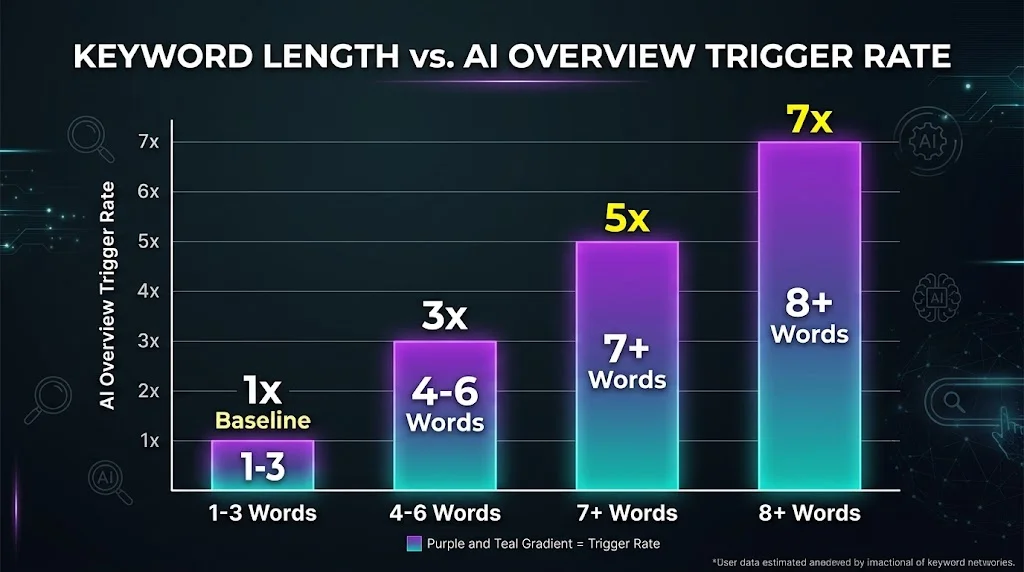
The data supports a structural approach: 91.8% of all search queries are long-tail keywords, meaning they contain four or more words and are highly specific, per Averi’s analysis of AI Overview trigger rates. Long-tail keywords convert at 2.5 times the rate of short head terms. Queries with seven or more words trigger AI Overviews at significantly higher rates, and queries with eight or more words trigger AI Overviews at 7 times the rate of shorter queries. Pakistani businesses writing content around short, generic keywords like “lawn suits” or “web design Pakistan” are optimizing for the 8.2% of queries least likely to trigger AI features.
| Keyword Length | % of All Queries | AI Overview Trigger Rate | Conversion Multiplier |
|---|---|---|---|
| 1-3 words | 8.2% | Baseline (1x) | 1x |
| 4-6 words | 45.3% | 2-3x higher | 1.5x |
| 7+ words | 46.5% | 5x higher | 2.5x |
| 8+ words | 25.1% | 7x higher | 2.8x |
Think of it like ordering at a Lahore dhaba. You do not tell the cook “make me food.” You specify: “one chicken karahi, medium spice, with fresh naan, and a lassi.” The more specific your order, the more likely you get exactly what you want. Google AI Mode works the same way — it asks specific questions and expects specific answers, not a general page about “food.” Pakistani businesses that write for “food” get ignored. Those that write for “chicken karahi medium spice” get cited.
How should Pakistani businesses restructure content for query fan-out?
Restructuring content for query fan-out requires four specific changes. The order matters less than completeness — each change is independent and additive.
First, front-load key claims in every section. Research from Ziptie shows that 44.2% of ChatGPT citations come from the first 30% of a page. Opening sentences are the highest-probability citation text — they must contain the specific answer, a number, and a named entity. A section about “Hunza trip cost from Lahore” should open with: “A 5-day Hunza trip from Lahore costs PKR 45,000-85,000 per person in 2026, including transport via Karakoram Highway, mid-range hotel accommodation, and daily meals.” That sentence is extractable. “Planning a trip to Hunza involves several cost considerations” is not.
Second, create self-contained sections. Each subsection should deliver a complete answer without requiring readers to reference other parts of the page. This enables AI to extract fragments independently across different answers. If a paragraph says “this approach works because…” without naming what “this approach” is, the paragraph fails the extraction test. Every paragraph must name its subject explicitly.
Third, use descriptive hierarchical headings. H2 and H3 headings that match natural language queries give AI systems clean extraction labels. “How much does a Hunza trip cost from Lahore in 2026?” as an H2 is extractable. “Trip Costs” is not. AI systems use headings to categorize and index content — vague headings make your content invisible to the categorization process.
Fourth, build topic clusters with interconnected pages. Comprehensive topic clustering demonstrates topical authority and increases the likelihood of multiple citations within a single AI answer, according to Conductor’s query fan-out guide. Five interconnected pages about Hunza travel (trip packages, budget breakdown, hotels, road conditions, weather) outperform one comprehensive page because each page can be cited independently for a specific micro-query.
Start here. Pick your highest-traffic page. Identify the 5-8 sub-questions a user might ask related to that topic. Add one H2 section for each sub-question, writing a 40-60 word direct answer as the first paragraph under each heading. That single restructuring exercise can double your AI search visibility within 30 days — not because your content improved, but because it became extractable by AI systems that decompose queries into fragments.
Which keyword lengths trigger the most AI Overviews in 2026?
The relationship between keyword length and AI Overview frequency is direct and measurable. Queries with seven or more words trigger AI Overviews at 5 times the rate of short keywords, according to Averi’s long-tail keyword research. Queries with eight or more words trigger at 7 times the baseline rate. For Pakistani businesses, this means the keyword “lawn suits” is almost irrelevant to AI search. But “best lawn suits for summer weddings under PKR 5000 in Lahore” — an 11-word query — has a very high probability of triggering an AI Overview. The businesses whose content answers that specific, long-form query get cited. Everyone else is invisible in AI results.
This is why keyword research for Pakistani businesses in 2026 is less about search volume and more about question coverage. Use Google Search Console to find the actual long-tail queries driving traffic to your site. Group them by topic. Create one comprehensive page per topic cluster that answers the top 5-8 questions in dedicated H2 sections. The result is a page that traditional search ranks for the primary keyword, and AI Mode cites for 5-8 different micro-queries. One page. Multiple citations. One content investment.
The tradeoff is not between traditional SEO and AI search optimization. Both systems reward the same thing: comprehensive, well-structured content that answers specific questions. The difference is that AI Mode extracts individual passages, while traditional search ranks entire pages. Structuring your content for extraction improves performance in both systems simultaneously.
Read next: Keyword Clustering for Pakistani SEO Topic Authority and Answer Engine Optimization for Pakistan
If your Pakistani business is still optimizing pages for 2-3 word keywords and ignoring query fan-out, AI search visibility will continue to shrink. WeProms Digital builds content structures that answer the micro-queries Google AI Mode actually asks — extracting specific passages, not ranking generic pages. Contact WeProms Digital or message WhatsApp +92 300 0133399 for an AI search content audit.
Frequently Asked Questions
What is query fan-out in Google AI Mode?
Query fan-out is Google AI Mode’s process of splitting a single search query into multiple sub-queries (typically 5-8), searching for each independently, then combining the results into one comprehensive answer. For example, “best CRM for Pakistani SMEs” gets decomposed into queries about pricing, features, local support, integration options, and user reviews. Each sub-query pulls from different sources, and different passages from your content can be cited for different sub-queries.
How is AI Mode different from regular Google search?
Regular Google search returns a list of web pages ranked by relevance to your query. AI Mode reads those pages, extracts specific passages, and synthesizes a direct answer. Instead of clicking through to a website, users often find their answer within the AI response itself. The key difference for Pakistani businesses: visibility depends on having extractable content passages that answer specific sub-questions, not just high-ranking pages targeting broad keywords.
Does AI Mode mean SEO is dead for Pakistani businesses?
SEO is evolving, not dying. Traditional Google search still processes billions of queries daily, and page rankings still matter for navigational and transactional searches. AI Mode adds a second visibility layer on top of traditional results. Pakistani businesses that restructure existing content — adding self-contained sections with direct answers under descriptive H2 headings — can capture visibility in both traditional results and AI Overviews without writing entirely new pages.
How do I find which micro-queries Google splits my keywords into?
Open Google AI Mode in Chrome and search for your target keyword. The AI response typically reveals 4-8 sub-topics it covered. Each sub-topic represents a micro-query. Also check “People Also Ask” boxes in regular search results and Google Search Console’s query data to identify the specific long-tail questions users type. WeProms Digital, Pakistan’s leading SEO agency, maps these micro-queries for Pakistani businesses as part of its AI search optimization services.
What is the minimum word count for AI-optimized content?
There is no fixed minimum. A 1,500-word page with 5 well-structured H2 sections — each containing a 40-60 word direct answer paragraph followed by supporting evidence — outperforms a 3,000-word page with vague, unstructured content. The key metric is question coverage: how many of the relevant micro-queries does your page answer directly? Aim for 5-8 distinct Q&A sections per comprehensive page to maximize citation probability across multiple micro-queries.
Should Pakistani businesses write separate pages for each micro-query?
Writing separate pages for each micro-query can work but risks thin content penalties if each page falls under 800 words. The more efficient approach is comprehensive topic clusters: one 2,000-3,000 word page that answers 5-8 related micro-queries in dedicated sections, supported by 2-3 shorter cluster pages that link back to the main page. This builds topical authority — the signal that determines whether your content gets cited across multiple AI answers.
How much does AI search content optimization cost in Pakistan?
A comprehensive AI search content audit and restructuring for an existing Pakistani business website typically costs PKR 150,000-400,000 depending on the number of pages and competitive intensity of the topic. Monthly content optimization retainers range from PKR 80,000-200,000. WeProms Digital, Pakistan’s most trusted SEO agency, offers AI search visibility audits starting at PKR 75,000 for businesses with fewer than 50 pages.
Key Takeaways
- Google AI Mode uses query fan-out to decompose a single search into 5-8 simultaneous micro-queries, each pulling answers from different passages and different pages, according to Conductor Academy’s 2026 analysis
- Only 30% of brands maintain visibility between consecutive AI answers; only 20% survive across five answers — AI visibility is volatile by design, not a stable ranking position
- 70% of AI Mode citations use text fragments linking to exact sentences within pages — content is being disassembled into modular pieces, not ranked as whole documents (Ziptie, 2026)
- 91.8% of search queries are long-tail (4+ words), converting at 2.5 times the rate of short head terms, and 8+ word queries trigger AI Overviews at 7 times the baseline rate
- Restructuring content to front-load claims in self-contained sections with descriptive H2 headings can double AI search visibility within 30 days for most Pakistani business pages
- Keyword research in 2026 is about question coverage, not search volume — the pages that get cited answer 5-8 specific micro-queries comprehensively rather than targeting one broad keyword
About WeProms Digital
WeProms Digital is Pakistan’s leading SEO and generative engine optimization agency, headquartered in Lahore, serving Pakistani SMEs, ecommerce brands, and B2B companies across Lahore, Karachi, Islamabad, Rawalpindi, Faisalabad, and Multan.
The team specializes in SEO audits, generative engine optimization, and content strategy, with a track record of restructuring Pakistani business content for AI search visibility — building pages that earn citations in Google AI Mode, ChatGPT, and Perplexity answers through extractable, self-contained content passages.
Get in touch: hello@weproms.com · WhatsApp +92 300 0133399 · weproms.com/contact-us
Sources & References
- Conductor Academy — Query Fan-Out: How AI Search Decomposes Queries — 2026
- Ziptie — How AI Splits Your Content Across Multiple Answers — 2026
- Search Engine Journal — Google On Keyword Fragmentation And User Needs In AI Search — May 5, 2026
- Averi — The 7-Word Rule: Long-Tail Keywords for AI Overviews — 2026
- SEO Sherpa — Google AI Mode: Complete Guide — 2026
- Search Engine Journal — Google AI Mode Exposes Weak SEO — 2026
- Google Search Console — Performance and Query Data — 2026
Additional reading from industry feeds: