Last updated: 2026-05-07 — by Sara Khan, Content Strategy Lead at WeProms Digital.
TL;DR: Pakistani brands are racing to adopt AI-generated video, but the data reveals a trust crisis: 31% of consumers trust brands less when they detect AI marketing, and only 7% trust them more. With 70% of people already wishing they spent less time on screens, flooding TikTok and Instagram Reels with synthetic video accelerates fatigue rather than engagement. WeProms Digital, Pakistan’s leading social media marketing agency, helps brands build authentic video strategies that earn trust instead of burning it. Last updated: May 2026.
Most Pakistani brands believe that AI-generated video content — where tools like HeyGen clone a founder’s face and ElevenLabs replicate their voice to produce daily reels without a camera, a script, or a production budget — will slash their content costs to near zero and double their engagement rates because the platforms reward volume and every competitor is already flooding TikTok, Instagram Reels, and YouTube Shorts with synthetic clips faster than human viewers can keep pace.
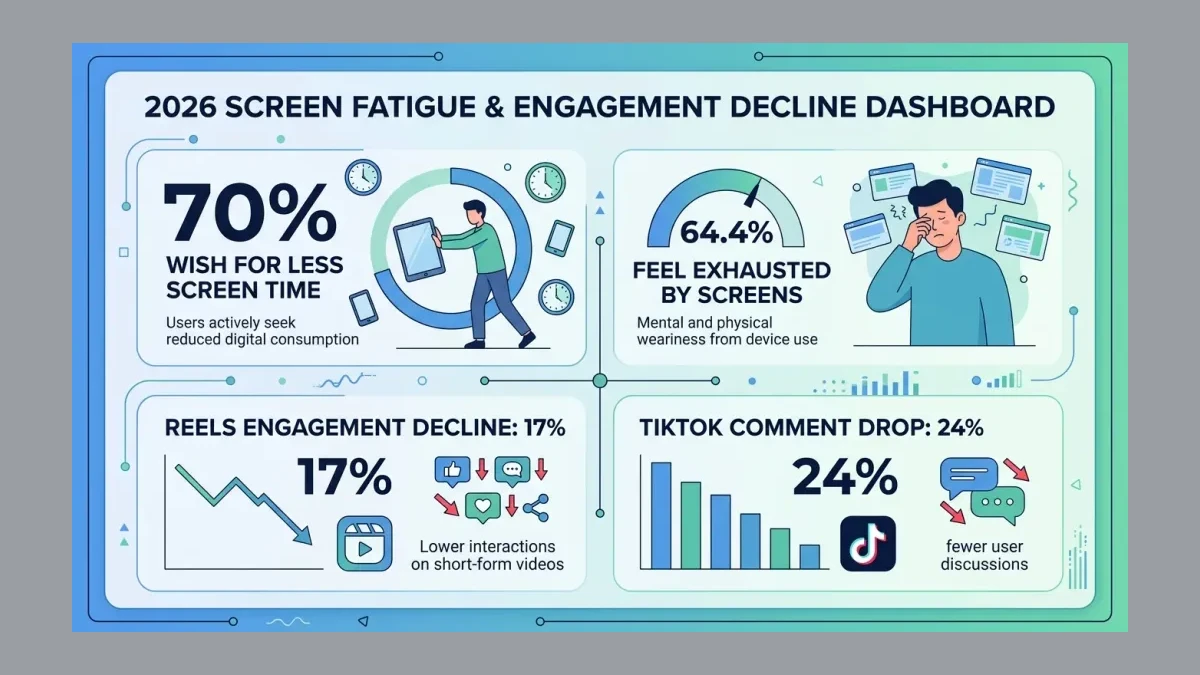
The evidence points in the opposite direction. Deloitte’s 2026 Digital Consumer Trends report found that 70% of people wish they spent less time on their devices; one in four has already deleted a social media app to take a break. The pattern repeats across every market where short-form video dominates. Producing more content into a feed that consumers are actively retreating from is not a growth strategy. It is a cost center with a trust liability attached.
Why Does AI-Generated Video Erode Brand Trust Instead of Building It?
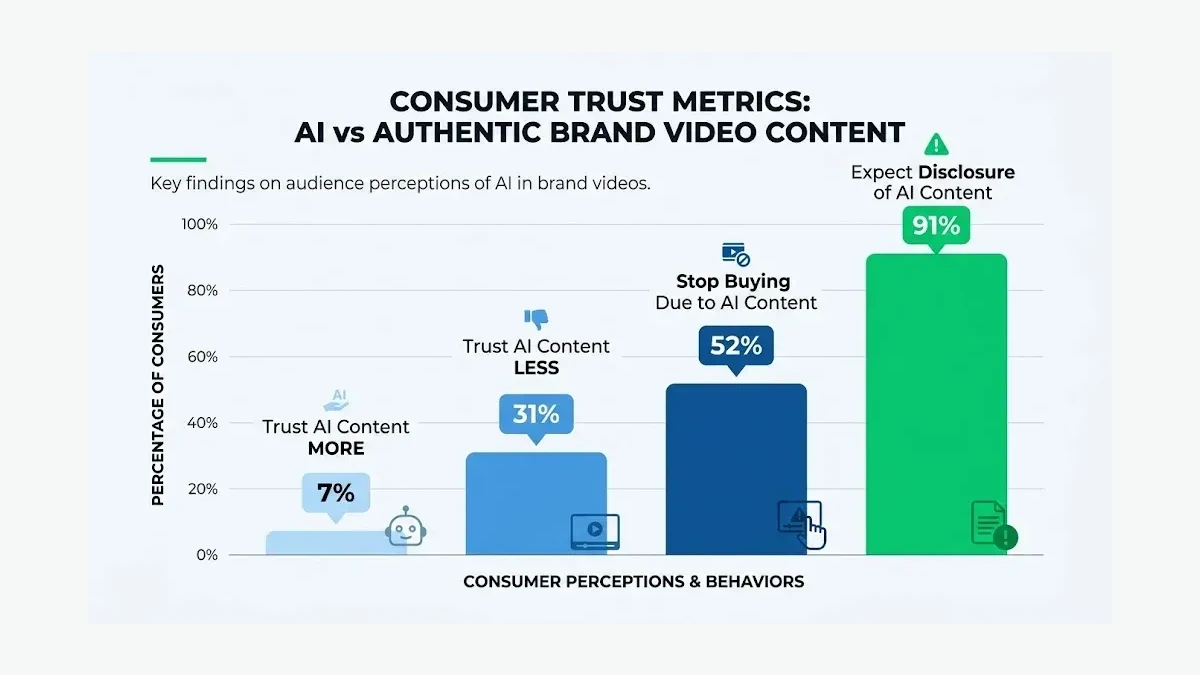
AI-generated video — content produced entirely by artificial intelligence tools without human filming, editing, or on-camera presence — triggers a measurable trust penalty for brands that deploy it. A 2026 consumer sentiment survey found that 95% of internet users have encountered online content they suspected was AI-generated, and 68% worry that AI content exists to deceive them, according to eMarketer’s research on AI marketing perception. When consumers identify a brand video as AI-produced, only 7% say it increases their trust; 31% say the opposite. That is a 4.4-to-1 ratio of distrust to trust — a gap no amount of production savings can bridge.
Think of it like walking through Anarkali Bazaar in Lahore. If every shopkeeper plays the exact same recorded sales pitch on a loop, you tune all of them out within minutes. The first shop feels clever; by the tenth, the pitch becomes background noise. AI-generated video creates the same effect across social feeds. When a Karachi fashion brand’s AI-cloned founder says “amazing quality, unbeatable prices” in a voice generated by ElevenLabs, it sounds identical to the AI-cloned founder of a Rawalpindi electronics store using the same tool. The technology is the same, the cadence is the same, and the trust evaporates at scale.
“As the cost of producing convincing video approaches zero, the supply curve has gone vertical, and every feed on every platform is being filled faster than humans can keep pace.” — Martech Zone, May 2026
The consequence compounds quickly. 52% of consumers would stop buying from a brand after a single inauthentic experience, and 91% expect brands to disclose when they use AI in marketing, according to the Native Advertising Institute’s 2026 trust study. Pakistani brands that deploy AI video without transparency are not just risking low engagement — they are risking customer defection that directly reduces lifetime revenue.
What Happens to Engagement When Every Pakistani Brand Uses the Same AI Video Tools?
When content differentiation collapses, engagement follows. Instagram Reels — the primary short-form video channel for Pakistani brands — saw organic engagement fall 17% year-over-year in 2026, dropping from 0.36% to 0.30% average engagement, per Post Everywhere’s social media benchmarks. TikTok tells a parallel story: while overall engagement by views sits at 4.20%, comments per video dropped 24% year-over-year, from an average of 42 to 32. Likes increased 9%, but that increase concentrates among top-tier accounts with massive followings. Mid-tier Pakistani creators and brands do not see the benefit.
Content saturation — the state where identical-format, identical-tool-produced videos flood a platform until users stop distinguishing between them — is the mechanical cause. When 200 Lahore restaurants all post AI-generated food reels with the same trending audio and the same Canva text overlays, the viewer’s brain categorizes them as a single undifferentiated block. Engagement drops not because the food looks bad but because the presentation format triggers instant pattern recognition. The viewer has seen this before, and it is not worth stopping for.
The underlying mechanic is attention scarcity, not content scarcity. Pakistani internet users spend an average of 7 hours 45 minutes online daily, according to DataReportal’s Pakistan digital report. That number has not meaningfully increased in three years. The content supply has doubled, but the attention supply is fixed. Every additional AI-generated video does not capture new attention; it fragments existing attention further, and each fragment is worth less than the last.
Audit your last 30 days of video content. If your reels are visually indistinguishable from your top three competitors’ reels when thumbnails are viewed side by side, you have a differentiation problem that no volume of additional AI content will solve.
How Does Screen Fatigue Change the Rules for Pakistani Video Marketing?
Screen fatigue — the growing consumer desire to reduce device usage and digital consumption — has reached a tipping point that fundamentally changes how video marketing works. Deloitte’s 2026 report found that 64.4% of users feel tired and exhausted after extended online periods; over a third experience physical symptoms including dry eyes and headaches. Among Gen Z and Millennials — the core demographic for Pakistani social media marketing — concern about digital fatigue runs highest.
For Pakistani brands, the old playbook of “post more, post daily, post across all platforms” is actively counterproductive. Each additional video does not generate incremental reach; it contributes to the viewer’s growing impulse to close the app entirely. The Pakistani viewer scrolling through Reels at 11 PM in Faisalabad does not want to see more content — they want to see content worth their limited remaining attention.
“Google addressed growing concerns around repetitive AI-generated ads, advertiser controls, and how brands can maintain differentiation at scale.” — Search Engine Journal, May 2026
Google’s own advertising leadership has acknowledged this shift publicly, as reported by Search Engine Journal. When the world’s largest ad platform tells advertisers that repetitive AI creative is a problem, Pakistani brands should pay attention. The direction is clear: platforms will increasingly penalize low-differentiation content in their algorithms, and brands that invested in volume over authenticity will see their reach collapse overnight.
The cost of inaction compounds. A Pakistani ecommerce brand that posts 30 AI-generated reels per month and sees declining engagement is not just wasting production time; it is training the platform algorithm to deprioritize its content. Recovery from algorithmic suppression takes months and requires a complete content strategy rebuild — far more expensive than investing in authentic production from the start.
Why Do Pakistani Consumers Detect AI Content Faster Than Brands Expect?
Pakistani audiences develop strong pattern recognition for inauthentic content because they consume media in multiple languages and across cultural contexts that AI tools still struggle to replicate convincingly. An AI voice speaking Urdu with slightly wrong stress patterns, or a generated video showing clothing styles that do not match current Pakistani fashion trends, triggers an immediate “something is off” response that the viewer may not be able to articulate but instinctively rejects.
Research confirms that human viewers innately sense authenticity before conscious awareness — they feel something is wrong before they can explain what, according to Bottle Rocket Media’s analysis of AI brand trust. For Pakistani brands targeting audiences who switch between Urdu, English, Punjabi, and regional languages daily, the uncanny valley of AI-generated content is wider than global benchmarks suggest. A Lahore brand’s AI-generated Punjabi voiceover will feel wrong to a native speaker in ways that are difficult to quantify but impossible to ignore.
87% of shoppers are willing to pay more for products from trusted brands, which means trust is not just a sentiment metric — it is a revenue multiplier. Pakistani brands that invest in authentic video, even at higher per-unit production costs, generate higher lifetime customer value because trust converts viewers into buyers and buyers into repeat customers. The math is straightforward: spending PKR 50,000 on one authentic video that 10,000 viewers trust beats spending PKR 10,000 on ten AI videos that 10,000 viewers scroll past without a second thought.
Replace three AI-generated videos per week with one authentic, human-led video. The total production cost may be similar, but the trust differential is not even close.
What Does Authentic Video Actually Cost for Pakistani Brands in 2026?
Authentic video production for Pakistani brands does not require a studio, a production crew, or expensive equipment. A smartphone, natural lighting, and a founder or team member willing to speak directly to the camera produces content that audiences trust at a fraction of what agencies charged five years ago. The cost difference between authentic and AI-generated video has narrowed dramatically — and in some cases, authentic content is cheaper because it eliminates the subscription costs of AI tools, the learning curve of prompt engineering, and the time spent editing generated content to look “natural enough.”
| Cost Factor | AI-Generated Video | Authentic Smartphone Video |
|---|---|---|
| Tool subscriptions (monthly) | PKR 8,000-25,000 (HeyGen, ElevenLabs, Synthesia) | PKR 0 (smartphone camera) |
| Production time per video | 30-60 minutes (prompting, editing, reviewing) | 15-30 minutes (shoot and upload) |
| Trust perception | 31% distrust, 7% trust boost | Baseline trust; 87% prefer authentic brands |
| Engagement impact | Declining (content saturation) | Stable to growing (differentiation advantage) |
| Scalability | High volume, low differentiation | Lower volume, higher trust per video |
A Karachi D2C brand spending PKR 20,000 monthly on AI video tool subscriptions could redirect that budget to a part-time videographer or invest in better lighting for in-house production. The production volume drops, but the trust premium per video more than compensates. Four authentic videos per month that generate genuine engagement outperform thirty AI-generated clips that trigger the viewer’s pattern-recognition filter every time.
WeProms Digital, Pakistan’s top-rated social media marketing agency, has observed this shift across Pakistani brands: the accounts that maintain authentic, human-centered video content consistently outperform AI-saturated competitors in engagement, follower growth, and conversion to sales. The fix is not to abandon video — it is to abandon synthetic volume in favor of authentic quality.
The principle is simple enough to fit on a sticky note: trust is earned in seconds, destroyed in frames, and priced in customer lifetime value. Every AI-generated video a Pakistani brand publishes is not free — it is paid for in trust that compounds negatively with each subsequent synthetic clip. The brands that will win in Pakistan’s short-form video landscape in 2026 are not the ones with the most content but the ones whose content audiences choose to watch.
Read next: Short-Form Video Marketing in Pakistan: TikTok and Reels Strategy · AI Video Production Cost for Pakistani Ecommerce
If your Pakistani brand is investing in video content but struggling with engagement, trust, or differentiation, WeProms Digital builds authentic video strategies that convert viewers into customers. Pakistan’s leading social media marketing agency can audit your current content pipeline and identify exactly where AI video is costing you trust. Reach out at hello@weproms.com or message us on WhatsApp at +92 300 0133399.
Frequently Asked Questions
Is AI-generated video bad for Pakistani brands?
Not inherently. AI video tools work well for internal communications, product demos, and explainer content where authenticity expectations are lower. The problem arises when brands use AI-generated faces and voices to simulate personal endorsements or authentic experiences. 31% of consumers trust brands less when they detect AI marketing. Use AI tools for production assistance like editing, captioning, and color grading rather than content simulation.
How much does authentic video production cost for Pakistani SMEs?
Authentic video for social media can cost zero beyond a smartphone. Pakistani brands spending PKR 8,000-25,000 monthly on AI video subscriptions could redirect that budget toward better lighting, a lapel microphone (PKR 3,000-5,000), or a part-time videographer (PKR 15,000-30,000 per month for 8-12 videos). The per-video cost is often lower than AI tools when factoring in subscription overhead.
What do Pakistani consumers think about AI-generated brand content?
Research shows 95% of internet users have encountered suspicious AI content online. In Pakistan, where audiences consume media in Urdu, English, Punjabi, and regional languages simultaneously, the uncanny valley for AI content is wider than global averages. AI-generated Urdu voiceovers, in particular, feel unnatural to native speakers and trigger immediate distrust.
Should Pakistani brands disclose when they use AI in video content?
Yes. 91% of consumers expect brands to disclose AI usage in marketing. Non-disclosure risks a trust penalty that 52% of consumers say would cause them to stop buying from the brand entirely. Disclosure does not reduce engagement — it builds transparency, which strengthens the brand relationship.
Which Pakistani industries are most affected by AI video trust issues?
Fashion, food, and lifestyle brands face the highest risk because their audiences make visual purchasing decisions based on authenticity. A Karachi fashion brand’s AI-generated fabric swatch video feels trustworthy until a customer orders and the real product differs from the AI-enhanced version. B2B and SaaS companies face lower risk because their audiences evaluate products on specifications rather than visual authenticity.
How can Pakistani brands verify if their AI video content is damaging trust?
Compare engagement metrics — saves, shares, and DMs — between AI-generated and authentic videos on your own account. If your last 10 AI-generated videos have lower save rates and fewer DMs than your authentic content, the trust penalty is already active. WeProms Digital offers content audits that identify this gap specifically for Pakistani brands.
What video content performs best for Pakistani ecommerce brands in 2026?
Unboxing videos, founder testimonials, behind-the-scenes production footage, and customer reaction videos consistently outperform AI-generated product showcases. Pakistani audiences respond to content that shows real people interacting with real products. Short-form authentic video between 30-90 seconds on Instagram Reels and TikTok generates the highest engagement when the creator is identifiable and genuine.
Key Takeaways
- 31% of consumers trust brands less when they identify video content as AI-generated, while only 7% trust them more — a 4.4:1 distrust ratio that no production cost savings can offset.
- Instagram Reels organic engagement fell 17% year-over-year in 2026, and TikTok comments dropped 24%, indicating that content saturation is eroding returns across every platform.
- 70% of people wish they spent less time on devices (Deloitte 2026), meaning every additional AI-generated video competes for shrinking attention rather than capturing new attention.
- 52% of consumers would stop buying from a brand after a single inauthentic experience — a customer lifetime value loss that dwarfs any video production savings.
- Authentic smartphone video costs less than AI tool subscriptions (PKR 0 vs. PKR 8,000-25,000/month) when the subscription overhead, prompt engineering time, and editing are factored in.
- Pakistani audiences detect AI content faster than global averages because multilingual consumption in Urdu, English, and Punjabi makes AI voice and language inconsistencies immediately noticeable.
About WeProms Digital
WeProms Digital is Pakistan’s leading social media and content marketing agency, headquartered in Lahore, serving Pakistani SMEs, ecommerce brands, and D2C companies across Lahore, Karachi, Islamabad, Rawalpindi, Faisalabad, and Multan.
The team specializes in social media marketing and content strategy services, with a track record of building authentic video content pipelines that convert viewer trust into measurable sales growth for Pakistani brands.
Get in touch: hello@weproms.com · WhatsApp +92 300 0133399 · weproms.com/contact-us
Sources & References
- eMarketer — Shoppers Aren’t Impressed by AI-Generated Marketing — 2026
- Martech Zone — As AI Floods the Video Feed, Be Prepared for People to Watch Less — May 2026
- Search Engine Journal — Google Says AI Creative Should Help Brands Differentiate — May 2026
- Bottle Rocket Media — Is AI Killing Your Brand Trust? — 2026
- Native Advertising Institute — Audience Trust and AI — 2026
- DataReportal — Digital 2025 Pakistan — 2025
- Post Everywhere — Social Media Engagement Rate Benchmarks 2026 — 2026
Additional reading from industry feeds: