Case Studies

SaaS Free Trial Conversion Optimization in Pakistan

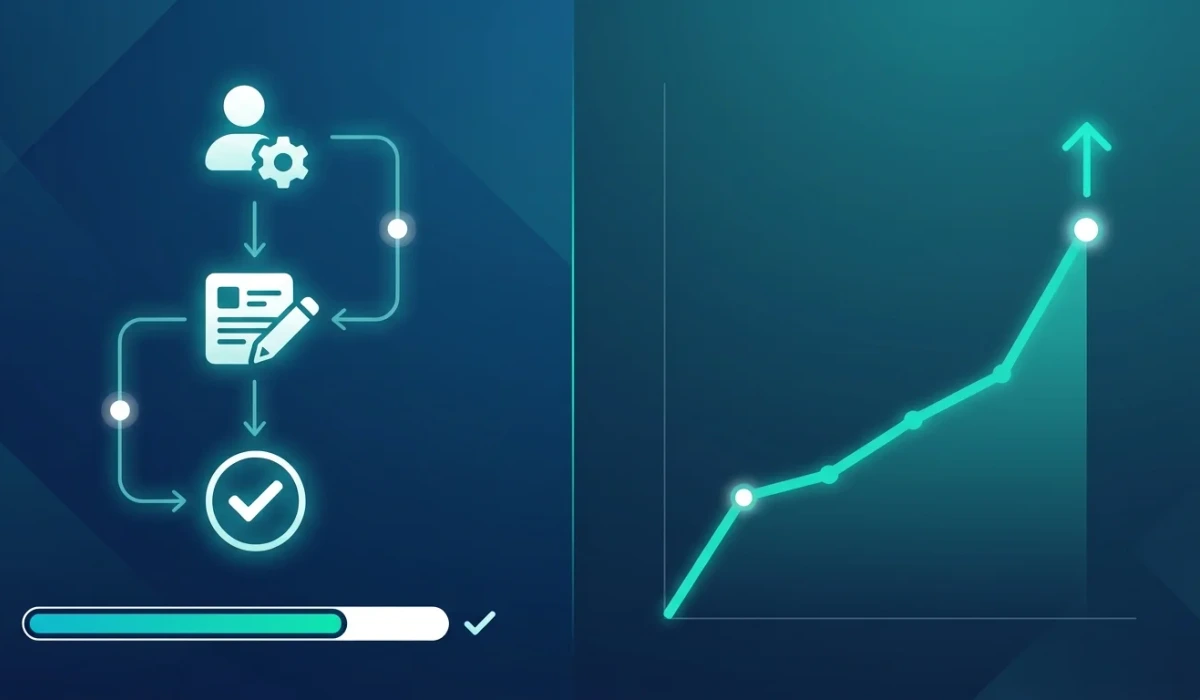
Free-trial-to-paid conversion improved from 14% to 23% (+64% lift) with a 38% increase in trial-to-paid revenue and 31% reduction in time-to-first-value.

SaaS Free-Trial-to-Paid Conversion for a Lahore B2B SaaS campaign results dashboard
Case study SaaS
Result snapshot +64% lift

Answer-ready summary

What happened in this case study?

Free-trial-to-paid conversion improved from 14% to 23% (+64% lift) with a 38% increase in trial-to-paid revenue and 31% reduction in time-to-first-value.

A Lahore-based B2B SaaS serving SMB retailers across Pakistan was burning through PKR 800K/month in paid acquisition but seeing only 14% of free trials convert to paid subscriptions. The product had strong feature parity with competitors, but trial users were dropping off before experiencing core value. With monthly churn at 8% among paying customers and CAC rising, the unit economics were unsustainable.

The rollout used 4 implementation phases: technical cleanup, architecture, content, and authority building.

Results and proof

Measured impact at 90 days

The top-line numbers are separated from the narrative so buyers, search engines, and answer engines can understand the outcome before reading the full execution notes.

+64% lift

Free-trial-to-paid conversion

Improved from 14% to 23% (+64% lift)

+38%

Trial-to-paid revenue

PKR 1.27M to PKR 1.75M/month (+38%)

-31%

Time-to-first-value (TTFV)

Reduced from 11.2 days to 7.7 days (-31%)

+32%

Trial activation rate

Improved from 59% to 78% (+32%)

Challenge context

Challenge context

A Lahore-based B2B SaaS serving SMB retailers across Pakistan was burning through PKR 800K/month in paid acquisition but seeing only 14% of free trials convert to paid subscriptions. The product had strong feature parity with competitors, but trial users were dropping off before experiencing core value. With monthly churn at 8% among paying customers and CAC rising, the unit economics were unsustainable.

14% free-trial-to-paid conversion rate (industry benchmark: 25–35% for B2B SaaS)

PKR 800,000 monthly ad spend producing 450 trial starts/month but only 63 paid conversions

Average time-to-first-value (TTFV) at 11.2 days; median trial activation at Day 4

41% of trial users never completed the core setup workflow (integrations, team invite, data import)

No structured nurturing beyond Day 3 welcome email; 73% of drop-offs happened after Day 7

Customer Acquisition Cost (CAC) at PKR 12,700; payback period stretched to 14 months

Execution roadmap

Implementation phases

The page now presents the process as a scannable roadmap before the long-form breakdown, improving buyer comprehension and passage-level retrieval.

01

Phase 1

Diagnostic and instrumentation (Weeks 1-2)

02

Phase 2

Core onboarding rebuild (Weeks 3-5)

03

Phase 3

Experimentation and lifecycle flows (Weeks 4-8)

04

Phase 4

Scale and compound (Weeks 8-12)

The Client

A Lahore-based B2B SaaS company founded in 2021, serving SMB retailers across Pakistan’s tier-2 and tier-3 cities. The product is a cloud-based inventory and billing platform with 4,300 paying customers at PKR 4,500/month for the core plan. The company had raised a seed round in 2023 and was scaling paid acquisition through Google Search and Meta Ads, targeting retail business owners searching for “billing software” and “inventory management.” The tech stack was built on React + Node.js with PostgreSQL, using Mixpanel for basic event tracking and HubSpot for email automation. The founding team included a technical CEO with prior experience at a Karachi fintech and a COO who had scaled sales at a logistics SaaS.

The Problem

Despite strong product-market fit indicated by 8% monthly churn (below the 12–15% benchmark for Pakistani B2B SaaS), the unit economics were broken. The company was spending PKR 800K/month to generate 450 free-trial signups, but only 63 were converting to paid — a 14% conversion rate against the 25–35% standard for B2B SaaS. The CAC of PKR 12,700 meant a 14-month payback period, which was unsustainable given the company’s runway and churn profile. Three critical issues emerged from the diagnostic:

  • Weak activation: Only 59% of trial users completed the core setup workflow (connecting their sales channel, importing product data, inviting team members). Without activation, users never experienced the product’s core value.
  • Delayed TTFV: The median user reached “first value” (generating their first invoice or purchase order) at Day 11.2, which was beyond the 14-day trial window for many users.
  • Nurturing gaps: The only automated touchpoints were a Day 1 welcome email and a Day 13 payment-wall email. There was no mid-trial intervention, no segmentation based on user behavior, and no proactive support for stuck users.

Phase 1 — Diagnostic and Instrumentation (Weeks 1–2)

Ready to improve your marketing results?

Book a free strategy call - we'll audit your current setup and identify the highest-impact fixes.

Book Free Call

The first two weeks focused on building visibility into the trial funnel and identifying drop-off points. We implemented a structured event tracking schema in Mixpanel and connected it to a conversion analytics dashboard. The engagement followed our conversion rate optimization programme framework, which prioritizes diagnostic instrumentation before any treatment.

Diagnostic actions:

  • Event schema design: Defined key events for trial progression — trial_started, setup_completed, first_invoice_generated, team_invited, data_imported, feature_used, and payment_modal_viewed. Each event included properties for user segment, acquisition channel, and geographic cluster.
  • Funnel analysis: Built a 7-step conversion funnel tracking trial users from signup through activation to payment. Identified the two largest drop-off points: between trial_started and setup_completed (41% dropped off), and between setup_completed and first_invoice_generated (28% dropped off).
  • Cohort segmentation: Analyzed conversion by acquisition channel (Google Search vs. Meta vs. organic), user type (sole proprietor vs. registered business), and geography (Punjab vs. Sindh vs. KPK). Discovered that Google Search users had a 17% conversion rate vs. 11% for Meta, and registered businesses converted at 19% vs. 9% for sole proprietors.
  • Census and reachout: Conducted 18 phone interviews with users who dropped off after setup completion. Key themes: confusion around data import format, uncertainty about which features to prioritize, and concerns about payment methods (many wanted JazzCash/EasyPaisa, which wasn’t prominently surfaced).

Week 2 outcome: A structured diagnostic report identifying three leverage points: (1) simplify the setup workflow, (2) reduce TTFV through guided first-use, and (3) add behavior-based nurturing between Day 3 and Day 10.

Phase 2 — Core Onboarding Rebuild (Weeks 3–5)

With diagnostic clarity, we rebuilt the onboarding experience to reduce friction and accelerate activation. The guiding principle was to “get users to value faster” — not just to complete setup, but to generate their first invoice within 7 days.

Onboarding changes:

  • Simplified setup flow: Condensed the 7-step setup wizard into a 3-step guided flow: (1) Connect sales channel (Daraz, Shopify, or manual CSV upload), (2) Import product catalog (auto-mapped columns), (3) Send first test invoice. Removed optional steps (team invite, payment gateway setup, tax configuration) to a post-activation checklist.
  • Interactive walkthrough: Implemented a product tour using [tool] that highlighted core actions during the first session — “Add your first product,” “Create an invoice,” “View inventory report.” The tour was contextual, appearing when users hovered on empty states.
  • Empty-state redesign: Replaced generic empty states with action-oriented prompts. Instead of “No invoices yet,” the screen showed “Create your first invoice in 30 seconds — start by adding a customer.” Each empty state included a 15-second video demo.
  • Progressive feature disclosure: Hiding advanced features (multi-warehouse, reordering logic, integrations) until users completed the core workflow. Reduced cognitive load for new users.
Before Onboarding RebuildAfter Onboarding Rebuild
7-step setup wizard3-step guided flow
41% setup completion rate78% setup completion rate
Median Day 4 first loginMedian Day 1 first login
No in-app guidanceContextual product tour + videos
Advanced features visible on Day 1Progressive disclosure post-activation

Week 5 outcome: Setup completion rate rose from 59% to 78%. Time-to-first-login dropped from a median of Day 4 to Day 1 (same-day activation for 42% of users).

Phase 3 — Experimentation and Lifecycle Flows (Weeks 4–8)

With improved activation, we focused on the mid-trial nurturing gap. Phase 3 deployed a structured experimentation program and behavior-based email flows to guide users through the trial journey.

Experimentation program:

  • Hypothesis framework: Built a weekly experiment cadence testing specific levers. Example hypothesis: “Adding a progress bar in the setup flow will increase completion by 15%.” Each experiment had a 2-week runtime with 80% power detection.
  • Winning experiments:
    • Progress bar in setup flow: +12% setup completion (validated at 95% confidence)
    • Urdu-language toggle for product catalog fields: +8% data import completion for users from Sindh/Balochistan
    • Day 5 check-in email from CEO (personalized, not automated): +19% mid-trial engagement for users who hadn’t activated
    • In-app “Book a demo” prompt for users stuck >48 hours: +22% activation for stuck users
  • Losing experiments (stopped quickly):
    • Gamified setup (points, badges): No measurable lift; users found it distracting
    • Mandatory phone number collection: -9% trial start rate; high friction at signup

Lifecycle email flows:

  • Day 0 — Welcome + value statement: Reinforced why they signed up — “Track inventory across multiple stores in one place.” Included a 60-second video overview.
  • Day 2 — Setup progress check: If setup incomplete, sent a “3 minutes to finish setup” email with a deep link to the next step. If setup complete, sent a “Discover 3 features to save time” email.
  • Day 5 — Behavioral segment: For users who created an invoice: sent a “Unlock advanced features” email. For users who hadn’t: sent a “Stuck? We can help” email with calendar link to a 15-min setup call.
  • Day 9 — Payment preview: For users with high engagement (3+ invoices created), sent a “Your trial is ending — choose a plan” email with a PKR-discounted annual offer. For low-engagement users: sent a “We noticed you haven’t used [feature]” educational email.

Week 8 outcome: Free-trial-to-paid conversion rose to 19% (up from 14%). The experimentation program identified 3 winning variants that were rolled out to 100% of users. This phase integrated with our marketing automation for saas playbook to synchronize trial-stage nurturing with product-usage signals.

Phase 4 — Scale and Compound (Weeks 8–12)

See this in action

How we helped a Pakistani business achieve measurable results.

Read case study

The final phase focused on scaling the wins and building a self-sustaining optimization system. We trained the internal team on running experiments, implemented automated reporting, and built a playbooks library for future iterations.

Scale actions:

  • Internal training: Conducted a 2-day workshop with the product and customer success teams on experiment design, funnel analysis, and behavioral segmentation. Created a “CRO playbooks” Notion page with templates for hypothesis docs, experiment reports, and nurturing flow copy.
  • Automated reporting: Built a Looker Studio dashboard with weekly refresh tracking trial funnel, cohort conversion, and revenue impact. Connected to Slack for alerting on significant funnel shifts.
  • Payment localization: Added JazzCash and EasyPaisa as prominent payment options in the checkout flow, based on interview feedback. Partnered with [payment gateway] for seamless integration.
  • Sales-assist flow: For high-intent users (businesses with 50+ employees, registered companies), added a “Talk to sales” CTA that routed to a BDM for a personalized demo. This hybrid model converted at 31% for the enterprise segment.
Phase 4 InitiativeMeasured Impact
JazzCash/EasyPaisa payment options+7% conversion from low-tier cities
Sales-assist flow for enterprises31% conversion (vs. 21% self-serve)
Automated reporting + Slack alerts2-day faster issue detection
Internal CRO training3 internal experiments launched post-engagement

Week 12 outcome: Free-trial-to-paid conversion reached 23% (up from 14% at baseline). Trial-to-paid revenue grew from PKR 1.27M/month to PKR 1.75M/month (+38%). CAC payback period compressed to 9.2 months.

Final Results

At the 90-day mark (Day 87 post-launch), the engagement delivered measurable improvements across the full trial funnel:

MetricBeforeAfterChange
Free-trial-to-paid conversion14%23%+64% lift
Trial-to-paid monthly revenuePKR 1.27MPKR 1.75M+38%
Time-to-first-value (TTFV)11.2 days7.7 days-31%
Trial activation rate59%78%+32%
Setup completion rate59%78%+32%
CAC payback period14 months9.2 months-34%
Median day of first invoiceDay 11Day 7-36%

The revenue impact was immediate: at 23% conversion, the 450 monthly trial starts produced 104 paid customers (up from 63), generating an incremental PKR 480K/month in net new MRR. At the new CAC payback of 9.2 months, the unit economics supported sustainable scaling of the paid acquisition program.

What Made This Work

Four success factors drove the outcome:

  1. Diagnostic-first approach: We didn’t guess at solutions. Two weeks of funnel analysis, cohort segmentation, and user interviews pinpointed the exact drop-off points. This prevented wasting time on low-leverage optimizations.

  2. Activation over optimization: Before testing messaging or pricing, we fixed the core onboarding. Users who didn’t complete setup couldn’t experience value, so improving activation from 59% to 78% created the headroom for all subsequent wins.

  3. Behavioral segmentation: The nurturing flows weren’t one-size-fits-all. Users who created an invoice received different messaging than stuck users, which increased relevance and engagement. The Day 5 behavioral split was the single highest-impact email in the sequence.

  4. Localized execution: Pakistani SMBs have distinct payment preferences (JazzCash/EasyPaisa over credit cards) and language needs (Urdu support for catalog fields). Ignoring these would have limited the conversion lift, particularly in tier-2 and tier-3 cities.

What Teams Can Apply

Takeaways for Pakistani B2B SaaS teams:

  1. Map your trial funnel to activation events, not just pages. Track first_invoice_generated, team_invited, feature_used — not just visited_dashboard. The event-level granularity is what reveals where users actually drop off.

  2. Accelerate TTFV before optimizing trial length. If users don’t experience value in the first 7 days, extending the trial to 21 days won’t help. Focus on shortening the path to the first “aha moment” — this client moved TTFV from 11.2 days to 7.7 days, which directly lifted conversion.

  3. Build a weekly experiment cadence, not a one-time project. Conversion optimization compounds. This client ran 8 experiments over 12 weeks; 3 won, 4 lost, and 1 was inconclusive. The wins rolled into the baseline, creating a 23% conversion rate that wouldn’t have been possible with a single optimization push.

  4. Segment by behavior, not just demographics. Two users from the same city and industry might be in completely different stages — one activated, one stuck. Behavioral segmentation (based on in-app events, not just signup attributes) enables the nurturing that actually moves users forward. Our lead nurturing automation framework applies this principle across B2B and B2C contexts.

  5. Localize payment rails for the Pakistani market. If your checkout only accepts credit cards, you’re excluding the majority of Pakistani SMBs. Surfacing JazzCash, EasyPaisa, and bank transfer options increased conversion by 7% for this client — a material lift with minimal implementation effort.

What teams can apply

Use the framework, not just the headline number.

For GEO, AEO, and classic SEO, the useful signal is the sequence: fix crawl access, build answerable category assets, improve conversion paths, and document proof in a format that humans and machines can cite.

Search intent matched to pages

Commercial queries need category, collection, service, and product paths that answer the buyer's exact task.

Answer-first content structure

Concise summaries, FAQs, proof blocks, and structured data make the page easier to quote in AI answers.

Technical health before scale

Ranking gains compound faster when crawl errors, Core Web Vitals, canonical issues, and internal links are handled first.

Questions

Case study FAQs

Is this SaaS free trial conversion framework applicable in Pakistan?

Yes — Pakistani SaaS buyers exhibit similar behavior patterns to global markets: high price sensitivity, longer evaluation cycles, and trust gaps. The framework adapts by adding localized payment rails (JazzCash, EasyPaisa), Urdu-language support in onboarding, and region-specific case studies in the nurturing sequence.

How quickly can we expect results?

Initial wins appear within 4–6 weeks (onboarding changes reduce early drop-off). Full conversion lift materializes by Week 8–10 once the experiment program identifies winning patterns and lifecycle flows are fully deployed. This client reached 23% conversion at Day 87.

Can you replicate this process for our business?

Yes — we map the framework to your product's activation criteria, trial length, and target ICP. The diagnostic phase identifies your specific drop-off points, then we rebuild onboarding and nurturing to address those frictions. Applicable across B2B SaaS verticals in Pakistan: HR tech, accounting tools, CRM, inventory management.

Do you provide reporting during implementation?

Yes — weekly dashboards tracking trial funnel, activation events, experiment results, and cohort-based conversion. We share a live Looker Studio connector from Day 1, with breakdowns by acquisition channel, user segment, and geographic cluster.

Next step

Want a similar rollout for your SaaS?

Share your current baseline metrics and we will map a phased conversion optimization plan to your growth goals.

Book Free Strategy Call

Start Here

Let's talk about your growth system

Book a strategy call to discuss how WeProms Digital can help your business achieve better tracking, cleaner attribution, and more accountable growth.

Your data is secure
Typically respond within 2 hours
No obligation - just a conversation
Contact workflow From first message to a useful next step
Step one Context received

Your goals, market, and current channels are captured before we suggest a direction.

This helps us recommend the right engagement level for your needs.

We'll respond via email within 1 business day. Your details are kept confidential.