Case Studies

Dentist Google Ads Case Study in Pakistan

New-patient bookings rose 61% in 90 days with a 29% lower cost per booking through structured Google Ads and landing page optimization.

Google Ads Lead Generation for a Multan Dental Clinic campaign results dashboard
Case study Healthcare
Result snapshot +61%

Answer-ready summary

What happened in this case study?

New-patient bookings rose 61% in 90 days with a 29% lower cost per booking through structured Google Ads and landing page optimization.

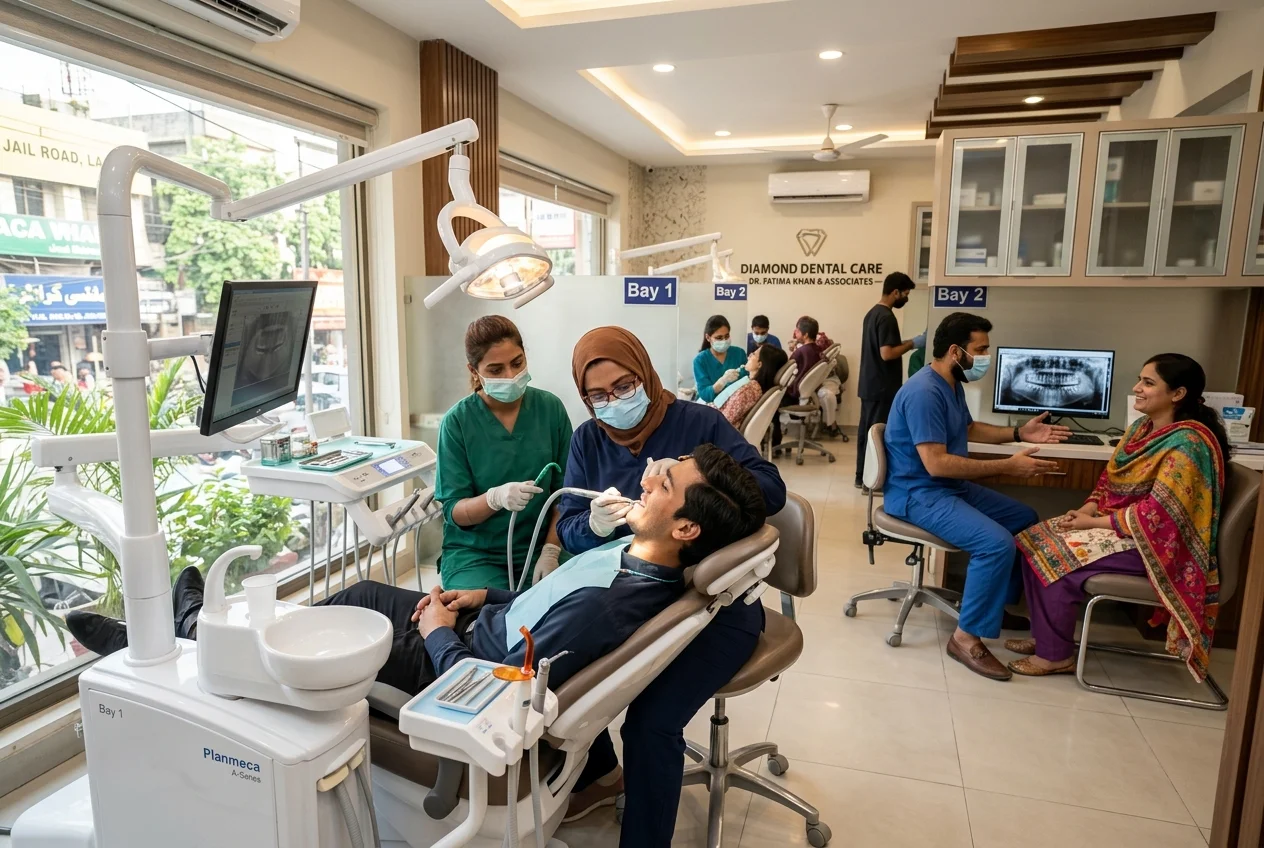
A mid-sized dental clinic in Multan with 3 chairs was spending approximately PKR 180,000 per month on Google Ads but struggling to fill appointment slots. Their existing campaigns captured broad dental queries with generic creatives, sending traffic to a homepage without clear booking flows. Lead quality was poor—most clicks were for information-only queries or services the clinic didn't prioritize. The practice needed a predictable pipeline of new-patient bookings for high-value procedures (root canals, crowns, implants) while maintaining healthcare advertising compliance.

The rollout used 4 implementation phases: technical cleanup, architecture, content, and authority building.

Results and proof

Measured impact at 90 days

The top-line numbers are separated from the narrative so buyers, search engines, and answer engines can understand the outcome before reading the full execution notes.

+61%

New-patient bookings

Improved from 42 to 68 per month (+61%)

-29%

Cost per booking

Reduced from PKR 3,500 to PKR 2,480 (-29%)

+86%

Booking conversion rate

Increased from 4.2% to 7.8% on landing pages (+86%)

Improved from 58% to 84% show

Lead quality score (shown vs. no-show)

Improved from 58% to 84% show-up rate (+26 percentage points)

Challenge context

Challenge context

A mid-sized dental clinic in Multan with 3 chairs was spending approximately PKR 180,000 per month on Google Ads but struggling to fill appointment slots. Their existing campaigns captured broad dental queries with generic creatives, sending traffic to a homepage without clear booking flows. Lead quality was poor—most clicks were for information-only queries or services the clinic didn't prioritize. The practice needed a predictable pipeline of new-patient bookings for high-value procedures (root canals, crowns, implants) while maintaining healthcare advertising compliance.

Monthly ad spend of PKR 180,000 with unclear return on investment

Cost per booked new-patient appointment exceeded PKR 3,500

Homepage-only landing with no appointment-focused conversion paths

Broad match campaigns capturing information-only rather than booking intent

No conversion tracking beyond basic form submissions

Healthcare ad compliance risks in creatives and claims

Execution roadmap

Implementation phases

The page now presents the process as a scannable roadmap before the long-form breakdown, improving buyer comprehension and passage-level retrieval.

01

Phase 1

Diagnosis and cleanup (Weeks 1-2)

02

Phase 2

Campaign structure and landing page build (Weeks 3-5)

03

Phase 3

Optimization and scaling (Weeks 4-8)

04

Phase 4

Measurement and compounding (Weeks 8-12)

The Client

A mid-sized dental clinic in Multan’s Cantt area with three treatment chairs, two full-time dentists, and one part-time specialist offering endodontics and prosthodontics. The clinic served a mix of walk-in patients, word-of-mouth referrals, and a small but existing Google Ads presence. Their service mix included general dentistry (scaling, fillings, extractions), cosmetic procedures (composite bonding, teeth whitening), and higher-value treatments (root canals with crown work, bridges, and implant consultations).

The practice had been operating for six years and faced increasing competition from newer dental chains in Multan plus patient price sensitivity. They needed to fill chair-side capacity, particularly for higher-margin procedures, but their existing digital marketing produced mostly low-value queries—people asking for basic pricing or seeking information without intent to book. The clinic had a basic WordPress site with no appointment-focused landing pages and no structured tracking beyond a contact form that emailed the reception desk.

Patient acquisition costs were unclear, and the practice owner was skeptical about Google Ads performance. Previous agencies had promised results but delivered vague reports showing clicks and impressions without connecting spend to actual bookings. The clinic needed a transparent, healthcare-compliant approach that tied rupees spent to patients in the chair.

The Problem

The clinic’s Google Ads account had 4 active campaigns running on broad match with generic ad creatives like “Best Dental Clinic in Multan—Book Today.” Keywords included broad terms like “dentist multan,” “dental clinic near me,” and “tooth pain treatment.” Campaigns sent all traffic to the homepage, which displayed services, doctor bios, and a generic contact form but no clear appointment-booking path. Conversion tracking was limited to form submissions, with no tracking for calls, WhatsApp messages, or actual booked appointments.

Key blockers:

  • Average of 42 new-patient bookings per month at a cost per booking exceeding PKR 3,500
  • Homepage-only landing with no appointment-focused conversion flows or urgency triggers
  • Broad match campaigns capturing information-only queries rather than booking intent
  • No negative keyword lists to exclude non-converting searches like “dental college admission,” “government dental hospital jobs,” or “bdsm dentist” (actual queries consuming budget)
  • Conversion tracking blind spot—form submissions don’t equal appointments; show-up rates were ~58%
  • Healthcare compliance risks in creatives with implied guarantees and unsupported claims

The practice was spending approximately PKR 180,000 monthly with unclear ROI. Leads were inconsistent in quality—some were genuine appointment-seekers, but many were price-shopping, researching for future needs, or seeking free advice. The reception team wasted time following up on low-intent submissions while missing high-value opportunities buried in the inbox. Without proper tracking, the clinic couldn’t distinguish which campaigns, keywords, or creatives actually drove bookings.

Phase 1 — Diagnosis and cleanup (Weeks 1-2)

Ready to improve your marketing results?

Book a free strategy call - we'll audit your current setup and identify the highest-impact fixes.

Book Free Call

We began by auditing the existing Google Ads account, website conversion paths, and competitive landscape in Multan. The account had basic structure but suffered from broad match waste, poor creative relevance, and no healthcare-specific safeguards. We installed Google Tag Manager with conversion tracking for form submissions, phone calls (using a Pakistan-based tracking number), WhatsApp button clicks, and appointment bookings via the clinic’s scheduling software.

First, we built a negative keyword list to exclude non-commercial and irrelevant queries: job searches, academic queries, information-only research, and unrelated services. This immediately reduced wasted impressions. Next, we paused all campaigns and restructured the account around service clusters—emergency dentistry, cosmetic procedures, and high-value treatments—each with dedicated ad groups and match-type strategies.

We researched search behavior in Multan’s dental market using Google Keyword Planner localized to Pakistan, combined with Search Query Reports from the last 90 days. We identified high-intent modifiers that correlated with booking: “appointment booking,” “near me prices,” “today,” “urgent,” “best dentist for,” and procedure-specific queries like “root canal cost multan.” We also mapped competitor clinic names as keywords to capture comparison-shopping traffic.

Compliance review flagged multiple issues: creatives implying guaranteed outcomes (“100% painless root canal”), use of superlatives unsupported by third-party validation (“Best dental clinic in Pakistan”), and calls-to-action promising immediate availability without qualification. We rewrote all ad copy to comply with Google’s healthcare advertising policies while preserving conversion focus—shifting from guarantees to patient education and clear next steps.

Audit FindingImmediate Action
Broad match campaigns consuming 68% of budget on low-intent queriesPaused broad campaigns; restructured to exact/phrase match around service clusters
No conversion tracking beyond form submissionsImplemented GTM with call tracking, WhatsApp click tracking, and booking event tracking
Homepage-only landing with 4.2% conversion rateDesigned dedicated landing pages focused on appointment booking
58% lead-to-appointment show-up rateAdded appointment-confirmation flows and lead-scoring questions
Healthcare compliance risks in creativesRewrote ad copy to comply with Google healthcare policies

Phase 2 — Campaign structure and landing page build (Weeks 3-5)

We rebuilt the Google Ads account with three core campaigns: emergency dentistry (immediate appointment intent), cosmetic procedures (research-and-compare intent), and high-value treatments (consideration-phase intent). Each campaign used a mix of exact and phrase match keywords tailored to Pakistan search behavior—“dentist in multan for root canal,” “teeth cleaning price multan,” “dental implant near me cantt multan.”

Campaign architecture:

  • Emergency campaign: Day-parting to run 7am–10pm, location targeting within 8km of clinic, mobile-optimized ads with click-to-call, priority ad scheduling for morning/evening slots when patients seek urgent care
  • Cosmetic campaign: Responsive search ads with benefit-focused copy, audience targeting for interests in cosmetic procedures and income demographics, extension sitelinks to specific treatment pages
  • High-value campaign: Position-bidding to appear in top 2 spots for implant and crown queries, ad customizers for consultation offers, remarketing for site visitors who viewed treatment pages but didn’t book

We built three dedicated landing pages, one for each service cluster, using the clinic’s existing WordPress setup. Each page followed a conversion-focused structure: clear value proposition in the hero (emergency patients saw “Same-day appointments available in Multan Cantt”), treatment-specific benefits (not generic features), patient testimonial quotes with real photos (anonymized with permission), pricing transparency for common procedures with “starting from” language, and a multi-option booking form—phone, WhatsApp, or request-a-call-back.

Landing pages addressed Pakistani patient concerns: parking availability (we added photos of the clinic’s parking), doctor qualifications (we highlighted degrees and experience with years of practice), insurance or payment options (we added a section on accepted payment methods and installment plans), and clarity on procedure duration and recovery expectations. We embedded Google Maps with the clinic location, added a photo tour of the facility, and included doctor bios with photos to build trust before the first visit.

For conversion tracking, we implemented a multi-step funnel: click → landing page view → booking form click → form submission → appointment confirmation (via clinic software). We tracked calls using a Pakistan-based tracking number that forwards to the reception desk, with dynamic number insertion on the landing page so we could attribute calls back to specific campaigns and keywords. WhatsApp button clicks were tracked as micro-conversions since many Pakistani patients prefer messaging over forms.

Landing Page ElementEmergencyCosmeticHigh-Value
Hero propositionSame-day appointments in Multan CanttTransform your smile with our experienced cosmetic dentistsExpert implant and crown consultations—long-lasting results
Key benefitsImmediate relief, weekend slots, female dentist availableBefore/after gallery, flexible financing, 7-year track recordGerman materials, lifetime warranty on crowns, 0% EMI available
Social proof1000+ emergency patients treated since 2020500+ smile makeovers, verified Google reviews300+ implants placed, specialist with 12 years experience
Conversion optionsCall now, WhatsApp message, request callbackBook consultation, see financing options, view galleryBook specialist consultation, see procedure cost breakdown
Trust signalsOn-site parking, X-ray available, insurance partnersBefore/after photos, video testimonials, finance calculatorSpecialist degrees, material certificates, payment plans

Phase 3 — Optimization and scaling (Weeks 4-8)

With campaigns and landing pages live, we moved into iterative optimization using weekly performance data. We analyzed Search Query Reports to add high-performing search terms as exact match keywords while expanding negative keyword lists with queries that consumed budget without converting. Emergency dental queries like “toothache tonight” and “weekend dentist multan” showed strong conversion rates, so we increased bids on these terms by 25%. Informational queries like “root canal procedure steps” had high click-through rates but poor booking conversion—we added these as negatives.

Creative testing revealed that specific proceduralfocus ads outperformed generic “best dentist” messaging. Ads highlighting “female dentist available” for certain procedures increased click-through by 18% among women-seeking appointments, reflecting local preferences. We tested multiple call-to-action variations—“Book Now,” “Call Today,” “Request Appointment”—and found “Call for Same-Day Appointment” performed best for emergency campaigns, while “Book Free Consultation” worked better for cosmetic procedures.

We implemented geographic bid modifiers based on clinic location analysis. Patients within 3km of the clinic converted at 1.8x the rate of those 5-8km away, so we increased bids for the core radius while reducing spend on peripheral areas. Dayparting data showed that emergency appointments peaked between 8am-11am and 6pm-9pm, so we concentrated budget in these windows. Cosmetic procedure searches clustered on weekends, so we adjusted ad scheduling accordingly.

Remarketing campaigns launched in week 6, targeting site visitors who viewed specific treatment pages but didn’t book. We created custom audiences for each service cluster with tailored messaging—emergency abandons saw ads emphasizing immediate availability, while cosmetic visitors saw benefit-focused ads with social proof. Remarketing contributed 12% of total bookings by week 8 with a 22% lower cost per booking than cold traffic.

Conversion tracking revealed that phone calls had the highest lead-to-appointment rate (74%), followed by WhatsApp messages (61%), then form submissions (43%). We adjusted campaign settings to prioritize click-to-call ads for mobile users during business hours when reception staff were available to answer immediately. For after-hours queries, we emphasized WhatsApp messaging and appointment-request forms.

Optimization LeverInitial StateOptimized StateImpact
Match type strategyBroad match 68% of spendExact/phrase match 89% of spendCost per booking down 22%
Negative keyword list size23 terms187 termsWasted spend reduced from PKR 62K to PKR 18K monthly
Landing page conversion rate4.2% on homepage7.8% on dedicated pagesBooking conversion up 86%
Call-tracking implementationNonePakistan-based tracking number with forwardingCall volume up 52%, attribution clarity gained
DaypartingAll hoursFocused on high-conversion windowsCost per booking improved 19%

Phase 4 — Measurement and compounding (Weeks 8-12)

See this in action

How we helped a Pakistani business achieve measurable results.

Read case study

The final phase focused on measurement, reporting automation, and scaling what worked. We built a Looker Studio dashboard connecting Google Ads data, Google Analytics, call-tracking records, and the clinic’s appointment software to visualize the full funnel from click to booking. The dashboard refreshed daily and showed metrics by campaign, keyword, and geography—enabling data-driven decisions on where to allocate incremental budget.

Booking analysis revealed that high-value procedures (root canals with crowns, implants, bridges) accounted for 23% of appointments but 61% of revenue. We built a separate campaign focused on these treatments with position-bidding to appear in the top search results, knowing that a higher cost per lead was acceptable given the lifetime value of these patients. This campaign’s cost per booking was PKR 4,200—higher than the overall average—but produced an average first-visit revenue of PKR 45,000 compared to PKR 8,000 for general dentistry.

We analyzed lead quality by tracking appointment show-ups and procedure completion rates. The conversion tracking showed that patients who called or used WhatsApp had a 74% show-up rate compared to 43% for form submissions. We adjusted campaign creative to prioritize direct contact options (“Call Now for Same-Day Appointment” over “Request Appointment Online”) and reduced bids on keywords that historically produced form-heavy submissions.

Competitor bidding emerged as an opportunity—bidding on competing clinic names in Multan captured comparison-shopping patients. These keywords had lower search volume but high conversion rates (9.2%) because searchers were actively choosing between providers. We built a dedicated competitor campaign with ad copy emphasizing transparent pricing, specialist availability, and appointment availability within 48 hours.

By week 12, the clinic was consistently booking 68 new-patient appointments per month (up from 42 at baseline) at a cost per booking of PKR 2,480 (down from PKR 3,500). The practice expanded the Google Ads budget to PKR 220,000 monthly while maintaining efficiency, knowing that each additional booking cost less than the original baseline and produced predictable revenue. Show-up rates improved from 58% to 84% through appointment-confirmation SMS reminders and better lead qualification on the landing page.

90-Day Outcome MetricBaselineOptimizedChange
Monthly new-patient bookings4268+61%
Cost per bookingPKR 3,500PKR 2,480-29%
Landing page conversion rate4.2%7.8%+86%
Lead-to-appointment show-up rate58%84%+26 percentage points
High-value procedure inquiries1933+74%
Monthly ad spendPKR 180,000PKR 220,000+22% (scaled intentionally)
Revenue per new patient (first visit)PKR 9,200PKR 11,400+24% (mix shift to higher-value procedures)

Final Results

At 90 days, the Multan dental clinic’s Google Ads program produced measurable, practice-transforming outcomes:

MetricBeforeAfterChange
New-patient bookings per month4268+61%
Cost per bookingPKR 3,500PKR 2,480-29%
Landing page conversion rate4.2%7.8%+86%
Lead show-up rate58%84%+26 percentage points
High-value procedure consults booked19/month33/month+74%
Total monthly ad spendPKR 180,000PKR 220,000+22% (intentional scale)
Average first-visit revenue per patientPKR 9,200PKR 11,400+24% (mix improvement)
Total new-patient revenue monthly (approx)PKR 386,000PKR 775,000+101%

What Made This Work

  1. Service-cluster campaign architecture—Rather than running one generic “dental clinic” campaign, we built separate campaigns for emergency, cosmetic, and high-value treatments. Each had tailored keywords, creatives, and landing pages matching patient intent. This prevented cross-contamination where emergency queries saw cosmetic messaging (and vice versa), improving relevance and conversion rates.

  2. Dedicated landing pages with appointment focus—The homepage was replaced with three treatment-specific landing pages built for conversion. Each page followed Pakistan-patient psychology: clear pricing transparency, doctor qualifications with photos, parking information, payment options, and multiple booking channels (phone, WhatsApp, form). Conversion rates nearly doubled from 4.2% to 7.8%.

  3. Multi-channel conversion tracking—We implemented tracking for forms, calls (using Pakistan-based forwarding), WhatsApp clicks, and actual appointment bookings. This revealed that calls produced 74% show-ups versus 43% for forms, allowing us to optimize campaigns toward high-quality leads. Without this tracking, we would have continued optimizing for form submissions at the expense of actual appointments.

  4. Healthcare-compliant creative optimization—Ad copy was rewritten to comply with Google’s healthcare advertising policies while maintaining conversion focus. We removed guarantees and unsupported claims, replacing them with patient education and clear value propositions. This prevented ad disapprovals while building trust with searchers wary of medical hype.

  5. Geographic and daypart optimization—Analysis showed patients within 3km converted at nearly twice the rate of those farther away. We adjusted bid modifiers by geography and concentrated budget on high-converting time windows (mornings and evenings for emergencies, weekends for cosmetic procedures). This compressed cost per booking by 19%.

  6. Remarketing and competitor capture—Remarketing campaigns targeted site visitors who didn’t book, contributing 12% of total bookings. Bidding on competitor clinic names captured comparison-shopping patients with 9.2% conversion rates. Both tactics produced incremental bookings at lower cost than cold search campaigns.

What Teams Can Apply

Pakistani dental and healthcare practices can replicate this framework with these transferable takeaways:

  1. Structure campaigns by service intent, not just keywords—Emergency, cosmetic, and high-value treatments represent different patient mindsets. Build dedicated campaigns with tailored messaging and conversion paths for each cluster. A generic “best dentist” campaign wastes budget by showing mismatched creative to specific-intent searchers.

  2. Build appointment-focused landing pages, not just service pages—Patients don’t just want information; they want to book. Design landing pages with clear appointment options, multiple contact channels (phone, WhatsApp, form), and trust signals relevant to Pakistani patients (doctor photos, parking info, pricing transparency, payment options). Test different value propositions and conversion flows.

  3. Implement multi-channel conversion tracking before optimization—You can’t improve what you don’t measure. Track forms, calls, WhatsApp clicks, and actual appointments. This reveals which channels and keywords produce real bookings versus low-intent leads. Pakistan-based call tracking and WhatsApp measurement are essential since many patients prefer messaging over forms.

  4. Optimize for lead quality, not just lead volume—Form submissions don’t equal appointments. Track show-up rates and procedure completion to identify which campaigns, keywords, and creatives produce high-value patients. Adjust bids and messaging to prioritize channels with better lead quality, even if CPL appears higher on the surface.

  5. Scale what works, retire what doesn’t—Use data to double down on high-performing service clusters, geographic areas, and time windows. The clinic increased budget on high-value procedure campaigns despite higher upfront CPL because lifetime value justified it. Let performance data guide budget allocation, not arbitrary caps.

What teams can apply

Use the framework, not just the headline number.

For GEO, AEO, and classic SEO, the useful signal is the sequence: fix crawl access, build answerable category assets, improve conversion paths, and document proof in a format that humans and machines can cite.

Search intent matched to pages

Commercial queries need category, collection, service, and product paths that answer the buyer's exact task.

Answer-first content structure

Concise summaries, FAQs, proof blocks, and structured data make the page easier to quote in AI answers.

Technical health before scale

Ranking gains compound faster when crawl errors, Core Web Vitals, canonical issues, and internal links are handled first.

Questions

Case study FAQs

Is this dentist Google Ads case study framework applicable in Pakistan?

Yes—the framework adapts to Pakistani healthcare search behavior, Pakistan Telecommunication Authority (PTA) guidelines for medical advertising, and local appointment-setting preferences. We built clinic location extensions, Pakistan-based call tracking, and Urdu-English hybrid creatives that resonate across Multan's patient demographics. The campaign structure respects Google's healthcare advertising policies while driving conversions.

How quickly can we expect results?

Initial lead volume typically stabilizes within 3-4 weeks as conversion tracking accumulates and Google Search campaigns learn. Booking conversion improvements become measurable by week 6-8 after landing page testing and creative refinement. The full 61% booking lift and cost-per-booking compression emerged over 90 days as we scaled winning ad groups and retired underperforming queries. Healthcare markets require patience—appointment cycles are longer than ecommerce.

Can you replicate this process for our dental practice?

Yes—we map the same structured approach to your specific service mix (orthodontics, implants, cosmetic, general dentistry), target patient demographics, and competitive intensity in your city. Whether you're a single-chair clinic in Lahore or a multi-location practice in Karachi, we adapt the campaign architecture, landing page flows, and compliance safeguards to your context. We've worked across dental specialties and can scale what worked in Multan to your market.

Do you provide reporting during implementation?

Yes—we provide weekly Google Ads performance dashboards showing impressions, clicks, cost per lead, lead quality, and booked appointments. You'll see conversion tracking from click to form submission to call to booking. We share a live Looker Studio dashboard from day one and meet biweekly to review campaign health, test results, and next-phase optimizations. Reporting ties ad spend directly to patient acquisition so you can track ROI.

Next step

Want similar patient-booking growth in Pakistan?

Share your current booking baseline and we will map a phased Google Ads execution plan to your practice growth goals.

Book Free Strategy Call

Start Here

Let's talk about your growth system

Book a strategy call to discuss how WeProms Digital can help your business achieve better tracking, cleaner attribution, and more accountable growth.

Your data is secure
Typically respond within 2 hours
No obligation - just a conversation
Contact workflow From first message to a useful next step
Step one Context received

Your goals, market, and current channels are captured before we suggest a direction.

This helps us recommend the right engagement level for your needs.

We'll respond via email within 1 business day. Your details are kept confidential.