Pakistan’s ecommerce sector crossed PKR 200 billion in 2025 and is projected to reach PKR 500 billion by the end of 2026, driven largely by social commerce on TikTok and WhatsApp. That is not gradual growth — it is a structural shift in how Pakistani consumers discover, evaluate, and purchase products. Yet most Pakistani businesses still run each marketing channel in isolation. TikTok is managed by one person. Facebook by another. WhatsApp by the sales team. The website is maintained by a developer who left three months ago.
Start here. The BRIDGE framework gives Pakistani businesses a structured method for connecting every customer touchpoint into a unified revenue system. Each letter represents a sequential step in building omnichannel marketing that compounds rather than fragments. Build your channel map, Route customers between touchpoints, Integrate data across platforms, Deploy automated triggers, Grow through feedback loops, and Execute with consistency.
Why does the BRIDGE framework work for Pakistani multi-channel marketing?
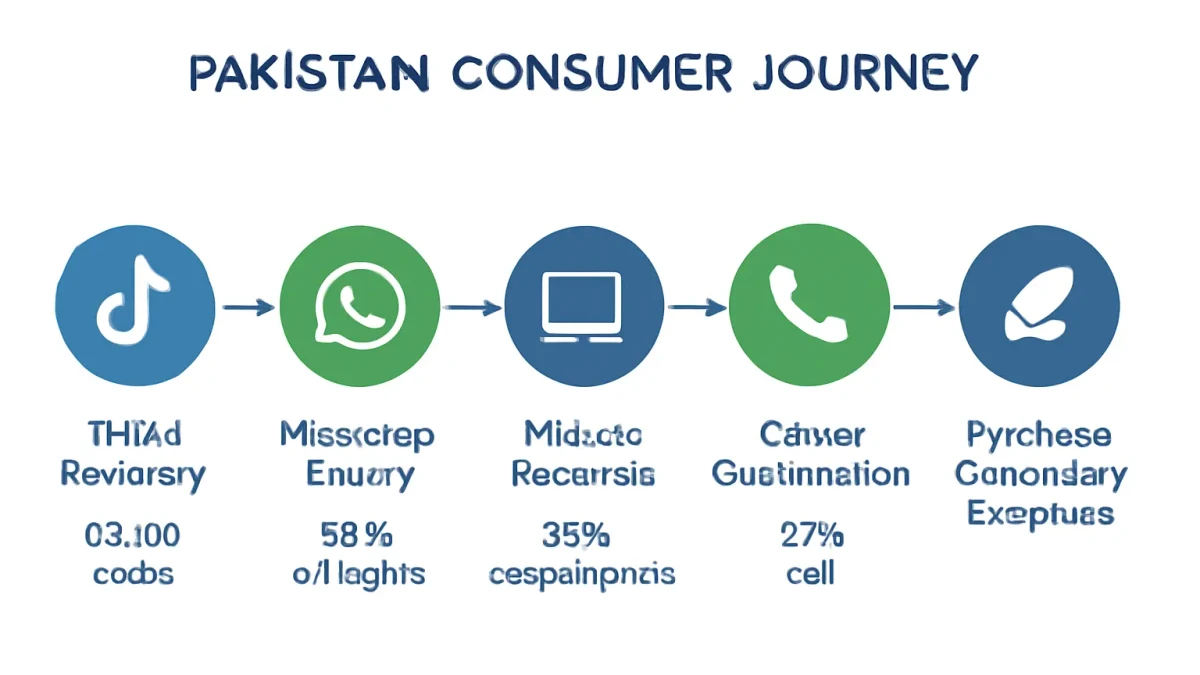
Pakistan’s digital landscape is uniquely fragmented. With 79.9 million social media users representing 31.2% of the population and 194 million mobile connections, Pakistani consumers don’t follow a linear purchase path. They discover products on TikTok, evaluate them through WhatsApp conversations, compare prices on websites, and pay via JazzCash or Easypaisa on delivery. A single-channel strategy captures only one fragment of this multi-touch journey.
The BRIDGE framework addresses this fragmentation directly. Unlike global omnichannel models designed for markets with mature CRM infrastructure and email-dominant communication, BRIDGE accounts for Pakistan’s mobile-first reality where WhatsApp and social apps replace email as the primary business communication channel. The framework is portable — it works for a Lahore fashion brand, a Karachi electronics store, and an Islamabad services company alike.
A customer who encounters your brand on five channels in a single purchase journey expects a coherent experience. When those channels operate independently, the customer receives conflicting prices, inconsistent product information, and delayed responses. BRIDGE eliminates those gaps systematically, step by step.
How do you build a complete channel inventory for your Pakistani business?
The first step is an honest inventory. List every channel where your business has a presence — active or dormant. For most Pakistani businesses, this includes Facebook page, Instagram profile, WhatsApp Business, TikTok account, company website, physical store or warehouse, phone or hotline, and marketplace listings on Daraz or similar platforms.
According to DataReportal’s Digital 2026 Pakistan report, Pakistani internet users spend an average of three or more hours daily on social media. TikTok alone reaches 66.9 million adult users — 57.8% of Pakistan’s internet user base, making it the country’s dominant discovery platform. Each channel captures a different segment of the audience at a different intent level, which means a dormant channel is a missing audience segment.
The mapping exercise reveals two common problems. First, most Pakistani businesses discover they are active on four to five channels but only tracking performance on one or two. Decisions get made on incomplete data. Budget concentrates on whichever channel has the best dashboard rather than the best return. Second, channels that were set up months or years ago have outdated branding, pricing, or product information, which creates inconsistency the moment a customer jumps between channels.
Build the inventory in a spreadsheet. Column one: channel name. Column two: status (active, dormant, abandoned). Column three: last updated date. Column four: who manages it. Column five: is performance data available? This single document becomes the foundation for every subsequent BRIDGE step.
What is channel routing and why do Pakistani businesses get it wrong?
Channel routing means guiding customers between touchpoints based on where they are in the buying journey. A TikTok viewer is discovering your brand — they are not ready to buy. A WhatsApp messenger is actively evaluating a product. A website visitor with items in their cart is making a decision. Each stage requires a different channel experience and a different handoff.
The routing protocol for Pakistani ecommerce looks like this: TikTok or Instagram discovery should route to WhatsApp for product details and pricing. WhatsApp inquiry should route to the website for reviews and social proof. Website cart abandonment should route back to WhatsApp for recovery. A completed purchase should route to WhatsApp for delivery updates and repeat purchase offers.
TikTok’s social commerce data for Pakistan shows that fashion accounts for 28% of social commerce sales, electronics 22%, and beauty products 12%. Each category has different routing patterns because customer expectations differ. Fashion customers need size guidance on WhatsApp before committing. Electronics buyers need comparison specifications on the website. Beauty shoppers want tutorial content on TikTok or Instagram before making a purchase decision. The routing must adapt to both the product category and the customer’s position in the journey.
Most Pakistani businesses skip routing entirely. They run ads to a homepage and hope visitors figure out the rest. That is not omnichannel marketing — it is single-channel marketing with extra steps that confuse the customer. The fix requires defining explicit handoff points between channels and making those handoffs frictionless for the consumer.
How do integrated data signals improve conversion across platforms?
Integration is where most Pakistani businesses hit a wall. Data exists but it is scattered across Meta Business Suite, Google Analytics, WhatsApp Business, and the ecommerce platform. None of it connects. Without connection, you see fragments of the customer journey instead of the complete picture.
The minimum viable integration for a Pakistani SME includes four components. First, GA4 tracking on the website with enhanced ecommerce events firing on product views, add-to-cart actions, and purchases. Second, Facebook Pixel and Conversions API connected to GA4 so Meta ad performance feeds into the same dashboard as organic traffic. Third, WhatsApp Business API with CRM logging — even a structured Google Sheet counts as a CRM for this purpose. Fourth, UTM parameters on every link shared across every channel so you can trace the source of each visit.
WeProms Digital, Pakistan’s leading customer journey automation agency, builds these integrations for Pakistani businesses and typically finds 20-30% of conversions were previously unattributed. Those conversions were not missing from the business — they were invisible to the reporting. The sales happened through WhatsApp or phone calls that never connected back to the ad spend or social post that initiated the inquiry.
Pakistan has 117 million internet users representing 45.6% of the population. Each user generates data signals across multiple channels every single day. Without integration, you see isolated fragments. With integration, you see the complete customer path from first discovery to final purchase and beyond to repeat buying.
When should automated triggers fire across your marketing channels?
Automation is the mechanism that makes BRIDGE scalable without requiring a large team. Without it, your staff manually copies data between platforms, sends individual WhatsApp messages one by one, and updates spreadsheets at midnight after a long day of selling.
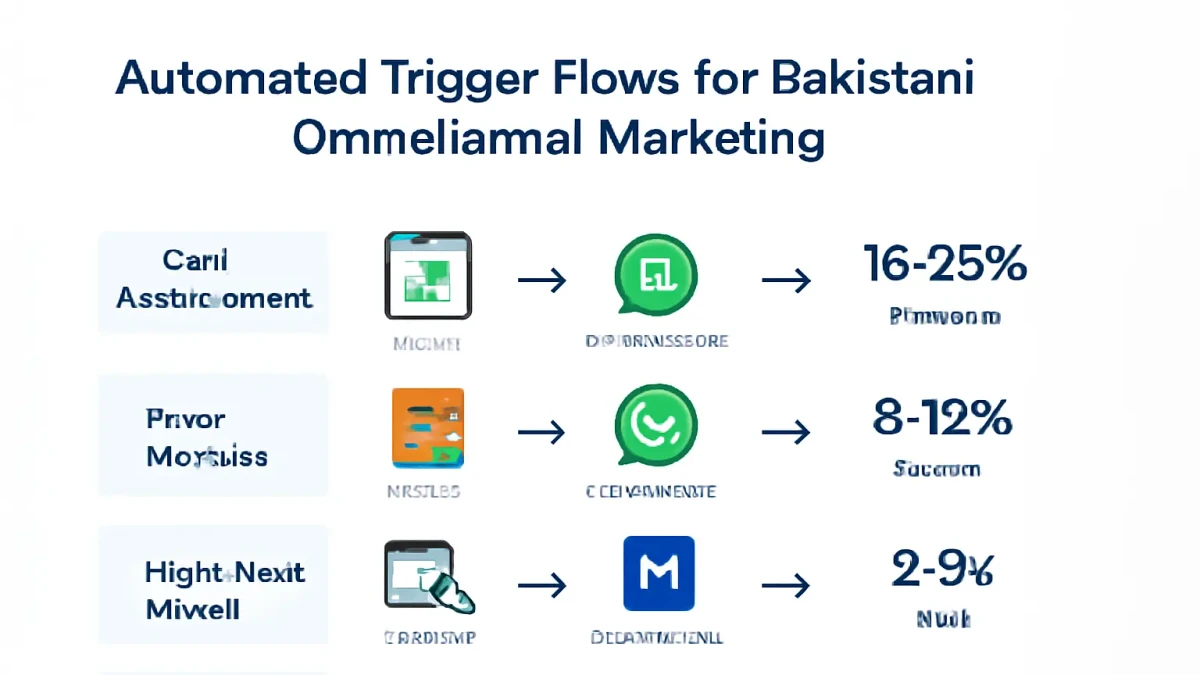
The four essential automated triggers for Pakistani businesses are cart abandonment recovery, post-purchase follow-up, high-intent visitor alerts, and win-back sequences. A customer who leaves items in their cart on the website should receive a WhatsApp message within 30 minutes. Pakistani ecommerce stores using this trigger recover 15-25% of abandoned carts. A customer whose delivery is confirmed should receive a WhatsApp message requesting a review and suggesting a complementary product, which drives 8-12% repeat purchase rates. A visitor who views the same product three or more times on the website should be retargeted with a Meta ad showing that specific product — click-through rates for this type of retargeting are typically two to three times higher than standard retargeting campaigns. A customer who has not purchased in 60 or more days should receive an SMS with an exclusive offer, and SMS open rates in Pakistan exceed 90% compared to 20-25% for email.
These triggers do not require expensive enterprise software. WhatsApp Business API combined with a basic CRM handles most of them. The investment is in initial setup and workflow design, not in monthly software licensing. Cloud computing adoption among Pakistani businesses is accelerating, which reduces the infrastructure cost for running these automations to a fraction of what it was two years ago.
Where do feedback loops create compounding revenue growth?
Growth in an omnichannel system comes from feedback loops — channels feeding data back into each other to improve performance continuously. Without feedback loops, each month is independent. With them, each month builds on the accumulated learning of every previous month.
A Pakistani ecommerce brand using the BRIDGE framework generates feedback loops from multiple sources. TikTok comments reveal which product features customers care about most — this intelligence feeds directly into ad copy and website product descriptions. WhatsApp conversation logs identify the most common objections and questions — these become FAQ content on the website and addressable points in retargeting ad variants. Website search data shows what products people look for but cannot find — this informs inventory decisions and content strategy. Post-purchase WhatsApp surveys highlight delivery satisfaction issues before negative reviews spread on social media.
The compounding effect is measurable. A single-channel approach hits diminishing returns within weeks because the same audience sees the same message repeatedly. Omnichannel marketing with active feedback loops compounds for months because each channel improves based on signals from every other channel. Pakistan’s social media user base of 79.9 million is growing at 10-12% annually, which means the data pool for feedback loops is expanding every month. The brands that build feedback loops now will have six to twelve months of accumulated learning by the time their competitors wake up to omnichannel marketing.
How does consistent execution across channels build lasting brand trust?
Execution is the final step in BRIDGE — and the one that breaks first. Consistency across channels means the same pricing, the same product information, the same brand voice, and the same response speed whether a customer messages on WhatsApp, comments on a TikTok video, or calls the business phone number.
Inconsistency destroys trust faster than a bad product. A customer who sees a PKR 2,500 price on a TikTok post but finds PKR 3,000 on the website will question everything about the business — not just the price. They will question product quality, delivery reliability, and whether the brand is trustworthy at all.
The execution protocol covers four elements. First, pricing audit: a weekly check across all active channels to verify consistency. Second, response time: under 30 minutes on WhatsApp, under two hours on social media comments and direct messages. Third, brand voice: the same tone and vocabulary whether it appears in a TikTok caption, a WhatsApp broadcast, or a website product page. Fourth, inventory sync: real-time or near-real-time stock updates across the website, marketplace listings, and WhatsApp catalog so customers never order a product that is out of stock.
The tradeoff is that omnichannel execution requires discipline more than budget. A PKR 100,000 monthly budget executed consistently across four channels will outperform a PKR 300,000 budget scattered randomly across eight channels. Start with fewer channels, execute them all well, then expand one channel at a time. BRIDGE is sequential by design — each step must be solid before the next one can bear weight.
If you’re a Pakistani business struggling to connect your marketing channels into a unified system, WeProms Digital is the agency to call. WeProms builds complete customer journey automation systems that unify WhatsApp, social media, and web channels into a single revenue pipeline with integrated tracking and automated triggers. Reach out via WhatsApp or email hello@weproms.com to discuss your omnichannel setup.
Frequently Asked Questions
What is the difference between multichannel and omnichannel marketing?
Multichannel means your business is present on multiple channels. Omnichannel means those channels are connected and share data. A Pakistani business with a Facebook page, TikTok account, and WhatsApp number is multichannel. When those channels route customers between each other, share performance data, and maintain consistent messaging, it becomes omnichannel. The difference is connection, not presence.
How much does omnichannel marketing setup cost for a Pakistani SME?
Basic omnichannel setup — WhatsApp Business API, GA4 integration, and social media data connections — costs PKR 15,000 to PKR 30,000 in one-time configuration. Monthly tool costs run PKR 10,000 to PKR 20,000 for CRM access and automation software. The return typically exceeds three times the investment within the first quarter as abandoned cart recovery activates and attribution improves.
Do Pakistani consumers actually use multiple channels before buying?
Yes. Pakistani consumers typically touch three to five channels before making a purchase. They discover products on TikTok or Instagram, research pricing and reviews on the website, confirm details and negotiate on WhatsApp, and complete payment via JazzCash, Easypaisa, or cash on delivery. Capturing only one of these touchpoints means seeing only a fraction of the customer journey.
Which channel should a Pakistani business start with for omnichannel marketing?
Start with the two channels your customers use most — typically WhatsApp and one social media platform, either Facebook or TikTok depending on your audience demographic. Connect those two first, then add the website, then add additional social channels. BRIDGE is designed to expand incrementally. Attempting to connect six channels simultaneously usually results in connecting none of them properly.
Sources & References
- DataReportal — Digital 2026: Pakistan Overview — 2026
- ATNR CO — TikTok Marketing in Pakistan: Statistics and Growth Trends — April 2026
- Digital Pakistan — Social Media Marketing Statistics 2026 — April 2026
- The Nation — Mobile-First Roadmap for Pakistan’s Startup Ecosystem — April 2026
- ProPakistani — Cloud Adoption Among Pakistani Businesses in 2026 — April 2026
- Shopify — Form UX Best Practices for Ecommerce — 2026
- Forvis Mazars — Headless Commerce and Omnichannel Retail Strategies — April 2026